Introduction
Product reviews and user-generated content (UGC) platforms are digital tools that help online stores collect and show feedback from their customers. Instead of a store simply telling you how great their items are, these platforms let the real buyers share their own stories, photos, and videos. These tools act like an automated bridge between the business and the consumer. They send out emails or texts after a purchase, asking the buyer to share their thoughts. Once a review is written, the platform displays it beautifully on the website to help other people decide if they should buy that same product. This creates a circle of trust where honest opinions help build a stronger brand.
Using these platforms is important because most people today do not buy anything without checking what others have said first. Seeing a photo of a real person wearing a dress or using a kitchen tool gives a buyer much more confidence than a professional studio photo. These tools are used in many real-world situations, such as a clothing brand showing a gallery of customer outfits or a software company displaying star ratings on their homepage. When you are looking for the right software, you should check if it is easy for customers to use, if it allows for photo and video uploads, and if it can automatically send requests at the right time. You want a tool that makes your store look busy, honest, and reliable without you having to do all the work manually.
Best for: These platforms are a perfect fit for e-commerce managers, marketing directors, and small business owners who want to increase their sales. They are especially helpful for retail brands in fashion, beauty, electronics, and home goods where visual proof is very important. Mid-sized and large companies that have thousands of orders will find these automation tools essential for keeping their reputation high across different countries and websites.
Not ideal for: A very small business that only sells one or two items a month might not need a dedicated platform. If you are just starting and have zero customers yet, a simple manual testimonial section might be a better choice until you have regular traffic. Also, businesses that sell highly private or sensitive services where customers do not want to share public photos might find that traditional private feedback forms work better than public UGC tools.
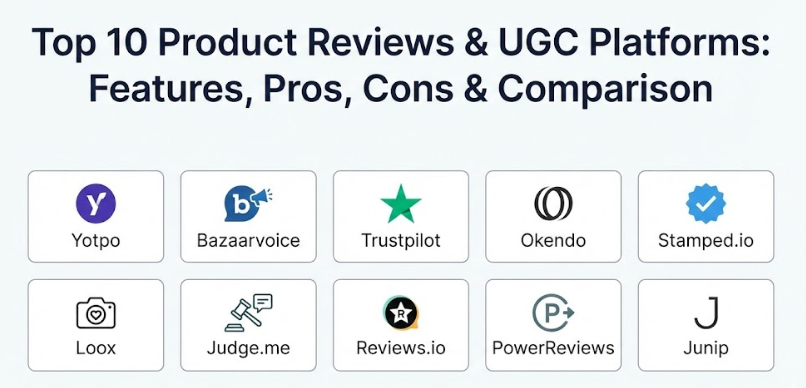
Top 10 Product Reviews & UGC Platforms Tools
1 — Yotpo
Yotpo is a comprehensive platform designed for growing stores that want to turn customer feedback into a powerful marketing engine. It is built to help businesses collect reviews, photos, and even build loyalty programs all in one place. By using smart technology, it sends requests to customers at the exact moment they are most likely to respond. It is a great choice for brands that want to show their reviews not just on their own site, but also on social media and search results.
- Key features:
- AI-Powered Review Requests: Uses smart timing to send emails when customers are likely to open them.
- Visual UGC Galleries: Creates beautiful on-site displays for customer photos and videos.
- Google Shopping Integration: Shows your star ratings directly in Google search results and ads.
- Review Syndication: Pushes your reviews to big retail sites like Target or Walmart.
- Advanced Sentiment Analysis: Automatically scans reviews to tell you what customers love or hate.
- Smart Filters: Lets shoppers sort reviews by specific topics like “size” or “quality.”
- Loyalty Integration: Connects reviews with a rewards program to give points for every post.
- Pros:
- High Conversion Power: The visual galleries and Google integration are proven to help sell more products.
- All-In-One Convenience: You can manage reviews, loyalty, and SMS marketing from a single dashboard.
- Cons:
- Premium Pricing: Some of the best features are only available on more expensive enterprise plans.
- Complex Setup: Because it has so many features, it can take some time to learn how to use everything.
- Security & compliance: SOC 2 compliant, GDPR ready, and uses enterprise-grade data encryption.
- Support & community: Offers 24/7 live chat, dedicated account managers for large brands, and a helpful online academy.
2 — Bazaarvoice
Bazaarvoice is a giant in the world of reviews, specifically designed for large global brands and retailers. It is famous for its massive network that connects brands with millions of shoppers across the world’s biggest retail websites. If you want your reviews to appear on a hundred different store websites at once, this is the tool for you. It focuses heavily on data and helping big companies understand how their products are performing in the real world.
- Key features:
- Retail Syndication Network: Distributes your reviews to over a thousand global retail websites.
- Product Sampling: Helps you send free samples to people in exchange for honest, detailed reviews.
- Social Commerce Tools: Turns customer photos from Instagram into clickable shopping links.
- Brand Benchmarking: Compares your star ratings and review volume against your competitors.
- Expert Moderation: Uses a mix of humans and AI to ensure every review is real and helpful.
- Questions & Answers: Allows potential buyers to ask questions that you or other customers can answer.
- Global Insights: Provides detailed reports on customer trends across different regions and languages.
- Pros:
- Massive Reach: No other tool can put your reviews on as many different retail sites as Bazaarvoice.
- High Trust: They have very strict rules to ensure all reviews are authentic and trustworthy.
- Cons:
- High Cost: It is built for large corporations, so the price is usually too high for small startups.
- Technical Requirements: Integrating such a big system often requires a specialized technical team.
- Security & compliance: Fully compliant with ISO standards, GDPR, and offers high-level data privacy controls.
- Support & community: Provides professional strategic consulting and enterprise-level technical assistance.
3 — Trustpilot
Trustpilot is an independent review platform that is very well-known by shoppers all over the world. It is unique because it hosts its own public website where anyone can search for a brand and see what others have said. It is designed for businesses that want to build a public reputation for being honest and reliable. Because Trustpilot is a “third-party” site, people often trust the reviews there more than the ones hosted on a company’s own private website.
- Key features:
- Open Public Platform: Every business has a public profile page that helps with search engine visibility.
- Review Invitations: Automatically asks every customer to leave a review after they make a purchase.
- Trust Boxes: Provides customizable widgets to show your “TrustScore” on your homepage.
- SEO Snippets: Helps your star ratings show up in organic search results to attract more clicks.
- Review Filtering: Helps you identify and report fake reviews to keep your page honest.
- Social Sharing: Makes it easy to turn a five-star review into a beautiful social media post.
- Customer Analytics: Tracks how your reputation is changing over time and how customers feel.
- Pros:
- Brand Recognition: The Trustpilot logo is very famous, and seeing it makes shoppers feel safe.
- Improved Search Ranking: Having a profile on a high-traffic site like Trustpilot helps your SEO.
- Cons:
- Public Nature: Because anyone can leave a review, you may occasionally get unfair or irrelevant negative posts.
- Feature Limits: Some of the most helpful tools for improving your score are locked behind paid plans.
- Security & compliance: GDPR compliant and uses standard web security protocols for data protection.
- Support & community: Offers a large self-service help center and email support for all users.
4 — Okendo
Okendo is a platform built specifically for fast-growing stores that use the Shopify platform. It is designed to help brands capture much more than just a star rating; it asks customers about specific product attributes. For example, if you sell shoes, Okendo can ask if they were “too small” or “just right.” This detailed information is incredibly helpful for other buyers. It is a very clean and modern tool that feels like a natural part of a high-end online store.
- Key features:
- Customer Attributes: Collects data on a shopper’s height, weight, or style to make reviews more relevant.
- High-Performance Widgets: On-site displays that load very fast so they don’t slow down your website.
- Review Incentives: Allows you to offer coupons or loyalty points in exchange for a detailed review.
- Media Collection: Encourages shoppers to upload high-quality photos and videos of their purchase.
- Klaviyo Integration: Connects perfectly with email tools to send personalized follow-up messages.
- Custom Review Forms: Lets you build your own questions to get the exact data you need from buyers.
- Review Grouping: Shows reviews for similar products together to help customers compare options.
- Pros:
- Detailed Feedback: The specific “attributes” help shoppers make much better buying decisions.
- Great Support: They are known for having a very responsive team that helps with setup and design.
- Cons:
- Shopify Focused: It is mostly built for one specific platform, so it might not work as well for others.
- No Free Plan: Unlike some simpler tools, you have to pay a monthly fee to use Okendo.
- Security & compliance: SOC 2 compliant and follows strict data protection rules for e-commerce.
- Support & community: Provides excellent technical documentation and live chat for all paid plans.
5 — Stamped.io
Stamped.io is a popular all-in-one tool that focuses on helping businesses build trust through many different types of social proof. It is designed for small to mid-sized businesses that want a lot of features without a giant price tag. Stamped makes it easy to collect reviews, photos, videos, and even private feedback. It is built to be “plug-and-play,” meaning you can get it running on your store in just a few minutes with very little effort.
- Key features:
- Net Promoter Score (NPS): Tracks how likely your customers are to recommend you to others.
- Instagram Curation: Pulls in photos where people have tagged your brand on social media.
- Q&A Section: Allows shoppers to ask questions directly on the product page.
- Community Questions: Lets previous buyers answer questions from new potential customers.
- Checkout Reviews: Asks for a quick rating immediately after someone finishes their purchase.
- Multi-Language Support: Translates your review widgets into dozens of different languages.
- Reward Integration: Connects with their own loyalty program to keep customers coming back.
- Pros:
- Feature Rich: You get a huge number of tools for a very fair monthly price compared to others.
- Easy to Use: The dashboard is very simple and doesn’t require any technical skill to navigate.
- Cons:
- Basic Analytics: The reports aren’t as deep or detailed as the ones found in enterprise tools.
- Interface Design: Some of the widgets look a bit simple compared to more modern alternatives.
- Security & compliance: GDPR compliant and uses secure encryption for all stored customer data.
- Support & community: Offers a helpful knowledge base and responsive email support tickets.
6 — Loox
Loox is a “photo-first” review platform that is perfect for brands where looks are everything. It is designed to help e-commerce stores build trust by showing a wall of beautiful customer photos. Loox is very popular with fashion and lifestyle brands because it turns a boring list of text reviews into a vibrant social media-style gallery. It is incredibly easy to set up and is built to help smaller stores look much more professional and established.
- Key features:
- Visual-First Displays: Focuses on showing photos and videos in a clean, grid-style layout.
- One-Click Referrals: Encourages customers to share their reviews with friends to get a discount.
- Automatic Reminders: Sends follow-up emails to people who forgot to leave a review.
- Upsell Prompts: Shows highly-rated items to customers after they leave a positive review.
- Import Tools: Allows you to quickly move reviews from other platforms or marketplaces.
- Mobile-Optimized Widgets: Ensures your galleries look great on smartphones and tablets.
- Discount Coupons: Automatically creates unique discount codes for shoppers who post a photo.
- Pros:
- Beautiful Aesthetics: It is arguably the best-looking tool for showing customer photos.
- Drives Sales: The referral and upsell tools help turn a simple review into a new purchase.
- Cons:
- No Free Tier: You must pay a subscription fee to use even the basic features.
- Less Technical Detail: It is not built for collecting complex data points like “fit” or “quality.”
- Security & compliance: GDPR compliant and uses standard cloud security to protect your store’s data.
- Support & community: Known for very fast and friendly customer support through live chat and email.
7 — Judge.me
Judge.me is a favorite among budget-conscious store owners because it offers an incredibly powerful free version. It is designed for businesses of all sizes that want to collect unlimited reviews without having to pay a high monthly fee. Despite being affordable, it includes almost every feature that the expensive platforms have. It is very fast, doesn’t slow down your website, and gives you total control over how your reviews look.
- Key features:
- Unlimited Review Requests: Does not charge you extra no matter how many emails you send.
- Photo & Video Reviews: Allows customers to easily upload their own media on any plan.
- SEO Rich Snippets: Helps your star ratings show up in Google search results for free.
- Review Importer: Lets you pull in reviews from AliExpress, Amazon, and other big sites.
- Spam Filtering: Automatically identifies and hides junk reviews to protect your score.
- Social Push: Sends your best reviews to your Facebook and Twitter pages automatically.
- Customizable Widgets: Offers many different styles for carousels, badges, and review lists.
- Pros:
- Best Value: The free plan is much better than the paid plans of many other companies.
- Fast Loading: The code is very light and won’t make your website feel sluggish to shoppers.
- Cons:
- Branding: The free version includes a small “Judge.me” logo that you have to pay to remove.
- Simple Analytics: It doesn’t offer the deep data insights that big corporations might need.
- Security & compliance: Fully compliant with GDPR and uses modern encryption for all data storage.
- Support & community: Offers 24/7 email and chat support, which is very rare for a free tool.
8 — Reviews.io
Reviews.io is a versatile platform that helps businesses collect both company reviews and product reviews. It is designed for brands that want to build a “verified” reputation that Google trusts completely. It is a licensed Google partner, which means it is very effective at getting your star ratings into Google Ads and search results. It is an excellent choice for businesses that want a mix of high-tech features and a very clean, professional look.
- Key features:
- Video Review Tool: Provides a specialized system for customers to record video feedback.
- Google Licensed Partner: Guarantees that your reviews will count toward Google Seller Ratings.
- SMS Review Collection: Allows you to text customers, which often gets a much faster response.
- Custom Card Design: Creates beautiful, branded review cards that look great on your site.
- Review Publishing: Lets you choose exactly which reviews to show and in what order.
- Data Dashboards: Provides clear charts on how reviews are impacting your actual sales.
- Social Proof Popups: Shows a small notification when someone else has just left a review.
- Pros:
- Google Synergy: It is one of the most reliable tools for making sure your stars show up in ads.
- Video Focus: The tools for collecting and showing video reviews are very advanced.
- Cons:
- Pricey for Starters: The cost can be a bit higher than some of the simpler alternatives.
- Complexity: Some users find the dashboard a bit confusing at first because it has so many options.
- Security & compliance: ISO 27001 certified, GDPR compliant, and follows strict global security rules.
- Support & community: Provides excellent technical support and helpful webinars for new users.
9 — PowerReviews
PowerReviews is a heavy-duty platform built for retailers and brands that sell a high volume of products. It is designed to handle millions of reviews and provides some of the most advanced data tools in the industry. It focuses on helping brands understand the “voice of the customer” so they can make better products. It is a great choice for established companies that need a tool that can grow as big as they are and handle very complex reporting.
- Key features:
- Retail Syndication: Sends your reviews to huge websites like Bed Bath & Beyond and Kohl’s.
- Review Intelligent Tagging: Uses AI to group reviews by specific product features or problems.
- Q&A Software: A robust system for answering customer questions at scale.
- Incentivized Review Management: Helps you track and manage reviews that were given in exchange for samples.
- Product Insights Dashboard: Tells you which products are underperforming and why, based on feedback.
- Moderation Services: Offers a team of experts to read and approve reviews for you.
- Mobile Collection: Optimized forms that make it very easy for people to review on their phones.
- Pros:
- Data Depth: The analytics are some of the best in the business for big companies.
- Syndication Power: Helps you get your products noticed on almost any major retail site.
- Cons:
- Enterprise Only: It is generally not affordable or suitable for small independent stores.
- Traditional Interface: The software can feel a bit corporate and less modern than newer apps.
- Security & compliance: SOC 2 compliant, GDPR ready, and uses high-level enterprise security.
- Support & community: Provides high-touch strategic account management for enterprise clients.
10 — Junip
Junip is a modern and design-focused platform that is perfect for brands that care about their aesthetic excellence. It is designed to be very fast, very clean, and very easy for customers to navigate. Junip focuses on a “mobile-first” experience, ensuring that every part of the review process feels smooth on a smartphone. It is a great choice for brands that want a high-end look and feel without the complexity of a giant enterprise system.
- Key features:
- Elegant Submission Forms: Some of the most beautiful and easy-to-use forms on the market.
- Fast Loading Widgets: Built to ensure that adding reviews never hurts your site’s speed.
- Google Shopping Sync: Seamlessly pushes your verified reviews to Google’s shopping tab.
- Automatic Requests: Simple tools to schedule and send emails after an order is delivered.
- Minimalist Design: Widgets that blend perfectly into your website without looking like a “plugin.”
- Verified Badge: Shows shoppers that every review came from a real, paying customer.
- Moderation Tools: A simple and clean dashboard to approve or respond to feedback.
- Pros:
- Beautiful Design: It is the best choice for brands that want their store to look sleek and modern.
- User Experience: Customers find it very easy to leave a review, which leads to more feedback.
- Cons:
- Feature Gating: Some of the advanced tools are only available on much more expensive plans.
- Basic Analytics: It does not offer as much data as the big enterprise-focused competitors.
- Security & compliance: Fully compliant with GDPR and uses secure modern encryption for all data.
- Support & community: Offers responsive email support and helpful guides for setting up your brand.
Comparison Table
| Tool Name | Best For | Platform(s) Supported | Standout Feature | Rating |
| Yotpo | High-Growth eCommerce | Shopify, BigCommerce | AI Sentiment Analysis | 4.8 / 5 |
| Bazaarvoice | Global Enterprise | Multi-Platform, API | Retail Syndication | 4.7 / 5 |
| Trustpilot | Public Brand Trust | All Web Platforms | Public Profile Page | 4.5 / 5 |
| Okendo | Detailed Product Data | Shopify | Customer Attributes | 4.9 / 5 |
| Stamped.io | Mid-Market Social Proof | All eCommerce | NPS & Q&A Tools | 4.7 / 5 |
| Loox | Visual Lifestyle Brands | Shopify, Wix | Photo-First Galleries | 4.9 / 5 |
| Judge.me | Budget-Conscious Stores | Shopify, WooCommerce | Unlimited Free Requests | 4.9 / 5 |
| Reviews.io | Video UGC & Google | All eCommerce | Video Review Tool | 4.8 / 5 |
| PowerReviews | Large Scale Retail | Enterprise Systems | Product Intelligence | 4.6 / 5 |
| Junip | Design-Led Brands | Shopify, Custom | Minimalist UI/UX | 4.7 / 5 |
Evaluation & Scoring of Product Reviews & UGC Platforms
When choosing the right platform, it is important to look at how each feature impacts your actual sales and trust. We have scored these tools using a weighted system to show what matters most to a store owner.
| Criteria | Weight | Why It Matters |
| Core Features | 25% | The ability to collect and display high-quality reviews and photos. |
| Ease of Use | 15% | How quickly you can set it up and how easy it is for customers. |
| Integrations | 15% | Does it talk to your email, marketing, and loyalty tools? |
| Security & Compliance | 10% | Ensuring your customer data is safe and follows privacy laws. |
| Reliability | 10% | The software should be fast and never crash during busy times. |
| Support & Community | 10% | Being able to get help quickly when you have a question. |
| Price / Value | 15% | Getting the best set of tools for the money you are spending. |
Which Product Reviews & UGC Platforms Tool Is Right for You?
Choosing a tool is a big decision that depends on your specific goals and how big your store is today. Here is a simple guide to help you decide.
- Solo Users & Small Shops: If you are just starting and want to save money, Judge.me is the clear winner. You get almost every feature for free. If you care most about photos and have a small budget, Loox is a great, easy choice.
- Mid-Market Brands: If you are growing and want deep data, Okendo or Stamped.io are excellent. They offer professional features that help you understand your customers better as you grow.
- Large Enterprises: For big companies that need the best, Yotpo or Bazaarvoice are the standard. They can handle global scale and connect with thousands of other retail websites.
- Budget-Conscious: If you need to keep costs as low as possible, start with the free version of Judge.me. You can always upgrade later as your sales increase.
- Design-Led Brands: If you want your store to look like a high-end fashion magazine, choose Junip or Loox. They focus more on style than anyone else.
- SEO Focus: If your main goal is getting more people from Google, Trustpilot or Reviews.io are the best choices because of their strong partnerships with search engines.
Frequently Asked Questions (FAQs)
1. What is a Product Reviews & UGC platform?
It is a digital tool that automatically asks your customers for feedback and then shows that feedback on your store. This helps build trust with new shoppers by showing them what real people think of your items.
2. Do reviews really increase sales?
Yes. Seeing real photos and honest star ratings makes shoppers feel much more confident. Most studies show that products with reviews sell significantly better than those with zero feedback.
3. Are these platforms SEO-friendly?
Yes. High-quality platforms help your star ratings show up in Google search results. This makes your store look more professional and can bring in more free traffic from search engines.
4. Can I moderate or hide bad reviews?
Most platforms allow you to moderate reviews. While you should be honest, you can hide reviews that are spam, contain bad language, or are completely irrelevant to the product being sold.
5. Is visual user-generated content (UGC) important?
Absolutely. Shoppers love seeing real photos and videos of products in use. It provides a level of detail that professional studio photos simply cannot match.
6. Are these tools expensive?
It varies. You can start for free with tools like Judge.me, but enterprise systems for giant companies can cost thousands of dollars a month. There is a price point for every budget.
7. Do they integrate with my existing store?
Yes. Most of these tools are built to work perfectly with platforms like Shopify, BigCommerce, and WooCommerce. They usually connect with just a few clicks.
8. How long does it take to set up?
For simple tools like Loox or Judge.me, you can be up and running in under an hour. For large enterprise systems like Bazaarvoice, it may take several weeks to integrate everything properly.
9. Can I import reviews from Amazon or AliExpress?
Many tools, especially Judge.me and Stamped.io, allow you to import reviews from major marketplaces. This is helpful if you are moving your products from a marketplace to your own store.
10. Do these tools follow privacy laws like GDPR?
Yes. Every reputable platform on this list follows global data privacy rules to ensure your customer’s personal information is handled safely and legally.
Conclusion
Choosing the right product reviews and user-generated content platform is a major step toward making your online store successful. When you allow your customers to speak for you, you are creating a more honest and welcoming shopping environment. These tools take the hard work out of building trust, allowing you to focus on creating great products and growing your business. By making it easy for customers to share their photos and stories, you are not just selling a product—you are building a community of loyal supporters.
There is no single “best” tool for everyone. The best tool is the one that fits your current size, your aesthetic goals, and your budget. Whether you need a simple free list of star ratings or a massive global syndication network, there is a partner on this list that can help you. Take a moment to think about what your store needs most right now, and then choose the tool that fixes that specific problem. Your customers—and your conversion rates—will thank you for it.