Introduction
Product feed management tools are specialized software applications that help online sellers organize and distribute their product information to different sales channels. Imagine you have a store with hundreds or thousands of items. Instead of manually typing out the name, price, and description for every item on Google Shopping, Amazon, Facebook, and Instagram, these tools do it for you automatically. They take the data directly from your website, clean it up, and make sure it meets the specific rules of each platform. By acting as a central hub, these tools ensure that your product details are always accurate and up-to-date across the entire internet.
Using these tools is important because it prevents common mistakes that can cost a business money. For example, if you sell your last blue shirt on your website but the ad on Facebook still says it is in stock, a customer might click that ad and be disappointed. This wastes your advertising budget and frustrates the shopper. Feed management tools fix this by syncing your inventory in real-time. They also help your products show up more often in searches by improving the quality of your titles and descriptions. This leads to more clicks, better ad performance, and ultimately, more sales for your business.
Furthermore, these platforms provide a layer of control that is impossible to achieve manually. You can create “rules” that change how your products appear depending on the channel. For instance, you might want a shorter title for mobile shoppers on Instagram and a longer, more detailed title for people searching on Google. These tools allow you to make these changes in bulk, saving you dozens of hours every month. They also alert you if there are errors in your data, such as missing images or incorrect categories, so you can fix them before your ads are rejected. In short, they are the backbone of a professional e-commerce strategy.
Key Real-World Use Cases
- Multi-Channel Selling: A brand that sells on their own site, Amazon, and eBay uses a feed tool to keep prices and stock levels the same everywhere.
- Global Expansion: A retailer moving into new countries uses the tool to translate product descriptions and convert prices into local currencies automatically.
- Seasonal Promotions: A store can set a rule to automatically add “Black Friday Sale” to all product titles for a specific weekend and remove it afterward.
- A/B Testing: A marketing team uses the tool to try two different sets of product images to see which one gets more clicks from customers.
What to Look For (Evaluation Criteria)
When choosing a product feed management tool, the first thing to check is how many channels it supports. You want a tool that can connect to all the places you sell now and the places you might want to sell later. Ease of use is also a big factor; you should be able to create rules and fix errors without needing to write complex code. Look for tools that offer real-time syncing, as this keeps your inventory numbers accurate. Finally, consider the quality of customer support, as you will likely need help the first few times you set up a complex feed for a new platform.
Best for: These tools are perfect for e-commerce managers, digital marketing agencies, and owners of online stores that have more than fifty products. They are particularly helpful for businesses that sell on multiple platforms or those who spend a large part of their budget on Google Shopping and Facebook ads. Companies of all sizes, from small local shops to global enterprises, can benefit from the organization and speed these tools provide.
Not ideal for: A person who only sells five or ten items on a single website probably does not need a professional feed management tool. In those cases, the manual work is small enough that a paid software would be an unnecessary expense. Also, businesses that do not use paid advertising or social media marketplaces might find that the basic built-in features of their website platform (like Shopify or WooCommerce) are enough for their needs.
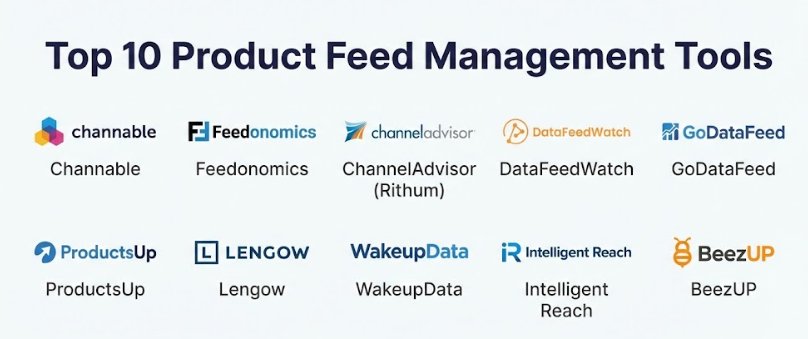
Top 10 Product Feed Management Tools
1 — Channable
Channable is an all-in-one platform that combines product feed management with PPC (pay-per-click) automation. It is designed to be very user-friendly, allowing marketing teams to take control of their data without needing a developer. The tool is famous for its “if-then” rule system, which makes it very easy to filter products or change information in bulk. It is a great choice for companies that want a powerful but simple tool to manage their ads and sales channels in one place.
- Key features:
- Over 2,500 integrated channels including Google, Amazon, and eBay.
- Simple “if-then” rules to modify product data without coding.
- Built-in tool for creating text ads for Google and Bing.
- Real-time inventory updates to prevent selling out-of-stock items.
- Order connection that brings orders from marketplaces back to your store.
- Analytics dashboard to see which products are performing best.
- Pros:
- The interface is very clean and easy for beginners to learn quickly.
- Pricing is transparent and based on the number of products and channels.
- Cons:
- The tool can become expensive as you add more products to your list.
- Advanced enterprise features might feel a bit limited for massive corporations.
- Security & compliance: Uses secure data encryption and is fully GDPR compliant to protect European user data.
- Support & community: Offers excellent help documentation and fast email and phone support in several different languages.
2 — Feedonomics
Feedonomics is often considered the most powerful feed management tool on the market because it offers a “full-service” option. This means they don’t just give you the software; they can also provide a team of experts to manage your feeds for you. It is designed for large brands and agencies that have extremely complex data and need to ensure their feeds are perfect at all times. They focus heavily on data optimization to make sure your ads get the best possible placement.
- Key features:
- 24/7 monitoring of your feeds to catch errors as soon as they happen.
- Advanced data mapping that can handle even the messiest spreadsheets.
- Global team of specialists who can manage the tool on your behalf.
- Automated category mapping to ensure products are in the right place.
- High-speed data crawling that works with almost any website.
- Custom reporting to track the health and success of every feed.
- Pros:
- The managed service takes the stress and work off your internal team.
- Highly effective at improving ad performance through deep data cleaning.
- Cons:
- It is a premium solution with a higher price tag than many competitors.
- The platform can be overwhelming for someone who wants to do it all themselves.
- Security & compliance: Enterprise-grade security including SOC 2 compliance and regular security audits.
- Support & community: Famous for having some of the best customer support in the industry with very fast response times.
3 — ChannelAdvisor (Rithum)
ChannelAdvisor, now part of the Rithum network, is one of the oldest and most established names in the industry. It is a massive platform built for enterprise-level retailers who sell millions of dollars of products across the globe. It handles everything from feed management to marketplace selling and digital marketing. It is a “heavy-duty” tool that is best suited for large teams with complex needs and big budgets who want a single system for their entire online business.
- Key features:
- Deep integration with hundreds of global marketplaces.
- Inventory and order management built directly into the platform.
- Advanced analytics that give a complete view of your business health.
- Automated pricing tools that change your prices based on competitors.
- Support for complicated product variations and bundles.
- Strategic consulting services for large retail brands.
- Pros:
- Offers a complete suite of tools for every part of e-commerce.
- Can handle a massive number of products and channels without slowing down.
- Cons:
- The software is very complex and takes a long time to learn.
- High cost and long-term contracts make it unsuitable for small businesses.
- Security & compliance: Highly secure with ISO certifications and compliance with global privacy standards.
- Support & community: Provides dedicated account managers and a large library of training materials.
4 — DataFeedWatch
DataFeedWatch is a very popular choice for small to medium-sized businesses and marketing agencies. It focuses on being affordable and easy to use while still providing all the essential features needed for successful feed management. It is designed to help users get their products onto Google Shopping and Facebook as quickly as possible. The tool is very reliable and offers a good balance between price and performance.
- Key features:
- Simple point-and-click interface for mapping product data.
- Powerful filtering tools to remove products with low margins.
- Built-in analytics to see the ROI for every single product.
- Automated categorization to save time during setup.
- Support for over 1,000 channels across 50 countries.
- Price watch tool to see how your prices compare to others.
- Pros:
- Very cost-effective for businesses with a moderate number of items.
- The “Copy Feed” feature makes it easy to set up new channels quickly.
- Cons:
- The interface can feel a bit dated compared to modern tools like Channable.
- Some of the more advanced automation features require a higher-tier plan.
- Security & compliance: Follows standard web security protocols and is compliant with GDPR rules.
- Support & community: Known for very helpful live chat support and an easy-onboarding process.
5 — GoDataFeed
GoDataFeed is a cloud-based platform that specializes in helping retailers grow their sales through better data. It is built to be flexible and works well with almost any e-commerce website, including Shopify, Magento, and BigCommerce. It is a great choice for businesses that want to experiment with many different sales channels without a huge upfront cost. The tool is very straightforward and focuses on the “essentials” of feed management.
- Key features:
- Unlimited data imports and updates on many plans.
- Rules-based engine for cleaning and optimizing product titles.
- Integrated marketplace order management for Amazon and eBay.
- Dynamic imaging to create better-looking ads automatically.
- Easy-to-read error reports that tell you exactly how to fix issues.
- Performance tracking to see which channels are making money.
- Pros:
- Very fair pricing that doesn’t punish you for having many products.
- The platform is very fast and easy to navigate.
- Cons:
- It has fewer “extra” features like PPC automation or text ad creation.
- Some users find the rule-building system a bit less intuitive than others.
- Security & compliance: Uses SSL encryption and maintains high standards for data privacy and protection.
- Support & community: Offers phone, email, and chat support, along with a helpful knowledge base.
6 — ProductsUp
ProductsUp is a high-end platform designed for global companies that deal with massive amounts of data. It is built to solve “data chaos” by taking information from any source and turning it into a perfect feed for any destination. It uses a very visual interface where you can see your data moving through the system. It is a great choice for companies that need to manage not just product feeds, but also digital catalogs and localized content for many different markets.
- Key features:
- Visual data flow designer that makes complex mapping easy to see.
- Support for millions of products and thousands of channels.
- AI-powered tools to help with product descriptions and images.
- Instant preview to see exactly how an ad will look before it goes live.
- Deep integration with social media platforms like TikTok and Snapchat.
- Advanced security features for large corporate teams.
- Pros:
- Incredible speed and power for handling extremely large data sets.
- The visual layout helps you understand complex rules very easily.
- Cons:
- The pricing is definitely in the “enterprise” category.
- It takes some time and training to master all the advanced features.
- Security & compliance: Fully SOC 2 compliant with advanced user permissions and audit logs.
- Support & community: Provides world-class enterprise support and a dedicated success team for clients.
7 — Lengow
Lengow is a European platform that focuses on helping brands and retailers grow their international sales. It is a very intelligent tool that helps you choose the best channels for your products based on where they are likely to sell. Lengow is very strong in the European market but supports channels all over the world. It is designed to be a “business intelligence” tool as much as a feed management tool, helping you make smarter decisions about where to spend your marketing money.
- Key features:
- Recommendation engine that suggests new channels for your products.
- Automated “matching” of your products to marketplace categories.
- Strong focus on European marketplaces like Zalando and Bol.com.
- Order management and stock synchronization across all sites.
- Insights dashboard that combines sales data from every channel.
- Ability to handle complicated VAT and shipping rules for Europe.
- Pros:
- Excellent for businesses focusing on the diverse European market.
- Very smart automation that saves a lot of manual configuration time.
- Cons:
- The interface can be a little complex for first-time users.
- Support for some smaller US-based channels may not be as deep.
- Security & compliance: Strictly follows European GDPR laws and uses secure cloud hosting.
- Support & community: Offers localized support in many European languages and a professional services team.
8 — WakeupData
WakeupData is a Danish company that provides a powerful and flexible feed management tool. They focus on “data transformation,” which means they are very good at taking a basic product list and turning it into something much more valuable. They offer a unique service where they can help you create “enriched” feeds with data like local weather or competitor prices to make your ads more effective. It is a great choice for mid-sized businesses that want to be more creative with their digital marketing.
- Key features:
- Weather-driven ads that show different products based on local climate.
- Competitor price monitoring to help you stay competitive.
- High-quality image transformation to make product photos stand out.
- Split testing for feeds to see which data version performs better.
- Integration with over 500 different global channels.
- Clean and modern dashboard for managing multiple projects.
- Pros:
- Very innovative features that you won’t find in most standard tools.
- The team is very responsive and willing to help with custom needs.
- Cons:
- Fewer integrations with very large ERP systems for big companies.
- The pricing can be slightly higher due to the specialized features.
- Security & compliance: Compliant with all EU data regulations and uses modern security practices.
- Support & community: Excellent personal support and a very high rating from existing customers.
9 — Intelligent Reach
Intelligent Reach is a platform that emphasizes performance and testing. They believe that a product feed is never “finished” and should always be tested and improved. Their tool includes advanced features for A/B testing your feeds, allowing you to try different titles or images for the same product to see which one makes more money. It is a great choice for data-driven companies that want to squeeze every possible dollar out of their advertising budget.
- Key features:
- Advanced A/B testing for every element of your product feed.
- Scientific attribution that shows exactly which channel led to a sale.
- Automated error correction that fixes common feed issues for you.
- Performance-based labels to group products by how well they sell.
- Support for thousands of global digital marketing channels.
- Real-time inventory and price syncing to ensure accuracy.
- Pros:
- The best tool for businesses that love to test and optimize.
- Provides very deep insights into how your data affects sales.
- Cons:
- It requires a more analytical mindset to get the full value.
- The setup process can be a bit more involved due to the testing features.
- Security & compliance: Enterprise-ready security with full data encryption and privacy protection.
- Support & community: Offers very knowledgeable support and strategic advice for performance marketing.
10 — BeezUP
BeezUP is a versatile platform that helps retailers manage their presence across marketplaces, price comparison sites, and social networks. It is designed to be an all-in-one solution that covers the entire “buy” cycle, from the moment a customer sees an ad to the moment they receive their order. It is very popular in France and other parts of Europe. BeezUP is a solid, reliable choice for businesses that want a tool that can grow as they add more channels and products.
- Key features:
- Centralized management for over 2,000 different sales channels.
- Automated order management to sync sales back to your store.
- Detailed performance statistics for every channel and product.
- Easy-to-use rule editor for modifying product information.
- Support for flash sales and limited-time promotions.
- Multi-user access with different levels of permissions for teams.
- Pros:
- Very comprehensive and handles many different types of channels.
- Good value for money considering the wide range of features.
- Cons:
- The learning curve can be steep because there are so many settings.
- Some of the documentation is better in French than in English.
- Security & compliance: Fully compliant with GDPR and uses secure data centers in Europe.
- Support & community: Provides a comprehensive help center and responsive customer support team.
Comparison Table
| Tool Name | Best For | Platform(s) Supported | Standout Feature | Rating |
| Channable | SMBs & Agencies | Web, API | PPC Automation Rules | N/A |
| Feedonomics | Full-Service Management | Web, Managed | Expert Managed Services | N/A |
| ChannelAdvisor | Global Enterprises | Web, Cloud | Complete Commerce Suite | N/A |
| DataFeedWatch | Budget-Conscious SMBs | Web | Simple ROI Analytics | N/A |
| GoDataFeed | Shopify/Magento Stores | Cloud | Flexible Unlimited Updates | N/A |
| ProductsUp | Massive Data Volume | Web, API | Visual Data Flow Designer | N/A |
| Lengow | European Market Growth | Web, Cloud | Channel Recommendations | N/A |
| WakeupData | Creative Performance | Web, Cloud | Weather-Driven Ads | N/A |
| Intelligent Reach | Data-Driven Testing | Web, Cloud | A/B Testing for Feeds | N/A |
| BeezUP | Marketplace Selling | Web, Cloud | Order Lifecycle Sync | N/A |
Evaluation & Scoring of Product Feed Management Tools
The following table shows how we evaluate these tools based on the key factors that lead to success for online sellers.
| Evaluation Category | Weight | Key Considerations |
| Core Features | 25% | Mapping, rules, and number of channel integrations. |
| Ease of Use | 15% | How quickly a non-technical person can set up a feed. |
| Integrations | 15% | Connecting to Shopify, Magento, ERPs, and APIs. |
| Security & Compliance | 10% | Data encryption, GDPR, and enterprise safety. |
| Performance | 10% | Speed of syncing and system uptime. |
| Support | 10% | Quality of human help and training materials. |
| Price / Value | 15% | How much the tool costs versus the time/money saved. |
Which Product Feed Management Tool Is Right for You?
Solo users vs SMB vs mid-market vs enterprise
If you are running a store by yourself or with a very small team, you should look for tools that are easy to use and don’t require a lot of setup. Channable and GoDataFeed are excellent for this because they are intuitive. Small to mid-market companies that have a bit more budget but not enough time should consider DataFeedWatch or WakeupData. If you are a giant enterprise with thousands of employees and a global presence, you need the massive power of ChannelAdvisor (Rithum) or the expert managed services of Feedonomics to keep your data under control.
Budget-conscious vs premium solutions
For those on a tight budget, DataFeedWatch and GoDataFeed offer the best value for your money. They provide all the basic tools you need to succeed without charging for fancy extras you might not use. On the other hand, premium solutions like Feedonomics or ProductsUp cost much more, but they offer features like AI-powered optimization and expert human management that can significantly increase your sales, often paying for the software many times over.
Feature depth vs ease of use
There is often a trade-off between how powerful a tool is and how easy it is to use. Channable is widely loved because it manages to be both powerful and easy. However, if you need incredibly deep technical features, you might have to choose a tool that is a bit harder to learn, like Stripe Connect or BeezUP. Always ask yourself if you really need the most complex features, or if a simpler tool will help you get your work done faster.
Integration and scalability needs
Think about where you want your business to be in two years. If you plan to sell on dozens of international marketplaces, you need a tool that can scale with you. Lengow and Intelligent Reach are great for scaling because they help you find and test new channels easily. Make sure the tool you choose connects directly to the platform your website is built on, so your stock and price information can flow back and forth without any manual work.
Security and compliance requirements
For businesses that handle a lot of customer data or operate in highly regulated industries, security is a top priority. In these cases, you should only look at tools that have official certifications like SOC 2 or ISO. ProductsUp and ChannelAdvisor are very strong in this area. If you are a smaller business, standard GDPR compliance and secure data encryption (which almost all these tools provide) are usually enough to keep you and your customers safe.
Frequently Asked Questions (FAQs)
1. What is a product feed?
A product feed is a digital file (like a CSV or XML) that contains a list of all your products and their details, such as titles, prices, images, and descriptions.
2. Do I really need a tool to manage my feed?
If you have more than 50 products or sell on more than two channels, a tool will save you hours of work and prevent expensive errors that happen when you do it manually.
3. Will these tools help my ads perform better?
Yes. By helping you improve your product titles and making sure you are in the right categories, these tools make your ads more relevant and easier for customers to find.
4. Can these tools sync my inventory?
Most of the top tools offer real-time or near-real-time inventory syncing, which means when you sell an item on your site, the stock level updates on Amazon and Facebook too.
5. How much time does it take to set up?
A simple feed can be set up in an hour. A complex enterprise feed with many rules and channels can take a few days or even weeks of testing.
6. Do I need to be a programmer to use these?
No. Most of these tools are designed for marketing people and use “drag and drop” or simple “if-then” rules instead of computer code.
7. Can I use these tools for international selling?
Yes. Many tools have built-in features for translating descriptions and converting your local currency into the currency of the country where you are selling.
8. What happens if there is an error in my feed?
The tool will usually send you an alert and show you exactly which product has the error and how to fix it before your ads are paused.
9. Are there any free alternatives?
Some website platforms have free plugins, but they are usually very basic and don’t offer the rules, optimization, or multi-channel support of a professional tool.
10. How do I choose between two similar tools?
The best way is to sign up for a free trial or a demo. Seeing the interface and trying to build one rule will usually tell you which tool feels better for your team.
Conclusion
Finding the right product feed management tool is a vital step in making your online store more successful and easier to run. These tools do the heavy lifting of organizing your data, allowing you to focus on big-picture ideas like branding and product development. By automating the most boring and difficult parts of multi-channel selling, you can ensure that your customers always see the right information, no matter where they find you on the internet. It is the difference between a store that struggles to keep up and a store that is built to grow.
It is important to remember that the “best” tool is the one that fits your specific business needs, your team’s skills, and your budget. There is no reason to pay for a massive enterprise system if you are a small business, just as a giant corporation shouldn’t try to get by with a basic plugin. The key is to look for a platform that makes your life easier and helps you reach more customers. When your data is clean and your feeds are optimized, your advertising budget goes further, and your sales will naturally follow. Take your time, test your options, and pick the partner that will help your business reach the next level.