Introduction
Print-on-demand (POD) platforms are specialized digital services that allow individuals and businesses to sell custom-designed products without ever holding inventory. When you use a POD service, you upload your artwork to a platform, choose the products you want to sell—such as t-shirts, mugs, or posters—and list them on your store. The “demand” part is key: the product is only printed and shipped once a customer actually places an order. This model effectively removes the biggest barrier to starting a retail business: the high cost of buying stock upfront and the risk of being stuck with unsold items.
The importance of these platforms lies in their ability to democratize e-commerce. They act as a silent partner that handles the messy logistics of manufacturing, printing, and global shipping, leaving the creator free to focus on design and marketing. In the real world, we see influencers using POD to sell branded merchandise to their followers, artists turning their illustrations into home decor, and small businesses creating corporate swag for remote teams. When choosing a platform, you should evaluate the quality of the print, the speed of shipping, the variety of the product catalog, and how well the software integrates with your existing website.
Best for:
These platforms are the best choice for artists, solo-preneurs, and small-to-medium businesses (SMBs) who want to test new product ideas without financial risk. They are also ideal for content creators and influencers in the lifestyle and entertainment industries who need a low-maintenance way to offer merchandise.
Not ideal for:
POD is generally not the best fit for high-volume brands that require deep bulk discounts to maintain high profit margins. If you have the capital and the storage space, traditional bulk manufacturing will almost always offer a lower per-unit cost. It is also not ideal for luxury brands that require highly specialized custom packaging or complex garment constructions that standardized printing machines cannot handle.
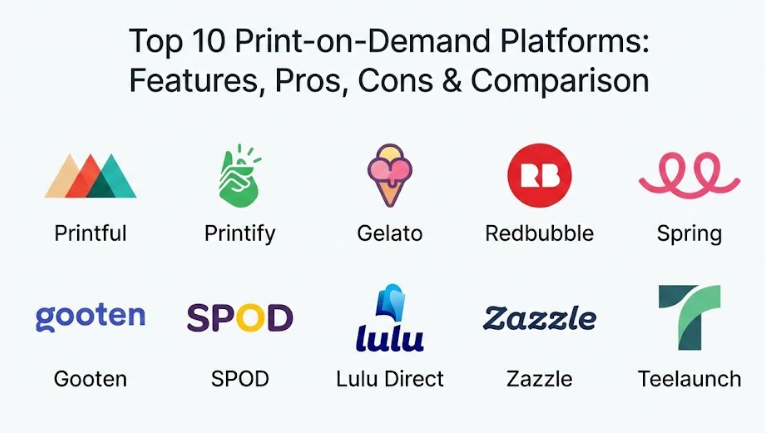
Top 10 Print-on-Demand Platforms
1 — Printful
Printful is often considered the “gold standard” of the print-on-demand world. Unlike many competitors that act as middlemen, Printful owns its own fulfillment centers across the globe. This gives them a level of control over quality and consistency that is hard to beat. They are designed for professional sellers who want a reliable, high-end experience for their customers.
Key Features:
- In-house fulfillment: Direct control over the printing process in multiple global locations.
- Product variety: Over 300 products ranging from apparel and hats to home decor and jewelry.
- Branding options: Custom neck labels, pack-ins, and branded packing slips to make the brand yours.
- Design tools: A built-in mockup generator and basic graphic design features within the dashboard.
- Warehousing: The ability to store and ship non-POD items through their fulfillment network.
- Automatic syncing: Seamless integration with over 20 e-commerce platforms like Shopify and Etsy.
- Direct-to-Garment (DTG): High-quality digital printing that handles complex colors and gradients well.
Pros:
- The print quality is exceptionally consistent because they manage their own machines and staff.
- The integration process is incredibly smooth, making it easy for beginners to sync their store.
Cons:
- The base prices are generally higher than other platforms, which can thin your profit margins.
- Certain high-demand products can occasionally go out of stock for weeks during peak holiday seasons.
Security & Compliance: Printful is GDPR compliant and uses secure, encrypted payment processing. They maintain strict audit logs for account changes and offer SSO for enterprise-level accounts.
Support & Community: They offer 24/7 customer support via chat and email. Their “Printful Academy” provides deep onboarding through video tutorials, and they have a massive, active Facebook community of sellers.
2 — Printify
Printify operates differently than Printful; instead of owning the machines, they are a massive network of printing partners. This aggregator model allows them to offer some of the most competitive prices in the industry. It is designed for sellers who want the freedom to choose their specific printer based on location, price, or product specialty.
Key Features:
- Global network: Access to over 100 printing locations worldwide to reduce shipping times.
- Price competition: Different printers compete for your business, leading to lower base costs.
- Printify Premium: A subscription service that offers significant discounts on every product.
- Massive catalog: One of the largest selections of unique items, including eco-friendly apparel.
- Supplier switching: If a printer goes out of stock, you can easily move your design to another partner.
- Mockup generator: Easy-to-use tool to visualize designs on 3D models.
- Order routing: Automatically sends orders to the printer closest to your customer.
Pros:
- The profit margins are typically higher here because the base product costs are so low.
- The massive variety of suppliers means you can find niche products that smaller platforms don’t carry.
Cons:
- Quality can vary significantly between different printing partners in the network.
- Shipping costs can become confusing if a customer orders two items fulfilled by different printers.
Security & Compliance: GDPR compliant and uses standard SSL encryption. Compliance levels for individual print providers may vary, but Printify maintains overall oversight.
Support & Community: Support is available via email and a help center. They have a very active blog and a growing community of sellers who share tips on which suppliers provide the best quality.
3 — Gelato
Gelato focuses heavily on “local production on a global scale.” They have built a software layer over local printers in over 30 countries. Their goal is to reduce carbon emissions and shipping times by printing the product in the same country where it is ordered. This makes them a top choice for environmentally conscious brands and international sellers.
Key Features:
- Local fulfillment: Products are printed in 32 countries to minimize cross-border shipping.
- Sustainability focus: Reduced shipping distances lead to a smaller carbon footprint.
- Gelato+: A subscription tier that offers premium mockups and image filters.
- Wall Art specialty: Particularly known for high-quality posters, canvases, and framed prints.
- End-to-end automation: Fully handles everything from tax calculation to delivery.
- Mobile App: A robust app to manage your store and track orders on the go.
- Reliability: High uptime and a heavy focus on consistent paper and ink quality.
Pros:
- Shipping is incredibly fast and cheap for international customers because the item stays local.
- The platform is very “clean” and easy to navigate for those who find competitors too cluttered.
Cons:
- Their apparel catalog is not as deep or varied as Printify or Printful.
- The free tier lacks some of the better design assets found in the paid subscription.
Security & Compliance: SOC 2 Type II compliant, which is rare for POD. They are fully GDPR compliant and prioritize data privacy.
Support & Community: They offer 24/7 multilingual support. Onboarding is straightforward, though their community is smaller and more focused on the European market.
4 — Redbubble
Redbubble is a marketplace rather than a fulfillment backend for your own store. This means you don’t need to build a website; you simply upload your art to the Redbubble site, and they handle the traffic. It is designed for artists who want to spend 100% of their time on art and 0% on website management or SEO.
Key Features:
- Built-in traffic: Millions of shoppers visit the marketplace every month looking for unique designs.
- Simple uploads: One upload can be applied to over 70 different products instantly.
- Social features: Follow artists, like designs, and message creators directly.
- Fan Art program: Legal pathways to create licensed art for big brands like Rick and Morty or DC.
- Tagging system: Robust internal SEO that helps shoppers find your work.
- Google Shopping: Redbubble spends their own money to advertise your designs on Google.
- Artist tiers: Specific levels (Standard, Premium, Pro) based on your account’s health and sales.
Pros:
- There is zero cost to start—no website hosting, no domain, and no marketing budget required.
- The “Fan Art” program is a unique way to legally profit from popular culture.
Cons:
- You don’t own the customer data; Redbubble owns the relationship with the buyer.
- Competition is fierce, and your designs are sitting right next to thousands of others.
Security & Compliance: Varies. Standard web encryption and secure payouts via PayPal or bank transfer.
Support & Community: They provide an artist blog and email support. The community is vibrant, especially among traditional illustrators and pop-culture fans.
5 — Spring (Formerly Teespring)
Spring is a platform built for the “creator economy.” It focuses heavily on integrations with social media platforms like YouTube, TikTok, and Instagram. It is designed for influencers who want to sell merch directly under their videos or on their social profiles without making the user leave the app.
Key Features:
- Social commerce: Direct integrations with the “YouTube Merch Shelf” and TikTok shopping.
- Spring Launcher: A very simple tool for creating and launching products in minutes.
- Boosted Network: Spring will help market your products on Amazon, eBay, and Etsy for a fee.
- Digital products: The ability to sell digital downloads alongside physical merch.
- Design services: Access to professional designers to help polish your ideas.
- Creator dashboard: Detailed stats on which social posts are driving the most sales.
- Payouts: Generally fast and reliable through various digital payment methods.
Pros:
- The YouTube and TikTok integrations are incredibly powerful for driving “impulse” buys.
- The ability to sell digital items (like PDFs or presets) makes it a versatile tool for creators.
Cons:
- The profit margins can be lower due to the fees associated with the “Boosted Network.”
- Customer service for the end buyer has been criticized for being slow in the past.
Security & Compliance: GDPR compliant. Uses standard encryption for all creator and customer transactions.
Support & Community: They have a dedicated creator support team and a strong presence on social media to help influencers grow their brand.
6 — Gooten
Gooten is a more technical, logistics-focused platform. It positions itself as a “supply chain” partner for growing businesses. It is designed for mid-to-large companies that need a sophisticated backend to manage complex orders and high volumes with high reliability.
Key Features:
- Smart routing: Advanced logic to determine the best printer for any given order.
- Enterprise focus: Tools specifically built for businesses with high daily order volumes.
- Diverse catalog: Includes unique items like pet beds, custom yoga mats, and high-end home textiles.
- API-first: Very strong API for developers who want to build a custom experience.
- Quality control: A multi-step verification process for all printing partners.
- VIM Program: A loyalty program for Very Important Merchants with dedicated support.
- White-labeling: Completely invisible fulfillment that feels like it came directly from your brand.
Pros:
- The product catalog is very “refined,” focusing on items that have higher perceived value.
- Their fulfillment technology is very robust, leading to fewer errors on complex orders.
Cons:
- The interface is not as “beginner-friendly” as Printful or Spring.
- The setup process can be a bit slower because it is a more powerful, professional tool.
Security & Compliance: Fully GDPR compliant and prioritizes secure data handling for its enterprise clients.
Support & Community: They offer dedicated account managers for high-volume sellers and have a very professional support desk.
7 — SPOD (Spreadshirt Print-on-Demand)
SPOD is owned by the Spreadshirt group and its biggest selling point is speed. They claim to have a 48-hour turnaround time for over 95% of their orders. It is designed for sellers on platforms like Shopify who want to compete with the fast shipping times of major retailers.
Key Features:
- 48-hour fulfillment: One of the fastest printing speeds in the entire POD industry.
- Spreadshirt backing: Backed by 20 years of experience in the printing industry.
- In-app design tool: Access to over 50,000 free designs to use on your products.
- Sample discounts: Cheap samples to check quality before you start selling.
- Eco-friendly options: A solid selection of sustainable and organic garments.
- Transparent pricing: Very clear and simple fee structure with no hidden costs.
- Shopify integration: Specifically optimized to run as a native Shopify app.
Pros:
- The speed is unmatched; your customers will often receive their items much faster than with other PODs.
- The user interface is very focused and doesn’t distract you with unnecessary features.
Cons:
- The product catalog is much smaller than competitors like Printify.
- It is mostly optimized for North America and Europe, with less focus on other regions.
Security & Compliance: GDPR compliant and follows the strict data privacy standards of its German parent company.
Support & Community: They offer reliable email support and have a helpful set of video guides for quick onboarding.
8 — Lulu Direct
Lulu Direct is a specialized platform that focuses entirely on books and printed media. It is designed for authors, coaches, and businesses who want to sell self-published books, journals, or manuals without ever having to order a bulk run of 500 copies.
Key Features:
- Book specialty: Wide range of sizes, bindings (hardcover, paperback), and paper types.
- Direct integration: Connects directly to Shopify to automate book sales.
- Global distribution: Access to Amazon, Barnes & Noble, and Ingram for an extra fee.
- Journal creation: Specific tools to build custom planners and journals.
- High-quality paper: Professional-grade options for coffee table books and photography.
- No minimums: Print and ship a single book to a single customer anywhere in the world.
- Template builder: Accurate templates to ensure your cover and spine fit perfectly.
Pros:
- It is the best tool for anyone whose primary product is the “written word.”
- The profit margins on self-published books are much higher than with traditional publishers.
Cons:
- Shipping heavy books internationally can become very expensive for the customer.
- The learning curve for book formatting (margins, bleeds) is steeper than for a t-shirt.
Security & Compliance: GDPR compliant and uses secure payment gateways for all transactions.
Support & Community: Extensive knowledge base for authors and a supportive community of self-publishers.
9 — Zazzle
Zazzle is a massive marketplace that is famous for its “customization” engine. It allows the customer to change parts of your design—like adding their own name or changing a color—within the boundaries you set. It is designed for gift-givers and people looking for party invitations or personalized wedding supplies.
Key Features:
- Customization engine: Real-time tools for customers to personalize your designs.
- Marketplace traffic: Millions of users specifically looking for “personalized gifts.”
- Zazzle LIVE: A platform to connect with professional designers for custom work.
- Unique products: Includes items like playing cards, wrapping paper, and custom shoes.
- Flash sales: Zazzle frequently runs site-wide sales to drive high traffic volumes.
- Royalty setting: You can choose your own royalty percentage (from 5% to 99%).
- Mobile App: Easy for customers to browse and customize on their phones.
Pros:
- The personalization aspect makes your products much more “giftable” than a standard print.
- You don’t have to deal with any customer service or shipping issues; Zazzle does it all.
Cons:
- The marketplace is incredibly crowded, making it hard to stand out without a niche.
- The interface can feel a bit dated and cluttered compared to modern sites.
Security & Compliance: Standard web encryption and secure payment processing. Varies by region.
Support & Community: They offer a massive forum where veteran sellers share strategies for “tagging” and design trends.
10 — Teelaunch
Teelaunch is a Shopify-exclusive platform known for its “quirky” and high-quality product catalog. They were one of the first POD apps on Shopify and have built a loyal following. It is designed for Shopify store owners who want to offer items that their competitors don’t have, like electronics or specialty kitchenware.
Key Features:
- Unique catalog: Items like Bluetooth speakers, headphones, and laser-etched cutting boards.
- Home Goods focus: Excellent selection of towels, pillows, and kitchen accessories.
- Sports apparel: High-quality performance wear and equipment.
- Global fulfillment: Production facilities in the US, Canada, UK, and Australia.
- Simplicity: Very straightforward app that integrates perfectly into the Shopify workflow.
- Personalization: Basic tools to allow for customer-name integration on certain items.
- Reliable pricing: Competitive base costs that allow for healthy retail markups.
Pros:
- The unique product selection allows you to build a very “different” brand than the typical t-shirt shop.
- The app is very stable and has a long history of reliability within the Shopify ecosystem.
Cons:
- It is strictly for Shopify; you cannot use it with Etsy or other platforms easily.
- The mockups are not as high-quality or diverse as Printful’s.
Security & Compliance: GDPR compliant and utilizes Shopify’s secure API for all data handling.
Support & Community: They offer email-based support and have a reputation for being very straightforward and honest with their sellers.
Comparison Table
| Tool Name | Best For | Platform(s) Supported | Standout Feature | Rating (TRN) |
| Printful | Professional Brands | Shopify, Etsy, WooCommerce | In-house fulfillment quality | 4.8 / 5 |
| Printify | Profit Margins | Shopify, Etsy, Wix | Massive printer network | 4.6 / 5 |
| Gelato | Global / Eco-brands | Shopify, Etsy, API | Local printing in 30+ countries | 4.7 / 5 |
| Redbubble | Artists (Marketplace) | None (Self-contained) | Built-in customer traffic | 4.2 / 5 |
| Spring | Social Creators | YouTube, TikTok, Instagram | Social media “Merch Shelf” | 4.3 / 5 |
| Gooten | Large Scale SMBs | Shopify, API | Smart logistics & routing | 4.5 / 5 |
| SPOD | Fast Shipping | Shopify | 48-hour order turnaround | 4.4 / 5 |
| Lulu Direct | Authors & Journals | Shopify | Professional book publishing | 4.6 / 5 |
| Zazzle | Personalized Gifts | None (Self-contained) | Customer customization engine | 4.1 / 5 |
| Teelaunch | Shopify Niche Items | Shopify | Electronics & Kitchenware | 4.5 / 5 |
Evaluation & Scoring of Print-on-Demand Platforms
| Category | Weight | Evaluation Criteria |
| Core Features | 25% | Variety of catalog, mockup quality, and branding options. |
| Ease of Use | 15% | Intuitiveness of the design tool and store setup. |
| Integrations | 15% | Number and stability of connections to e-commerce sites. |
| Security & Compliance | 10% | GDPR adherence, secure payments, and account safety. |
| Performance | 10% | Shipping speed and consistency of print quality. |
| Support & Community | 10% | Response times and availability of educational guides. |
| Price / Value | 15% | Competitive base costs vs. the quality of the final product. |
Which Print-on-Demand Platforms Tool Is Right for You?
Choosing the right platform is about matching the tool’s strength to your specific business model.
- Solo Users & New Artists: If you don’t want to build a website, start with Redbubble or Zazzle. These marketplaces allow you to test your art for free while they handle the customers.
- Social Media Creators: If you have a following on YouTube or TikTok, Spring is the logical choice because it allows your fans to buy without leaving your content.
- Budget-Conscious SMBs: If you are building your own store and want the highest profit margins, Printify is your best bet because their network model keeps costs low.
- Premium / Global Brands: If you want the absolute highest quality and consistent branding, go with Printful. If your audience is scattered across the globe and you care about sustainability, Gelato is the superior choice for local fulfillment.
- Niche Specialists: If you are an author, Lulu Direct is your only real option. If you want to sell unique electronics or high-end home goods on Shopify, Teelaunch or Gooten will offer the best catalog for your needs.
Frequently Asked Questions (FAQs)
1. Is print-on-demand actually profitable?
Yes, but margins are usually lower (15-30%) because you are paying the platform to handle the inventory and shipping. To be profitable, you must focus on high-quality designs and targeted marketing.
2. Do I need to buy my own designs?
No, you can create your own using free tools or hire a designer. Platforms like SPOD and Creative Fabrica also offer free-to-use assets.
3. What happens if a customer wants a return?
Most POD platforms only offer returns for damaged items or print errors. If a customer just changes their mind, you usually have to decide whether your store will eat that cost or if you’ll have a “no returns” policy.
4. How long does shipping usually take?
Most items take 2-5 days to print and another 3-7 days to ship. Total delivery time is usually 7-12 days, though SPOD and local printers (Gelato) can be faster.
5. Can I use more than one POD platform at once?
Absolutely. Many Shopify owners use Printful for t-shirts and Teelaunch for unique home items all in the same store.
6. Do I have to pay a monthly fee?
Most platforms (Printful, Printify, Redbubble) are free to join. You only pay when a customer makes a purchase. Some offer optional paid subscriptions for extra discounts.
7. Who handles the customer service for shipping?
If you use a marketplace (Redbubble), they handle it. If you use a fulfillment backend (Printful), you are responsible for talking to your customer, though you can ask the platform for help if a package is lost.
8. Is the print quality as good as store-bought clothes?
Modern DTG (Direct-to-Garment) printing is very high quality, but it feels slightly different than screen-printed clothes you find in a mall. Following wash instructions is key to longevity.
9. Can I sell internationally?
Yes. Platforms like Gelato and Printify have global networks specifically designed to handle international shipping and taxes.
10. Do I need a business license to start?
Usually, no, you can start as a hobbyist. However, once you start making regular sales, you should check your local laws regarding taxes and business registration.
Conclusion
The print-on-demand industry has made it possible for anyone with a creative spark to become a global retailer overnight. While the technology has become incredibly advanced, the “best” tool still depends entirely on your specific goals. If you value quality above all else, Printful remains the leader. If you are a creator focused on social media growth, Spring is the most integrated partner you can find. For those looking to scale a sustainable global business, Gelato offers a unique local-printing model that is hard to ignore.
The most important thing to remember is that a POD platform is a partner, not a magic solution. The platform handles the “how,” but you still have to handle the “what” and the “who.” Success in this space comes from choosing a reliable partner that matches your brand’s values, testing your product samples thoroughly, and staying consistent with your marketing. Whether you’re an author publishing your first book or an artist selling your first shirt, the right platform is out there to help you turn your vision into a physical reality.