Introduction
Pricing intelligence tools are specialized software programs that help businesses keep track of what their competitors are charging for similar products. In the fast-moving world of online shopping, prices can change multiple times a day. These tools work by automatically scanning the internet to find out the current prices, discounts, and stock levels of other stores. Instead of a person having to manually check hundreds of websites every morning, the software does all the heavy lifting and provides a clear report. This information allows a business owner to decide whether they should lower their price to stay competitive or raise it to make more profit when a competitor runs out of stock.
These tools are incredibly important because they help businesses make data-driven decisions rather than just guessing. In a market where customers are always looking for the best deal, being just a few cents more expensive than a rival can result in losing thousands of sales. Pricing intelligence tools provide the “eyes and ears” a company needs to understand the market in real-time. They allow for something called “dynamic pricing,” which means your prices can adjust automatically based on rules you set, such as “always stay ten cents cheaper than Store X.” This level of automation ensures that a business remains relevant and profitable without requiring a massive team to watch the market 24/7.
Having this kind of deep knowledge helps a company build a stronger brand. When you consistently offer fair prices based on real market trends, customers start to trust you more. Furthermore, these tools can reveal which competitors are currently winning the market and which products are trending. By using this software, you can spot opportunities that others might miss, such as a gap in the market where no one is selling a popular item at a reasonable price. It turns pricing from a stressful chore into a powerful strategy that can help a business grow much faster than its rivals.
Key Real-World Use Cases
- Competitive Tracking: A large electronics store uses the tool to watch five major rivals and gets an alert every time a competitor drops the price of a popular television.
- MAP Monitoring: Brands use these tools to make sure that the shops selling their products are not dropping the price below the “Minimum Advertised Price” they agreed upon.
- Stock Gap Analysis: A clothing retailer uses pricing intelligence to see when their competitors run out of a specific size or color, allowing them to raise their own price slightly since they are the only ones with stock.
- Promotional Planning: Marketing teams look at historical price data to decide the best time to launch a summer sale based on when rivals usually start their discounts.
What to Look For (Evaluation Criteria)
When you are choosing a pricing intelligence tool, you should first check how accurate the data is. A tool that gives you old or wrong prices is worse than having no tool at all. You should also look for “frequency,” which means how often the tool checks for price changes—some do it once a day, while others do it every hour. Ease of use is also vital; the dashboard should be simple enough for anyone on your team to understand without special training. Finally, consider how well it integrates with your existing website or store software so that price changes can happen automatically.
Best for: These tools are a perfect fit for e-commerce managers, category managers, and retail business owners who operate in crowded markets. They are especially useful for mid-sized to large companies that sell hundreds of different products and need a way to stay organized. Brands that sell through many different online stores also benefit greatly from using these tools to protect their brand value and price consistency.
Not ideal for: Small businesses that only sell one or two unique, handmade products probably do not need this software, as they don’t have direct competitors to track. It is also not necessary for service-based businesses like plumbers or lawyers, where prices are usually based on time and local reputation rather than a daily market rate. If you only have a few rivals and prices rarely change in your industry, manual checking is likely a better use of your budget.
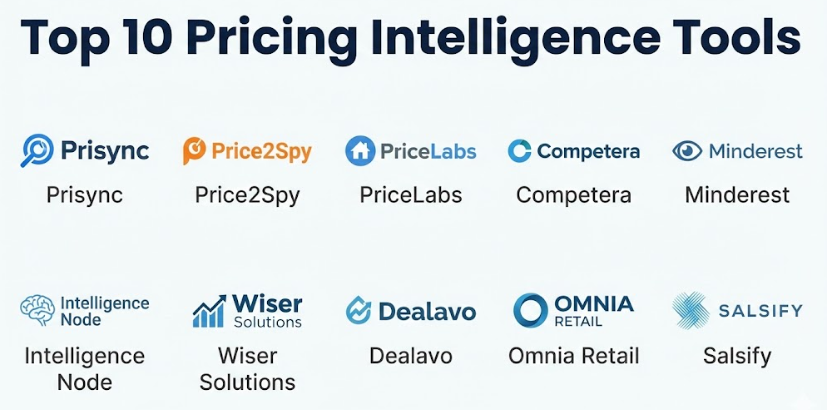
Top 10 Pricing Intelligence Tools
1 — Prisync
Prisync is a cloud-based pricing software designed specifically for e-commerce businesses of all sizes. It focuses on helping retailers stay competitive by tracking prices and stock levels from any website in the world. The tool is known for being very easy to set up, making it a favorite for businesses that want to start seeing results quickly. It offers a clean dashboard that summarizes everything you need to know about your competitors in one place, allowing you to react to market changes almost instantly.
- Key features:
- Unlimited competitor tracking from any website globally.
- Price change notifications sent directly to your email.
- Dynamic pricing engine that automatically updates your store prices.
- Comprehensive stock availability tracking.
- Historical price charts to see trends over time.
- Detailed Excel reports that can be exported with one click.
- API access for connecting to custom-built web stores.
- Pros:
- Very user-friendly interface that requires almost zero learning time.
- Excellent customer support that is available around the clock.
- Cons:
- The entry-level plans can be limited in the number of products you can track.
- Advanced features like dynamic pricing are only available on more expensive plans.
- Security & compliance: Uses SSL encryption for all data and is fully GDPR compliant.
- Support & community: High-quality documentation, 24/7 live chat support, and a very active blog with industry tips.
2 — Price2Spy
Price2Spy is a highly flexible tool that has been around for a long time and is trusted by thousands of companies. It is designed to work with almost any website, even those that try to block price-tracking bots. This makes it a very powerful option for businesses that need to track difficult or complex websites. It offers a wide range of reporting options and can be customized to fit the specific needs of a small shop or a massive international corporation.
- Key features:
- Advanced bot-detection bypassing to track “difficult” websites.
- Automated price comparisons across different countries and currencies.
- MAP (Minimum Advertised Price) violation alerts for brands.
- Visual “Price Matrix” to see all competitors at a glance.
- Support for multiple users with different permission levels.
- Automated repricing rules for major platforms like Shopify and Magento.
- Pros:
- Incredible ability to scrape data from even the most protected sites.
- Very flexible pricing plans that grow with your business.
- Cons:
- The dashboard can feel a bit old-fashioned compared to newer tools.
- The huge number of features can make it a bit confusing for beginners.
- Security & compliance: Provides secure login options and data encryption; follows standard privacy rules.
- Support & community: Very responsive email support and a detailed knowledge base for self-learning.
3 — PriceLabs
PriceLabs is a specialized tool created for the travel and hospitality industry, specifically for vacation rentals and hotels. Unlike general retail tools, it focuses on “nightly rates” rather than physical products. It uses a vast amount of data from the local area to suggest the best price for a room or house. It is designed for property managers who want to maximize their income by charging more when there is a local event and lowering prices when the town is quiet.
- Key features:
- Hyper-local data tracking for vacation rental markets.
- Automated “dynamic pricing” that updates your Airbnb or VRBO listing.
- Customizable rules for minimum stays and last-minute discounts.
- Market dashboards that show how your neighborhood is performing.
- Historical occupancy data to help you plan for the next season.
- Integration with most major Property Management Systems (PMS).
- Pros:
- The best tool for anyone managing short-term rental properties.
- Very effective at increasing total revenue for property owners.
- Cons:
- It is strictly for the rental industry and cannot be used for retail.
- The setup process requires connecting to your rental accounts, which takes time.
- Security & compliance: Uses secure API connections to travel platforms and protects owner data carefully.
- Support & community: Offers regular webinars, a help center, and email-based support.
4 — Competera
Competera is an enterprise-grade platform that uses “artificial intelligence” to help large retailers set the perfect price. It is designed for big companies that have thousands of products and need a very sophisticated way to manage them. The tool doesn’t just look at competitors; it also looks at how your own customers behave. It can predict how many more items you will sell if you lower the price by five percent, helping the finance team make very accurate predictions about future profits.
- Key features:
- AI-powered price optimization based on customer demand.
- Real-time competitive data from both online and offline sources.
- “What-if” scenario planning to test price changes before they happen.
- Automated workflow management for large pricing teams.
- Promotion optimization to see which sales are actually working.
- Detailed analysis of how your prices affect your brand image.
- Pros:
- Very powerful AI that can find profit opportunities humans would miss.
- Built to handle the massive data needs of giant supermarket chains and retailers.
- Cons:
- Much more expensive than simple price-tracking tools.
- Requires a lot of data and time to “train” the AI for your business.
- Security & compliance: Enterprise-level security, including SOC 2 and GDPR compliance.
- Support & community: Dedicated account managers and professional onboarding for every client.
5 — Minderest
Minderest is a popular European tool that offers a complete solution for both retailers and brands. It focuses on providing “clean” data that you can actually trust. One of its standout features is its ability to track prices on mobile apps, not just websites, which is becoming very important as more people shop on their phones. It is designed to be a “high-performance” tool that provides insights very quickly, allowing brands to protect their market position in a very competitive digital world.
- Key features:
- Tracking of prices on both websites and mobile shopping apps.
- Automated repricing engine for Amazon and other marketplaces.
- Global coverage with support for many different languages.
- “Smart Alerts” that only notify you of significant market changes.
- Catalog analysis to see where you have gaps in your product range.
- Brand protection tools to catch unauthorized sellers.
- Pros:
- Mobile app tracking is a unique and very useful feature.
- Very fast and reliable data updates.
- Cons:
- The pricing is not listed publicly, meaning you have to talk to a salesperson.
- The interface can be complex for a very small business owner.
- Security & compliance: Fully compliant with ISO standards and European privacy laws.
- Support & community: Offers personalized demos, phone support, and a wealth of educational guides.
6 — Intelligence Node
Intelligence Node is a massive data company that claims to have the world’s largest database of retail prices. Their tool is designed for global brands that need to see the “big picture” of how their products are priced across the entire world. It uses very advanced image recognition to find your products even if a competitor uses a different name or a different photo. It is a premium tool for companies that want to dominate their category through superior data and insights.
- Key features:
- AI-driven image recognition to match products perfectly.
- Real-time data from millions of websites across 190 countries.
- Detailed “Digital Shelf” analytics to see how your brand is appearing to shoppers.
- Stock-out alerts to help you identify sales opportunities.
- Integration with large corporate data systems like SAP.
- Historical data reaching back several years for deep analysis.
- Pros:
- The most accurate product matching in the industry.
- Global reach that is perfect for international corporations.
- Cons:
- The cost is quite high, putting it out of reach for many small businesses.
- It provides so much data that it can be hard to know where to start.
- Security & compliance: High-level enterprise security and full compliance with international data laws.
- Support & community: Global support teams and comprehensive training for large corporate users.
7 — Wiser Solutions
Wiser Solutions provides what they call “Commerce Intelligence.” They are unique because they combine online price tracking with “in-store” data. This means they can tell you what your competitors are charging on their website AND what is happening inside their physical stores through a network of mystery shoppers. This makes it an incredible tool for large brands that sell in physical retail locations like Walmart or Target as well as online.
- Key features:
- Combined online and in-store price monitoring.
- Real-time MAP monitoring and enforcement tools.
- “Shelf health” tracking to see if your products are placed correctly in stores.
- Competitive benchmarking to see how you rank against rivals.
- Consumer sentiment analysis to see what shoppers are saying about you.
- Customizable dashboards for different departments in your company.
- Pros:
- The only tool that truly bridges the gap between online and physical stores.
- Very helpful for brands that need to manage a large network of sellers.
- Cons:
- Can be very complex to manage because of the many different types of data.
- The in-store features are expensive and require a lot of coordination.
- Security & compliance: Adheres to strict corporate security protocols and privacy standards.
- Support & community: Provides professional services and dedicated support for enterprise clients.
8 — Dealavo
Dealavo is a straightforward and effective tool that focuses on the core needs of e-commerce stores: price monitoring and automated repricing. It is particularly popular in Europe and offers a very strong integration with price comparison sites like Google Shopping. It is designed to be a practical, “no-nonsense” tool that helps businesses increase their profit margins by making sure they are never too expensive or unnecessarily cheap.
- Key features:
- Daily or hourly price updates from any online store.
- Powerful “Repricing” rules to automatically change your prices.
- Historical price data for over five years of market history.
- Alerts for when competitors run out of stock.
- E-mail reports that are easy to read and share with a team.
- Dedicated tools for brands to monitor their distribution network.
- Pros:
- Excellent value for money for mid-sized businesses.
- Very reliable and easy to connect to standard e-commerce platforms.
- Cons:
- Does not have the advanced AI features of some larger competitors.
- Customer support is mostly focused on European time zones.
- Security & compliance: Standard data protection and full GDPR compliance.
- Support & community: Helpful technical support and a good library of “how-to” articles.
9 — Omnia Retail
Omnia Retail is a platform built for retailers who want to take full control of their pricing and marketing. It is divided into two parts: one for price tracking and one for managing your marketing ads based on those prices. For example, it can automatically stop spending money on ads for a product if a competitor has a much lower price, saving you money on clicks that won’t turn into sales. It is a very smart tool for companies that spend a lot on Google Ads.
- Key features:
- Automated price tracking and dynamic repricing.
- Integration between pricing data and marketing ad spend.
- “Profit-based” pricing rules to ensure you never sell at a loss.
- Detailed reporting on how price changes affect your sales volume.
- User-friendly interface with a focus on visual data.
- Support for large catalogs with millions of items.
- Pros:
- Brilliant for connecting your pricing strategy to your advertising budget.
- Helps prevent wasting money on ads for overpriced products.
- Cons:
- The marketing features take some time to set up correctly.
- Better suited for larger retailers than very small shops.
- Security & compliance: Uses secure cloud infrastructure and follows all standard data laws.
- Support & community: High-quality onboarding and proactive customer success teams.
10 — Salsify
Salsify is a “Product Experience Management” platform that includes pricing intelligence as part of a much larger system. It is designed for big brands that need to manage all their product information, images, and prices across many different retailers (like Amazon, Walmart, and specialized sites). It helps ensure that your product looks great and is priced correctly everywhere it is sold. It is more of a “brand management” tool than a simple price tracker.
- Key features:
- Centralized hub for all product data and pricing.
- Competitive price monitoring across global retail networks.
- Automated syncing of product details to hundreds of different stores.
- Workflow tools to help teams collaborate on new product launches.
- Detailed analytics on how your products are performing on different sites.
- Inventory tracking to prevent “out of stock” messages on retail sites.
- Pros:
- Perfect for brands that sell through many different online retailers.
- Helps keep your brand looking professional and consistent everywhere.
- Cons:
- Very large and complex system that takes time to implement.
- Highly expensive; only suitable for large, established brands.
- Security & compliance: Top-tier security certifications, including SOC 2 and ISO 27001.
- Support & community: Massive community of users and extensive professional support services.
Comparison Table
| Tool Name | Best For | Platform(s) Supported | Standout Feature | Rating |
| Prisync | SMB E-commerce Stores | Web, Shopify, Magento | 24/7 Live Support | N/A |
| Price2Spy | Complex/Hard Websites | Web, API | Bot-Bypassing Tech | N/A |
| PriceLabs | Vacation Rentals | Web, PMS | Nightly Rate Prediction | N/A |
| Competera | Enterprise Retailers | Cloud, API | AI Demand Prediction | N/A |
| Minderest | Mobile App Tracking | Web, API, Mobile | Mobile App Monitoring | N/A |
| Intelligence Node | Global Brands | Cloud, API | Image-Based Matching | N/A |
| Wiser Solutions | Retail & Brands | Web, In-Store | Online & In-Store Data | N/A |
| Dealavo | Mid-Market Europe | Web, API | 5-Year Price History | N/A |
| Omnia Retail | Ad-Heavy Retailers | Web, API | Ad-Spend Integration | N/A |
| Salsify | Large Brand Owners | Web, Cloud | Product Data Hub | N/A |
Evaluation & Scoring of Pricing Intelligence Tools
The following table shows how these tools are evaluated. We use a weighted system to determine which tools provide the most value for different types of users.
| Evaluation Category | Weight | Key Considerations |
| Core Features | 25% | Accuracy, frequency of updates, and bot-handling. |
| Ease of Use | 15% | How simple the dashboard is for non-tech users. |
| Integrations | 15% | Connecting to Shopify, Amazon, and ERP systems. |
| Security & Compliance | 10% | Data encryption, GDPR, and enterprise safety. |
| Performance | 10% | Speed of the tool and reliable data uptime. |
| Support & Community | 10% | Quality of help articles and response times. |
| Price / Value | 15% | Total cost compared to the money and time saved. |
Which Pricing Intelligence Tool Is Right for You?
Solo users vs SMB vs mid-market vs enterprise
If you are running a store by yourself or have a very small team, you should focus on Prisync or Price2Spy. These tools offer easy-to-understand dashboards and don’t require you to be a computer expert. Small to medium-sized businesses (SMBs) will find Dealavo or Price2Spy to be great choices as they offer more depth without a massive price tag. Mid-market companies that spend a lot on advertising should look at Omnia Retail. For giant global enterprises with huge catalogs, only a high-end AI tool like Competera or Intelligence Node will provide the level of detail and automation needed.
Budget-conscious vs premium solutions
If you have a limited budget, you should look for tools that charge based on the number of products you track. Prisync and Price2Spy have plans that allow you to start small and pay more as you grow. If money is less of an issue and you want the absolute best insights, premium solutions like Wiser Solutions or Competera are the way to go. These tools cost more because they do much more than just track prices—they provide deep strategic advice and AI-powered predictions.
Feature depth vs ease of use
There is always a balance between having many features and being easy to use. Prisync is the clear winner for ease of use, but it doesn’t have as many complex “if-this-then-that” rules as Price2Spy. If you have a dedicated person on your team whose only job is to manage prices, you can choose a more “feature-heavy” tool. If the business owner is doing the pricing themselves in between other tasks, a simpler tool is always better to save time and reduce stress.
Integration and scalability needs
Before you buy any tool, check if it works with the software you already use. If you have a Shopify store, you want a tool that can “talk” to Shopify and change your prices automatically. If you plan to grow from 100 products to 10,000 products in the next year, make sure the tool can handle that growth without becoming too expensive or slow. Tools like Price2Spy and Minderest are known for being very scalable as your business expands.
Security and compliance requirements
If you are a large company or if you work in Europe, you must ensure that the tool follows GDPR and other privacy laws. Most established tools like Prisync, Minderest, and Competera are fully compliant and very safe. If you need to store your data on your own servers or need special “audit logs” to see who changed which price, you will need an enterprise-level solution like Salsify or Intelligence Node.
Frequently Asked Questions (FAQs)
1. What is pricing intelligence exactly?
It is the process of using software to automatically track and analyze the prices and stock levels of your competitors to help you make better pricing decisions.
2. Is it legal to track competitor prices?
Yes, it is perfectly legal to track public prices on websites. The tools simply do what a human would do, but much faster and more efficiently.
3. Will my competitors know I am tracking them?
No. Most pricing intelligence tools use special technology to browse websites anonymously, so the competitor just sees another regular visitor to their site.
4. Can these tools change my prices automatically?
Yes, most of the top tools have a feature called “Dynamic Pricing” or “Repricing” that can change your prices on your website based on the rules you set.
5. How often does the data update?
This depends on your plan. Some tools update once a day, while premium plans can provide updates every hour or even in real-time.
6. Do these tools work on Amazon and eBay?
Yes, almost all the tools on this list can track prices on major marketplaces like Amazon, eBay, Walmart, and many others.
7. Can I track prices in different currencies?
Yes, many of these tools, like Price2Spy and Prisync, can automatically convert prices from different countries into your local currency.
8. What is MAP monitoring?
MAP stands for Minimum Advertised Price. It is a tool for brands to make sure that the shops selling their products are not dropping the price too low.
9. Do I need to be a developer to use these?
For most of these tools, no. They are designed for regular business owners. Only the very complex enterprise tools might require some technical help to set up.
10. How much money can I save with these tools?
While the software costs money, it usually pays for itself by preventing you from being too cheap (losing profit) or being too expensive (losing sales).
Conclusion
Choosing the right pricing intelligence tool is a critical step in making your business more professional and profitable. These programs act as your “secret weapon” in a crowded market, giving you the information you need to stay one step ahead of your rivals. By automating the boring task of price checking, you free up your time to focus on other important things, like finding new products or improving your customer service. It is not just about having the lowest price; it is about having the smartest price that helps your business grow while keeping your profit margins healthy.
It is important to remember that the “best” tool is not always the most expensive one. It is the one that fits your specific business needs, your budget, and the technical skills of your team. Whether you choose a simple and friendly tool like Prisync or a massive AI-powered system like Competera, the key is to start using the data to make your decisions. In today’s competitive landscape, businesses that rely on real facts and numbers will always outperform those that rely on luck. Taking the time to pick the right partner in pricing intelligence is an investment that will benefit your company for many years to come.