Introduction
Pipeline Integrity Management Software, often called PIMS, is a specialized digital tool used by companies that own or operate pipelines. Think of it as a high-tech health monitor for the long stretches of pipe that carry oil, gas, water, or chemicals across the country. These pipes face many threats, such as rust, shifting soil, or accidental damage from digging. This software gathers data from sensors, inspections, and manual checks to help engineers understand which parts of the pipe are strong and which parts might need a repair soon.
Using these tools is important because a leaking pipeline can cause massive environmental damage, cost millions in fines, and put people’s lives at risk. By using software instead of paper notes or simple spreadsheets, companies can predict problems before they happen. Real-world use cases include calculating the exact pressure a pipe can handle after some rust is found, scheduling repair crews for the most dangerous spots first, and keeping perfect records to show government inspectors that everything is safe. When choosing a tool, you should look for how easily it handles large amounts of data, whether it works with map-based systems, and if it can grow as your company adds more miles of pipe.
Best for: Large energy companies, utility providers, and engineering firms that manage hundreds or thousands of miles of pipelines. It is perfect for integrity engineers, safety officers, and compliance managers who need to track risk and stay within the law.
Not ideal for: Very small businesses that manage short, simple plumbing lines or local distribution networks that do not face strict national safety regulations. In those cases, basic maintenance software might be a better and cheaper choice.
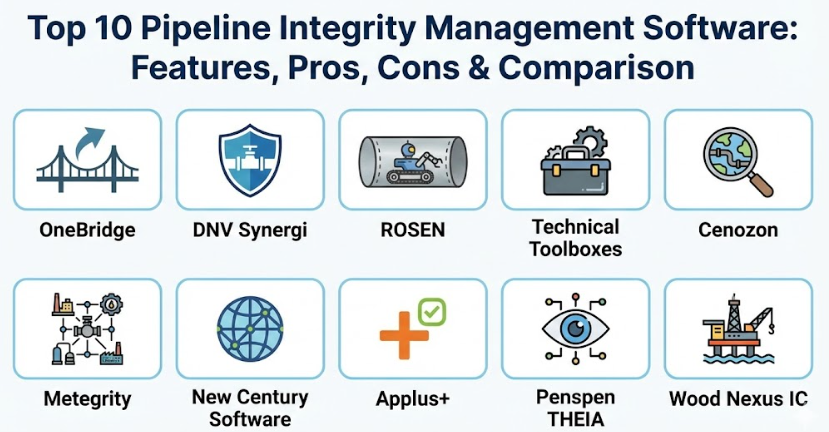
Top 10 Pipeline Integrity Management Software Tools
1 — OneBridge (Cognitive Integrity Management)
OneBridge offers a modern, cloud-based platform that uses advanced math and machine learning to help engineers understand their pipeline data. It is designed for companies that want to move away from old-fashioned data entry and use a system that can spot patterns automatically.
Key features:
- Automated data loading that cleans up messy inspection reports from different vendors.
- A “threat assessment” tool that shows you exactly where your pipe is at risk.
- Cloud-based access so your team can look at the data from anywhere in the world.
- Tools that compare new inspection results with old ones to see how fast a problem is growing.
- Interactive dashboards that turn thousands of data rows into easy-to-read charts.
- Built-in tools to help you meet strict safety standards without doing manual paperwork.
Pros:
- It saves a huge amount of time by organizing data that used to take weeks to sort through.
- The system is very good at finding small issues that a human might miss in a large file.
Cons:
- Because it is a newer type of software, some older engineers might find the interface a bit different than what they are used to.
- It requires a good internet connection since everything is stored in the cloud.
Security & compliance: Uses modern encryption to keep data safe, offers single sign-on (SSO) for easy logging in, and follows high standards like SOC 2 for data privacy.
Support & community: Offers a dedicated support team, online training videos, and regular updates to make sure the software stays up to date with new laws.
2 — DNV (Synergi Pipeline)
DNV is a well-known name in the industry, and their Synergi Pipeline software is considered one of the standard tools for managing risk. It is designed for large operators who need to handle every single detail of their pipeline’s life, from the day it is buried to the day it is retired.
Key features:
- A deep risk engine that calculates exactly how likely a pipe is to fail.
- Direct connection to map systems so you can see your pipes on a digital map.
- Tools for managing “inline inspections,” which are the tests done by robots inside the pipe.
- A module for managing repairs and tracking who did the work and when.
- Support for both liquid and gas pipelines with different rules for each.
- Customizable reports that can be sent directly to government agencies.
Pros:
- It is backed by decades of engineering knowledge and “expert” logic.
- It is extremely reliable and can handle massive amounts of data for very large companies.
Cons:
- The software can be quite complex and usually requires a lot of training to master.
- It can be expensive to buy and set up compared to simpler tools.
Security & compliance: Follows international ISO standards for security and provides full audit logs to see who changed what data.
Support & community: Offers global support offices, an annual user conference, and very detailed technical manuals.
3 — ROSEN (Asset Integrity Management)
ROSEN is famous for building the robots that inspect pipes, and their software is designed to make sense of the data those robots collect. It is a great choice for teams that want a direct link between the inspection service and the management software.
Key features:
- Seamlessly imports data from ROSEN inspection tools without any errors.
- Advanced “life cycle” tracking to predict how many years a pipe has left.
- Engineering tools to calculate the strength of pipes with dents or rust.
- A central hub for all asset information, including photos and repair history.
- Modules for managing “cathodic protection,” which is a way to stop pipes from rusting.
- Expert support from ROSEN’s own engineers built right into the platform.
Pros:
- The software is built by people who understand the physical science of pipes.
- The data visualization is top-notch, making it easy to see where a problem is located.
Cons:
- It works best if you are already using ROSEN for your inspections.
- The interface has a lot of technical buttons that might confuse non-engineers.
Security & compliance: GDPR compliant and uses secure data centers with high-level encryption for all client files.
Support & community: High-quality onboarding, enterprise-level support, and access to a massive library of engineering research.
4 — Technical Toolboxes (Pipeline HUB)
Technical Toolboxes provides a “HUB” that connects many different engineering tools into one place. It is designed for engineers who need to do a lot of math and calculations to prove that their pipelines are safe to operate.
Key features:
- A library of hundreds of standard engineering formulas for pipelines.
- Tools for calculating how much stress a pipe can take during a crossing or under a road.
- Integration with map data to show the physical location of every calculation.
- A “Project” view that lets teams collaborate on a specific repair or new build.
- Regular updates that include the latest industry standards and “best practices.”
- Easy-to-use templates for common tasks like checking for rust or dents.
Pros:
- It is like having a giant book of engineering secrets that does the math for you.
- It is very helpful for small to medium teams that don’t have a huge engineering department.
Cons:
- It is more of a “calculation” tool than a full “data management” tool.
- You might still need another system to store your long-term records.
Security & compliance: Offers secure login and data storage, though specific certifications like SOC 2 may vary by version.
Support & community: Known for excellent customer support and offering many training classes for engineers.
5 — Cenozon (Pipeline Integrity Explorer)
Cenozon is a user-friendly platform that is very popular in North America. It is designed to be simple and clear, helping companies stay organized and follow safety laws without getting lost in complex menus.
Key features:
- A very clean map interface that shows you your entire pipeline network at a glance.
- Automated “risk ranking” that highlights your top 10 most dangerous segments.
- Simple tools for tracking inspections and making sure they are done on time.
- A mobile app that lets workers in the field upload photos and notes directly.
- Easy reporting for regulatory bodies that shows you are following the rules.
- Cost-tracking features to help you stay within your repair budget.
Pros:
- It is one of the easiest tools to learn, even for people who aren’t tech experts.
- The mobile integration is excellent for teams that spend a lot of time outdoors.
Cons:
- It might not have enough advanced “deep math” for very complex offshore pipelines.
- The focus is more on day-to-day management than on long-term AI predictions.
Security & compliance: Includes secure user roles so people only see what they need to, and maintains strong data backup systems.
Support & community: Offers friendly, fast support and a very straightforward onboarding process.
6 — Metegrity (Visions Enterprise)
Metegrity provides software that manages not just the pipelines, but also the tanks, valves, and plants they connect to. It is designed for companies that want one single system to track every piece of equipment they own.
Key features:
- Manages “fixed assets” like pressure vessels and tanks alongside pipelines.
- Uses “Risk-Based Inspection” (RBI) to tell you exactly when to check each part.
- A highly customizable database that can store any kind of information you want.
- Integration with many different types of inspection equipment and sensors.
- Detailed scheduling tools to manage large maintenance projects.
- Audit-ready records that are very hard to lose or accidentally change.
Pros:
- Perfect for refineries or chemical plants that have a lot of different equipment.
- Very strong at keeping a “paper trail” for every single inspection ever done.
Cons:
- Because it does so much, it can take a long time to set up and configure.
- The software can feel a bit “heavy” if you only want to track one simple pipe.
Security & compliance: ISO certified security and very strong audit logs that track every mouse click for high-level safety.
Support & community: Large enterprise support team and a long history of helping major oil companies.
7 — New Century Software (Integrity Plus)
New Century Software is a leader in using map-based data (GIS) to manage pipelines. Their tool, Integrity Plus, is designed for companies that want to use geography to understand their risks.
Key features:
- Deep integration with Esri’s ArcGIS, which is the gold standard for digital maps.
- Tools to help you decide which parts of the pipe are in “High Consequence Areas” (near schools or rivers).
- A system for managing “alignment sheets,” which are the long maps used by pipeline crews.
- Automated tools to check for errors in your map data.
- Risk assessment models that can be changed to fit your specific company rules.
- Professional services to help you clean up your maps and data.
Pros:
- If your company uses GIS and maps, this is one of the best tools available.
- It is great at showing the “big picture” of how a pipe interacts with the environment.
Cons:
- You really need to have a good map system already in place to get the most out of it.
- It can be a bit technical for people who aren’t familiar with map software.
Security & compliance: Follows standard security practices and is designed to meet strict pipeline mapping laws.
Support & community: Offers expert consulting, training, and a strong community of GIS professionals.
8 — Applus+ (PIMS)
Applus+ is a global inspection and testing company, and their PIMS software is built to handle the results of those tests. It is designed for operators who want a clear, professional way to store their inspection history.
Key features:
- A centralized database for all inspection reports and repair documents.
- Tools to calculate the “remaining life” of a pipe based on rust and wear.
- Integration with “Non-Destructive Testing” (NDT) data from the field.
- A clear dashboard that shows your current compliance status.
- Support for many different international standards and languages.
- Easy ways to export data for further study in other programs.
Pros:
- Very straightforward and does exactly what it says on the box.
- Backed by a company that does inspections every day, so they know what data looks like.
Cons:
- It might feel a bit basic compared to the AI-driven tools.
- The visual maps aren’t as advanced as some of the competitors.
Security & compliance: SOC 2 compliant and provides secure, encrypted cloud storage.
Support & community: Global presence means you can get help in almost any time zone.
9 — Penspen (THEIA)
Penspen’s THEIA software is built by pipeline engineers for pipeline engineers. It focuses on the technical side of integrity, helping companies make big decisions about whether to repair or replace a pipe.
Key features:
- Sophisticated risk models that look at both the “E” (Environmental) and “S” (Safety) impact.
- Detailed modules for managing “internal” and “external” corrosion.
- A tool to help plan the budget for the next five to ten years of repairs.
- Clear visuals that show which parts of the pipe are the most likely to fail.
- Support for old pipelines that might not have perfect original records.
- Built-in advice based on decades of Penspen’s engineering experience.
Pros:
- Excellent for “life extension” projects where you want to keep an old pipe running safely.
- The reports are very professional and easy to show to a board of directors.
Cons:
- The software is very focused on engineering, so it might be “too much” for a simple maintenance team.
- It requires high-quality data to give the best results.
Security & compliance: High-level data protection and fully compliant with international privacy laws.
Support & community: Direct access to some of the world’s best pipeline engineers for support.
10 — Wood (Nexus IC)
Wood is a massive engineering firm, and their Nexus IC tool is designed for complex systems, especially those that are underwater or in very difficult environments. It is a “premium” choice for the most challenging jobs.
Key features:
- Incredible detail for offshore and subsea pipelines.
- Links to live sensors so you can see what is happening in the pipe right now.
- A “digital twin” capability that creates a 3D model of your pipeline system.
- Tools to manage the integrity of the structures that hold the pipes in place.
- Advanced “anomaly management” to track every single dent or scratch.
- Integration with Wood’s other engineering and design software.
Pros:
- If you have a very complex or offshore system, this is likely the best tool for you.
- The “live” data features help you react to problems in seconds, not days.
Cons:
- It is one of the most expensive and complex tools on the list.
- It is definitely “overkill” for a simple onshore water or gas pipe.
Security & compliance: Enterprise-grade security with full global certifications for data safety.
Support & community: World-class support from a global engineering powerhouse.
Comparison Table
| Tool Name | Best For | Platform(s) Supported | Standout Feature | Rating |
| OneBridge | AI & Machine Learning | Cloud / Web | Automated Data Cleaning | 4.8 |
| DNV Synergi | Large Enterprise Risk | Desktop / Cloud | Expert Risk Engine | 4.7 |
| ROSEN | Inspection Data Focus | Desktop / Cloud | Direct Robot Integration | 4.6 |
| Technical Toolboxes | Engineering Math | Desktop / Cloud | Library of Formulas | 4.5 |
| Cenozon | Ease of Use & Mobile | Web / Mobile | Simple Map Interface | 4.7 |
| Metegrity | Plant & Pipe Assets | Desktop / Cloud | Multi-Asset Management | 4.4 |
| New Century | GIS & Mapping | Desktop / GIS | ArcGIS Integration | 4.5 |
| Applus+ | Inspection Storage | Web / Cloud | Testing Data Sync | 4.2 |
| Penspen THEIA | Life Extension | Web / Cloud | Deep Engineering Advice | 4.4 |
| Wood Nexus IC | Offshore & Subsea | Cloud / 3D | Digital Twin / Live Data | 4.6 |
Evaluation & Scoring of Pipeline Integrity Management Software
To understand which tool is best, we use a scoring system. Not every feature is equally important. For example, the “Core Features” (how it actually manages the pipe) are more important than the “Price,” because a cheap tool that doesn’t stop leaks is a waste of money.
| Category | Weight | What it Means |
| Core Features | 25% | Does it have the math, risk models, and tools to keep the pipe safe? |
| Ease of Use | 15% | Can a normal person learn it, or do you need a PhD to open the program? |
| Integrations | 15% | Does it talk to maps, sensors, and your other company software? |
| Security & Compliance | 10% | Is the data safe from hackers and does it meet safety laws? |
| Performance | 10% | Does the software run fast or does it crash when you load a big file? |
| Support & Community | 10% | Is there someone to call when things go wrong? |
| Price / Value | 15% | Is the price fair for what you get in return? |
Which Pipeline Integrity Management Software Tool Is Right for You?
Choosing the right software is a big decision that involves several different factors. Here is a simple guide to help you decide.
By Company Size
- Small Teams / SMBs: If you only have a few pipes and a small budget, look for Cenozon or Technical Toolboxes. These tools are easy to set up and don’t require a whole IT department to keep them running.
- Mid-Market: If you are growing and need better maps, New Century Software is a great choice. It lets you use professional maps without being as expensive as the giant enterprise systems.
- Enterprise: Large global companies should look at DNV Synergi, OneBridge, or Wood. These tools can handle the massive amounts of data that come with managing thousands of miles of pipeline across different countries.
By Budget and Complexity
- Budget-Conscious: If you need to save money, a tool like Applus+ or Technical Toolboxes provides the basics without a lot of expensive “extra” features you might not use.
- Premium Solutions: If safety is your only concern and you have the budget, OneBridge or DNV offer the most advanced technology to keep your risk as low as possible.
Feature Depth vs. Ease of Use
If you have a team of highly trained engineers, they will appreciate the depth of Penspen THEIA or ROSEN. However, if your team is mostly made of field workers and maintenance managers, they will much prefer the simple and clear screens of Cenozon.
Integration and Security
Always check if the software works with what you already have. If you use ArcGIS for maps, New Century is the natural choice. If you are very worried about hackers or data leaks, make sure to pick a tool with SOC 2 or ISO certifications, such as Metegrity or OneBridge.
Frequently Asked Questions (FAQs)
What exactly is pipeline integrity?
It means making sure a pipeline is “whole” and working correctly without any leaks or breaks. Software helps by tracking the health of the pipe over time.
Can I use Excel instead of this software?
You can for a very small pipe, but it is dangerous for large ones. Excel doesn’t have a “history” of changes, it can’t show data on a map, and it is easy to make a math mistake that goes unnoticed.
How does the software get the data?
It usually comes from “smart pigs” (robots that crawl inside the pipe), manual inspections by workers, or sensors that are attached to the outside of the pipe.
Does this software work for water pipes?
Yes, while many of these tools were made for oil and gas, the same math and mapping tools work very well for large water mains and sewage lines.
Is cloud-based software safe for my data?
Yes, most modern cloud tools use the same level of security as online banks. It is often safer than keeping data on a single laptop that could be lost or stolen.
How much does implementation cost?
It varies wildly. A simple tool might cost a few thousand dollars to set up, while a major enterprise system could cost hundreds of thousands when you include data cleaning and staff training.
What is a “High Consequence Area” (HCA)?
This is a place where a leak would be extra bad, like near a school, a city, or a drinking water source. Good software helps you find these areas on a map automatically.
Can the software predict a leak?
It can’t see the future perfectly, but it uses “predictive modeling” to tell you which part of the pipe is the most likely to have a problem based on its age and condition.
What is the biggest mistake companies make when buying PIMS?
Buying a tool that is too complicated for their team to use. If the software is too hard, people will stop putting data into it, and then the tool becomes useless.
Do these tools help with government audits?
Absolutely. Instead of hunting through filing cabinets, you can just click a button and show the inspector a perfect record of every test and repair you have ever done.
Conclusion
Managing a pipeline is a massive responsibility that requires the best tools available. Whether you are a small operator looking for a simple way to track your repairs or a global giant needing AI to predict risks, there is a Pipeline Integrity Management Software that fits your needs.
The “best” tool isn’t the one with the most features; it’s the one that your team will actually use every day. When you choose a tool, remember to focus on data quality, ease of use, and strong support. By moving your integrity data into a professional system, you aren’t just following the law—you are protecting the environment, your employees, and the future of your company. Take your time, request a few demos, and pick the partner that understands your specific challenges.