Introduction
Open Banking Platforms are the modern “bridges” that connect traditional banks to the apps and services we use every day. In simple terms, these platforms use secure technology called APIs to allow different financial tools to talk to each other. For example, if you use a budgeting app to see all your different bank balances in one place, or if you pay for something online directly from your bank account without using a credit card, an open banking platform is likely working behind the scenes to make that happen.
These platforms are very important because they give people more control over their own money data. In the past, your bank was the only one that could see your transaction history. Now, with your permission, these platforms can securely share that data with other helpful tools. This leads to more competition, better financial products, and faster ways to pay.
Key Real-World Use Cases
- Personal Finance Management: Seeing all your accounts from different banks in a single dashboard to track spending.
- Instant Payments: Paying for goods online directly from a bank account, which is often safer and faster than typing in card numbers.
- Faster Loans: Allowing a lender to see your real-time income and spending so they can approve a loan in minutes instead of days.
- Subscription Management: Finding and canceling old subscriptions that you no longer use by scanning your bank history.
What to Look For When Choosing Tools
When you are looking for an open banking platform, you should focus on how many banks it can actually connect to (coverage). You also want to make sure it is easy for your team to set up and that it has very high security standards. Finally, check if the platform offers “data enrichment,” which means it cleans up messy bank data so it is easy for humans to read.
Best for: Fintech startups building new apps, large retailers who want to lower their payment fees, and banks that want to offer more modern services to their customers.
Not ideal for: Small local shops that only take cash or very simple businesses that do not need to connect to their customers’ financial data.
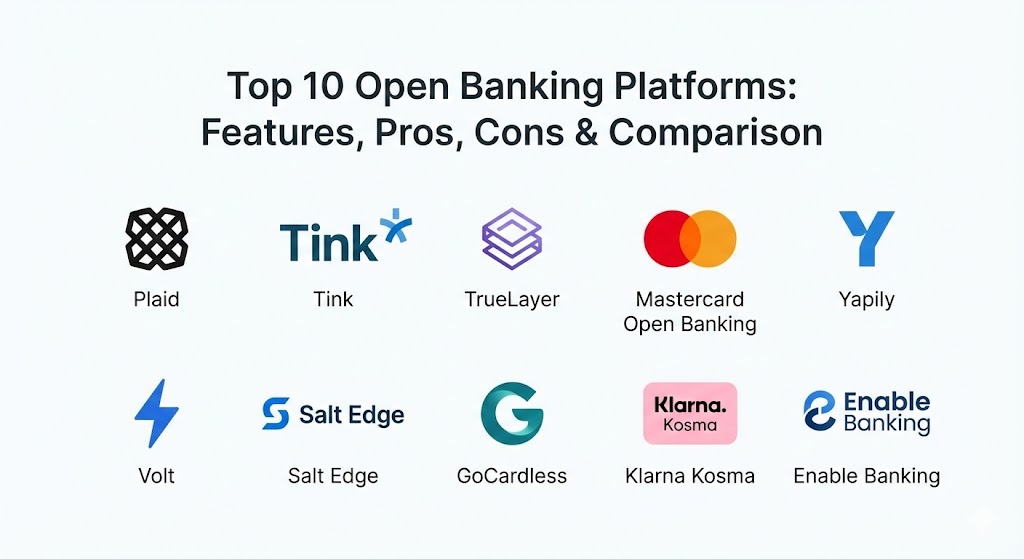
Top 10 Open Banking Platforms Tools
1 — Plaid
Plaid is one of the most famous names in open banking, especially in North America. It acts as a secure middleman that helps thousands of apps connect to bank accounts. It is designed for developers who want a reliable way to verify bank details and move money.
- Key Features:
- Connects to over 12,000 financial institutions globally.
- Instant account verification for setting up payments.
- Detailed income and payroll verification for lenders.
- Real-time balance checks to prevent failed payments.
- Transaction categorization that labels spending (e.g., “Groceries”).
- A simple “Link” tool that users can click to sign into their bank.
- Tools to detect and prevent financial fraud.
- Pros:
- The largest network of bank connections in the United States.
- Excellent documentation that makes it very easy for tech teams to build with.
- Cons:
- Pricing can be higher than competitors as you scale up.
- European coverage is growing but is not as deep as some local rivals.
- Security & compliance: ISO 27001, SOC 2 Type II, and uses end-to-end encryption for all data; fully GDPR compliant.
- Support & community: Offers a large developer forum, 24/7 technical support for businesses, and very clear online manuals.
2 — Tink (Visa)
Tink is a leading European platform that was recently bought by Visa. It focuses on helping businesses build great customer experiences, like smart budgeting tools and easy payment flows. Because it is owned by Visa, it has a very strong and stable foundation.
- Key Features:
- Coverage for more than 3,400 banks across 18 European countries.
- Advanced analytics that predict a user’s future spending.
- High-speed payment initiation for instant bank transfers.
- Tools specifically for managing recurring payments and subscriptions.
- A “Business Account” feature to help small companies manage money.
- Data cleaning services that turn raw bank codes into clear merchant names.
- Integration with Visa’s global payment network.
- Pros:
- Deep expertise in the European market and its specific rules.
- Very stable platform with the backing of a global giant like Visa.
- Cons:
- Less focus on the North American market compared to Plaid.
- Can be a bit more “corporate” and slower for tiny startups to get started.
- Security & compliance: PCI DSS, ISO 27001, and fully compliant with PSD2 (European banking rules).
- Support & community: Professional enterprise support and a very helpful “Success Manager” for larger clients.
3 — TrueLayer
TrueLayer is a UK-based company that has become a champion for “Pay by Bank” technology. They focus on making bank payments so easy that people stop using credit cards. They are popular with trading apps, online casinos, and e-commerce stores.
- Key Features:
- Instant payouts that send money back to customers in seconds.
- Variable Recurring Payments (VRP) for flexible monthly bills.
- A highly customizable payment screen that matches your brand.
- Verification tools that confirm a user’s identity via their bank.
- Real-time notifications for when a payment is successful.
- Deep coverage of UK and European banks.
- A “signup and pay” feature that does two jobs at once.
- Pros:
- The absolute leader in making bank payments feel as smooth as card payments.
- Excellent conversion rates, meaning fewer people give up during the payment process.
- Cons:
- Mainly focused on Europe and the UK for now.
- Their tools are very focused on payments, so they might have fewer features for deep data research.
- Security & compliance: ISO 27001, SOC 2, and authorized by the FCA in the UK; uses the highest level of bank encryption.
- Support & community: Very active on social media and Slack; offers great technical support for engineering teams.
4 — Mastercard Open Banking (Finicity)
Mastercard entered the open banking space by acquiring a company called Finicity. They use their massive global network to help lenders make better decisions by looking at a borrower’s real-time financial health.
- Key Features:
- Specialized reports for mortgage and auto loan lenders.
- “Credit Decisioning” tools that use AI to predict risk.
- High-quality data feeds that are updated in real-time.
- A secure portal for users to manage which data they are sharing.
- Direct connections to major banks, which means fewer errors.
- Support for “Open Finance” (investments and savings, not just bank accounts).
- Tools to help people improve their credit scores by sharing more data.
- Pros:
- Incredible data accuracy, which is vital for banks and lenders.
- Global reach and trust that comes with the Mastercard brand.
- Cons:
- The platform is very much geared towards large banks and lenders.
- Might be “too much tool” for a simple fintech app.
- Security & compliance: SOC 2 Type II, PCI DSS, and follows strict global privacy standards.
- Support & community: Extensive professional documentation and high-level account support for large institutions.
5 — Yapily
Yapily is unique because they call themselves an “infrastructure” platform. They don’t have their own user-facing screens; instead, they provide the “pipes” that let other companies build whatever they want. They are perfect for companies that want total control over the design.
- Key Features:
- A “pure” API that lets you build your own custom experience.
- Connectivity to over 2,000 banks in the UK and Europe.
- Bulk payment features for paying many people at once.
- No “middleman” data storage—your data goes straight to you.
- Support for “Virtual Accounts” to help with reconciliation.
- Fast payment routing to ensure money gets there as quickly as possible.
- Lightweight code that doesn’t slow down your app.
- Pros:
- Gives you the most freedom to design your app exactly how you want.
- Very transparent pricing because they only provide the infrastructure.
- Cons:
- Requires a strong team of programmers to build the user interface.
- Does not offer as many “extra” features like data cleaning or analytics.
- Security & compliance: ISO 27001, GDPR compliant, and uses secure OAuth 2.0 connections.
- Support & community: Excellent developer documentation and a dedicated technical help desk.
6 — Volt
Volt is a global platform that specializes in real-time payments. They want to create a single “standard” for bank payments across the whole world, making it just as easy to pay someone in Brazil as it is in London.
- Key Features:
- A “smart router” that finds the fastest way to move money.
- Support for instant payments in Europe, Brazil, and beyond.
- A single API that works for many different countries.
- Real-time fraud monitoring to block suspicious transfers.
- Tools to help merchants track their cash flow across the globe.
- A simple “Pay by Link” feature for emails or text messages.
- Integration with popular shopping carts like Shopify.
- Pros:
- Best choice if you need to take bank payments from many different countries.
- Very focused on the future of “Instant Everything.”
- Cons:
- Less focused on “Data Sharing” and more focused on “Moving Money.”
- Still expanding its network in some regions.
- Security & compliance: PCI DSS compliant and uses bank-grade security for all global transactions.
- Support & community: Offers 24/7 global support and helpful onboarding for international merchants.
7 — Salt Edge
Salt Edge is a global player known for its massive coverage and its help with “Compliance.” They don’t just provide the tech; they also help banks meet the legal requirements for open banking.
- Key Features:
- Connections to over 5,000 banks in 50+ countries.
- A “Compliance-as-a-Service” tool for banks.
- Detailed financial insights for lenders and insurance companies.
- Automated debt collection tools using open banking payments.
- Support for both individual and business bank accounts.
- A dashboard to monitor the status of every bank connection.
- A “Sandbox” mode to test your app without using real money.
- Pros:
- One of the widest global footprints in the industry.
- Very knowledgeable about the different laws in different countries.
- Cons:
- The interface for developers can sometimes feel a bit older than rivals.
- Connecting to so many banks means that some connections might be slower than others.
- Security & compliance: ISO 27001, SOC 2, and fully compliant with global open banking standards.
- Support & community: Professional technical support and a library of guides for different industries.
8 — GoCardless
GoCardless was originally a company for “Direct Debits,” but they have added open banking to make recurring payments better. They are great for any business that takes monthly payments, like gyms or software companies.
- Key Features:
- Combines traditional direct debit with instant open banking payments.
- “Instant Bank Pay” for taking the first payment immediately.
- Verified bank account checks to stop “stolen” account numbers.
- Automatic retries if a payment fails due to lack of funds.
- Integration with accounting software like Xero and QuickBooks.
- A simple dashboard to see who has paid and who is late.
- Support for multiple currencies across the globe.
- Pros:
- The best at handling the mix of “Monthly Bills” and “Instant Payments.”
- Very easy to use for businesses that are not very technical.
- Cons:
- Less focus on deep data analytics or credit scoring.
- Fees can be based on a percentage of the transaction, which adds up.
- Security & compliance: ISO 27001 and regulated by major financial authorities around the world.
- Support & community: Excellent customer service and a very helpful blog with business tips.
9 — Klarna Kosma
Klarna Kosma is a sub-brand of the famous shopping app Klarna. They took the technology they used for their own app and opened it up for other businesses to use. It is one of the largest bank networks in the world.
- Key Features:
- Access to 15,000 banks across 27 different countries.
- A “Proven” platform that handles millions of transactions a day.
- High-speed account aggregation for a full view of user wealth.
- Payment initiation services that are very reliable.
- A “one-stop-shop” for both data and payments.
- Tools to help with “Know Your Customer” (KYC) checks.
- Simplified legal agreements for faster onboarding.
- Pros:
- Incredible scale and reliability because it powers the main Klarna app.
- One of the most extensive bank lists available today.
- Cons:
- Can feel like you are working with a very large and busy company.
- Pricing and terms might be less flexible for small, unique projects.
- Security & compliance: Follows all major EU banking safety rules and uses advanced fraud detection.
- Support & community: Professional enterprise support with a focus on high-volume clients.
10 — Enable Banking
Enable Banking is a “Privacy-First” platform based in Northern Europe. They focus on providing the simplest and most transparent way to connect to banks without storing any of the user’s data on their own servers.
- Key Features:
- A “Zero-Storage” policy—your data stays between you and the bank.
- Direct API connections with no middle layers.
- Simple and transparent pricing (usually a flat fee per month).
- Focus on “Pure Connectivity” without extra fluff.
- Very fast and lightweight integration process.
- Support for all major banks in the Nordic and Baltic regions.
- A commitment to total transparency for the end user.
- Pros:
- The best choice for businesses that are very worried about data privacy.
- The simplest and most honest pricing model in the market.
- Cons:
- Does not have as many “extra” features (like AI spending tips).
- Coverage is mainly focused on Europe and may be smaller in the US.
- Security & compliance: GDPR compliant by design; doesn’t store any credentials or personal data.
- Support & community: High-quality developer support and a very active GitHub presence.
Comparison Table
| Tool Name | Best For | Platform(s) Supported | Standout Feature | Rating |
| Plaid | US Fintech & Lending | Cloud / Mobile SDKs | Best US Bank Coverage | 4.8 |
| Tink | EU Analytics & PFM | Cloud / API | ML-based spend analytics | 4.6 |
| TrueLayer | Pay by Bank Checkout | Cloud / API | High-conversion payments | 4.7 |
| Mastercard OB | Mortgage & Auto Loans | Cloud / SaaS | Verified Credit Decisioning | 4.5 |
| Yapily | Custom Build Teams | Infrastructure API | No-UI Pure Connectivity | 4.4 |
| Volt | Global Real-Time Pay | Cloud / API | Global Payment Routing | N/A |
| Salt Edge | Bank Compliance | Cloud / SaaS | Compliance-as-a-Service | N/A |
| GoCardless | Gyms & Subscriptions | Cloud / SaaS | Hybrid Instant/Monthly Pay | 4.5 |
| Klarna Kosma | High-Volume Scaling | Cloud / API | 15,000+ Bank Connections | N/A |
| Enable Banking | Privacy-First Apps | API | Zero-Data-Storage Policy | N/A |
Evaluation & Scoring of Open Banking Platforms
We have evaluated these platforms based on what is most important for a modern business. This weighted scoring system helps you see where each tool shines.
| Category | Weight | Why it Matters |
| Core Features | 25% | Can it handle both data and payments? Is the data clean? |
| Ease of Use | 15% | Is the API simple for humans to read and build with? |
| Integrations | 15% | Does it work with the banks and software you already use? |
| Security | 10% | Does it have ISO/SOC 2 and keep data private? |
| Performance | 10% | Is it fast? Do the bank connections often fail? |
| Support | 10% | Is there a human you can talk to if something breaks? |
| Price / Value | 15% | Is the price fair for the features you are getting? |
Which Open Banking Platforms Tool Is Right for You?
The “best” tool for you depends on where you are located and what your business does.
For Solo Users and Very Small Businesses
If you are a solo developer or a tiny shop, you need something that “just works” without a huge setup. Plaid or GoCardless are great because they offer very simple tools that you can set up in a few hours. They also have “Pay as you go” pricing, so you don’t have to pay a big bill every month if you only have a few users.
For Small to Medium Businesses (SMBs)
If your business is growing, you probably want to save money on transaction fees. TrueLayer or Tink are excellent because they help you move away from expensive credit card fees and use bank payments instead. They also provide great dashboards so you can see your cash flow without being a math expert.
For Large Enterprises and Banks
Large companies need security and scale above all else. Mastercard Open Banking, Klarna Kosma, or IBM-partnered solutions are the top choices. They can handle millions of people at once and provide the deep legal and security documentation that big corporations require.
Budget-Conscious vs. Premium Solutions
If you want the lowest possible cost, look at Enable Banking or Yapily. Because they don’t provide a “fancy” user interface, they are often cheaper. If you want a “premium” experience where the tool does all the hard work (like cleaning data and creating charts), Tink or Plaid are worth the extra cost.
Frequently Asked Questions (FAQs)
1. Is open banking safe?
Yes. You never share your bank password with the app. Instead, you sign in to your bank directly, and the bank gives the app a “secure token” (like a digital key) that only lasts for a short time and only shares what you allow.
2. Can an app take money without me knowing?
No. For every payment, you have to give explicit permission through your banking app using a fingerprint, face scan, or password.
3. Does open banking work with all banks?
In regions like Europe and the UK, almost all banks are required by law to participate. in the US, most major banks are connected, but some very small local credit unions might not be yet.
4. What is the difference between “Data” and “Payments” in open banking?
“Data” means the app can see your balance and history. “Payments” means the app can help you send money to someone else. Some platforms do both, while some only do one.
5. How much does it cost to use these platforms?
It varies. Some charge a few cents per transaction, while others charge a monthly fee. Most have a free “testing” mode for developers.
6. Do I need to be a programmer to use these?
To build an app with them, yes. But if you just want to take payments for your store, tools like GoCardless or Stripe have pre-built versions you can use without writing code.
7. Can I cancel an app’s access to my bank?
Yes. You can revoke permission at any time, either through the app itself or directly through your bank’s website.
8. What is “Data Enrichment”?
It is when a platform takes a confusing transaction code (like “TXN-992-Z”) and turns it into something a human can understand (like “Starbucks – $5.50”).
9. How long does it take to set up?
A basic setup can take a few days. A complex system for a large bank can take several months of planning and testing.
10. Why should I use this instead of credit cards?
Bank payments are usually much cheaper for businesses (no 3% card fee) and they are “instant,” meaning the money arrives in your account right away.
Conclusion
Choosing an open banking platform is a strategic decision that can change how your business handles money. There is no single “winner” that works for everyone. If you are in the US and need deep data, Plaid is hard to beat. If you are in Europe and want to replace credit cards, TrueLayer is a fantastic choice. For those who care deeply about privacy and want to build their own custom tools, Enable Banking or Yapily are the way to go.
What matters most is choosing a partner that fits your specific needs and treats your customers’ data with the respect it deserves. By embracing open banking today, you are giving your users more control and helping build a faster, fairer, and more human-friendly financial world.