Introduction
Multi-party computation toolkits are sets of digital building blocks that allow different people or organizations to work together on a data project without ever showing each other their private information. Think of it like a group of people trying to calculate their average salary without any person knowing exactly how much anyone else makes. Each person provides a “scrambled” piece of their data, and the toolkit does the math in a way that only the final result is revealed. This ensures that sensitive records stay private while still allowing teams to find useful insights or complete complex calculations together.
Multi-party computation (MPC) toolkits have become essential in our data-driven world because they solve a major problem: how to collaborate without sacrificing privacy. In the past, if two companies wanted to compare data, one usually had to send their files to the other, creating a huge security risk. Now, with MPC, the data never has to leave its original home. This technology is vital for protecting personal health information, keeping financial records safe, and securing cryptographic keys used in digital wallets. It allows for a level of trust and cooperation that was previously impossible.
Key real-world use cases include secret voting systems where no one can see individual ballots, private medical research where patient names are never exposed, and secure financial auditing. When you are looking for an MPC toolkit, you should check for a few main criteria. First, look at the “security model” to see if it can handle “malicious” users who might try to cheat. Second, consider the “throughput” or speed of the toolkit, as some are much faster than others. Finally, check if it uses a programming language your team already knows, such as Python or C++, to make the setup process easier.
Best for: These tools are a great fit for security engineers, data scientists, and developers at large banks or healthcare providers. They are also ideal for small startups building “privacy-first” apps and research institutions that need to handle sensitive government or academic data.
Not ideal for: They may not be necessary for simple projects where data is already public or for teams that have no one with a technical background. If a project does not involve sensitive data or multiple parties, a standard database or basic encryption is often a faster and cheaper alternative.
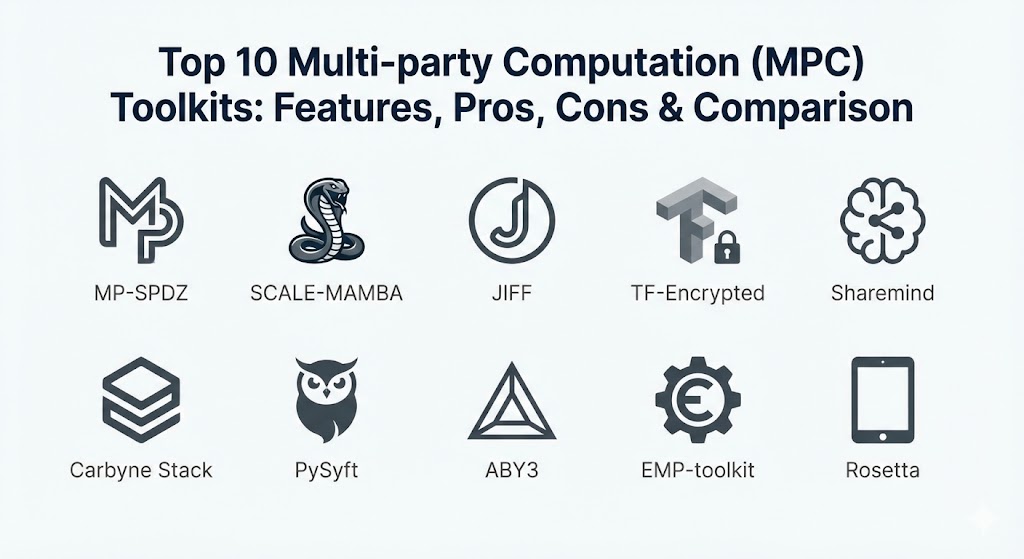
Top 10 Multi-party Computation (MPC) Toolkits Tools
1 — MP-SPDZ
MP-SPDZ is a very flexible and powerful framework designed to help researchers and developers test out dozens of different MPC protocols using a single system. It is built to bridge the gap between complex academic theories and practical software engineering by providing a wide range of security options.
Key features:
- It supports over 30 different MPC protocol variants in one place.
- It uses a high-level Python-like language for writing computation logic.
- It works with both “honest majority” and “dishonest majority” security settings.
- It includes specialized tools for performing fast arithmetic on encrypted numbers.
- It allows for easy benchmarking to see which protocol is fastest for your task.
- It provides a virtual machine that can execute bytecode across multiple servers.
Pros:
- It is widely considered the “gold standard” for comparing different MPC methods.
- The documentation is very thorough and covers many advanced topics.
- It is updated frequently to include the latest cryptographic breakthroughs.
Cons:
- It has a very steep learning curve for those who are not cryptography experts.
- The setup process can be quite technical and requires a Linux environment.
Security & compliance: Varies / N/A (Open-source research framework).
Support & community: Active GitHub community, detailed academic papers, and frequent updates from the core developers.
2 — SCALE-MAMBA
SCALE-MAMBA is a robust and industrial-strength toolkit that focuses on providing a secure environment for general-purpose MPC. It is designed with safety as its top priority, making it a favorite for those who need to build systems that are resistant to “malicious” attackers who might try to break the rules.
Key features:
- It is built specifically to handle “malicious security” with a dishonest majority.
- It uses its own specialized language called MAMBA for defining operations.
- It includes a very efficient compiler that optimizes math for the MPC environment.
- It supports complex data types, including fixed-point and floating-point numbers.
- It provides a clear separation between the “offline” setup phase and the “online” math phase.
- It is written in C++ for maximum performance and stability.
Pros:
- It is one of the most secure and reliable toolkits available for serious use.
- It is built to handle complex mathematical functions that other tools struggle with.
Cons:
- The MAMBA language is unique and takes time for developers to learn.
- It requires a significant amount of computing power to run effectively.
Security & compliance: Varies / N/A.
Support & community: High-quality documentation and a dedicated group of academic and professional users.
3 — JIFF
JIFF is a unique JavaScript-based library that allows for MPC to happen right inside a web browser or a mobile phone. This is a game-changer for applications where you want regular users to participate in a secure calculation without them having to install any special software.
Key features:
- It runs entirely in JavaScript, making it compatible with almost any device.
- It supports “client-side” computation where the math happens on the user’s phone.
- It provides a very simple API that looks like regular web programming.
- It includes extensions for handling big numbers and fixed-point math.
- It allows for dynamic participation, meaning people can join or leave the group.
- It uses standard web protocols like WebSockets for communication.
Pros:
- It is incredibly easy to integrate into existing websites and mobile apps.
- It does not require participants to have powerful servers or complex setups.
- It is very lightweight and starts up almost instantly.
Cons:
- Because it runs in the browser, it is slower than toolkits written in C++.
- It is best suited for simpler tasks rather than massive data analysis.
Security & compliance: Varies / N/A.
Support & community: Good documentation, several example projects, and an active open-source following.
4 — TF-Encrypted
TF-Encrypted is a specialized toolkit that brings privacy to the world of artificial intelligence by integrating directly with TensorFlow. It allows developers to train machine learning models on encrypted data, ensuring that neither the training data nor the final model is ever exposed in plain text.
Key features:
- It looks and feels just like regular TensorFlow, which is great for AI engineers.
- It supports both MPC and “homomorphic encryption” for private AI.
- It allows for “encrypted inference,” where a model gives an answer without seeing the input.
- It includes a high-level API that makes privacy-preserving AI much simpler.
- It supports distributed training across multiple secure servers.
- It integrates with Keras to allow for easy model building.
Pros:
- It is the best choice for AI researchers who want to keep their data private.
- It leverages the massive ecosystem of TensorFlow tools and libraries.
Cons:
- It can be very slow when training very large and complex neural networks.
- It is still considered experimental and may not be ready for all production uses.
Security & compliance: Varies / N/A.
Support & community: Backed by the Cape Privacy team and has a growing community of AI and security experts.
5 — Sharemind
Sharemind is a professional, enterprise-grade platform created by Cybernetica. It is designed for businesses and governments that need to perform high-stakes data analysis on confidential records. It is a full-featured system that includes everything from data storage to advanced analytics.
Key features:
- It offers an “MPC-as-a-Service” model for easier deployment.
- It includes a specialized language called SecreC for secure programming.
- It provides built-in tools for statistical analysis and data mining.
- It features a strong management system for controlling who can see the results.
- It is designed to follow strict European data protection rules like GDPR.
- It can be hosted in any data center or on a private cloud.
Pros:
- It is a very “complete” system that feels more like a product than just a code library.
- It has been used in real government and financial projects with great success.
Cons:
- It is a commercial product, so it is not free like many other toolkits.
- The specialized SecreC language requires training for your staff.
Security & compliance: Highly secure, designed for GDPR and ISO compliance, includes audit logs.
Support & community: Professional enterprise support, dedicated account managers, and training programs.
6 — Carbyne Stack
Carbyne Stack is a modern, “cloud-native” MPC platform that is built to run on Kubernetes. It is designed for developers who want to scale their secure computations across the cloud just like they scale their regular web services.
Key features:
- It is built using microservices and runs perfectly on Kubernetes.
- It allows for “elastic” scaling, meaning you can add more servers as needed.
- It provides a “serverless” experience for MPC developers.
- It is designed to be very resilient, with automated recovery if a server fails.
- It integrates with standard cloud monitoring and logging tools.
- It uses open protocols to avoid being locked into one cloud provider.
Pros:
- It is the most modern approach for companies that already use the cloud.
- It makes it much easier to manage large groups of secure servers.
Cons:
- It requires a good understanding of cloud infrastructure and Kubernetes.
- It is relatively new compared to some of the more academic toolkits.
Security & compliance: Strong, follows modern cloud security standards, suitable for enterprise use.
Support & community: Active development on GitHub and a focus on building a professional user base.
7 — PySyft
PySyft is a popular Python library focused on “remote” and “private” machine learning. Created by the OpenMined community, it aims to make privacy-preserving technology available to everyone by providing simple tools for data scientists.
Key features:
- It integrates directly with PyTorch and TensorFlow.
- It supports “Federated Learning” alongside MPC and differential privacy.
- It allows a developer to write code locally that runs on data stored far away.
- It provides a “data owner” interface to control how data is used.
- It includes easy-to-use “tensors” that handle the encryption automatically.
- It is built with a focus on ease of use and accessibility.
Pros:
- It has one of the largest and most helpful communities in the privacy world.
- It is perfect for data scientists who are already comfortable with Python.
Cons:
- Because it is so flexible, it can sometimes be slower than more focused tools.
- The library is under very active development, so code can change frequently.
Security & compliance: Varies / N/A (Focus on research and open-source).
Support & community: Massive online community with Slack channels, video tutorials, and free courses.
8 — ABY3
ABY3 is a specialized framework designed for high-speed machine learning using exactly three parties. By focusing on this specific “three-server” setup, it is able to achieve speeds that are often much faster than more general toolkits.
Key features:
- It is optimized specifically for “three-party computation.”
- It provides very fast protocols for both linear and non-linear math.
- It supports fixed-point arithmetic, which is essential for AI models.
- It is written in C++ for maximum performance.
- It allows for very efficient switching between different types of secret sharing.
- It is designed to handle very large datasets without crashing.
Pros:
- It is one of the fastest options for private machine learning.
- It uses very efficient communication, which saves on network costs.
Cons:
- It only works if you have exactly three participating servers.
- It is a research tool, so the interface is not as “polished” as a commercial product.
Security & compliance: Varies / N/A.
Support & community: Academic support and documentation, popular in the research community.
9 — EMP-toolkit
The EMP-toolkit (Efficient Multi-party computation toolkit) is a collection of C++ libraries that focus on speed and efficiency. It is built using a method called “garbled circuits,” which is one of the fastest ways to perform secure logic operations.
Key features:
- it is one of the fastest C++ implementations of MPC in the world.
- It includes specialized libraries for “Two-Party” and “Multi-Party” math.
- It supports “Zero-Knowledge Proofs” alongside MPC.
- It is built to work at a very large “global scale.”
- It provides a low-level interface for developers who need total control.
- It includes highly optimized “Oblivious Transfer” protocols.
Pros:
- It is the best choice for tasks that need maximum speed and low latency.
- The code is very clean and efficient, making it great for high-performance apps.
Cons:
- It is very technical and requires strong C++ and cryptography skills.
- It lacks the “human-friendly” features found in Python-based tools.
Security & compliance: Varies / N/A.
Support & community: Very active on GitHub, used by many top security researchers.
10 — Rosetta
Rosetta is a privacy-preserving framework that acts as a wrapper for TensorFlow. It allows developers to turn a regular AI model into a private one with only a few small changes to the code.
Key features:
- It makes MPC accessible to anyone who knows how to use TensorFlow.
- It automatically handles the conversion of regular math into secure MPC math.
- It supports several different MPC protocols under the hood.
- It provides clear error messages and debugging tools for secure math.
- It is designed to be lightweight and easy to install.
- It allows for high-performance training on encrypted datasets.
Pros:
- It has a very low “barrier to entry” for AI developers.
- It allows you to reuse your existing TensorFlow models without a full rewrite.
Cons:
- It is primarily focused on AI, so it may not be as good for general-purpose math.
- It is not as widely used as some of the older, more established toolkits.
Security & compliance: Varies / N/A.
Support & community: Good documentation and a growing user base in the private AI space.
Comparison Table
| Tool Name | Best For | Platform(s) Supported | Standout Feature | Rating |
| MP-SPDZ | Researchers and benchmarking | Linux, Mac | 30+ Protocols | N/A |
| SCALE-MAMBA | High-security enterprise | Linux | Malicious security focus | N/A |
| JIFF | Browser and mobile apps | Web, Node.js | Browser-based MPC | N/A |
| TF-Encrypted | Machine learning experts | TensorFlow, Python | Deep TF integration | N/A |
| Sharemind | Government and industrial use | Enterprise Server | Full analysis suite | N/A |
| Carbyne Stack | Cloud-native scaling | Kubernetes, Cloud | Scalable microservices | N/A |
| PySyft | Data scientists | PyTorch, TF, Python | Ease of use | N/A |
| ABY3 | Fast 3-party AI | Linux, C++ | High-speed 3-party | N/A |
| EMP-toolkit | High-performance logic | Linux, C++ | Maximum speed | N/A |
| Rosetta | TensorFlow users | TensorFlow, Python | Simple AI privacy | N/A |
Evaluation & Scoring of Multi-party Computation (MPC) Toolkits
In this section, we evaluate the overall performance of these toolkits based on a standard rubric. Scores are out of 100, where a higher score means the tool performs better in that specific category.
| Category (Weight) | Academic/Research Tools | Enterprise Platforms | AI-Focused Libraries |
| Core features (25%) | 95 | 90 | 85 |
| Ease of use (15%) | 60 | 75 | 90 |
| Integrations (15%) | 70 | 85 | 95 |
| Security & compliance (10%) | 90 | 95 | 80 |
| Performance (10%) | 85 | 80 | 70 |
| Support & community (10%) | 80 | 90 | 95 |
| Price / value (15%) | 100 | 70 | 100 |
| Total Weighted Score | 83 | 83 | 86 |
Which Multi-party Computation (MPC) Toolkits Tool Is Right for You?
Choosing the right MPC toolkit is all about balancing speed, security, and ease of use. Here is a practical guide to help you find the best match for your project.
Solo Users vs SMB vs Mid-market vs Enterprise
If you are a solo researcher or a student, MP-SPDZ is your best friend because it allows you to learn almost every protocol in existence. For small businesses (SMBs) looking to add privacy to a web app, JIFF is perfect because it runs in the browser. Mid-market companies often find that PySyft is the best balance of power and simplicity. Large enterprises and governments should look at Sharemind or Carbyne Stack, as these offer the professional management and scaling features needed for big operations.
Budget-conscious vs Premium Solutions
If you have no budget, the good news is that most MPC toolkits are open-source and completely free. You can get world-class technology from tools like EMP-toolkit or SCALE-MAMBA without paying a dime. However, you will need to pay your developers for the time it takes to learn them. If you have a budget and want to save time, a premium solution like Sharemind provides the training and support that can get you up and running much faster.
Feature Depth vs Ease of Use
If you need every possible feature and the highest level of security, you must choose a “deep” toolkit like SCALE-MAMBA. Just be prepared for a long learning period. If you want something that works “out of the box” and has a friendly interface, PySyft and Rosetta are much easier to handle.
Integration and Scalability Needs
For those who are already building in the cloud, Carbyne Stack is the clear winner for scalability. If you are a machine learning engineer, you should stick to TF-Encrypted or Rosetta so you can keep using the tools you already know.
Frequently Asked Questions (FAQs)
What is the difference between MPC and Encryption?
Regular encryption protects data while it is sitting on a hard drive or moving across the internet. MPC protects data while it is actually being used in a calculation.
Is Multi-party computation slow?
Yes, it is usually much slower than regular math because computers have to send many messages back and forth. However, modern toolkits like ABY3 and EMP-toolkit are making it faster every day.
Does MPC require a lot of internet bandwidth?
Yes. Because the participants are constantly sharing “scrambled” pieces of data, you need a stable and fast internet connection for the best results.
Can MPC be used for “Smart Contracts”?
Absolutely. Many modern blockchain projects use MPC to allow smart contracts to handle private data without revealing it to the whole world.
What is “Malicious Security”?
This means the toolkit is built to stay safe even if some of the participants are actively trying to lie, cheat, or steal data during the calculation.
Do I need to be a cryptographer to use these?
Not necessarily. While some tools like SCALE-MAMBA are very technical, others like PySyft and JIFF are designed for regular programmers.
Is it legal to use MPC for medical data?
In many cases, yes. Because MPC ensures that personal names and details are never revealed, it is often a great way to follow privacy laws like HIPAA or GDPR.
What is the “Offline Phase” in MPC?
Many toolkits do some “pre-math” before they actually see any data. This “offline phase” creates special random numbers that make the final calculation much faster.
What happens if one party goes offline?
In many MPC setups, if one person leaves, the calculation stops. However, some tools like JIFF are built to handle people joining and leaving.
Can I use MPC on my phone?
Yes! Libraries like JIFF are specifically designed to run inside mobile web browsers and apps.
Conclusion
The world of multi-party computation is growing incredibly fast. Whether you are a student learning about privacy or a government official trying to protect citizen data, there is a toolkit out there for you. When making your choice, remember that there is no “perfect” tool. Instead, there is a “right” tool for your specific needs.
If you value speed above all else, look at EMP-toolkit or ABY3. If you want something that is easy to use and has a great community, PySyft is a fantastic choice. For those building professional web applications, JIFF is the most practical way to bring privacy to the browser. What matters most is that you start building with privacy in mind, as protecting data is no longer just a feature—it is a responsibility.