Introduction
Influencer affiliate platforms are special tools that connect brands with creative people on social media to help sell products. These platforms act as a middleman, giving influencers unique links or codes that they can share with their followers. When a follower clicks that link and buys something, the platform tracks the sale and makes sure the influencer gets paid a small piece of the money as a reward. This way of working is very different from just paying someone to post a picture; it is based on real results. These tools bring together everything a brand needs, from finding the right people to talk to, to sending out payments automatically every month.
These platforms are very important because they take the guesswork out of marketing. Instead of hoping a social media post helps the business, a brand can see exactly how many people bought a product because of a specific person. It helps businesses spend their money wisely and helps influencers earn a fair living based on how much they actually help the brand. Real-world use cases include a fashion brand working with hundreds of style bloggers for a big sale, or a tech company giving review channels a way to earn money when their fans buy new gadgets. When choosing a tool, you should look for how accurate the tracking is, how easy it is for everyone to use, and if it can handle paying a lot of people at the same time without making mistakes.
Best for:
These tools are best for marketing managers, small business owners, and social media teams who want to grow their sales through word-of-mouth. They are perfect for companies in the fashion, beauty, health, and technology industries where people often look for recommendations before buying. Both small startups and very large global companies benefit from having a clear way to track their partnerships and manage their money.
Not ideal for:
These platforms are not ideal for businesses that only have one or two partners and can track everything in a simple spreadsheet. They might also be too much for companies that sell very expensive products that people only buy once every ten years, like houses or heavy factory machines. If you do not have a budget to pay for a monthly software fee, you might be better off starting with simple, free tools first.
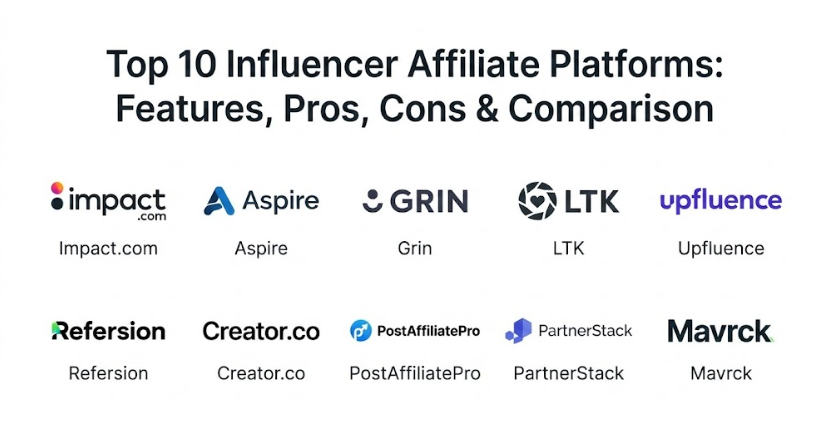
Top 10 Influencer Affiliate Platforms Tools
1 — Impact.com
Impact.com is a very large and powerful platform that helps businesses manage all kinds of partnerships in one place. It is built for companies that want to grow very fast and work with thousands of different influencers across many countries. The software is designed to handle every step, from finding new partners to checking if their posts follow the rules and making sure everyone gets paid on time. It is a professional tool that focuses on giving you deep data so you can see exactly which partnerships are worth your time and money.
- Key features:
- A huge marketplace where you can find and talk to millions of influencers.
- Automated tracking that works across websites and mobile apps perfectly.
- Tools to spot and stop people who are trying to cheat the system.
- Flexible payment options that can pay influencers in many different currencies.
- Clear reports that show you the path a customer took before buying.
- Contract management that lets you set different rules for every partner.
- Automated emails to keep your partners updated on new deals and products.
- Pros:
- It can handle massive amounts of data and thousands of partners without slowing down.
- The tracking is very deep, showing you exactly how much money each person is making for you.
- Cons:
- Because it has so many features, it can take a long time to learn how to use it all.
- The cost can be quite high, which makes it a better fit for bigger businesses.
- Security & compliance: SOC 2 compliant; uses high-level encryption for all data; strictly follows GDPR rules for privacy; offers SSO for safe team logins.
- Support & community: Offers a very detailed help center, video training through an academy, and dedicated support for large enterprise clients.
2 — Aspire
Aspire is a platform that focuses on building long-term relationships rather than just one-time sales. It is designed to be a “content-first” tool, meaning it helps brands find influencers who already love their products and create great videos or photos. The software is very easy to look at and use, making it a favorite for beauty and lifestyle brands that care a lot about how their images look. It helps teams manage the creative side of things, like sending out free products and approving posts, while still tracking every sale through affiliate links.
- Key features:
- An image-search tool that finds influencers who match your brand’s style.
- A central place to manage all your messages and emails with partners.
- Tools to track when influencers post and if they used the right tags.
- Automated product shipping to get your items into the hands of creators.
- Customizable landing pages that influencers can share with their fans.
- Sales tracking that connects directly to your online shop.
- A dashboard that shows how much your total content is worth in real money.
- Pros:
- The interface is very modern and simple, so your team will enjoy using it every day.
- It is excellent at helping you manage the actual physical products you send to influencers.
- Cons:
- It might not have as many technical affiliate tools as some of the more data-heavy platforms.
- The pricing is often hidden and can be expensive for very small teams.
- Security & compliance: GDPR compliant; uses secure data centers; offers audit logs to see who on your team made changes; encrypted transmissions.
- Support & community: Features a helpful blog, regular webinars, and a fast customer support team that answers questions quickly.
3 — Grin
Grin is famous for being a “CRM” for influencers, which means it acts like a giant address book that tracks every interaction. It is designed for brands that want to own their relationships directly without a middleman taking a cut of the money. Grin connects to your email, your online shop, and your shipping tools so that everything happens in one place. It is built to be “invisible” to the influencer, so they just feel like they are talking to a person at your brand, while the software tracks all their sales and clicks in the background.
- Key features:
- Direct integration with major email providers like Gmail and Outlook.
- Automated product seeding that tracks the package from your warehouse to the influencer.
- Content harvesting that automatically saves every photo or video an influencer posts about you.
- A powerful search tool with filters for location, follower count, and interest.
- Real-time sales tracking that shows you the exact ROI for every partner.
- Tools to manage and pay influencers in their own currency.
- A simple way to create and send out legal contracts and tax forms.
- Pros:
- It makes your brand look very professional because you talk to influencers directly.
- The way it saves your influencers’ content automatically saves your team hours of work.
- Cons:
- It is primarily built for e-commerce brands, so it might not work for other types of businesses.
- You need to have a clear plan in place because the tool offers a lot of freedom.
- Security & compliance: SOC 2 compliant; follows all major data privacy laws; provides secure access controls; encrypted data storage.
- Support & community: Offers a dedicated account manager for most plans and a very high-quality knowledge base for self-learning.
4 — LTK (LikeToKnow.it)
LTK is a very special platform that is built specifically for fashion, home, and beauty influencers who use high-quality photos to sell products. It is both a tool for brands and a popular app where millions of people go to shop for things they see on social media. For a brand, being on LTK means your products are being shown to a huge audience of people who are already in a “buying mood.” It is a closed system, meaning they pick the influencers carefully to make sure the quality stays very high, which is great for luxury or trendy brands.
- Key features:
- Access to a private network of high-quality lifestyle and fashion creators.
- A dedicated shopping app where fans can find and buy products easily.
- Automated tracking for “swipe-up” links and social media posts.
- Tools to see which specific items are trending and selling the best.
- Historical data that shows you which influencers have the most loyal fans.
- End-to-end management from the first contact to the final payment.
- Global reach with support for many international brands and stores.
- Pros:
- It gives your brand access to a very large and active community of shoppers.
- The data they provide on fashion and beauty trends is some of the best in the world.
- Cons:
- It is a closed network, so you cannot bring in just any influencer you want.
- It is not a good fit for brands that don’t sell visual products like clothes or makeup.
- Security & compliance: GDPR and CCPA compliant; uses industry-standard encryption; secure payment processing for all creators.
- Support & community: Provides a lot of data-driven advice to brands and has a very strong community of professional creators.
5 — Upfluence
Upfluence is a smart platform that helps you find influencers within your own customer list. It is designed for businesses that want to find people who are already buying their products and have a good following on social media. The software scans your database and tells you which of your customers could be great partners for an affiliate program. This makes your marketing feel much more real because the people talking about you are already your fans. It also includes all the standard tools for tracking sales, managing campaigns, and paying your partners.
- Key features:
- A tool that scans your website and customer list to find “hidden” influencers.
- A massive database of millions of social media profiles with deep search filters.
- Chrome extension that lets you see an influencer’s data while browsing their profile.
- Automated campaign management that handles everything from invites to post-approvals.
- Real-time tracking of sales, clicks, and how much people are talking about you.
- Integration with major online store platforms like Shopify and WooCommerce.
- A central place to manage all payments and see your total spending.
- Pros:
- Finding influencers among your own customers leads to much better sales and trust.
- The Chrome extension is a huge time-saver for teams who spend a lot of time on social media.
- Cons:
- The search database can sometimes feel a bit overwhelming because there are so many profiles.
- The email tools are good but might not be as deep as a dedicated email platform.
- Security & compliance: GDPR compliant; uses secure data transmission; offers audit trails; follows modern security best practices.
- Support & community: Offers live training sessions, a helpful blog, and a responsive customer support team via email and chat.
6 — Refersion
Refersion is a simple and effective affiliate tracking tool that is built mainly for businesses that use Shopify or other big online store systems. It is designed to be very easy to set up so you can start an influencer program in just one afternoon. Instead of having a lot of “fancy” search tools, it focuses on the core job: giving influencers links and codes and tracking their sales accurately. It is a great choice for small to mid-sized businesses that already have influencers they want to work with and just need a reliable way to manage the money side of things.
- Key features:
- A very fast and simple setup that connects directly to your online shop.
- A customizable “affiliate portal” where influencers can sign up and see their earnings.
- Automated tracking for both links and discount codes.
- Tools to set up different commission rates for different products or people.
- Automated payment options to pay your partners through PayPal or other ways.
- A dashboard that shows your most successful partners and products.
- Simple reporting that you can share with your team or board.
- Pros:
- It is very affordable compared to the “all-in-one” influencer platforms.
- The focus on the “money and tracking” side makes it very reliable and easy to understand.
- Cons:
- It does not have a large database to help you find new influencers.
- The design is very functional and might not feel as “modern” as other tools.
- Security & compliance: PCI compliant for payments; follows data privacy standards; secure cloud hosting; standard encryption.
- Support & community: Provides a clear knowledge base, helpful onboarding guides, and good email support for all users.
7 — Creator.co
Creator.co is a platform that focuses on helping smaller “micro-influencers” work with brands. It is designed to be an automated system where the brand sets the rules and the influencers come to them. This is a great choice for businesses that want to work with a large number of people at the same time without having to talk to everyone individually. The platform handles the matching, the tracking, and the payments, making it a very “hands-off” way to run an affiliate program. It is built to help small brands get a lot of social media coverage very quickly.
- Key features:
- An automated system that matches your brand with influencers who fit your needs.
- A dashboard where you can see all your active campaigns and their results.
- Tools for influencers to apply to your program directly.
- Integrated sales tracking that shows you the exact ROI for every post.
- Automated product fulfillment to send items to your new partners.
- Deep data on influencer audiences to make sure they are real people.
- A simple payment system that handles all the paperwork for you.
- Pros:
- It is an excellent way to get a lot of people talking about you without much manual work.
- The pricing is very fair and transparent for smaller businesses.
- Cons:
- You have less control over the specific relationship compared to a CRM tool.
- It is focused mostly on Instagram and TikTok, so it might not work for other platforms.
- Security & compliance: GDPR compliant; uses secure payment partners; follows standard data safety rules; encrypted data storage.
- Support & community: Offers a helpful help center and personal support to help you set up your first campaign.
8 — PostAffiliatePro
PostAffiliatePro is a very technical and deep tracking tool that has been around for a long time. It is designed for businesses that want to build a very complex and large affiliate program with many different layers. While it is not strictly for “influencers,” it is one of the most powerful ways to track sales from any person who shares your brand. It offers a massive amount of customization, allowing you to set up very specific rules for how and when people get paid. It is a “workhorse” tool that is built to handle millions of clicks and thousands of sales every single day.
- Key features:
- Over 200 different integrations with payment and store systems.
- Support for “multi-tier” programs where influencers can earn money from people they recruit.
- Highly customizable tracking links and banners for your partners to use.
- Advanced fraud detection to make sure every sale is real.
- A private portal for your partners that you can design to look like your brand.
- Automated commissions that can change based on the volume of sales.
- Multilingual support for businesses that work in many different countries.
- Pros:
- It is one of the most powerful and flexible tracking systems on the market.
- The cost is very reasonable for the huge number of features you get.
- Cons:
- The interface is quite old and can be very difficult for a beginner to set up.
- It does not help you find influencers; you must bring your own partners to the tool.
- Security & compliance: PCI compliant; offers secure data storage; customizable access levels for your team; encrypted transmissions.
- Support & community: Provides 24/7 customer support, a massive library of video tutorials, and a very detailed forum.
9 — PartnerStack
PartnerStack is a platform that is built specifically for software and technology companies. It is designed to help brands manage not just influencers, but also marketing agencies and other business partners. The software focuses on the “B2B” world, where sales cycles are longer and more complex. It provides a very clean and professional experience for your partners, making it easy for them to find your marketing materials and see their pending payments. It is a great choice for a tech company that wants to grow its sales through a professional network of experts and creators.
- Key features:
- A marketplace of thousands of partners who specialize in the technology world.
- Automated commission tracking that handles complex “subscription” payments.
- A clean portal for partners to access training and marketing assets.
- Automated email campaigns to keep your partners excited and informed.
- Detailed reporting that shows you which channels are your most profitable.
- Integration with major sales tools like Salesforce and HubSpot.
- Automated tax compliance and payment processing for partners globally.
- Pros:
- It is the best tool for technology companies because it understands subscription sales.
- The interface is very polished and makes your brand look very professional to partners.
- Cons:
- It is not a good fit for brands that sell physical products like clothes or food.
- The setup can be a bit more complex because it connects to deep business tools.
- Security & compliance: SOC 2 Type II compliant; GDPR and CCPA compliant; features advanced encryption and SSO for security.
- Support & community: Offers a dedicated success manager, a deep help center, and regular “partner growth” webinars.
10 — Mavrck
Mavrck is an enterprise platform that is designed to help very large brands manage their influencer marketing at scale. It uses a “full-lifecycle” approach, meaning it helps with everything from the first search to the final payment and everything in between. The software is built to be a central system for large marketing teams who need to stay organized and follow strict rules. It includes a very powerful search engine that uses a lot of data to find the perfect influencers for your specific brand. It is a heavy-duty tool for companies that take influencer marketing very seriously.
- Key features:
- A massive database of millions of influencers with deep audience data.
- Automated campaign workflows that handle thousands of people at once.
- Tools to manage and approve the creative content before it goes live.
- Integrated sales tracking that connects to your online and offline sales.
- A central place to manage all your contracts and legal documents.
- Detailed reporting on your brand’s total “social reach” and ROI.
- Automated payments and tax forms for thousands of creators globally.
- Pros:
- It provides an incredible amount of data to help you make very smart decisions.
- The automation can save a large marketing team hundreds of hours every month.
- Cons:
- It is very expensive and is only really suitable for very large companies.
- The system is so big that it requires a lot of training to use effectively.
- Security & compliance: SOC 2 compliant; follows all major global privacy laws; offers secure SSO and audit logs; encrypted storage.
- Support & community: Provides a dedicated account team, high-level strategic consulting, and a very professional help center.
Comparison Table
| Tool Name | Best For | Platform(s) Supported | Standout Feature | Rating |
| Impact.com | Fast-growing brands | Web / Cloud | Deep tracking data | 4.8 / 5 |
| Aspire | Lifestyle brands | Web / Mobile | Product shipping tools | 4.6 / 5 |
| Grin | E-commerce CRM | Web / Cloud | Content harvesting | 4.7 / 5 |
| LTK | Fashion & Beauty | Web / Mobile App | Dedicated shopper app | 4.5 / 5 |
| Upfluence | Customer-first brands | Web / Chrome | Customer scanning tool | 4.4 / 5 |
| Refersion | Simple Shopify stores | Web / Shopify | Easy affiliate portal | 4.3 / 5 |
| Creator.co | Micro-influencers | Web / Social | Automated matching | 4.2 / 5 |
| PostAffiliatePro | Technical tracking | Web / Desktop | 200+ integrations | 4.5 / 5 |
| PartnerStack | Tech & Software | Web / Cloud | B2B partner network | 4.7 / 5 |
| Mavrck | Global enterprises | Web / Enterprise | Full-lifecycle management | 4.6 / 5 |
Evaluation & Scoring of Influencer Affiliate Platforms
To help you compare these tools fairly, we have evaluated them using a weighted scoring model based on what professional marketing teams care about most.
| Evaluation Category | Weight | What We Looked For |
| Core Features | 25% | Search tools, sales tracking, and payment automation. |
| Ease of Use | 15% | How simple the dashboard is for your team and the influencers. |
| Integrations | 15% | How well it talks to Shopify, email, and your bank. |
| Security & Compliance | 10% | Data safety, GDPR rules, and secure team logins. |
| Performance | 10% | Speed of the website and accuracy of the tracking. |
| Support & Community | 10% | Quality of the help articles and speed of the support team. |
| Price / Value | 15% | Whether the monthly cost is worth the time it saves you. |
Which Influencer Affiliate Platforms Tool Is Right for You?
Choosing a tool is all about knowing your budget and how many influencers you want to work with.
- Solo Users & Small Businesses: If you are just starting and have a few partners, Refersion or Creator.co are great choices. They are affordable and focus on the basics of tracking sales and making sure people get paid without making it too complicated.
- Mid-Market Brands: If you are growing fast and want to build a real community, Aspire or Upfluence are perfect. They give you the tools to find new people and manage the creative side of your partnerships while still providing strong data on your sales.
- Enterprise & Global Brands: For very large companies that work with thousands of people, you need Impact.com, Grin, or Mavrck. These tools are built to handle massive amounts of work and provide the deep data your board of directors will want to see.
- Budget-Conscious vs. Premium: If you want to keep costs low, look for tools that charge based on your sales. If you have a larger budget and want to save time, a premium tool with a lot of automation is worth the investment.
- Feature Depth vs. Ease of Use: Do you need a lot of technical tracking and custom rules? Then PostAffiliatePro is the winner. Do you want something your team will actually enjoy using because it looks great? Then Aspire or Grin are better picks.
Frequently Asked Questions (FAQs)
1. What exactly is an influencer affiliate platform?
It is a piece of software that helps brands work with social media creators. It gives influencers special links to share with their fans and tracks when those fans buy products so the influencer can get a commission.
2. How do these platforms track sales accurately?
They use “cookies” or unique codes. When a fan clicks a link, the platform remembers who sent them there. If they buy something within a few days, the platform knows exactly which influencer to reward.
3. Is it expensive to use these tools?
It varies. Some tools for small businesses cost about fifty dollars a month, while big enterprise tools can cost thousands of dollars every month. Most tools pay for themselves by saving you time and increasing your sales.
4. Can I use these tools if I don’t have a Shopify store?
Yes, almost all of these tools work with other store systems like WooCommerce, BigCommerce, or even custom-built websites. You just need to check the “integrations” list for the tool you pick.
5. How do influencers get paid through the platform?
Most platforms connect to PayPal or your bank. You just have to put money into the system, and it automatically sends the right amount to each influencer every month based on their sales.
6. Do I need a legal contract for every influencer?
Yes, it is very important. Most of these platforms have contract templates built-in that you can send to influencers to sign digitally before they start working with you.
7. Can these tools help me find new influencers?
Yes, many of them have giant databases where you can search for influencers by their location, what they talk about, and who their fans are. This saves you days of searching on social media.
8. Is my data safe on these platforms?
Yes, professional tools use high-level encryption and follow strict privacy laws like GDPR. They are built to keep your brand’s information and your influencers’ data very safe.
9. Can I track more than just sales, like how many people saw a post?
Yes, most platforms show you “impressions,” which is how many times a post was seen, as well as “engagements” like likes and comments, giving you a full picture of your marketing.
10. What happens if an influencer tries to cheat?
Most of these tools have “fraud detection” built-in. They can see if someone is using fake clicks or “bots” to try and earn more money and will flag those sales so you don’t have to pay for them.
Conclusion
Finding the right influencer affiliate platform is one of the best ways to grow your business in the modern world. These tools do much more than just track links; they help you build a professional and trustworthy relationship with the people who talk about your brand online. By moving away from manual work and toward a smart, automated system, you are ensuring that your marketing is based on real results and that your money is being spent wisely. Whether you need a simple tool to manage a few friends or a massive system to run a global empire, there is a solution on this list that will fit your mission perfectly.
The best tool for you is the one that makes your team’s life easier and makes your influencers feel valued and professional. Always take the time to look at your budget, your goals, and how many people you plan to work with before making a final choice. Remember that the goal is to spend less time on paperwork and more time building a brand that people love. A great platform is like a quiet partner that handles all the difficult parts of your business, helping you grow with confidence. By choosing the right platform today, you are setting your brand up for long-term success in the exciting world of influencer marketing.