Introduction
An Industrial IoT Analytics Platform is a specialized software suite designed to collect, process, and analyze data from industrial assets like turbines, manufacturing robots, and sensors. Unlike general-purpose business intelligence tools, IIoT platforms are built to handle “time-series” data—continuous streams of information coming from thousands of points at high speeds. These platforms use advanced algorithms and machine learning to identify patterns, monitor equipment health, and provide a digital representation of physical assets, often called a “Digital Twin.”
Why It Is Important
Efficiency is the lifeblood of manufacturing. Even a single hour of unplanned downtime in a high-volume factory can cost hundreds of thousands of dollars. IIoT analytics platforms are vital because they move maintenance from a “reactive” model (fixing things when they break) to a “predictive” model (fixing things because the data shows they are about to break). They also help in reducing energy consumption, improving product quality through tighter process control, and ensuring worker safety by monitoring environmental conditions.
Key Real-World Use Cases
- Predictive Maintenance: Analyzing vibration and temperature data to predict when a motor bearing will fail.
- Asset Performance Management (APM): Comparing the performance of identical machines across different global factories to find the most efficient settings.
- Supply Chain Optimization: Tracking raw materials through the production line to reduce waste and bottlenecks.
- Energy Management: Monitoring power-hungry equipment to identify peak usage times and reduce utility costs.
What to Look For
When choosing a platform, the primary evaluation criteria should be edge-to-cloud connectivity. The platform must be able to talk to old, “legacy” machines as easily as new ones. You should also look for “No-Code” analytics capabilities so that plant floor engineers—not just data scientists—can create their own dashboards. Finally, ensure the platform has a robust security framework to protect your proprietary manufacturing data from external threats.
Best for: Large-scale manufacturing plants, energy utilities, oil and gas companies, and logistics providers who operate a vast fleet of expensive physical assets and need deep operational visibility.
Not ideal for: Small service-based businesses or companies that do not own significant physical machinery, as the complexity of setup and the cost of sensor hardware would not provide a sufficient return on investment.
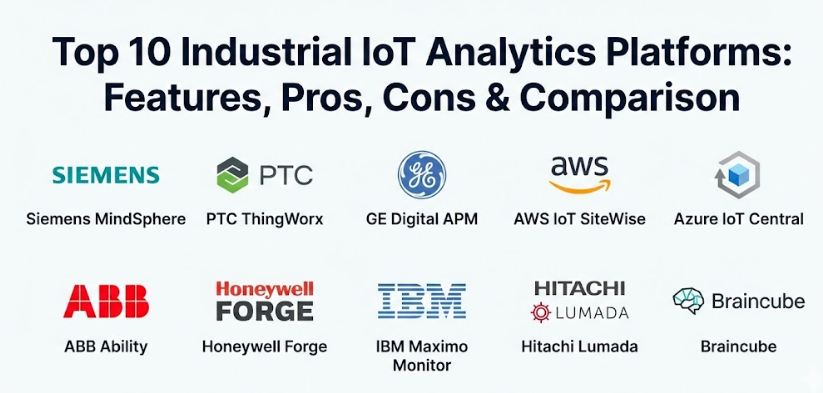
Top 10 Industrial IoT Analytics Platforms Tools
1 — Siemens MindSphere
MindSphere is a leading industrial IoT as-a-service solution from Siemens. It is designed to connect real-world machines and physical infrastructure to the digital world, providing powerful data analytics and AI capabilities to improve operational efficiency.
- Key features:
- Open PaaS (Platform as a Service) for developing custom industrial apps.
- Deep integration with Siemens hardware and automation tools.
- Advanced Digital Twin capabilities for simulation.
- Native connectivity to a wide range of industrial protocols (OPC UA, S7).
- Built-in machine learning tools for anomaly detection.
- Extensive marketplace of third-party industrial applications.
- Pros:
- Extremely strong for users already invested in the Siemens ecosystem.
- Handles massive volumes of high-frequency industrial data with ease.
- Cons:
- Can be complex to set up for non-Siemens hardware.
- The pricing structure can be confusing for smaller deployments.
- Security & compliance: ISO 27001, SOC 2, GDPR, and robust data encryption.
- Support & community: Extensive documentation, global partner network, and dedicated enterprise support.
2 — PTC ThingWorx
ThingWorx is specifically built for the rapid development of IIoT applications. It is famous for its “No-Code” environment, which allows industrial companies to build complex dashboards and analytics workflows without needing a team of software developers.
- Key features:
- Drag-and-drop mashup builder for creating custom UIs.
- ThingModel framework for organizing assets logically.
- Seamless integration with Vuforia for Augmented Reality (AR) experiences.
- Automated machine learning specifically for time-series data.
- Edge-to-cloud connectivity via Kepware.
- Pre-built accelerators for common use cases like asset monitoring.
- Pros:
- One of the fastest platforms for moving from a pilot to full production.
- The AR integration provides a futuristic way for technicians to view data.
- Cons:
- Licensing costs can scale quickly as you add more “Things.”
- Advanced customization may eventually require JavaScript knowledge.
- Security & compliance: SOC 2, GDPR, and supports SSO and role-based access control.
- Support & community: Strong “PTC University” for training and an active developer community.
3 — GE Digital APM (formerly Predix)
GE Digital’s Asset Performance Management (APM) platform is built on decades of experience in heavy industry. It focuses on reducing risk and increasing the reliability of critical infrastructure like power plants and aircraft engines.
- Key features:
- Deep “Digital Twin” models for specific industrial components.
- Specialized modules for Reliability Centered Maintenance (RCM).
- Health and integrity monitoring for hazardous environments.
- Advanced vibration and thermal analysis tools.
- Integrated root cause analysis (RCA) workflows.
- Global fleet views for multi-site organizations.
- Pros:
- The depth of industrial domain knowledge is unmatched.
- Excellent for high-stakes environments where safety is the top priority.
- Cons:
- Can feel “heavy” and slow to move for agile, smaller manufacturers.
- Requires significant professional services for initial configuration.
- Security & compliance: ISO 27001, SOC 2, and specialized compliance for energy sectors.
- Support & community: High-touch enterprise support and deep industry-specific documentation.
4 — AWS IoT SiteWise
AWS IoT SiteWise is a managed service that makes it easy to collect, store, organize, and monitor data from industrial equipment at scale. It is designed for companies that want to build their IIoT strategy on top of the world’s largest cloud provider.
- Key features:
- SiteWise Edge for processing data locally before sending to the cloud.
- Pre-built library of common industrial mathematical functions.
- Integration with AWS Lambda for custom data processing logic.
- Seamless connection to Amazon S3 for long-term data “lakes.”
- Visual “Monitor” portals for plant-floor operators.
- Pay-as-you-go pricing model.
- Pros:
- Infinite scalability—it grows as your data grows.
- Very cost-effective for companies already using AWS.
- Cons:
- Lacks the “out-of-the-box” industrial templates found in Siemens or PTC.
- Requires more cloud architecture knowledge to set up.
- Security & compliance: SOC 1/2/3, ISO, GDPR, HIPAA, and AWS IAM security.
- Support & community: Massive AWS documentation and global developer ecosystem.
5 — Microsoft Azure IoT Central
Azure IoT Central is a highly polished “IoT Plug and Play” solution. It is designed to take the complexity out of IoT by providing a managed environment where users can connect devices and start seeing data in minutes.
- Key features:
- Pre-built app templates for retail, energy, and government.
- Integration with Power BI for advanced executive reporting.
- Rule-based alerts that trigger emails or automated workflows.
- Deep integration with Azure Digital Twins.
- Device bridge for connecting legacy hardware.
- Enterprise-grade management for thousands of devices.
- Pros:
- The most user-friendly interface among the “Big 3” cloud providers.
- Excellent integration with the Microsoft 365 ecosystem.
- Cons:
- Advanced users might find the managed environment too restrictive.
- Latency can be an issue if not using Azure IoT Edge properly.
- Security & compliance: Top-tier security, ISO, SOC, and HIPAA compliant.
- Support & community: Direct support via Azure and a wide network of Microsoft partners.
6 — ABB Ability
ABB Ability is a unified, cross-industry digital capability. It leverages ABB’s massive installed base of industrial robots and power grids to provide a platform that excels in process automation and electrification.
- Key features:
- Specialized solutions for marine, mining, and chemical industries.
- Condition monitoring for motors and bearings.
- Collaborative Operation Centers for remote assistance.
- Cybersecurity services specifically for industrial control systems.
- Optimization tools for large-scale power distribution.
- Advanced process control (APC) integration.
- Pros:
- Best-in-class for heavy electrical and robotic automation.
- Global reach with local support in almost every country.
- Cons:
- The platform can feel fragmented across different industry modules.
- Less focus on general discrete manufacturing than some rivals.
- Security & compliance: ISO 27001, GDPR, and deep industrial security protocols.
- Support & community: Professional field services and technical support.
7 — Honeywell Forge
Honeywell Forge is “Enterprise Performance Management” software that uses IIoT data to provide a top-down view of a company’s operations. It is particularly strong in the buildings, aerospace, and industrial sectors.
- Key features:
- Performance dashboards for executive-level visibility.
- Connected Life Safety for worker protection.
- Predictive maintenance for HVAC and mechanical systems.
- Cybersecurity monitoring for OT (Operational Technology) networks.
- Integrated supply chain and warehouse management.
- SaaS-based delivery for quick updates and scaling.
- Pros:
- Excellent for managing the “business” side of industrial operations.
- Strong focus on energy efficiency and sustainability reporting.
- Cons:
- Lacks some of the granular “developer” tools found in PTC or MindSphere.
- Highly targeted toward specific industries (Buildings, Aero).
- Security & compliance: SOC 2, ISO 27001, and GDPR.
- Support & community: Comprehensive enterprise training and account management.
8 — IBM Maximo Monitor
Maximo is a legendary name in asset management. Maximo Monitor is the IoT extension that allows companies to see the real-time health of their assets directly within their existing Maximo workflows.
- Key features:
- AI-driven anomaly detection to reduce false alarms.
- Seamless integration with Maximo Manage (EAM).
- Root cause analysis powered by IBM Watson.
- Visual inspection tools using computer vision.
- Remote monitoring dashboards for field technicians.
- Historical trend analysis for long-term reliability planning.
- Pros:
- The natural choice for any company already using IBM Maximo for work orders.
- Very strong at turning “data” into “work orders” automatically.
- Cons:
- The interface can feel heavy and a bit complex for new users.
- Requires a solid IBM data strategy to get the most value.
- Security & compliance: ISO 27001, SOC 2, and HIPAA ready.
- Support & community: Large global user groups and extensive IBM support.
9 — Hitachi Lumada
Hitachi Lumada focuses on the concept of “Social Innovation.” It combines industrial data with big data analytics to solve complex problems in transportation, energy, and smart cities.
- Key features:
- “Lumada Data Ops” for managing complex industrial data lakes.
- Edge intelligence for real-time decision making.
- Video analytics for safety and quality control.
- Collaborative co-creation process with Hitachi experts.
- Multi-cloud and on-premise deployment options.
- Digital Twin visualization for entire cities or factories.
- Pros:
- Excellent for large-scale, complex infrastructure projects.
- Very high degree of data engineering sophistication.
- Cons:
- Can feel more like a “consulting-led” solution than a plug-and-play tool.
- Marketing and documentation can be somewhat abstract.
- Security & compliance: SOC 2, ISO 27001, and GDPR compliant.
- Support & community: High-touch technical support and professional services.
10 — Braincube
Braincube is a niche player that focuses specifically on “Edge-to-Cloud” data processing for the manufacturing industry. It is known for its ability to clean and structure messy industrial data automatically.
- Key features:
- Automated data structuring and cleaning.
- Proprietary algorithms for finding “optimal” production settings.
- Simplified dashboards for plant floor operators.
- Integrated root cause analysis for quality issues.
- Quick-start apps for common industrial problems.
- Historical “replay” features to analyze past production runs.
- Pros:
- Very effective at handling the “dirty data” problem in older factories.
- Excellent ROI for specific process optimization tasks.
- Cons:
- Lacks the massive ecosystem of a Siemens or AWS.
- Smaller global support footprint.
- Security & compliance: SOC 2, GDPR, and secure data hosting.
- Support & community: Direct access to data experts and responsive email support.
Comparison Table
| Tool Name | Best For | Platform(s) Supported | Standout Feature | Rating (Gartner/Other) |
| Siemens MindSphere | Siemens-heavy factories | Cloud (AWS/Azure) | Massive industrial app store | 4.4 / 5 |
| PTC ThingWorx | Rapid App Development | Cloud / On-Prem | No-Code Mashup Builder | 4.5 / 5 |
| GE Digital APM | High-risk Infrastructure | Cloud / Hybrid | Deep industrial physics models | 4.1 / 5 |
| AWS SiteWise | Scalable Cloud Strategy | Cloud-native | Massive AWS ecosystem integration | 4.2 / 5 |
| Azure IoT Central | Microsoft-centric teams | Cloud-native | IoT Plug and Play simplicity | 4.3 / 5 |
| ABB Ability | Electrical / Robotics | Cloud / Edge | Specialized process automation | 4.0 / 5 |
| Honeywell Forge | Enterprise Performance | Cloud-based | Sustainability & ESG reporting | N/A |
| IBM Maximo Monitor | Maximo users | Cloud / Hybrid | AI-driven Work Order automation | 4.2 / 5 |
| Hitachi Lumada | Smart Cities / Big Data | Cloud / On-Prem | Complex Data Operations | N/A |
| Braincube | Process Optimization | Cloud / Edge | Automated data structuring | 4.6 / 5 |
Evaluation & Scoring of Industrial IoT Analytics Platforms
To help you compare these tools more objectively, we have evaluated them based on a weighted rubric that reflects the priorities of a modern industrial operation.
| Evaluation Category | Weight | Score (Avg) | Analysis |
| Core Features | 25% | 9 / 10 | Most tools are very mature in data collection and storage. |
| Ease of Use | 15% | 7 / 10 | Industrial software still has a reputation for being complex. |
| Integrations | 15% | 8 / 10 | Connectivity to legacy protocols is improving significantly. |
| Security & Compliance | 10% | 10 / 10 | Essential for protecting intellectual property. |
| Performance | 10% | 9 / 10 | Reliability and speed are critical for real-time analytics. |
| Support | 10% | 8 / 10 | Enterprise support is generally high quality but expensive. |
| Price / Value | 15% | 7 / 10 | High entry costs, but the potential ROI is massive. |
Which Industrial IoT Analytics Platform Tool Is Right for You?
Choosing the right platform is a major strategic decision. Your choice will depend on your existing hardware, your technical expertise, and your specific goals.
Solo Users vs SMB vs Enterprise
If you are a small manufacturer (SMB), look at Azure IoT Central or Braincube. They offer a lower barrier to entry and don’t require a fleet of data scientists to get started. Large Enterprises with thousands of assets should prioritize the scalability and power of Siemens MindSphere, PTC ThingWorx, or AWS SiteWise.
Budget-Conscious vs Premium Solutions
For budget-conscious teams, AWS SiteWise and Azure IoT Central are excellent because you only pay for what you use. Premium solutions like GE Digital or ABB Ability come with a higher upfront cost but provide industry-specific logic and specialized support that can prevent catastrophic failures.
Feature Depth vs Ease of Use
If you need Ease of Use to get your team onboarded quickly, PTC ThingWorx is the winner due to its drag-and-drop environment. If you need maximum Feature Depth for complex engineering simulations and digital twins, Siemens MindSphere and GE Digital offer the most advanced capabilities.
Integration and Scalability Needs
Always start by looking at your current shop floor. If your machines are 90% Siemens, MindSphere is the logical choice. If you are a Microsoft-heavy office and want your factory data to show up in Excel and Power BI seamlessly, Azure IoT Central is the best path forward.
Frequently Asked Questions (FAQs)
1. What is the difference between IoT and IIoT?
IoT usually refers to consumer devices like smart thermostats. IIoT (Industrial IoT) refers to high-stakes industrial environments where sensors monitor critical machinery like turbines and manufacturing lines.
2. Can I connect old machines that don’t have internet?
Yes. You can use “IoT Gateways” or devices like Kepware to bridge the gap between old mechanical protocols (like Modbus or Serial) and modern cloud platforms.
3. Is my factory data safe in the cloud?
Most providers use bank-level encryption and secure “edge” devices that filter data before it ever leaves the factory. However, some companies still prefer “Hybrid” models where sensitive data stays on-premise.
4. What is a Digital Twin?
It is a virtual representation of a physical asset. If you change a setting in the virtual model, the analytics engine can predict how the physical machine will react before you actually change it.
5. How long does implementation take?
A pilot project can be done in 4–8 weeks. A full-scale global rollout across multiple factories usually takes 12–24 months.
6. Do I need a data scientist to use these platforms?
Not necessarily. Many platforms like PTC ThingWorx and Azure IoT Central are designed for “Citizen Developers”—engineers who know the machines but aren’t experts in coding.
7. Can these tools help with energy savings?
Absolutely. By monitoring power usage patterns, IIoT platforms can identify “peak” loads and suggest times to run certain machines to take advantage of lower energy rates.
8. What is “Edge Computing” in IIoT?
It is when data is processed locally on the factory floor instead of being sent to a distant cloud server. This is essential for actions that need to happen in milliseconds (like an emergency stop).
9. Will this replace my existing SCADA system?
Usually, no. IIoT platforms work with SCADA. SCADA is for real-time control (opening a valve), while IIoT is for long-term analytics and optimization.
10. What is the biggest challenge in IIoT?
The “Dirty Data” problem. Industrial environments are messy, and sensors can fail or report incorrect data due to heat or vibration. Choosing a platform that can “clean” this data is vital.
Conclusion
The shift toward a data-driven factory floor is no longer a luxury—it is a requirement for survival in a global market. A high-quality Industrial IoT Analytics Platform turns your machinery from a passive expense into an active source of competitive advantage.
As we have seen, the “best” platform depends on whether you value the “No-Code” speed of PTC ThingWorx, the industrial depth of Siemens, or the cloud scalability of AWS and Azure. Before committing to a multi-year contract, run a small pilot project on a single critical machine. Seeing the real-time data flow and the first “predictive” alert will do more to prove the value than any brochure ever could.