Introduction
Identity resolution is the technical process of connecting these fragmented data points to a single, persistent individual or household profile. An Identity Resolution Platform acts as the “connective tissue” of a modern data stack, stitching together disparate identifiers like hashed emails (HEMs), device IDs, physical addresses, and IP addresses into a unified “golden record.”
This technology is essential for businesses seeking to survive the “cookieless” era. With the deprecation of third-party tracking, organizations must rely on first-party data. Identity resolution makes this data actionable by ensuring that a “user” seen on a laptop is recognized as the same “customer” who made a purchase in-store yesterday. Key real-world use cases include personalized marketing at scale, accurate multi-channel attribution, and the enforcement of global privacy consent. When evaluating these tools, users should prioritize matching accuracy (deterministic vs. probabilistic), data persistence, privacy-safe collaboration (clean rooms), and the breadth of their integration ecosystem.
Best for: These platforms are most beneficial for Chief Data Officers (CDOs), Growth Marketers, and Data Architects at mid-market to enterprise-level organizations. They are essential for industries with high-frequency customer interactions, such as Retail, Financial Services, Travel, and Media.
Not ideal for: They may not be necessary for small businesses with simple, single-channel sales funnels or organizations that do not collect first-party data. For those with limited datasets, a basic Customer Relationship Management (CRM) system or a simple Google Analytics setup often suffices.
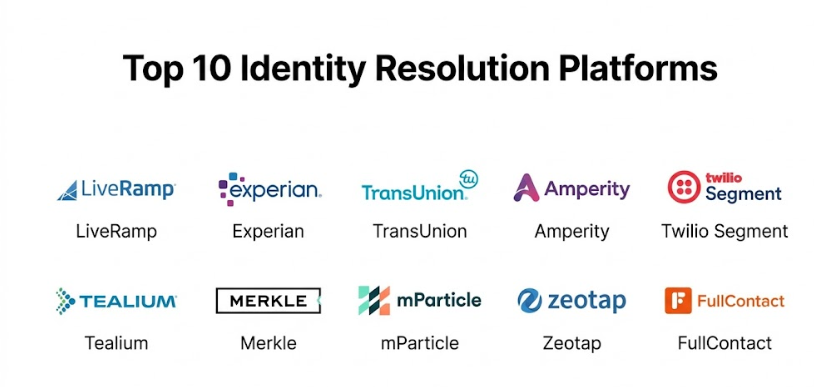
Top 10 Identity Resolution Platforms Tools
1 — LiveRamp (RampID)
LiveRamp is widely considered the industry benchmark for enterprise identity resolution. It utilizes its proprietary RampID (formerly IdentityLink) to provide a privacy-safe, deterministic-first identity graph that connects the digital and physical worlds.
- Key features:
- RampID: A persistent, people-based identifier that replaces traditional cookies.
- Deterministic & Probabilistic Matching: Uses high-assurance matching with a massive identity spine.
- Data Clean Room Integration: Native support for secure data collaboration without sharing PII.
- Offline-to-Online Onboarding: Links store transactions to digital profiles with industry-leading accuracy.
- Global Addressability: Resolves identities across major DSPs, SSPs, and social platforms globally.
- Durable ID Framework: Ensures profiles remain stable even as signals like IP or cookies change.
- Pros:
- The most extensive ecosystem of partners and platforms in the world.
- Exceptionally high standards for privacy and regulatory compliance.
- Cons:
- High cost of entry, often making it inaccessible for smaller organizations.
- Implementation is complex and usually requires significant professional services.
- Security & compliance: SOC 2 Type II, ISO 27001, GDPR, and CCPA compliant; features advanced pseudonymization.
- Support & community: High-touch enterprise support, dedicated account managers, and a vast community of agency partners.
2 — Experian (Identity Resolution)
Leveraging its heritage as a global credit bureau, Experian offers a highly accurate identity resolution solution that excels in high-assurance environments and regulated industries like finance and healthcare.
- Key features:
- Consumer View Graph: Access to one of the world’s largest sets of offline consumer data.
- Household-Level Matching: Groups individuals into household units for broader marketing strategies.
- Real-Time Data Cleansing: Automatically fixes typos and outdated contact info during ingestion.
- Risk & Fraud Scoring: Integrates identity verification with marketing resolution to assess user risk.
- Persistent ID Spine: Links fragmented digital IDs back to a verified physical identity.
- Custom Match Rules: Allows business users to configure thresholds for deterministic merges.
- Pros:
- Unrivaled accuracy in offline data matching and demographic enrichment.
- Highly trusted in regulated sectors where data accuracy is a legal requirement.
- Cons:
- The digital-only identity graph is slightly less expansive than pure-play digital competitors.
- Reporting and UI can feel “legacy” compared to modern SaaS platforms.
- Security & compliance: HIPAA, GDPR, ISO standards, and banking-grade security protocols.
- Support & community: Global technical support teams and deep professional consulting services.
3 — TransUnion (Neustar)
Following the acquisition of Neustar, TransUnion has built a powerhouse identity resolution suite that focuses on real-time addressability and cross-channel marketing attribution.
- Key features:
- OneID System: A proprietary identity graph that fuses telecom-grade data with digital signals.
- Real-Time Identity Stitching: Resolves anonymous web visitors to known profiles in milliseconds.
- Omnichannel Attribution: Links ad exposures across TV, desktop, and mobile to final conversions.
- Data Enrichment: Adds hundreds of attributes (income, interest, life stage) to resolved profiles.
- Cookie-Free Connectivity: Built for a post-cookie environment using persistent person-level IDs.
- Verified Call/Text Data: Links phone-based interactions to the digital customer journey.
- Pros:
- Strongest platform for Connected TV (CTV) and telecom-based identity linkage.
- Real-time capabilities allow for instant website personalization.
- Cons:
- Pricing models can be opaque and scale significantly with data volume.
- Heavily focused on the US market, with slightly less dominance in APAC/EMEA.
- Security & compliance: SOC 2 compliant, GDPR support, and high-assurance audit logging.
- Support & community: Solid documentation, enterprise support tiers, and regular user webinars.
4 — Amperity (AmpID)
Amperity is a Customer Data Platform (CDP) that gained fame for its AI-first approach to identity resolution, specifically designed to handle messy, unstructured enterprise data.
- Key features:
- AmpID AI Engine: Uses machine learning to find “hidden” matches that standard rules miss.
- Warehouse-Native Integration: Operates directly on top of Snowflake, BigQuery, or Databricks.
- Patented Stitching Logic: Provides high transparency into why two records were merged.
- Stitch Quality Reporting: Gives a confidence score for every resolved “golden record.”
- Real-Time Activation: Syncs resolved profiles to marketing tools instantly.
- Household & Individual Views: Easily toggles between person-based and group-based insights.
- Pros:
- Much faster time-to-value for companies with large, messy legacy databases.
- Highly flexible; business users can adjust match rules without coding.
- Cons:
- As a full CDP, it may be “overkill” if you only need the identity resolution layer.
- Can be resource-heavy for organizations not already using a modern cloud data warehouse.
- Security & compliance: SOC 2 Type II, GDPR, CCPA, and ISO 27001; features robust PII encryption.
- Support & community: Excellent onboarding documentation and a very responsive technical support team.
5 — Twilio Segment (Identity Stitching)
Twilio Segment is a developer-centric platform that offers deterministic identity resolution through its Personas (now Unify) framework, focusing on real-time event-driven data.
- Key features:
- IDSync Framework: Merges identifiers (User ID, Email, Anonymous ID) as events occur.
- Deterministic Focus: Prioritizes high-accuracy matching based on specific event signals.
- Real-Time Profile Updates: Profiles are updated the second a user clicks or logs in.
- Broad SaaS Connector Library: Thousands of pre-built integrations for immediate data activation.
- Computed Traits: Automatically calculates values (e.g., “Lifetime Value”) on resolved profiles.
- Privacy Orchestration: Propagates consent signals across all connected tools in real-time.
- Pros:
- Best-in-class for developers and organizations with heavy mobile app usage.
- Extremely easy to integrate with a modern SaaS marketing stack.
- Cons:
- Struggles with “offline” data compared to LiveRamp or Experian.
- Probabilistic matching (guessing a match) is less robust than AI-specialized tools.
- Security & compliance: ISO 27001, SOC 2 Type II, GDPR, and HIPAA (with specific BAA).
- Support & community: Extensive developer documentation, Slack community, and 24/7 technical help.
6 — Tealium (AudienceStream)
Tealium provides identity resolution through its AudienceStream CDP, focusing on a “data-layer-first” approach that prioritizes real-time consent and omnichannel orchestration.
- Key features:
- Real-Time Visitor Stitching: Unifies cross-device behavior while the visitor is still on the site.
- Consent Management Integration: Ensures identity is only resolved when privacy flags allow.
- Omnichannel Connectors: Ingests and resolves data from call centers, IoT, and POS systems.
- Durable ID Graph: Creates persistent profiles that withstand the deletion of browser cookies.
- Event-Level Governance: Controls exactly which identifiers are sent to third-party partners.
- Predictive Insights: Uses resolved data to forecast future customer behavior.
- Pros:
- Top-tier choice for organizations prioritizing real-time privacy and consent.
- Reduces the need for complex ETL (Extract, Transform, Load) processes.
- Cons:
- Not a standalone identity provider; requires adoption of the Tealium ecosystem.
- Can have a steep learning curve for those unfamiliar with tag management.
- Security & compliance: HIPAA, GDPR, ISO 27001, and SOC 2 Type II compliant.
- Support & community: Comprehensive “Tealium Learning Center” and global professional services.
7 — Merkle (Merkury)
Merkury is the identity resolution and data platform from Merkle (part of dentsu), designed for large brands seeking a managed, person-based identity solution.
- Key features:
- Private Identity Graph: Brands can own their own identity graph rather than renting one.
- Person-Based IDs: Links digital cookies and mobile IDs to a stable individual record.
- Merkle Data Enrichment: Augments resolved profiles with Merkle’s proprietary consumer data.
- Clean Room Interoperability: Enables secure collaboration with media partners.
- Cookieless Addressability: Powers targeted advertising in a first-party-only ecosystem.
- Consulting-Led Implementation: Custom-built graphs tailored to specific business models.
- Pros:
- Allows brands to maintain “ownership” and control over their identity graph.
- Deeply integrated with dentsu’s media buying and agency services.
- Cons:
- Best suited for very large brands with significant agency spend.
- Implementation is less “plug-and-play” than modern SaaS platforms.
- Security & compliance: Enterprise security controls, GDPR, and SOC 2 Type II support.
- Support & community: Managed services model with high-touch consulting and support.
8 — mParticle (IDSync)
mParticle is an identity framework specifically optimized for mobile-first brands, providing real-time identity stitching for complex app-based customer journeys.
- Key features:
- IDSync Framework: Provides a developer-friendly API for real-time identity management.
- Mobile-First Graph: Excels at linking mobile advertising IDs (MAIDs) to user accounts.
- Cross-Channel Governance: Manages data flows and privacy flags across mobile, web, and TV.
- Real-Time Personalization: Profiles update in milliseconds to trigger in-app offers.
- Data Quality Tools: Prevents bad or duplicate data from entering the identity graph.
- Audience Segmentation: Builds cohorts based on resolved, multi-device behavior.
- Pros:
- The gold standard for mobile app developers and gaming companies.
- Highly flexible and scalable for massive volumes of real-time events.
- Cons:
- Weaker in offline-only data scenarios (e.g., mail-in catalogs).
- Reporting can feel more technical and less “marketer-friendly.”
- Security & compliance: SOC 2 Type II, GDPR, CCPA, and HIPAA support.
- Support & community: Excellent documentation and responsive technical assistance.
9 — Zeotap (ID+)
Zeotap’s ID+ is a European-born platform that emphasizes high privacy standards and deterministic data from telecommunications and high-assurance sources.
- Key features:
- ID+ Identity Graph: A deterministic graph designed to replace third-party cookies globally.
- Privacy-by-Design: Built specifically to meet the world’s strictest data regulations.
- First-Party Enrichment: Maps your CRM data to Zeotap’s verified consumer attributes.
- Cookieless Activation: Connects brands directly to publishers and ad platforms.
- Universal Identifier: Provides a stable ID that works across the entire ad tech stack.
- Real-Time Profile Consolidation: Updates customer views instantly across channels.
- Pros:
- One of the most compliant platforms for European and global privacy-sensitive markets.
- High match accuracy due to deterministic sourcing from telecom partners.
- Cons:
- Smaller footprint in North America compared to LiveRamp or Experian.
- The UI is functional but lacks the advanced visualizations of competitors.
- Security & compliance: ISO 27001, CSA STAR, GDPR, and CCPA certified.
- Support & community: Localized support in major global markets and strong technical documentation.
10 — FullContact
FullContact is an identity-as-a-service platform that focuses on real-time data enrichment and identity resolution for mid-sized businesses.
- Key features:
- Person-Level Enrichment: Turns an email or social handle into a full consumer profile.
- Identity Map: A real-time API that resolves identifiers across billions of data points.
- Privacy-Safe Insights: Uses “identity fragments” to match data without exposing raw PII.
- Customer Journey Tracking: Links anonymous visitors to known customers for better attribution.
- Durable Customer IDs: Maintains persistent profiles across browser and device changes.
- High-Speed API: Designed for developers needing real-time resolution for apps.
- Pros:
- Much more affordable and accessible for mid-market founders.
- Excellent real-time API performance for application developers.
- Cons:
- Lacks the deep “offline-onboarding” power of enterprise bureaus.
- Community support is mostly restricted to developer forums.
- Security & compliance: GDPR, SOC 2, and CCPA compliant; features PII vaulting.
- Support & community: Developer-friendly documentation and email/chat support.
Comparison Table
| Tool Name | Best For | Platform(s) Supported | Standout Feature | Gartner Rating |
| LiveRamp | Large Enterprises | Web, Cloud, App | Privacy-Safe Global Graph | 4.6 / 5 |
| Experian | Regulated Industries | Web, Offline | Rich Offline/Credit Data | 4.4 / 5 |
| TransUnion | Real-Time Marketing | Web, Mobile, CTV | Telecom-Grade Graph | 4.4 / 5 |
| Amperity | Messy Legacy Data | Cloud, Data Warehouse | AI-Powered Stitching | 4.8 / 5 |
| Twilio Segment | Developer-Led Teams | Web, Mobile, SaaS | Real-Time IDSync | 4.5 / 5 |
| Tealium | Privacy & Consent | Web, Mobile, IoT | Consent-Driven Graph | 4.4 / 5 |
| Merkle | Managed Enterprise | Web, Media, CRM | Brand-Owned Graph | N/A |
| mParticle | Mobile-First Apps | App, Web, Mobile | Mobile ID persistence | 4.4 / 5 |
| Zeotap | GDPR-Strict Markets | Web, Mobile, AdTech | Deterministic ID+ | 4.2 / 5 |
| FullContact | Mid-Market Founders | Web, App, API | Real-Time Profile Enrichment | 4.1 / 5 |
Evaluation & Scoring of Identity Resolution Platforms
| Criteria | Weight | Highest Scorer (Avg) | Description |
| Core Features | 25% | 9.5 | Accuracy, deterministic/probabilistic matching, and graph depth. |
| Ease of Use | 15% | 8.8 | UI/UX, dashboard clarity, and self-service rule configuration. |
| Integrations | 15% | 9.6 | Breadth of the partner ecosystem (DSPs, CDPs, CRMs). |
| Security & Compliance | 10% | 10.0 | ISO/SOC certifications and privacy-first architecture. |
| Performance | 10% | 9.4 | Real-time processing speed and system uptime. |
| Support & Community | 10% | 8.5 | Documentation quality and responsiveness of support. |
| Price / Value | 15% | 7.9 | ROI relative to enterprise licensing costs. |
Which Identity Resolution Platforms Tool Is Right for You?
Choosing the right platform is a strategic decision that depends on your data maturity and primary business goals.
Solo Users vs SMB vs Mid-Market vs Enterprise
If you are a solo user or early-stage founder, identity resolution is often best handled by the built-in features of your marketing automation tool. For SMBs with a growing digital footprint, FullContact or Segment offer the best entry points. Mid-market firms requiring high accuracy should look toward Amperity or Tealium. Large enterprises with massive offline and online datasets almost always require the scale of LiveRamp, Experian, or TransUnion.
Budget-Conscious vs Premium Solutions
If you are budget-conscious, prioritize “warehouse-native” tools like Amperity or Segment that allow you to keep data in your own cloud, reducing duplication costs. Premium solutions like Merkury or LiveRamp are worth the investment when the “cost of misidentification” is high—such as in million-dollar ad campaigns or high-compliance sectors.
Feature Depth vs Ease of Use
If you have a small team, prioritize Ease of Use. Tools like Amperity allow non-technical marketers to manage match rules. If you have a robust data science team, prioritize Feature Depth. mParticle or FullContact provide the deep API control developers need for custom builds.
Frequently Asked Questions (FAQs)
1. What is the difference between deterministic and probabilistic matching?
Deterministic matching links records based on a 100% match of a unique identifier (like an email or phone number). Probabilistic matching uses AI to guess that two people are the same based on behavior, location, and device patterns.
2. How do these platforms handle the decline of third-party cookies?
They use “First-Party Identity Graphs” and “Universal Identifiers” (like RampID). These IDs are based on authenticated data (logins) and persistent signals that don’t disappear when a browser clears its cache.
3. Is identity resolution safe for GDPR and CCPA?
Yes, but only if the platform has built-in consent management. Leading platforms pseudonymize PII, meaning they turn “John Doe” into a random string of characters so his identity is protected while he is being tracked.
4. How long does it take to implement identity resolution?
Simple SaaS implementations can take 4–6 weeks. Complex enterprise deployments involving offline data and multiple business units can take 6 months to a year.
5. Does identity resolution replace my CRM?
No. A CRM stores your known customer interactions. An identity resolution platform sits “behind” the CRM, cleaning up the data and connecting it to anonymous digital signals that the CRM can’t see.
6. What is a “Golden Record”?
A golden record is the single, most accurate, and up-to-date version of a customer’s profile, created after all duplicates have been merged and identities resolved.
7. Can I do identity resolution inside my data warehouse?
Yes. Modern “warehouse-native” tools like Amperity and Hightouch allow you to run identity stitching directly inside Snowflake or BigQuery without moving your data.
8. Why is “persistence” important in an ID?
Persistence ensures that a customer’s history stays linked to them even if they get a new phone, change their email, or move to a new house.
9. What is a Data Clean Room?
A clean room is a secure environment where two companies (like a brand and a publisher) can match their identity data without either side ever seeing the other’s raw PII.
10. What is the biggest mistake people make in identity resolution?
Relying on “batch” processing (overnight updates) for real-time use cases. If a customer abandons a cart, you need to recognize them and send a reminder in minutes, not 24 hours later.
Conclusion
Identity resolution is no longer a “nice-to-have” marketing feature; it is a foundational requirement for any business operating in a digital-first economy. As third-party signals vanish, the “golden record” created by these platforms becomes your most valuable asset. The “best” tool isn’t necessarily the one with the biggest identity graph, but the one that aligns with your specific technical stack, regulatory requirements, and customer journey.
Whether you choose the enterprise-grade power of LiveRamp, the AI-driven flexibility of Amperity, or the developer-first simplicity of Segment, the goal remains the same: knowing exactly who your customer is, no matter where they show up. Start by auditing your current data silos, define your most critical use cases, and choose a partner that can grow with you into the increasingly complex identity landscape of tomorrow.