Introduction
Managing a community association is often a complex balancing act. HOA and Condo management software is a specialized digital platform designed to help board members and property managers handle the daily operations of homeowners’ associations and condominium complexes. These tools act as a central hub for everything from collecting monthly dues and tracking maintenance requests to managing community documents and architectural reviews. Instead of relying on scattered spreadsheets and stacks of paper, these platforms provide a transparent, organized way to keep a community running smoothly.
The importance of this software cannot be overstated. It ensures that association rules are enforced fairly, financial records remain accurate for audits, and communication between the board and residents is clear. Real-world use cases include automating the billing of hundreds of residents at once, providing a digital “gatehouse” for amenity bookings like pools or clubhouses, and offering a secure portal for board members to vote on important resolutions. When evaluating these tools, users should prioritize ease of use for residents, the depth of financial reporting, mobile accessibility, and how well the system tracks violations and work orders.
Who Benefits and Who Doesn’t
Best for: These tools are a lifesaver for professional property management companies handling multiple communities and self-managed HOA boards looking to reduce their administrative workload. They are particularly beneficial for mid-sized to large residential developments, luxury high-rise condos, and gated communities that require robust security and amenity management. Roles such as association treasurers, community managers, and administrative assistants will find that these platforms significantly reduce manual data entry and “he-said-she-said” communication hurdles.
Not ideal for: This software may be overkill for tiny associations with only a handful of units where a simple shared folder and a basic bank account might suffice. It is also not a great fit for traditional rental property landlords who do not have to deal with association boards, common area maintenance, or complex community bylaws. Organizations that are extremely resistant to technology or those with zero budget for software subscriptions might find better value in manual processes or generic accounting software, though they will miss out on the specialized automation features.
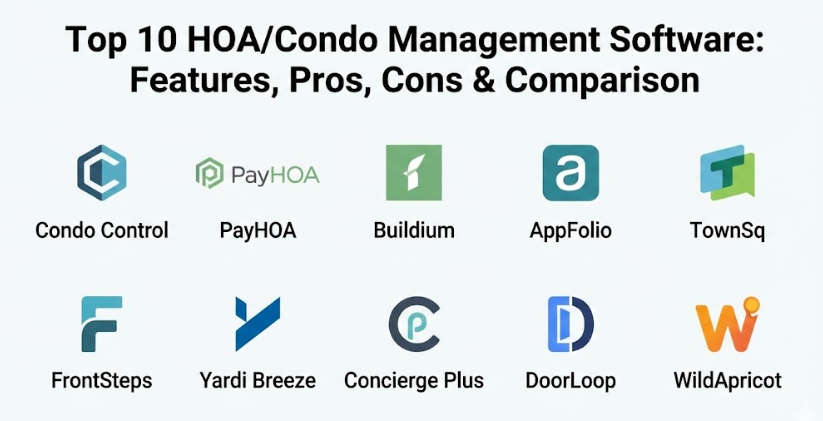
Top 10 HOA/Condo Management Software Tools
1 — Condo Control
Condo Control is a comprehensive platform built specifically for the unique needs of condominium and homeowners’ associations. It focuses heavily on resident communication and streamlining the tasks that typically cause headaches for board members.
- Key features:
- Automated amenity booking system with integrated payment processing.
- Digital voting and proxy tools for annual general meetings.
- Concierge and package tracking module for high-rise security desks.
- Visitor management and parking permit tracking.
- Violation tracking with the ability to attach photos directly from a mobile device.
- A central document library with customizable permission levels for owners and tenants.
- Online payment portal for dues, fines, and special assessments.
- Pros:
- The user interface is very modern and easy for non-technical residents to navigate.
- It offers one of the best digital voting systems in the industry, significantly increasing quorum participation.
- Cons:
- The sheer number of features can feel overwhelming during the initial setup process.
- Some advanced modules are sold as add-ons, which can increase the total cost for smaller associations.
Security & compliance: Condo Control offers SOC 2 Type 2 compliance, data encryption at rest and in transit, and robust audit logs to track all administrative actions.
Support & community: They provide a dedicated success manager for enterprise clients, extensive online documentation, and regular webinars to help boards get the most out of the platform.
2 — PayHOA
PayHOA is known for its simplicity and “all-in-one” approach, making it a favorite for self-managed associations. It prioritizes financial transparency and ease of payment above all else.
- Key features:
- Full-cycle accounting system designed specifically for the HOA fund structure.
- Automated invoice generation and digital payment collection via ACH or credit card.
- Resident portal where owners can view their payment history and upcoming dues.
- Communication tools including mass email, text messaging, and physical mail services.
- Architectural request workflows to manage home improvement approvals.
- Work order management system to track common area repairs.
- Detailed financial reporting with one-click balance sheets and income statements.
- Pros:
- It is incredibly easy to set up, often allowing an association to go live in just a few days.
- The pricing is transparent and typically based on the number of units, making it budget-friendly for smaller groups.
- Cons:
- It lacks some of the high-end security desk features found in luxury condo software.
- The accounting system, while robust, may not be as flexible as a general-purpose enterprise ERP for massive management firms.
Security & compliance: They use bank-level encryption (AES-256) and are PCI compliant for all payment processing. Audit logs are included for financial transactions.
Support & community: PayHOA offers highly rated customer support via chat and email, along with a searchable knowledge base that covers most common scenarios.
3 — Buildium
Buildium is a heavyweight in the property management world. While it handles rentals too, its association management module is powerful enough to handle massive portfolios with thousands of doors.
- Key features:
- Automated fee collection with recurring payment options.
- A dedicated association owner portal for 24/7 access to account details.
- Violations and architectural review tracking with automated letter generation.
- Comprehensive financial reporting including budget-to-actual comparisons.
- Integrated 1099 filing and vendor management tools.
- Maintenance request tracking with the ability to assign tasks to external contractors.
- Board member specialized access for viewing confidential financial documents.
- Pros:
- It offers a massive ecosystem of integrations, connecting with insurance providers and background check services.
- The financial reporting is enterprise-grade, meeting the requirements of the most demanding association audits.
- Cons:
- The software has a steeper learning curve compared to “HOA-only” platforms.
- Because it serves many types of property management, some HOA-specific features can feel buried in the menu.
Security & compliance: Buildium is SOC 2 compliant and follows strict data privacy standards. They offer multi-factor authentication (MFA) to protect board accounts.
Support & community: They have a very large user community, a dedicated “Buildium Academy” for training, and phone support for higher-tier plans.
4 — AppFolio Property Manager
AppFolio is often considered the “premium” choice for large-scale management companies. It uses modern AI and automation to handle repetitive tasks like data entry and bill scanning.
- Key features:
- AI-powered bill entry that reads invoices and suggests accounting codes.
- “Smart” maintenance workflows that prioritize urgent common area repairs.
- Mobile app specifically designed for board members to approve payments on the go.
- Online architectural reviews with a transparent status tracker for residents.
- Professional community websites that integrate directly with the software.
- Digital newsletter and announcement tools with engagement tracking.
- Automated bank reconciliations to keep the association’s books perfectly balanced.
- Pros:
- The mobile experience is arguably the best in the market, making it easy for busy board members to stay involved.
- The AI automation features save significant time for property managers with large portfolios.
- Cons:
- It is generally more expensive than other options, often requiring a minimum monthly fee.
- The platform is so deep that smaller associations might find themselves paying for features they never use.
Security & compliance: AppFolio maintains high security standards, including SOC 2 compliance and regular third-party security audits. They offer SSO for enterprise organizations.
Support & community: They provide a dedicated account representative and a robust help center. Their annual user conference is a major event for industry networking.
5 — TownSq
TownSq is unique because it positions itself as the “social network” for your community. It focuses heavily on engagement and making the resident experience feel connected rather than just administrative.
- Key features:
- Community forum and social feed where residents can interact and share news.
- Polls and surveys to gather resident feedback on community projects.
- Integrated payment portal for one-click dues payments.
- Amenity reservation system with a visual calendar for residents.
- Direct messaging between residents and the management team.
- Digital storage for bylaws, meeting minutes, and financial reports.
- “Concierge” features like parking management and package alerts.
- Pros:
- It excels at building a sense of community, which can lead to higher satisfaction among residents.
- The interface looks and feels like a modern consumer app, which helps with adoption.
- Cons:
- The accounting features are not as deep as platforms like Buildium or PayHOA; it often works best when paired with an accounting partner.
- The “social” aspect requires active moderation to prevent community drama from escalating.
Security & compliance: TownSq uses standard encryption for all data and offers granular permissions to ensure residents only see the information intended for them.
Support & community: They offer a variety of training materials and a support team that specializes in community engagement strategies.
6 — FrontSteps
FrontSteps is a security-first platform that is particularly strong for gated communities and associations that prioritize controlled access and resident safety.
- Key features:
- Advanced gate access control that integrates with hardware systems.
- Visitor management with digital “guest passes” sent to smartphones.
- Public safety officer patrol tracking and reporting.
- Credential management for resident fobs, stickers, and license plate readers.
- Online payment and billing system for all association assessments.
- Document management and community announcement tools.
- Architectural and violation tracking modules.
- Pros:
- It is the best choice for communities that need to bridge the gap between their software and their physical security hardware.
- It provides a professional, unified experience for both administrative tasks and security operations.
- Cons:
- Setting up the hardware integrations can be a complex and expensive process.
- The focus on security means the accounting and social features aren’t as specialized as some competitors.
Security & compliance: As a security-focused company, they use enterprise-grade encryption and follow strict compliance protocols for sensitive resident data.
Support & community: They offer professional installation services for security hardware and dedicated support for their software platform.
7 — Yardi Breeze
Yardi is one of the oldest names in real estate software. Yardi Breeze is their modern, “refreshingly simple” take on association management, aimed at smaller and mid-sized organizations.
- Key features:
- Simplified accounting with a focus on ease of use for non-accountants.
- Built-in communication tools for email and text alerts.
- Online owner portals for payments and maintenance requests.
- Vendor management and tracking of insurance certificates.
- Automated task reminders for recurring board meetings and audits.
- Streamlined violation tracking with mobile photo capabilities.
- Basic financial reporting that is clean and easy to read.
- Pros:
- It is backed by the power of the Yardi ecosystem but without the complexity of their legacy systems.
- The pricing is very straightforward, usually a flat fee per unit with no hidden costs.
- Cons:
- It lacks some of the hyper-specialized features like digital voting or amenity booking found in Condo Control.
- Large associations might eventually outgrow Breeze and need to migrate to Yardi’s more complex enterprise platforms.
Security & compliance: Yardi Breeze follows global security standards and offers reliable data backups and encryption.
Support & community: They offer excellent live chat support and a large library of self-help articles and videos.
8 — Concierge Plus
Concierge Plus is designed specifically for high-end condominiums and luxury high-rises where the “concierge” experience is the most important part of the building’s operations.
- Key features:
- Sophisticated package tracking with automated resident notifications.
- Incident reporting module for security and front-desk staff.
- Amenity management for high-demand areas like rooftop gyms or theaters.
- Parking and vehicle tracking, including guest parking logs.
- Digital display integrations for lobby screens and elevators.
- Key tracking system to manage building and unit access.
- Resident portal for payments and document access.
- Pros:
- The front-desk and concierge modules are the most detailed and refined in this category.
- The ability to push information to lobby screens keeps the building feeling modern and tech-forward.
- Cons:
- It is a niche product that may not be a good fit for a standard spread-out HOA with no front desk.
- It can be more expensive than general-purpose association tools.
Security & compliance: They offer secure data handling and audit trails, ensuring that building access logs are protected and available for review.
Support & community: They provide personalized onboarding and excellent technical support for front-desk teams.
9 — DoorLoop
DoorLoop is one of the fastest-growing property management tools. It stands out for its speed, ease of use, and a user interface that feels like a modern website rather than a boring database.
- Key features:
- Fastest payment processing times for association dues.
- Customizable resident portals with community-specific branding.
- Unlimited document storage for meeting minutes and bylaws.
- Work order management with automated vendor notifications.
- Owner reports that can be customized and scheduled for delivery.
- Communication tools including email, text, and physical mail.
- Integrations with thousands of other apps via Zapier.
- Pros:
- The speed of the platform is impressive; there is very little “lag” when navigating between menus.
- It is incredibly easy to customize, making it feel like a bespoke solution for your specific community.
- Cons:
- As a newer player, some of the very deep HOA features (like complex architectural review workflows) are still being refined.
- The accounting system is powerful but may require a bit of a learning curve for those used to QuickBooks.
Security & compliance: DoorLoop uses 256-bit encryption and offers SOC 2 compliance. They prioritize data safety for all users.
Support & community: They are famous for their “world-class” support, which includes a dedicated account manager and rapid response times.
10 — WildApricot
WildApricot is technically “membership management” software, but many small, self-managed HOAs use it because it is affordable and handles the “club” aspect of an association perfectly.
- Key features:
- Membership directory with customizable profiles for residents.
- Event management for community socials and annual meetings.
- Automated renewal reminders and dues collection.
- Simple website builder to create a community home page.
- Email marketing and newsletter tools.
- Online payment processing through multiple gateways.
- Mobile app for residents to access the directory and events.
- Pros:
- It is one of the most affordable ways for a small community to get organized online.
- The website builder is very user-friendly, allowing the board to share news easily.
- Cons:
- It lacks specialized HOA features like violation tracking or architectural reviews.
- It does not have a “work order” system for maintenance tasks.
Security & compliance: They are PCI compliant and follow standard data protection practices for membership organizations.
Support & community: They have a massive community of users and a very deep library of “how-to” articles.
Comparison Table
| Tool Name | Best For | Platform(s) Supported | Standout Feature | Rating |
| Condo Control | Luxury Condos & High-rises | Web, iOS, Android | Digital Voting & Proxy | 4.8/5 |
| PayHOA | Self-Managed Associations | Web, Mobile Web | Financial Transparency | 4.7/5 |
| Buildium | Large Management Firms | Web, iOS, Android | Enterprise Integrations | 4.6/5 |
| AppFolio | Tech-Forward Large Portfolios | Web, iOS, Android | AI Bill Entry & Automation | 4.8/5 |
| TownSq | Community Engagement | Web, iOS, Android | Community Social Feed | 4.5/5 |
| FrontSteps | Gated Communities | Web, iOS, Android | Security & Gate Integration | 4.4/5 |
| Yardi Breeze | Simple Asset Management | Web, Mobile Web | Refreshing Simplicity | 4.6/5 |
| Concierge Plus | High-Rise Front Desks | Web, iOS, Android | Lobby Screen Integration | 4.5/5 |
| DoorLoop | Speed & Customization | Web, iOS, Android | Ultra-fast UI & Payments | 4.7/5 |
| WildApricot | Small, Budget-Conscious HOAs | Web, iOS, Android | Event & Member Directory | 4.3/5 |
Evaluation & Scoring of HOA/Condo Management Software
To determine which tool offers the best value, we have used a weighted scoring rubric. This helps associations look beyond the price tag and see how a tool will actually perform in day-to-day operations.
| Criteria | Weight | What We Looked For |
| Core Features | 25% | Presence of dues collection, violations, architectural reviews, and voting. |
| Ease of Use | 15% | Intuitiveness for board members and resident adoption rates. |
| Integrations | 15% | Ability to connect with banks, security hardware, and other software. |
| Security | 10% | SOC 2 compliance, encryption, and administrative audit trails. |
| Reliability | 10% | Uptime history and mobile app performance. |
| Support | 10% | Quality of documentation, training, and customer service speed. |
| Price / Value | 15% | Transparent pricing models and return on investment for the association. |
Which HOA/Condo Management Software Tool Is Right for You?
Choosing the right tool is a big decision that will affect your community for years to come. Here is a practical guide to help you decide based on your specific situation.
- For Self-Managed Small HOAs: If you are a volunteer board member looking to stop using spreadsheets, PayHOA is your best bet. It is built for non-professionals and focuses on getting the money side of things right without overcomplicating the rest.
- For High-Rise Luxury Condos: If your building has a lobby, a package room, and high-end amenities, Condo Control or Concierge Plus are the clear winners. They understand the “hospitality” side of living in a luxury condo and provide the tools your front-desk staff needs.
- For Gated Communities with Security: If you have a gatehouse and security guards, FrontSteps is the way to go. The ability to manage both your dues and your gate access in one ecosystem is a massive benefit that most other tools can’t match.
- For Large Management Companies: If you manage 50 different associations and need to keep them all straight, Buildium or AppFolio are the tools for you. They are built for scale and offer the deep financial reporting that professional managers require.
- For Community-Focused Boards: If your main goal is to get neighbors talking and improve the “vibe” of the neighborhood, TownSq is the most modern and engaging option. It turns the management of the association into a collaborative social experience.
Frequently Asked Questions (FAQs)
1. How long does it typically take to set up HOA software?
For a small, self-managed association using a tool like PayHOA, you can be up and running in a few days. For large complexes with complex historical data and security hardware integrations, it can take 30 to 60 days to fully migrate and train everyone.
2. Is my community’s financial data safe in the cloud?
Reputable providers use the same level of encryption as major banks. Look for “SOC 2 Type 2” certification, which means an independent auditor has verified their security practices. Always ensure you enable Multi-Factor Authentication (MFA).
3. Do these tools handle physical mail for residents who aren’t online?
Yes, several tools (like PayHOA and Buildium) offer integrated mail services. You can “click a button” to send a physical violation letter or statement, and the software provider will print, stuff, and mail it for you for a small fee.
4. Can residents pay their dues with a credit card?
Almost all modern platforms allow for credit card and ACH (bank transfer) payments. Be aware that credit card companies charge processing fees (usually 2.9% + 30 cents), while ACH transfers are usually much cheaper or even free.
5. Does the software replace the need for an association accountant?
Not necessarily, but it makes their job much easier. The software automates the data entry and reconciliation, allowing your accountant or treasurer to focus on high-level budgeting and financial planning rather than chasing down checks.
6. Can we use the software to run our board elections?
Yes, tools like Condo Control specialize in digital voting and proxies. This is often one of the best reasons to get the software, as it makes it much easier to reach a “quorum” and get enough votes to pass important community changes.
7. Is there a mobile app for residents?
Most of the top-tier tools offer dedicated apps for iOS and Android. Residents love these because they can pay their bills, book the pool, or report a broken streetlight in just a few taps while they are out and about.
8. What happens to our data if we decide to switch software later?
You should always ensure that you own your data. Most professional platforms allow you to export your resident lists, financial history, and documents as CSV or PDF files if you ever decide to move to a different provider.
9. Can we track parking and visitor permits?
Specialized condo management tools like Concierge Plus and Condo Control have very detailed modules for this. You can track which car belongs to which unit and even issue digital guest passes for visitors.
10. How much does HOA management software typically cost?
Pricing is usually based on the number of units. Small associations might pay $50–$100 per month, while mid-sized communities often pay $200–$500. Large-scale management firms usually negotiate custom pricing based on their total “door” count.
Conclusion
Finding the right HOA or Condo management software is about more than just finding a place to store names and numbers. It is about choosing a digital partner that will help your community thrive, reduce the stress of your board members, and provide a professional experience for your residents. There is no “perfect” tool that fits every single association, but the options available today are better and more user-friendly than they have ever been.
When you are ready to make a move, we recommend picking three tools from this list that match your community’s “profile” and requesting a demo. See the software in action, ask about their onboarding process, and most importantly, check how the resident portal looks on a smartphone. A tool that is easy for your neighbors to use is a tool that will actually be used. By automating the boring administrative work, you can get back to what really matters: building a great place to live.