Introduction
Financial stress testing platforms are advanced software solutions designed to help banks, investment firms, and corporations simulate “what-if” scenarios to see how their portfolios or business models would hold up during an economic crisis. Imagine a bank wanting to know if it would stay solvent if housing prices dropped by 30% or if interest rates suddenly doubled. These platforms use complex mathematical models and historical data to predict those outcomes. Instead of relying on guesswork, financial leaders use these tools to prepare for the worst while hoping for the best.
The importance of these platforms has grown significantly as global markets become more interconnected and volatile. They are no longer just a “nice to have” tool but a regulatory requirement for many large financial institutions. Key real-world use cases include meeting capital adequacy requirements (like CCAR or DFAST), managing market risk for hedge funds, and performing liquidity analysis for corporate treasuries. By running these tests, organizations can identify hidden vulnerabilities in their balance sheets before they become real-world disasters.
When evaluating these tools, users should look for strong data integration capabilities, the quality of the built-in economic scenarios, the speed of the calculation engine, and the ability to generate reports that satisfy both internal boards and external regulators. A good platform should be able to handle massive amounts of data without slowing down, while still being flexible enough to allow users to create their own custom “doomsday” scenarios.
Best for: Risk managers, Chief Financial Officers (CFOs), and compliance officers at mid-sized to large banks, insurance companies, and investment firms. It is also essential for government regulatory bodies and large multinational corporations with complex debt structures.
Not ideal for: Small local businesses or solo entrepreneurs with simple cash flows and no complex investment portfolios. Basic accounting software or a simple spreadsheet is usually sufficient for their needs.
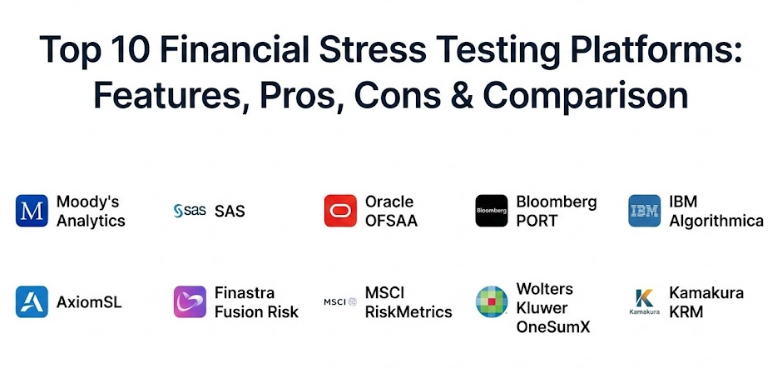
Top 10 Financial Stress Testing Platforms
1 — Moody’s Analytics RiskIntegrity
Moody’s Analytics provides a world-class platform designed specifically for banks and insurance companies to manage regulatory capital and perform deep-dive stress tests. It is built to handle the most complex global regulations.
- Key features:
- Automated data collection from various internal and external sources.
- Pre-configured regulatory scenarios for CCAR, DFAST, and IFRS 9.
- Advanced credit risk modeling and loss forecasting.
- Real-time “what-if” analysis for immediate decision-making.
- Highly detailed audit trails for regulatory transparency.
- Integration with Moody’s vast economic database.
- Pros:
- Unmatched depth in economic data and historical trends.
- Excellent reputation with global regulators, making compliance easier.
- Cons:
- The platform is very complex and requires specialized training.
- Implementation can be a long and expensive process.
- Security & compliance: SOC 2, GDPR compliant, AES-256 encryption, and multi-factor authentication.
- Support & community: Extensive documentation, dedicated relationship managers, and a global network of expert consultants.
2 — SAS Stress Testing
SAS is a leader in data analytics, and their stress testing solution is known for its incredible processing power and ability to handle massive datasets for the world’s largest financial institutions.
- Key features:
- High-performance computing engine for rapid scenario execution.
- Centralized model inventory and governance.
- Dynamic balance sheet forecasting.
- Visual analytics for presenting results to non-technical stakeholders.
- Seamless integration with other SAS risk and finance modules.
- Customizable modeling framework for unique business needs.
- Pros:
- Able to process millions of records in a fraction of the time of other tools.
- Very flexible for organizations that have their own proprietary models.
- Cons:
- Requires a high level of technical expertise (coding knowledge is often needed).
- Higher total cost of ownership compared to lighter alternatives.
- Security & compliance: ISO 27001 certified, SOC 1 and 2, and advanced audit logging.
- Support & community: Robust user forums, SAS Academy for training, and 24/7 premium support options.
3 — Oracle Financial Services Analytical Applications (OFSAA)
Oracle offers a comprehensive suite of tools that integrate stress testing directly into the broader financial management and accounting ecosystem, making it a favorite for large-scale banking operations.
- Key features:
- Unified data architecture that links risk, finance, and treasury.
- Built-in scenarios for liquidity stress testing and market risk.
- Automated regulatory reporting for multiple jurisdictions.
- Capital planning and projection capabilities.
- Advanced behavioral modeling for customer deposits and loans.
- Scalable cloud or on-premise deployment options.
- Pros:
- Great for organizations already using the Oracle ecosystem.
- Provides a “single source of truth” across different departments.
- Cons:
- User interface can feel dated and less intuitive than modern SaaS apps.
- Upgrades can be complex and time-consuming.
- Security & compliance: HIPAA, SOC 1/2/3, GDPR, and FedRAMP authorized.
- Support & community: Large global user community and professional services through Oracle Support.
4 — Bloomberg Risk Solutions (PORT)
Bloomberg’s PORT platform is the industry standard for investment managers and hedge funds who need to stress test their portfolios against market movements in real-time.
- Key features:
- Real-time market data integration for immediate impact analysis.
- Factor-based risk modeling to identify specific vulnerabilities.
- Historical scenario library (e.g., simulating the 2008 crash).
- Portfolio optimization tools based on stress test results.
- VaR (Value at Risk) and tracking error calculations.
- Mobile accessibility for on-the-go risk monitoring.
- Pros:
- Industry-leading data accuracy and real-time updates.
- Very easy to compare current portfolios against historical benchmarks.
- Cons:
- Expensive monthly terminal fees make it less accessible for smaller firms.
- Focused more on market risk than long-term regulatory bank capital.
- Security & compliance: SSAE 18, encryption at rest and in transit, and robust access controls.
- Support & community: 24/7 “Instant Help” through the Bloomberg terminal and dedicated account reps.
5 — IBM Algorithmica
IBM’s solution is focused on providing high-fidelity risk analytics and stress testing for capital markets and large banking institutions, with a strong emphasis on model integrity.
- Key features:
- High-speed Monte Carlo simulations for complex derivatives.
- Managed data services to ensure input quality.
- Limit management and real-time monitoring.
- Cross-asset class coverage (equities, fixed income, FX, etc.).
- Intuitive dashboarding for risk reporting.
- Pros:
- Strong performance in pricing complex financial instruments.
- Reliable and stable platform with decades of development history.
- Cons:
- Integration with non-IBM systems can sometimes be a challenge.
- Can feel like a “black box” without significant configuration.
- Security & compliance: ISO 27001, SOC 2, and GDPR compliant.
- Support & community: IBM Support portal and specialized training via IBM Skills Gateway.
6 — AxiomSL (Adenza)
AxiomSL is highly specialized in regulatory reporting and risk management, offering a platform that is specifically designed to meet the ever-changing demands of central banks.
- Key features:
- Data integrity and lineage tracking (knowing where every number came from).
- Automated submission of stress test results to regulators.
- Flexible scenario engine for both macro and micro-stress tests.
- Support for global regulations like Basel III and IV.
- Cloud-native architecture for easier scaling.
- Pros:
- Best-in-class for regulatory compliance and audit readiness.
- Excellent at handling data from multiple siloed systems.
- Cons:
- Less focus on general business strategy compared to other tools.
- The UI is functional but lacks the “polish” of newer fintech apps.
- Security & compliance: SOC 2 Type II, ISO 27001, and HIPAA (where applicable).
- Support & community: Dedicated client success teams and regular regulatory update webinars.
7 — Finastra Fusion Risk
Finastra provides a modular approach to risk management, making it an excellent choice for mid-sized banks that want to grow their stress testing capabilities over time.
- Key features:
- Integrated liquidity and market risk analysis.
- Easy-to-use scenario manager for custom stress events.
- Regulatory reporting templates for various regions.
- Real-time limit monitoring and alerts.
- Open API architecture for easier third-party integrations.
- Pros:
- More user-friendly than the “big three” legacy platforms.
- Good value for money for mid-tier financial institutions.
- Cons:
- May struggle with the extreme data volumes of a global “mega-bank.”
- Some modules feel more modern than others.
- Security & compliance: SOC 2, ISO 27001, and strong encryption protocols.
- Support & community: Online customer portal and a growing community of fintech partners.
8 — MSCI RiskMetrics
RiskMetrics is a legendary name in risk management, offering powerful stress testing and risk analysis tools specifically for institutional investors and asset managers.
- Key features:
- Extensive library of historical stress scenarios.
- Multi-asset class risk analytics.
- Stress testing for environmental, social, and governance (ESG) factors.
- Flexible reporting engine for clients and regulators.
- Cloud-based delivery for rapid deployment.
- Pros:
- Highly respected methodology that is understood by investors worldwide.
- Strong focus on transparency and explaining the “why” behind the numbers.
- Cons:
- Can be costly as you add more asset classes or data sets.
- Primarily designed for investment risk, not operational bank risk.
- Security & compliance: SOC 2, GDPR, and robust data privacy controls.
- Support & community: Expert-led training sessions and a massive library of white papers.
9 — Wolters Kluwer OneSumX
OneSumX is a comprehensive solution that combines finance, risk, and reporting into a single platform, helping organizations stay compliant while improving their business performance.
- Key features:
- Fully integrated stress testing and capital adequacy.
- Automated data validation and reconciliation.
- Support for IFRS 9 and CECL accounting standards.
- Scenario analysis for interest rate risk in the banking book (IRRBB).
- Scalable modular design.
- Pros:
- Excellent balance between technical risk features and accounting needs.
- Very strong presence in the European and Asian regulatory markets.
- Cons:
- Implementation requires a deep understanding of the software’s logic.
- Some users find the reporting customizer difficult to master.
- Security & compliance: ISO 27001, SOC 1/2, and HIPAA compliant.
- Support & community: Professional services, localized support teams, and a dedicated user portal.
10 — Kamakura Risk Manager (KRM)
Now part of SAS, Kamakura is known for its rigorous scientific approach to risk management and its ability to perform “holistic” stress testing across all risk types.
- Key features:
- Fully integrated market, credit, and liquidity risk.
- Advanced term structure modeling for interest rates.
- Simulation of every single instrument in the portfolio (not just buckets).
- Default probability modeling based on real-time data.
- Transparent methodology with full access to underlying formulas.
- Pros:
- Unmatched precision for valuing complex debt and derivatives.
- Excellent for long-term strategic planning and capital management.
- Cons:
- Requires a very high level of mathematical and financial knowledge.
- User interface is very technical and can be intimidating.
- Security & compliance: Varies by deployment (shares SAS compliance standards).
- Support & community: High-touch support from PhD-level financial engineers.
Comparison Table
| Tool Name | Best For | Platform(s) Supported | Standout Feature | Rating |
| Moody’s Analytics | Global Bank Compliance | Web, Cloud, On-Premise | Deepest Economic Database | 4.8/5 |
| SAS Stress Testing | Large-scale Data Crunching | Web, Cloud, On-Premise | High-Speed Calculation Engine | 4.7/5 |
| Oracle OFSAA | Integrated Finance & Risk | Web, On-Premise | Unified Data Architecture | 4.4/5 |
| Bloomberg PORT | Investment & Hedge Funds | Bloomberg Terminal, Web | Real-time Market Data | 4.9/5 |
| IBM Algorithmica | Derivatives & Market Risk | Web, On-Premise | High-Fidelity Simulations | 4.3/5 |
| AxiomSL | Regulatory Reporting | Cloud, Web, On-Premise | Data Lineage & Integrity | 4.6/5 |
| Finastra Fusion | Mid-market Banks | Web, Cloud | Modular & Open API | 4.2/5 |
| MSCI RiskMetrics | Institutional Asset Managers | Web, Cloud | Historical Scenario Library | 4.5/5 |
| OneSumX | Accounting & Risk Sync | Web, On-Premise | IFRS 9 / CECL Integration | 4.4/5 |
| Kamakura (KRM) | Scientific Precision | On-Premise | Holistic Multi-risk Analysis | 4.6/5 |
Evaluation & Scoring of Financial Stress Testing Platforms
To provide a fair comparison, we have scored these platforms using a weighted rubric that reflects what matters most to a professional risk department.
| Criterion | Weight | Scoring Logic |
| Core Features | 25% | Scenario depth, modeling flexibility, and calculation accuracy. |
| Ease of Use | 15% | Intuitiveness of the UI and the learning curve for new analysts. |
| Integrations | 15% | How easily the tool connects to existing databases and accounting apps. |
| Price / Value | 15% | The total cost compared to the features and “regulatory safety” provided. |
| Security | 10% | Encryption standards, compliance certifications, and access logs. |
| Performance | 10% | Stability and speed when processing millions of transactions. |
| Support | 10% | Quality of documentation and availability of expert technical help. |
Which Financial Stress Testing Platforms Tool Is Right for You?
Choosing a stress testing platform is a major commitment. You aren’t just buying software; you are buying the infrastructure that will prove your organization’s stability during a crisis.
Solo Analysts and Small Investment Boutiques
If you are a small team managing a specific portfolio, you likely do not need the heavy regulatory machinery of an Oracle or a SAS. Focus on Bloomberg PORT or MSCI RiskMetrics. These tools give you the market-leading data you need to satisfy investors without requiring a team of IT people to keep the servers running.
Mid-Market Banks and Insurance Companies
If you are big enough to have regulators knocking on your door but not big enough to have an unlimited tech budget, look at Finastra Fusion Risk or Wolters Kluwer OneSumX. These platforms offer “ready-made” compliance modules that can get you up and running faster than a fully custom enterprise build.
Global “Too Big to Fail” Institutions
For the world’s largest banks, anything less than the best is a risk. Moody’s Analytics, SAS, and AxiomSL are the gold standard. These platforms are built to handle the immense pressure of global audits and the massive data volume of millions of accounts. They are expensive and complex, but they provide the “regulatory peace of mind” that these institutions require.
Feature Depth vs. Ease of Use
If your team consists of PhD-level financial engineers, you will want the precision and “open-hood” nature of Kamakura. However, if you want your business leaders and board members to actually understand the reports, a tool like SAS with its strong visual analytics might be the better choice.
Frequently Asked Questions (FAQs)
1. What is the difference between a simulation and a stress test?
A simulation is a general exploration of possible outcomes, while a stress test specifically looks at “extreme but plausible” negative events to see if an organization can survive them.
2. Are these platforms required by law?
In many countries, yes. Large banks are required by central banks (like the Fed or the ECB) to perform regular stress tests to ensure they have enough capital to survive an economic downturn.
3. How long does it take to implement a new platform?
For large institutions, implementation can take anywhere from 6 to 18 months. This includes cleaning data, setting up models, and training the staff.
4. Can I run my own custom scenarios?
Yes, all professional-grade platforms allow you to create your own scenarios, such as “What happens if a major trade partner collapses?” in addition to using standard economic models.
5. How much do these platforms cost?
The cost varies wildly. Small cloud-based tools might cost a few thousand dollars a month, while enterprise-level installations for global banks can cost millions in licensing and implementation.
6. Do I need a data scientist to use these tools?
For the more advanced platforms like SAS or Kamakura, yes. However, some modern SaaS-based tools are becoming more “user-friendly” for standard financial analysts.
7. Can these tools predict a market crash?
No tool can predict exactly when a crash will happen. Instead, they tell you what would happen to your specific company if a crash were to occur today.
8. What is “reverse stress testing”?
This is a feature where the software tells you exactly what kind of disaster would be required to break your company. It works backward from failure to find your breaking point.
9. Is my data safe in the cloud?
Top-tier providers use bank-grade encryption and are SOC 2 and ISO 27001 certified. For many, the cloud is actually more secure than their own internal aging servers.
10. Can I use these for ESG (Environmental, Social, Governance) risk?
Yes, several modern platforms (like MSCI and Moody’s) now include scenarios for climate change and other social factors that could impact financial stability.
Conclusion
Financial stress testing is no longer a niche activity for mathematicians in the basement; it is a core part of modern business strategy. The right platform can transform “risk” from a scary unknown into a manageable variable.
When choosing your tool, remember that the most expensive platform isn’t always the best for your needs. A small firm will drown in the complexity of an enterprise bank system, and a major bank will fail an audit if they use a tool that is too simple. Look for a solution that matches your regulatory requirements, your team’s technical skill level, and your budget. Most importantly, choose a partner that values data integrity above all else, because a stress test is only as good as the numbers you put into it.