Introduction
Data governance platforms are comprehensive software solutions that establish a framework for managing the availability, usability, integrity, and security of an organization’s data. Think of them as the “constitution” and “police force” for a company’s information. These platforms combine several capabilities—such as data catalogs, business glossaries, policy management, and lineage—to ensure that data is not just sitting in a database, but is documented, protected, and used ethically. By setting clear rules on who can access what and defining exactly what specific terms mean, these tools prevent “data chaos.”
The importance of data governance has skyrocketed as businesses become more data-dependent and regulations become stricter. Without a governance platform, different departments often use conflicting definitions for the same metric (like “revenue”), leading to boardroom arguments over whose report is correct. Furthermore, with the rise of AI, governance is the only way to ensure that models are trained on high-quality, legally compliant data. These platforms transform data from a potential liability into a verified strategic asset, reducing the risk of massive fines and improving overall operational efficiency.
Key Real-World Use Cases
- Regulatory Compliance: Automating the identification and protection of Personal Identifiable Information (PII) to meet GDPR, CCPA, and HIPAA requirements.
- Data Democratization: Providing a “one-stop-shop” where business users can search for and find trusted, verified datasets without needing to ask a developer.
- AI Readiness: Ensuring that data used for training Machine Learning models is high-quality, unbiased, and properly sourced.
- Mergers and Acquisitions: Harmonizing different data standards and policies between two organizations into a single, unified governance framework.
What to Look For (Evaluation Criteria)
When selecting a data governance platform, prioritize these four evaluation criteria:
- Automation (AI/ML): Does the tool automatically suggest tags, classify sensitive data, and detect quality issues, or is it a manual “wiki-style” effort?
- Workflow Management: Can you build custom approval processes for when someone wants to access a dataset or change a definition?
- Data Lineage: Can the platform visually show the “journey” of data from its origin to its final report?
- Business Connectivity: Does the tool bridge the gap between technical metadata (database tables) and business concepts (Glossary terms)?
Best for: Chief Data Officers (CDOs), data stewards, and compliance managers in mid-market to enterprise-level organizations. It is indispensable for highly regulated sectors such as finance, healthcare, government, and insurance.
Not ideal for: Small startups with very few data sources or organizations looking for a simple, technical “data dictionary.” If you only need to know what columns are in your SQL database, a full governance platform is likely more expensive and complex than you need.
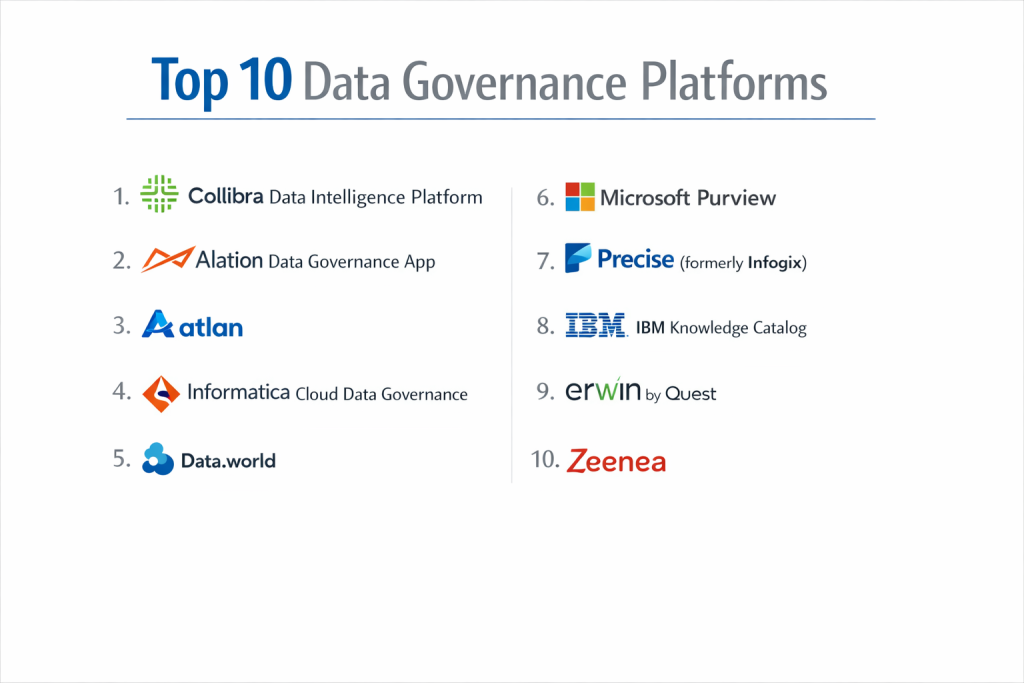
Top 10 Data Governance Platforms
1 — Collibra Data Intelligence Platform
Collibra is the market leader and arguably the most recognizable name in data governance. It provides a highly sophisticated, enterprise-grade environment for managing the entire data lifecycle.
- Key features:
- Comprehensive Business Glossary to unify company-wide definitions.
- Advanced policy manager to automate compliance with global laws.
- Collaborative Data Helpdesk for users to report data issues.
- Native integration with Collibra Data Quality and Catalog.
- Powerful workflow engine for access requests and stewardship tasks.
- Pros:
- It is the most robust tool for strictly regulated industries (Banking, Pharma).
- Extremely customizable; it can adapt to the most complex organizational hierarchies.
- Cons:
- The implementation time is often measured in months or years.
- It is a high-cost solution that requires dedicated staff to maintain.
- Security & compliance: FedRAMP, SOC 2 Type II, ISO 27001, HIPAA, and GDPR compliant.
- Support & community: World-class support, a dedicated university for training, and a global ecosystem of implementation partners.
2 — Alation Data Governance App
Alation started as a data catalog but has evolved into a leading governance platform. It focuses on “Active Governance,” which uses people’s actual behavior to drive policy enforcement.
- Key features:
- “Trust Check” signals that warn users inside their BI tools if data is deprecated.
- Automated stewardship suggestions based on usage patterns.
- Integrated SQL editor that reinforces governance rules while querying.
- Collaborative stewardship to capture “tribal knowledge.”
- Deep lineage that connects business terms to technical assets.
- Pros:
- It has a very high user adoption rate because it feels like a social tool.
- It helps engineers and business users work in the same environment effectively.
- Cons:
- Not as “strict” out-of-the-box as Collibra for traditional top-down governance.
- Pricing can scale quickly as more data sources are added.
- Security & compliance: SOC 2 Type II, HIPAA, and GDPR compliant. Supports SSO and fine-grained access.
- Support & community: Very active online community and a high-quality “Alation University” training program.
3 — Atlan
Atlan is a “modern” data governance tool built for cloud-native teams. It is designed to feel as intuitive as Slack or Notion, making it a favorite for fast-growing technology companies.
- Key features:
- “Governance-as-code” capabilities for developer-heavy teams.
- Chrome extension that brings governance into Tableau, Power BI, and Snowflake.
- Column-level lineage that tracks sensitive data automatically.
- Automated PII detection and classification using machine learning.
- Open API architecture for building custom governance workflows.
- Pros:
- It can be set up in days rather than months.
- The interface is modern, clean, and requires almost no training for new users.
- Cons:
- Less focus on legacy “on-prem” systems compared to Informatica.
- The feature depth for complex “legal” policy modeling is still catching up.
- Security & compliance: SOC 2 Type II compliant with support for private cloud deployments and VPC.
- Support & community: Fast, responsive Slack-based support and a very active modern data community.
4 — Informatica Cloud Data Governance
Informatica provides a massive, unified platform that handles everything from data movement to governance. Its CLAIRE AI engine is the centerpiece for automating metadata management.
- Key features:
- CLAIRE AI for automated data discovery and sensitive data masking.
- Integrated data quality monitoring within the governance dashboard.
- End-to-end lineage across multi-cloud and on-premise environments.
- Stakeholder dashboards to track the “Health” of governance programs.
- Pre-built industry templates for retail, finance, and healthcare.
- Pros:
- Best-in-class for hybrid environments (Cloud + Old Servers).
- Very stable and trusted by the world’s largest government agencies.
- Cons:
- The user interface can feel complex and “heavy” compared to modern tools.
- Managing the platform often requires specialized Informatica certifications.
- Security & compliance: Meets strict global security standards, including FedRAMP, HIPAA, and ISO.
- Support & community: 24/7 global support and a massive network of certified consultants.
5 — Data.world
Data.world is built on a “Knowledge Graph,” which makes it unique. It doesn’t just list data; it maps the relationships between people, data, and business goals.
- Key features:
- Graph-based architecture for finding “hidden” connections in data.
- Social features like “Likes,” “Comments,” and “Follows” for datasets.
- Native integration with Excel and Google Sheets for business users.
- Federated search across different cloud warehouses.
- Agile governance features to allow for faster, smaller project wins.
- Pros:
- Excellent for identifying “Who knows what” in a large company.
- The pricing is often more approachable for mid-sized organizations.
- Cons:
- The “Graph” concept can have a learning curve for traditional SQL users.
- Lineage visualization can be less intuitive for non-technical users.
- Security & compliance: SOC 2 Type II and HIPAA compliant.
- Support & community: Strong community of data scientists and a good library of tutorials.
6 — Microsoft Purview
For companies heavily invested in the Microsoft Azure and Office 365 ecosystem, Purview is the logical, integrated choice for governance and risk management.
- Key features:
- Automatic classification of sensitive data across Azure and O365.
- Sensitivity labels that follow files (like Excel/Word) wherever they go.
- Unified map of data assets across hybrid environments.
- Deep integration with Power BI for report governance.
- Business Glossary that syncs with Microsoft Teams.
- Pros:
- Very cost-effective if you already have a Microsoft Enterprise Agreement.
- Unmatched security for local office documents and spreadsheets.
- Cons:
- Can be difficult to govern data that lives outside the Microsoft cloud.
- The interface is quite technical and can be intimidating for business roles.
- Security & compliance: World-class Microsoft security; meets nearly every global standard.
- Support & community: Massive global support and extensive documentation on Microsoft Learn.
7 — Precise (formerly Infogix)
Precise offers a data governance solution that is highly focused on the “Quality” and “Accuracy” of data, making it popular for financial reporting and insurance.
- Key features:
- Integrated data quality checks that prevent bad data from being governed.
- Highly structured business glossaries.
- Workflow automation for data remediation (fixing errors).
- Strategic dashboards to show ROI on governance activities.
- Strong support for regulatory reporting (like BCBS 239).
- Pros:
- Excellent for companies where an error in data leads to financial loss.
- It connects data governance directly to business performance metrics.
- Cons:
- The UI is not as modern as cloud-only tools like Atlan.
- Implementation requires a very well-defined business plan.
- Security & compliance: Meets strict ISO and banking-level security requirements.
- Support & community: Professional services and dedicated account management.
8 — IBM Knowledge Catalog
Part of the IBM Cloud Pak for Data, this platform is built for large-scale enterprise governance and is increasingly focused on “AI Governance.”
- Key features:
- Automated metadata discovery and tagging using IBM Watson.
- Advanced data masking and anonymization for privacy.
- Integrated “AI Factsheets” to track how models were built.
- Role-based access control that syncs with enterprise directories.
- Support for “Data Fabric” architecture.
- Pros:
- A leading choice for companies moving into high-scale AI and ML.
- Very powerful for global companies with data in many different countries.
- Cons:
- Can feel like a “Black Box” because of the heavy reliance on Watson AI.
- High licensing costs and complex pricing tiers.
- Security & compliance: ISO 27001, HIPAA, and GDPR compliant.
- Support & community: Global 24/7 support and deep technical documentation.
9 — Erwin by Quest
Erwin is a legendary name in “Data Modeling.” Their governance platform is designed for architects who want to link the physical design of a database to business policies.
- Key features:
- Best-in-class data modeling and metadata harvesting.
- Self-service “Data Literacy” portal for business users.
- “Lineage Analysis” to see the impact of database changes.
- Social collaboration tools for data stewards.
- Strong integration with Quest’s database management tools.
- Pros:
- Perfect for companies with very complex, custom-built databases.
- It bridges the gap between database design and executive policy.
- Cons:
- It is a “technical-first” tool that can be hard for HR or Marketing teams to use.
- Modern cloud warehouse support is not as deep as some rivals.
- Security & compliance: SOC 2 compliant and follows standard data privacy protocols.
- Support & community: Dedicated technical support and long-term industry reputation.
10 — Zeenea
Zeenea is a European-based platform that calls itself a “Data Discovery Platform.” It focuses on simplicity and helping users find data in a very visual, clean way.
- Key features:
- Modern, “catalog-first” interface for easy searching.
- Smart connectors for cloud and on-premise sources.
- Collaborative business glossary with version control.
- “Role-based” experiences (different views for different employees).
- Automated lineage that is easy for non-tech users to read.
- Pros:
- Very fast implementation and a “no-nonsense” approach.
- Excellent at handling European privacy regulations (GDPR).
- Cons:
- Fewer advanced “automation” features than Informatica or IBM.
- Smaller third-party ecosystem for support in North America.
- Security & compliance: GDPR specialist; SOC 2 and ISO 27001 compliant.
- Support & community: Responsive customer success team and clear online guides.
Comparison Table
| Tool Name | Best For | Platform(s) Supported | Standout Feature | Rating |
| Collibra | Large Enterprises | Multi-Cloud | Workflow Engine | 4.7 / 5 |
| Alation | Data Culture | Cloud & On-Prem | Trust Check Alerts | 4.8 / 5 |
| Atlan | Fast-Moving Teams | Cloud-Native | Chrome Extension | 4.8 / 5 |
| Informatica | Hybrid Environments | Multi-Cloud | CLAIRE AI Engine | 4.4 / 5 |
| Data.world | Relationship Mapping | Cloud-Native | Knowledge Graph | 4.5 / 5 |
| MS Purview | Microsoft Shops | Azure | Sensitivity Labels | 4.1 / 5 |
| Precise | Data Accuracy | Any Platform | Quality-Linked Gov | 4.3 / 5 |
| IBM | AI Governance | Hybrid Cloud | AI Factsheets | 4.2 / 5 |
| Erwin | Data Architects | Any Platform | Data Modeling Link | 4.4 / 5 |
| Zeenea | Simplicity / GDPR | Cloud & On-Prem | Multi-Experience UI | 4.3 / 5 |
Evaluation & Scoring of Data Governance Platforms
| Criteria | Weight | Evaluation Focus |
| Core features | 25% | Presence of Business Glossary, Catalog, Lineage, and Policy Manager. |
| Ease of use | 15% | Adoption potential for non-technical business users. |
| Integrations | 15% | Connectivity with modern warehouses (Snowflake) and BI (Tableau). |
| Security & compliance | 10% | Encryption, SSO, and specific regulatory certifications (HIPAA, FedRAMP). |
| Performance | 10% | Stability and speed of metadata harvesting and search. |
| Support & community | 10% | Documentation quality, user groups, and responsiveness. |
| Price / value | 15% | ROI based on time saved and risk mitigated. |
Which Data Governance Platform Is Right for You?
Small to Mid-Market vs. Enterprise
If you are an Enterprise with global operations and strict legal requirements, you need a heavy hitter like Collibra or Informatica. These tools can manage the complex politics and policies of a 50,000-person company. For Small to Mid-Market companies or modern tech startups, Atlan and Zeenea provide enough power without the administrative burden, allowing you to stay “agile” while staying governed.
Budget and Value
Microsoft Purview offers the best raw value for organizations already paying for Azure. If you are looking for a premium experience but want to ensure it gets used, Alation offers great “value-per-user” because its adoption rates are typically higher. If you need a free entry point, some tools like Data.world offer community versions to test the waters before committing to a six-figure contract.
Technical Depth vs. Simplicity
If your governance team consists of Database Administrators and Data Architects, they will value the “depth” found in Erwin or IBM. If your governance is driven by Marketing, Finance, and HR managers, they will much prefer the “simplicity” of CastorDoc (not listed but similar to Zeenea) or Atlan, which uses plain English rather than database schemas.
Security and Compliance Requirements
If you work in a U.S. Government agency, look for FedRAMP certified tools like Informatica or Collibra. If you are a European company, Zeenea is a great choice because of its deep focus on GDPR. Always verify that the tool allows for “Data Masking” if your stewards will be looking at sensitive production data.
Frequently Asked Questions (FAQs)
1. What is the difference between a Data Catalog and a Data Governance Platform?
A catalog is a “Search Engine” (finding the data). A governance platform is the “Policy Manual” (rules on how to use it). Most top platforms now do both.
2. Does data governance slow down our work?
If done poorly, yes. But a good platform like Atlan or Alation actually speeds up work by helping people find trusted data faster and reducing “re-work” caused by errors.
3. How much do these platforms cost?
Enterprise solutions typically start at $50,000 per year and can easily exceed $250,000 for large companies. Microsoft Purview is often based on consumption (how much you use).
4. Who should “own” the platform?
Ideally, the Chief Data Officer (CDO) or a Data Governance Council. IT should support the technical setup, but the “business” should define the rules.
5. How long does implementation take?
Modern cloud tools can show value in 4–8 weeks. Full enterprise transformations for companies like SAP or Informatica can take 12–18 months.
6. Do I need an engineer to run this?
For the initial setup and connecting to databases, yes. For daily use (writing definitions, approving requests), it is designed for non-technical business users.
7. Can it find sensitive data automatically?
Yes, tools like Informatica and Purview use AI to scan for patterns like Social Security numbers or credit card digits and tag them as “Sensitive.”
8. What is “Data Lineage”?
It is a visual map showing where data came from, how it was changed, and where it ended up (e.g., from an Excel upload to a Power BI dashboard).
9. Can we govern data in spreadsheets?
Yes. Platforms like Microsoft Purview and Alation have specific connectors to track data even when it is “trapped” in Excel or Google Sheets.
10. What is a “Data Steward”?
A steward is a person responsible for the quality and definition of a specific set of data (e.g., the Finance Manager who “owns” the Revenue data definition).
Conclusion
Data governance is no longer a “nice-to-have” administrative task; it is the backbone of a successful modern business. As companies rush to adopt AI and predictive analytics, the risks of using ungoverned data—from legal fines to biased algorithms—become too high to ignore. A data governance platform provides the structure, transparency, and trust needed to move fast without breaking things.
The “best” platform is not the one with the most features, but the one that your employees will actually use. If you are a Microsoft-centric company, start with Purview. If you want a social, collaborative culture, look at Alation. If you need to move at the speed of light, Atlan is your winner. By choosing a tool that fits your culture, you ensure that your data remains a source of truth rather than a source of confusion.