Introduction
Brand tracking tools are specialized digital platforms that help you measure things like brand awareness, customer sentiment, and how you compare to your rivals over time. Instead of guessing how your latest campaign performed, these tools give you concrete data from social media, news sites, and direct customer surveys. They act as a constant “health check” for your business’s reputation, allowing you to catch problems early and double down on what is working.
Using these tools is important because it turns invisible feelings into measurable numbers that your team can use to grow. For example, a brand manager might use a tracker to see if a celebrity partnership actually made more people want to buy their product, or a PR team might use it to monitor a developing crisis in real-time. When you are looking for the right software, you should look for things like data accuracy, the variety of sources it monitors, and how easy the charts are to read. You want a tool that doesn’t just give you a pile of data, but actually tells you a story about your customers and your future. It should help you answer the big questions: Do people know who we are? Do they like us? And are they choosing us over the other guys?
Best for: Brand managers, marketing directors, and PR professionals at mid-sized to large companies benefit the most from these tools. They are especially useful in fast-moving industries like retail, tech, and consumer goods where public opinion can shift overnight. Agencies that manage multiple clients will also find these platforms essential for proving the value of their work to their customers.
Not ideal for: A very small local business, like a single neighborhood bakery or a local plumber, might not need a dedicated brand tracking tool. For them, a simple free alert system or just talking to customers in person is often enough. These tools can be quite expensive and complex, so they might be too much for someone who only needs to check their mentions once a month.
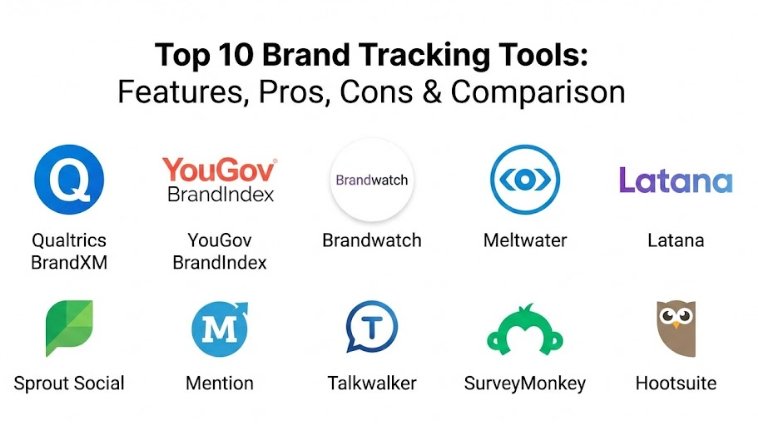
Top 10 Brand Tracking Tools
1 — Qualtrics BrandXM
Qualtrics BrandXM is a high-level platform built for large organizations that want to connect their brand data with their actual business results. It is designed for enterprise teams that need to know exactly how every move they make affects their reputation and their sales. The software is famous for its “predictive” abilities, meaning it can help you guess which marketing steps will lead to the most growth in the future. It is a massive, powerful system that doesn’t just track data but gives you a clear plan for what to do next.
- Key features:
- Simulated Brand Testing: Lets you test different brand messages before you spend money on ads.
- Automated Action Alerts: Notifies the right team member as soon as a brand metric drops below a certain level.
- Integrated Panel Access: Connects you with millions of real people to answer your survey questions quickly.
- Demographic Deep-Dives: Breaks down your brand awareness by age, location, and interests.
- Predictive Analytics: Uses smart technology to show you which brand attributes are driving the most sales.
- Cross-Experience Insights: Links your brand health data with your employee and customer service data.
- Real-time Dashboards: Provides visual charts that update the second a new response comes in.
- Pros:
- Incredible Depth: There is almost no question about your brand that this tool cannot answer with enough data.
- Highly Reliable: It is a professional-grade system used by the world’s biggest brands for high-stakes decisions.
- Cons:
- Steep Learning Curve: Because it has so many features, it takes a long time for a new user to master.
- High Cost: The pricing is built for large corporations, making it very expensive for smaller businesses.
- Security & compliance: This platform is incredibly secure, offering SOC 2 Type II, ISO 27001, and GDPR compliance. It also meets the high standards of FedRAMP for government use.
- Support & community: Offers 24/7 technical support, a dedicated account manager for larger plans, and a huge online university for learning.
2 — YouGov BrandIndex
YouGov BrandIndex is a unique tool because it uses a massive, permanent panel of real people to track how thousands of brands are doing every single day. It is designed for businesses that want to benchmark themselves against their competitors using the same standard across the whole industry. YouGov is famous for its accuracy and its ability to show you how “buzz” about your brand is changing in real-time. It is a great choice for companies that want to see how their reputation compares to the “big players” in their field without having to build their own research panel from scratch.
- Key features:
- Daily Brand Tracking: Collects fresh data every single day from thousands of real consumers.
- Buzz Scores: Measures whether the things people are hearing about your brand are positive or negative.
- Purchase Intent Tracking: Shows you exactly how many people are thinking about buying from you right now.
- Competitor Benchmarking: Allows you to put your brand’s chart right next to your rival’s chart.
- Historical Data Access: Lets you look back several years to see how your brand has grown or changed.
- Global Coverage: Tracks brand health across dozens of different countries using the same methods.
- Demographic Filtering: Allows you to see how your brand is doing with specific groups like “moms” or “tech enthusiasts.”
- Pros:
- High Trust: YouGov is a very respected name in research, so your board of directors will trust the data.
- Standardized Data: Because they use the same questions for everyone, it is the best way to compare yourself to competitors.
- Cons:
- Limited Flexibility: You cannot always change the questions they ask their panel, as the system is built for consistency.
- Higher Price for Granular Data: Getting very deep data on small niche groups can become quite expensive.
- Security & compliance: They follow strict global research standards and are fully compliant with GDPR and other data privacy laws.
- Support & community: Provides excellent customer service with research experts who can help you understand the numbers.
3 — Brandwatch
Brandwatch is a powerhouse in the world of social listening and digital consumer intelligence. It is designed for brands that want to listen to the “billions of voices” across social media, blogs, forums, and news sites. Instead of sending out surveys, Brandwatch “crawls” the internet to find every mention of your brand and tells you what people are saying when they think no one is listening. It is the best tool for spotting trends early and understanding the real, unedited emotions of your audience.
- Key features:
- Massive Data Archive: Searches through years of past social media posts to find trends.
- AI-Powered Sentiment: Automatically tells you if a post is happy, sad, or angry with high accuracy.
- Image Recognition: Finds pictures of your logo even if people don’t mention your brand’s name in text.
- Crisis Alerts: Sends an instant notification to your phone if people suddenly start complaining about you.
- Trend Prediction: Uses smart math to show you which topics are about to go viral in your industry.
- Influencer Identification: Helps you find the people who have the most power to talk about your brand.
- Vizia Visualizations: Turns your brand data into beautiful, high-tech displays for your office walls.
- Pros:
- Real-time Speed: You see what people are saying almost the exact second they post it online.
- Huge Data Source: It covers more of the internet than almost any other listening tool available.
- Cons:
- Can be Overwhelming: Seeing millions of mentions can be confusing if you don’t have an analyst to filter them.
- Requires Setup Time: Building the right “queries” to find your brand without getting “noise” takes some skill.
- Security & compliance: Offers robust data protection, is GDPR compliant, and provides secure SSO login options.
- Support & community: Has a very active user community and offers detailed training webinars and documentation.
4 — Meltwater
Meltwater is a comprehensive tool that combines traditional news monitoring with modern social media tracking. It is designed for PR and marketing teams that need to see their brand’s footprint across the entire media world—from a small local newspaper to a viral TikTok video. Meltwater is exceptional at showing you your “Share of Voice,” which is a fancy way of saying how much people are talking about you compared to everyone else. It is a very professional, “all-in-one” solution for managing a brand’s total reputation.
- Key features:
- Global News Monitoring: Tracks mentions in millions of news articles, podcasts, and TV broadcasts.
- Share of Voice Analysis: Clearly shows who is winning the “attention battle” in your industry.
- Social Media Management: Allows you to post and respond to fans directly from the same tool.
- Influencer Database: Contains a huge list of journalists and influencers you can reach out to.
- Custom Newsletter Tools: Lets you easily share your best press hits with the rest of your company.
- Executive Reporting: Creates professional PDF reports that look great in a boardroom.
- Competitor Tracking: Keeps a constant eye on what your rivals are doing in the news and on social media.
- Pros:
- Complete Media View: It is one of the few tools that covers both “old” media (TV/News) and “new” media (Social).
- Professional Look: The entire platform feels very high-end and is built for serious business teams.
- Cons:
- Complex Pricing: The cost can change a lot depending on which features you add on.
- Learning Curve: Like other large tools, it takes some time to learn how to navigate all the menus.
- Security & compliance: Uses enterprise-grade security, is GDPR compliant, and follows strict data center rules.
- Support & community: Offers 24/7 support and has offices all over the world to help with local needs.
5 — Latana
Latana is a modern brand tracking tool that focuses on making high-quality survey data affordable and fast. It is designed for growing brands that want to track their awareness and perception among very specific groups of people without spending millions of dollars. Latana uses a mobile-first approach, reaching people on their phones while they are just going about their day. It is a great choice for agile marketing teams that need to make quick decisions based on how their brand is doing this month, not last year.
- Key features:
- Precise Niche Targeting: Allows you to track your brand among very specific groups, like “vegetarians” or “gamers.”
- Brand Funnel Metrics: Tracks awareness, consideration, and preference in a clear, simple way.
- Mobile-First Surveys: Reaches people where they spend most of their time, leading to more honest answers.
- Advanced Statistical Cleaning: Uses smart math to ensure that the data you get is accurate and not full of “noise.”
- Competitor Comparison: Lets you see exactly where you are winning or losing against specific rivals.
- Intuitive Dashboard: The charts are designed to be so simple that you don’t need to be a data scientist to read them.
- Flexible Frequency: You can choose to get updates monthly or even weekly depending on your needs.
- Pros:
- Great Value: It provides very high-quality research data for a lower cost than traditional agencies.
- Easy to Use: You can set up your brand tracker and start seeing results much faster than with older tools.
- Cons:
- Less Historical Data: Because it is a newer style of tool, it might not have decades of past data to look at.
- Survey Only: It doesn’t include social media listening, so you only see what people say in surveys.
- Security & compliance: Fully GDPR compliant and follows the highest standards for data privacy and user consent.
- Support & community: Offers very helpful personal support to help you set up your first tracking project correctly.
6 — Sprout Social
Sprout Social is primarily a social media management tool, but its brand tracking and “listening” features are some of the best for mid-sized teams. It is designed for businesses that want to manage their social accounts and track their brand reputation in the same place. Sprout is famous for being incredibly easy to use and for having a very “human” design. It is perfect for a social media manager who needs to show their boss exactly how people feel about the brand without spending hours making a spreadsheet.
- Key features:
- Unified Smart Inbox: Brings every mention of your brand from every social platform into one single list.
- Listening Queries: Allows you to track specific industry terms and brand names across the web.
- Sentiment Visualization: Shows you a simple “green and red” chart of how people are feeling.
- Competitive Benchmarking: Tells you if you are getting more engagement than your rivals.
- Automated Reporting: Creates beautiful, ready-to-share reports with just one click.
- Team Collaboration: Lets you assign a specific mention to a teammate so they can respond quickly.
- Trend Identification: Helps you see which hashtags and topics are becoming popular with your fans.
- Pros:
- Very User-Friendly: Most people can learn how to use Sprout in just a few hours.
- All-in-One Workflow: You can see a problem, talk to your team, and post a response all in the same window.
- Cons:
- Lower Data Volume: It doesn’t search as many deep corners of the web as a specialized tool like Brandwatch.
- Price Per User: As you add more teammates, the cost can grow quite quickly.
- Security & compliance: Offers SSO, two-factor authentication, and is fully GDPR compliant.
- Support & community: Highly rated for customer service and has a very active online learning center.
7 — Mention
Mention is a focused, real-time monitoring tool designed for small to mid-sized businesses that want to know the second someone talks about them online. It is designed to be fast, simple, and affordable. Mention is like a “super-powered” version of a free alert system—it finds mentions on social media, blogs, news sites, and forums that other tools might miss. It is the best choice for a small team that needs to be “agile” and respond to every customer comment immediately.
- Key features:
- Real-time Web Monitoring: Scans millions of sources every day to find your brand name.
- Social Media Engagement: Allows you to reply to tweets and Facebook posts directly from the app.
- Influencer Scouting: Helps you find the most important people talking about your industry.
- Competitive Analysis: Lets you track your rivals’ names just as easily as your own.
- Custom Alert Filters: Helps you filter out “junk” mentions so you only see the important ones.
- Simple Sentiment Analysis: Tells you at a glance if people are happy or unhappy.
- Daily Summary Emails: Sends you a morning report of everything people said about you yesterday.
- Pros:
- Very Fast Setup: You can have your first alert running in under five minutes.
- Affordable Pricing: They offer plans that fit the budget of a small startup or a solo business owner.
- Cons:
- Less Deep Analysis: It doesn’t have the advanced mathematical tools that large enterprises might need.
- Source Limits: Some of the cheaper plans limit how many mentions you can see each month.
- Security & compliance: Uses secure data encryption and follows standard GDPR and privacy guidelines.
- Support & community: Offers helpful email support and a clear, simple knowledge base.
8 — Talkwalker
Talkwalker is an enterprise-grade consumer intelligence platform that focuses on using advanced AI to find insights that others miss. It is designed for global brands that need to track their reputation in dozens of languages and across many different types of media. Talkwalker is famous for its “Visual Listening,” which means it can recognize your product packaging or logo in a photo even if no one wrote your name. It is a very high-tech tool for teams that want to be at the cutting edge of brand tracking.
- Key features:
- Blue Silk AI: A very smart artificial intelligence that understands human emotion and context.
- Image & Video Recognition: Finds your brand logo in photos and videos across social media.
- Global Data Coverage: Monitors mentions in over 180 countries and 100 different languages.
- Conversation Clusters: Groups millions of posts into “bubbles” so you can see the main topics people discuss.
- Influencer Network Analysis: Shows you exactly how information travels from one person to another.
- Custom Dashboards: Allows you to build a totally unique screen that shows only the data you care about.
- Automated Newsletters: Sends your team a regular update on the most important brand news.
- Pros:
- Incredible Visual Tech: The ability to find your logo in a random Instagram photo is a huge advantage.
- Deep Global Reach: It is excellent for brands that have a presence in many different parts of the world.
- Cons:
- High Complexity: The tool can be difficult to use at first because it has so many advanced settings.
- Enterprise Pricing: This is a premium solution with a price tag that reflects its high-tech features.
- Security & compliance: This platform is highly certified, with SOC 2 Type II and GDPR compliance.
- Support & community: Offers professional services to help you set up complex tracking and has a global support team.
9 — SurveyMonkey (Momentive)
SurveyMonkey, now part of Momentive, is the most famous survey tool in the world, and its specialized brand tracking solutions are excellent for businesses that value direct feedback. It is designed for companies that want to build their own custom brand studies and reach people directly. SurveyMonkey is a great choice because almost everyone knows how to fill out one of their surveys, which leads to better data. It is a very flexible tool that can grow from a simple one-page poll to a massive global brand study.
- Key features:
- Brand Tracker Solution: A pre-built set of questions designed by experts to measure brand health.
- Global Panel Access: Allows you to buy responses from specific types of people all over the world.
- Advanced Skip Logic: Makes surveys shorter and easier for people to finish by hiding irrelevant questions.
- Sentiment Analysis: Automatically reads text answers to find the “vibe” of your customers.
- Benchmark Data: Lets you compare your survey results against other companies in your field.
- Collaborative Analysis: Allows your whole team to look at the results and leave comments.
- Mobile-Responsive Design: Every survey looks great and works perfectly on a phone or tablet.
- Pros:
- Very Easy to Start: Almost anyone can build a professional-looking survey in just a few minutes.
- Huge Reach: Their massive panel of respondents makes it easy to find people to talk to.
- Cons:
- Requires Planning: You have to know which questions to ask to get the best results.
- Limited Listening: It doesn’t track social media mentions, so you only see what people tell you directly.
- Security & compliance: Offers enterprise-grade security, is HIPAA and GDPR compliant, and has SOC 2 certification.
- Support & community: Has a massive help center, email support, and phone support for their higher-tier plans.
10 — Hootsuite
Hootsuite is one of the “original” social media tools, and its integrated brand tracking features are built for efficiency and ease. It is designed for teams that want to spend their time creating content and engaging with fans, rather than digging through complex data. Hootsuite’s “Streams” allow you to watch your brand name and industry keywords in real-time right next to your social media inbox. It is a very practical, “day-to-day” tool that helps you stay on top of your brand’s reputation while you are doing your other work.
- Key features:
- Listening Streams: Customizable columns that show every mention of your brand in real-time.
- Iris AI Assistant: A smart tool that summarizes long conversations so you don’t have to read them all.
- Unified Social Inbox: Brings all your brand’s direct messages and comments into one place.
- Competitive Analysis: Shows you how your brand’s social growth compares to your rivals.
- Employee Advocacy: Makes it easy for your staff to share positive brand news with their own followers.
- Impact Reporting: Tells you exactly which social posts led to the most people talking about you.
- Mobile App: A fully-featured app that lets you monitor your brand while you are away from your desk.
- Pros:
- Simple Workflow: It is built for the “busy social manager” who needs everything in one place.
- Proven Reliability: It is a very stable platform that has been trusted by brands for a long time.
- Cons:
- Older Interface: Some people find the “stream” design a bit cluttered compared to newer tools.
- Advanced Listening Costs Extra: To get the best brand tracking features, you usually have to pay for an add-on.
- Security & compliance: Fully GDPR compliant and offers very strong security features like HTTPS and SSO.
- Support & community: Offers 24/7 support and has a massive “Hootsuite Academy” for professional training.
Comparison Table
| Tool Name | Best For | Platform(s) Supported | Standout Feature | Rating (Avg.) |
| Qualtrics | Enterprise Brands | Web, Mobile App | Predictive BrandXM AI | 4.8 / 5 |
| YouGov | Global Benchmarking | Web | Permanent Daily Research Panel | 4.7 / 5 |
| Brandwatch | Social Listening | Web | Image & Logo Recognition | 4.6 / 5 |
| Meltwater | PR & News Teams | Web, Mobile | Share of Voice Analysis | 4.5 / 5 |
| Latana | Agile Growth Teams | Web, Mobile | Niche Demographic Targeting | 4.7 / 5 |
| Sprout Social | Mid-Sized Teams | Web, iOS, Android | Smart Inbox & Unified Reports | 4.8 / 5 |
| Mention | Small Businesses | Web, Mobile | Real-time “No Noise” Alerts | 4.4 / 5 |
| Talkwalker | Cutting-edge Tech | Web | Visual Listening for Logos | 4.7 / 5 |
| SurveyMonkey | Direct Feedback | Web, Mobile | Flexible Brand Tracker Surveys | 4.6 / 5 |
| Hootsuite | Social Workflow | Web, iOS, Android | Real-time Listening Streams | 4.5 / 5 |
Evaluation & Scoring of Brand Tracking Tools
Choosing the right tool is a big decision, and it is important to know which factors matter most. We have scored these tools based on a weighted system to show which ones offer the best overall value for a modern brand manager.
| Category | Weight | Why It Matters |
| Core Features | 25% | The basic ability to track awareness, sentiment, and competition accurately. |
| Ease of Use | 15% | How quickly your team can learn the tool without needing a PhD in data. |
| Integrations | 15% | How well the tool talks to your other software like Salesforce or Slack. |
| Security & Compliance | 10% | Ensuring your brand data is safe and follows all global privacy laws. |
| Reliability | 10% | The software should be fast and work perfectly every single day. |
| Support & Community | 10% | Being able to get help from a human or a helpful article when you are stuck. |
| Price / Value | 15% | Whether the cost of the tool is worth the extra growth it helps you achieve. |
Which Brand Tracking Tools Tool Is Right for You?
Selecting the right partner for your brand health journey depends mostly on your size, your budget, and what exactly you want to find out. Use this guide to help you make your final choice.
- Solo Users & Small Businesses: If you are a team of one or a very small group, Mention is your best bet. It is easy to set up and will keep you alerted to the most important things without a giant bill. If you just want to do an occasional survey, SurveyMonkey is a great starting point.
- Mid-Market & Agile Teams: If you are growing fast and need a professional tool but aren’t a giant corporation yet, Latana or Sprout Social are excellent choices. They provide high-level insights that are very easy to act on every day.
- Large Enterprises & Global Brands: For the “big players” who need to protect their brand in 50 countries, Qualtrics or Talkwalker are the industry standards. They provide the deep, data-heavy analysis that your board of directors will demand.
- Budget-Conscious Solutions: If you are watching every dollar, focus on tools that offer a “pay-for-what-you-use” model. SurveyMonkey allows you to do a single study, and Mention has very low starting tiers.
- Feature Depth vs. Ease of Use: If you want the most features possible, go with Talkwalker. If you want a tool that your whole team can use today with zero training, choose Sprout Social or Hootsuite.
Frequently Asked Questions (FAQs)
1. What is the difference between brand tracking and social listening?
Brand tracking is the “big picture” of your reputation over time, often using surveys to measure awareness. Social listening is about hearing the “live” conversations on the web right now. The best brands usually use a mix of both.
2. How often should I track my brand health?
For most companies, checking your brand health once a month is perfect. However, if you are running a huge advertising campaign, you might want to check it every day to see if the “buzz” is growing.
3. Is brand tracking software very expensive?
It ranges from about $50 a month for basic tools like Mention to thousands of dollars a month for enterprise systems like Qualtrics. There is a price point for almost every business size.
4. Can I track my competitors’ brand health too?
Yes! Almost every tool on this list allows you to put your rival’s name into the system. This helps you see if they are getting more attention than you and why people might like them better.
5. What is “sentiment analysis”?
This is when the computer reads a post and decides if it is positive, negative, or neutral. It helps you see if your brand reputation is generally “happy” or if there is a problem brewing.
6. Do these tools work in different languages?
Yes, tools like Talkwalker and Brandwatch are built to understand hundreds of different languages and cultures, making them perfect for global businesses.
7. Is my data safe in these platforms?
If you choose a reputable tool like the ones on this list, your data is very safe. They use the same kind of security as banks and follow strict privacy laws like GDPR.
8. Can I use these for my own employee reputation?
Yes, many companies use Qualtrics to track how their own staff feels about the brand, which is just as important as how customers feel.
9. How long does it take to see the first results?
For social listening tools, you can see results in about five minutes. For survey-based tools like Latana, it usually takes a few days to get enough answers from real people.
10. Do I need to be a “tech expert” to use this?
No. While some tools are very deep, most are designed for regular marketing people. If you can use an app on your phone, you can use most of the tools on this list.
Conclusion
Choosing the right brand tracking tool is a major step toward taking control of your company’s future. By turning invisible public feelings into clear data, you are giving your team the power to make much smarter choices about where to spend your marketing money. These platforms take the guesswork out of brand management, allowing you to build a reputation that is strong, honest, and respected by your customers. By making it easy to see where you are winning and where you need to improve, these tools act as a silent partner in your business’s success.
There is no single “best” tool for everyone; the right choice is the one that fits your specific needs and your team’s skills. Whether you need a simple alert for a new startup or a massive AI-powered system for a global brand, there is a partner on this list that can help you. Take a moment to think about what your brand needs most right now—is it awareness, better sentiment, or a clearer view of the competition? Once you know that, choosing the right tool becomes easy. Your brand is your most valuable asset, so give it the protection and attention it deserves.