Introduction
A B2B E-commerce Platform is a specialized digital commerce solution that allows businesses to sell products or services to other businesses through an online storefront. Unlike traditional consumer shopping, these platforms are built to handle high-volume orders, complex pricing structures, and long-term contract negotiations. They provide a digital space where wholesalers, manufacturers, and distributors can showcase their catalogs and manage transactions with their professional clients without relying entirely on manual phone calls or paper trails.
The importance of these platforms lies in their ability to streamline operations and meet the rising expectations of professional buyers who want a “consumer-like” experience. Real-world use cases include a manufacturer allowing dealerships to order spare parts via a private portal, a wholesaler managing different price lists for hundreds of different retailers, and a medical supply company ensuring that only licensed professionals can purchase specific equipment. When choosing a platform, users should evaluate its ability to handle custom pricing, bulk ordering, multi-warehouse inventory, and integration with existing Enterprise Resource Planning (ERP) systems.
Choosing the right tool is a strategic decision that affects every part of the supply chain. A well-implemented platform reduces the cost of sales, improves order accuracy, and allows sales teams to focus on relationship building rather than data entry. However, the market is crowded with options ranging from simple plug-ins to massive, enterprise-grade ecosystems, making the evaluation process critical for long-term success.
Best for: Wholesale distributors, manufacturers, and large-scale brands looking to digitize their sales cycle. It is ideal for operations managers, digital transformation officers, and B2B marketing teams in industries like automotive, healthcare, electronics, and construction.
Not ideal for: Small individual freelancers or tiny retail shops that only sell directly to consumers. It is also not necessary for businesses that have only one or two fixed clients and no intention of scaling their customer base through digital channels.
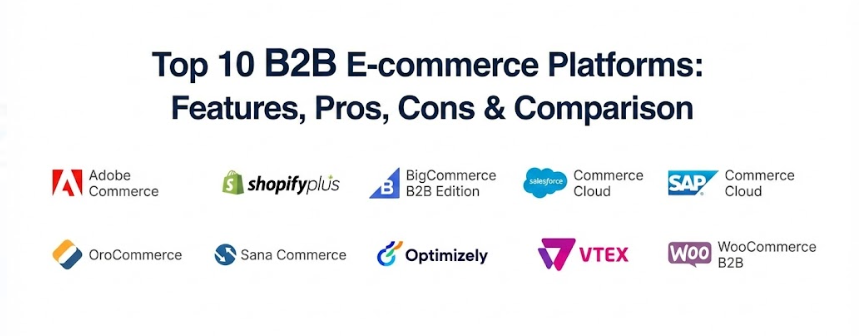
Top 10 B2B E-commerce Platforms Tools
1 — Adobe Commerce (Magento)
Adobe Commerce, built on the Magento framework, is widely considered the powerhouse of the e-commerce world. It is a highly flexible, feature-rich platform designed for large enterprises that need total control over their digital storefront and complex B2B workflows.
- Key features:
- Extensive B2B module for company account management and hierarchy.
- Advanced quote management system for price negotiations.
- Custom catalogs and price lists for different customer segments.
- Robust API for seamless integration with ERP and CRM systems.
- Support for multi-site and multi-language global operations.
- Intelligent search and product recommendations powered by AI.
- Comprehensive inventory management across multiple locations.
- Pros:
- Unmatched flexibility; if you can imagine a feature, you can build it.
- A massive ecosystem of developers and pre-built extensions.
- Cons:
- High total cost of ownership, including hosting and development.
- Requires significant technical expertise to maintain and update.
- Security & compliance: PCI DSS compliant, SSO support, AES-256 encryption, and regular security patches from Adobe.
- Support & community: Vast global community of developers, extensive official documentation, and dedicated enterprise support for Managed Services.
2 — Shopify Plus
Shopify Plus is the enterprise version of the world-famous Shopify platform. It has rapidly evolved to offer a dedicated B2B experience that brings the ease of use of consumer shopping to the complex world of wholesale.
- Key features:
- Built-in B2B “Company Profiles” to manage multiple locations and buyers.
- Custom price lists and quantity-based price breaks.
- Seamless integration between B2B and D2C (Direct-to-Consumer) on one platform.
- High-speed checkout and vaulted payment methods for easy reordering.
- Powerful automation tools like Shopify Flow to streamline order approvals.
- Dedicated wholesale expansion stores for private buyer experiences.
- Pros:
- Extremely fast time-to-market compared to traditional enterprise software.
- Very intuitive interface that requires minimal training for staff and customers.
- Cons:
- Limited customization for very specific, non-standard business logic.
- Transaction fees apply unless using the platform’s native payment gateway.
- Security & compliance: Level 1 PCI DSS compliant, SOC 2 Type II, and fully hosted secure environment.
- Support & community: 24/7 priority support, a dedicated Merchant Success Program, and a large marketplace of certified partners.
3 — BigCommerce B2B Edition
BigCommerce is known for being an “Open SaaS” platform, providing the benefits of a hosted service with the flexibility of open-source software. Their B2B Edition is specifically tuned for manufacturers and distributors.
- Key features:
- Advanced “Quote-to-Order” functionality for complex sales cycles.
- Sophisticated buyer portal for managing accounts and viewing invoices.
- Multi-storefront capabilities to manage various brands from one login.
- Native integration with major ERP systems like NetSuite and Sage.
- “Login as Customer” feature for sales reps to assist buyers in real-time.
- Shared shopping lists for collaborative buying teams.
- Pros:
- Generally lower total cost of ownership than Adobe Commerce.
- Excellent native SEO features and high site performance.
- Cons:
- The app marketplace is smaller than Shopify’s.
- High-volume sales may trigger automatic plan upgrades and higher costs.
- Security & compliance: PCI DSS Level 1, ISO 27001 certified, and GDPR compliant.
- Support & community: 24/7 technical support, comprehensive knowledge base, and a dedicated account management team for enterprise clients.
4 — Salesforce Commerce Cloud
Salesforce is the world leader in CRM, and their Commerce Cloud leverages that data to provide a deeply personalized B2B buying experience. It is designed for companies that want their sales, marketing, and commerce to exist in one ecosystem.
- Key features:
- Built on the core Salesforce platform for a 360-degree view of the customer.
- AI-driven product recommendations through Einstein AI.
- Streamlined reordering and subscription management.
- Complex contract pricing and negotiated terms automation.
- Mobile-first design for sales reps in the field.
- Scalable architecture that handles massive holiday peaks or flash sales.
- Pros:
- Best-in-class integration with Salesforce CRM and Marketing Cloud.
- Highly scalable for the world’s largest multinational corporations.
- Cons:
- Very expensive and often requires a dedicated team of consultants to implement.
- The complexity can be overwhelming for mid-market businesses.
- Security & compliance: SOC 2, ISO 27001, HIPAA compliant options, and robust data encryption.
- Support & community: Massive “Trailblazer” community, extensive certification programs, and premium enterprise support.
5 — SAP Commerce Cloud
SAP is the backbone of many of the world’s largest supply chains. Their Commerce Cloud (formerly Hybris) is an industrial-strength solution designed for complex, global B2B operations with deep manufacturing roots.
- Key features:
- Native, deep integration with SAP ERP and S/4HANA.
- Support for complex product configurations (CPQ).
- Multi-dimensional catalog management for millions of SKUs.
- Advanced self-service portals for order tracking and returns.
- Built-in support for different tax laws and regulations across countries.
- Powerful content management system (CMS) for rich product storytelling.
- Pros:
- The undisputed leader for companies already heavily invested in the SAP ecosystem.
- Capable of handling the most complex data structures in the world.
- Cons:
- Notoriously long and expensive implementation cycles.
- User interface for administrators can be complex and technical.
- Security & compliance: GDPR, SOC 1/2, ISO 27001, and enterprise-grade audit logs.
- Support & community: Global network of SAP partners and deep technical documentation for developers.
6 — OroCommerce
OroCommerce is unique because it was built from the ground up specifically for B2B needs, rather than being a B2C platform with B2B features added later. It includes a built-in CRM as part of the core package.
- Key features:
- Comprehensive out-of-the-box B2B feature set (quotes, contracts, lists).
- Integrated CRM to track the entire customer lifecycle.
- Extremely flexible workflow engine to match your specific business processes.
- Support for corporate account hierarchies and multiple websites.
- Native localized content, currencies, and tax rules.
- High-performance search optimized for massive catalogs.
- Pros:
- Exceptional value for money because many “advanced” B2B features are native.
- Designed specifically for the way B2B companies actually operate.
- Cons:
- Smaller community and fewer third-party developers than Magento or Shopify.
- Documentation can be quite technical and geared toward developers.
- Security & compliance: GDPR compliant, SSO support, and secure data encryption protocols.
- Support & community: Professional training, dedicated account managers for enterprise, and a focused developer community.
7 — Sana Commerce
Sana Commerce takes a different approach by “living” inside your ERP (like Microsoft Dynamics or SAP). It uses the logic already in your business system to power your web store, ensuring 100% data accuracy.
- Key features:
- Real-time integration with ERP logic (pricing, inventory, discounts).
- Single source of truth; no data syncing required between systems.
- Simplified order management that follows your existing ERP workflows.
- Customer self-service for viewing invoices and payment history.
- Built-in SEO and mobile-responsive design.
- Rapid deployment because the business logic is already built in the ERP.
- Pros:
- Eliminates data silos and ensures customers always see correct pricing.
- Very stable because it relies on your established business rules.
- Cons:
- Your web store is only as good as your ERP data.
- Limited flexibility to create features that don’t exist in your ERP.
- Security & compliance: PCI DSS, ISO 27001, and inherits the security of the host ERP.
- Support & community: Strong focus on customer success with localized support teams and a clear product roadmap.
8 — Optimizely (Configured Commerce)
Optimizely (formerly Insite Software) offers a platform that combines powerful B2B commerce with world-class content management and experimentation tools. It is ideal for companies that want to test and optimize their sales funnels.
- Key features:
- Deep integration with B2B workflows like bill-to/ship-to logic.
- Native mobile app for sales reps and customers.
- Built-in A/B testing and personalization features.
- Robust product information management (PIM) capabilities.
- Advanced search and filtering for complex industrial catalogs.
- Unified interface for managing content and commerce.
- Pros:
- Strongest focus on “experimentation” to increase conversion rates.
- Very reliable for companies with complex, multi-layered distribution models.
- Cons:
- Can be expensive when adding advanced optimization modules.
- Implementation requires a specialized partner for the best results.
- Security & compliance: SOC 2, GDPR, ISO 27001, and HIPAA-ready options.
- Support & community: High-quality training via Optimizely Academy and a strong global partner network.
9 — VTEX
VTEX is a cloud-native, “composable” commerce platform that has gained massive popularity in Latin America and is now expanding globally. It is known for its “collaborative commerce” approach, allowing companies to easily build marketplaces.
- Key features:
- Native marketplace architecture to sell third-party products.
- Low-code development environment for rapid customization.
- Powerful distributed order management (OMS) system.
- Built-in “SmartCheckout” for frictionless B2B reordering.
- Support for omnichannel sales, linking physical stores and digital.
- Subscription and recurring billing models built-in.
- Pros:
- Excellent for businesses that want to operate their own multi-vendor marketplace.
- Faster deployment times than many traditional enterprise platforms.
- Cons:
- Still building out its partner and developer ecosystem in North America.
- Pricing models can be complex based on sales volume and usage.
- Security & compliance: PCI DSS Level 1, SOC 2, ISO 27001, and GDPR compliant.
- Support & community: Extensive developer portal, 24/7 technical support, and a growing global community.
10 — WooCommerce B2B
WooCommerce is the world’s most popular e-commerce tool for WordPress. With the right set of B2B plugins, it becomes a viable, cost-effective option for small-to-mid-sized businesses that want to stay within the WordPress ecosystem.
- Key features:
- Role-based pricing and tax exemptions.
- Wholesale registration forms and approval workflows.
- Minimum/maximum order quantities and bulk discounts.
- Request a quote functionality for custom negotiations.
- Integration with thousands of WordPress plugins.
- Private “Members Only” store areas.
- Pros:
- Most affordable entry point for B2B e-commerce.
- If you already use WordPress, the learning curve is almost zero.
- Cons:
- Not designed for massive enterprise data loads or millions of SKUs.
- You are responsible for managing your own hosting, security, and updates.
- Security & compliance: Varies by hosting provider; requires careful management of security plugins and SSL.
- Support & community: Massive global community of developers and endless online tutorials.
Comparison Table
| Tool Name | Best For | Platform(s) Supported | Standout Feature | Rating |
| Adobe Commerce | Complex, high-growth enterprise | Web, Cloud, On-Premise | Unlimited customization | 4.6/5 |
| Shopify Plus | Rapid growth & ease of use | SaaS (Cloud) | Fastest time-to-market | 4.8/5 |
| BigCommerce B2B | Open SaaS & SEO | SaaS (Cloud) | Multi-storefront control | 4.5/5 |
| Salesforce | CRM-integrated commerce | Cloud | Einstein AI & CRM synergy | 4.4/5 |
| SAP Commerce | SAP ERP users | Cloud, On-Premise | Industrial-scale reliability | 4.2/5 |
| OroCommerce | B2B-native workflows | Cloud, On-Premise | Built-in B2B CRM | 4.7/5 |
| Sana Commerce | ERP-driven accuracy | Cloud (Integrated) | Direct ERP logic usage | 4.4/5 |
| Optimizely | Content & optimization | SaaS (Cloud) | A/B testing & personalization | 4.3/5 |
| VTEX | Marketplace models | Cloud (Composable) | Native Marketplace architecture | 4.5/5 |
| WooCommerce | SMBs on WordPress | Self-hosted (WP) | Affordability & Ecosystem | 4.0/5 |
Evaluation & Scoring of B2B E-commerce Platforms
To help you choose the right platform, we have evaluated these tools based on a weighted scoring rubric that prioritizes the core needs of a professional B2B organization.
| Criterion | Weight | Scoring Logic |
| Core Features | 25% | Native B2B functionality like quote management, custom price lists, and account hierarchies. |
| Ease of Use | 15% | Intuitiveness for both the business administrator and the end-buyer. |
| Integrations | 15% | Strength and variety of pre-built connectors for ERP, CRM, and PIM systems. |
| Price / Value | 15% | Total cost of ownership (licensing + development) versus the feature set provided. |
| Security | 10% | Compliance certifications (PCI, SOC 2) and platform stability. |
| Performance | 10% | Site speed, uptime reliability, and ability to handle large catalogs. |
| Support | 10% | Quality of documentation, developer ecosystem, and customer service responsiveness. |
Which B2B E-commerce Platforms Tool Is Right for You?
Selecting a platform is a balance between your current needs and your future growth plans. Here is a practical guide to making the final call.
Solo Users and Small Businesses (SMB)
If you are a small wholesaler or a niche manufacturer, your primary goal is likely low cost and ease of maintenance. WooCommerce B2B is an excellent choice if you already use WordPress. If you want a more “set it and forget it” experience with professional features, a standard Shopify or BigCommerce plan with B2B apps will serve you well without breaking the bank.
Mid-Market and Scaling Companies
For businesses that have outgrown simple tools and need real B2B logic (like different prices for different groups), Shopify Plus and BigCommerce B2B Edition are the front-runners. They offer a great balance of power and simplicity. If your business process is very unique and requires custom workflows, OroCommerce is a fantastic choice because it was built specifically for this middle ground.
Enterprise and Global Leaders
If your company has thousands of employees and a complex global supply chain, you need a platform that can handle the weight. Adobe Commerce (Magento) is the best choice if you need complete creative and functional freedom. If you already use SAP or Salesforce to run your business, sticking with their native commerce clouds will save you significant integration headaches and provide a unified data experience.
Budget vs. Performance
Don’t be fooled by low licensing fees. A platform like WooCommerce might be free to start, but the cost of plugins, hosting, and developer hours can add up. Conversely, a premium SaaS tool like Shopify Plus has a high monthly fee but eliminates hosting and security maintenance costs. Always calculate the Total Cost of Ownership (TCO) over three years before making a decision.
Frequently Asked Questions (FAQs)
1. How is B2B e-commerce different from B2C?
B2B involves bulk orders, negotiated pricing, and long-term contracts. Unlike B2C where everyone sees the same price, a B2B buyer sees pricing specifically agreed upon in their individual contract.
2. Can I use a B2C platform like standard Shopify for B2B?
You can, but you will need many third-party apps to handle things like “Request a Quote” or custom price lists. It is usually better to use a platform that has these features built-in.
3. Do I need an ERP integration?
For small businesses, no. But for larger companies, an ERP integration is essential to ensure that online orders automatically sync with inventory and accounting without manual entry.
4. What is “Headless” or “Composable” commerce?
This is a modern approach where the front-end (what the customer sees) is separated from the back-end (the logic). It allows for extreme flexibility and faster site speeds but is more complex to build.
5. How long does implementation take?
A simple SaaS setup can take 2-3 months. A complex enterprise migration for a global company using Adobe or SAP can take 9-18 months.
6. Are these platforms mobile-friendly?
Yes, all modern platforms are mobile-responsive. Some even offer native apps so your sales reps can place orders while visiting customers in person.
7. Can I sell both B2B and B2C on one platform?
Yes, platforms like Shopify Plus and BigCommerce allow you to manage both from a single dashboard, which is very efficient for brands that do both wholesale and direct retail.
8. What is the most expensive part of B2B e-commerce?
Usually, it is not the software license, but the implementation and integration with other business systems (ERP/CRM), along with ongoing digital marketing costs.
9. How do I handle custom pricing for 1,000 different customers?
Look for platforms with “Price List” or “Contract Pricing” features. You can assign each customer to a specific group, and the system automatically shows them their correct negotiated price.
10. Is open-source better than SaaS?
Open-source (like Magento) gives you total control but requires you to manage security and hosting. SaaS (like Shopify) is easier to manage but gives you less control over the underlying code.
Conclusion
The “best” B2B e-commerce platform is the one that removes the most friction from your sales process. For some, that means a simple, easy-to-use storefront like Shopify Plus. For others, it means a highly customized, industrial-grade powerhouse like Adobe Commerce or SAP.
When making your choice, prioritize three things: Integration, Scalability, and User Experience. If your platform can’t talk to your ERP, you’ll drown in manual data entry. If it can’t scale, you’ll have to migrate again in two years. And if it’s too hard for your customers to use, they’ll go back to calling your sales reps.
Take the time to run a detailed “Discovery Phase,” involve your sales and IT teams in the decision, and choose a platform that won’t just solve today’s problems but will also empower your growth for the next decade.