Introduction
Air quality monitoring software refers to specialized digital platforms designed to track, analyze, and report on the presence of pollutants like particulate matter (PM2.5, PM10), nitrogen dioxide (NO2), and carbon monoxide (CO) in the air. These systems serve as a bridge between physical sensors and human users, converting raw electrical signals into readable maps, charts, and alerts.
In today’s world, these tools are vital because air pollution is often invisible but has immediate impacts on health and safety. By using this software, organizations can identify the exact sources of pollution, predict future air quality trends using historical data, and ensure they are meeting legal environmental standards. Real-world use cases range from “smart city” projects that protect residents during wildfires to industrial plants managing their emissions to stay within regulatory limits.
When choosing a tool in this category, users should look for high data accuracy, the ability to integrate with different types of hardware, and an interface that is easy to navigate. Reliable alerting systems and robust reporting features are also essential for those who need to act quickly when air quality drops.
Best for:
These tools are ideal for Environmental Health and Safety (EHS) managers, urban planners, and facility directors at large industrial sites or hospitals. They are also highly beneficial for government agencies responsible for public health and sustainability.
Not ideal for:
Small residential users or hobbyists may find professional-grade software overly complex and expensive. If you only need to know if you should open a window at home, a simple standalone air monitor with a basic mobile app is usually a better alternative than a full enterprise software suite.
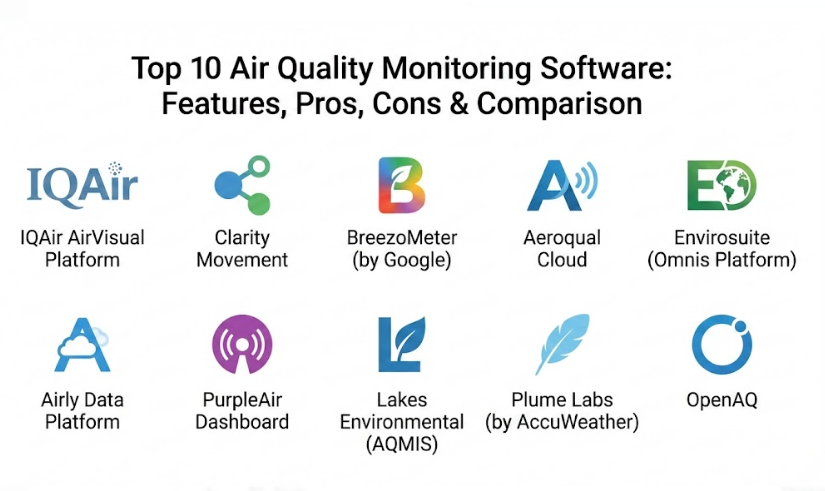
Top 10 Air Quality Monitoring Software Tools
1 — IQAir AirVisual Platform
This is a globally recognized platform that aggregates air quality data from both government stations and private sensors to provide a comprehensive view of global pollution levels. It is designed for researchers, governments, and businesses needing high-level geographic insights.
- Global data aggregation: Pulls information from thousands of locations worldwide.
- Real-time AQI tracking: Provides live Air Quality Index readings for almost any major city.
- Interactive 3D maps: Visualizes how pollution moves across the globe in real-time.
- Health recommendations: Offers specific advice based on the current pollution levels.
- Historical trend analysis: Allows users to look back at past data to identify patterns.
- Public API: Enables developers to build air quality data into their own apps.
Pros:
- Extremely user-friendly interface with beautiful visualizations.
- Access to one of the largest networks of air quality sensors globally.
Cons:
- The free version has limited deep-dive analytical features.
- Enterprise-level data access can be expensive for smaller organizations.
Security & compliance: GDPR compliant; uses encrypted data transmission for private sensor networks.
Support & community: Extensive online documentation, a massive global community of contributors, and dedicated enterprise support.
2 — Clarity Movement
Clarity provides an “end-to-end” solution that combines robust hardware nodes with a powerful cloud-based analytics platform. It is a favorite for cities and schools because of its “sensing-as-a-service” model.
- Modular sensor support: Easily adds modules for specific gases like Ozone or Black Carbon.
- Cloud-based dashboard: Access data from any device without installing software.
- Automated calibration: Uses machine learning to ensure sensors remain accurate over time.
- Public OpenMap: Allows cities to share their air quality data with the public easily.
- Cellular connectivity: Hardware connects directly to the software via global SIM cards.
- Threshold alerts: Sends notifications immediately when pollutants reach dangerous levels.
Pros:
- Very low maintenance since the software handles sensor health and calibration.
- Fast deployment; networks can be set up and visible on the map in minutes.
Cons:
- Primary focus is on their own hardware, which may limit third-party sensor integration.
- Subscription-based model means ongoing costs.
Security & compliance: SOC 2 Type II compliant; secure cloud infrastructure with data encryption.
Support & community: High-quality technical support and a strong network of smart-city partners.
3 — BreezoMeter (by Google)
Now part of the Google ecosystem, BreezoMeter focuses on hyper-local, street-level air quality intelligence. It uses big data and complex algorithms to provide data even in areas where there are no physical sensors nearby.
- Street-level resolution: Provides data with a resolution of up to 500 meters.
- Pollen tracking: Includes detailed information on allergens, which is rare in this category.
- Predictive forecasting: Offers air quality “weather” forecasts for up to four days.
- Wildfire tracking: Real-time monitoring of smoke plumes and fire movements.
- Health-focused insights: Tailors data for people with asthma or allergies.
- Scalable API: Designed to be integrated into automotive or health insurance apps.
Pros:
- Incredible accuracy in urban areas due to multi-layered data analysis.
- Includes environmental factors like traffic and weather in its calculations.
Cons:
- More of a data provider (API) than a standalone management tool for your own sensors.
- Pricing can be complex based on the volume of data requests.
Security & compliance: ISO 27001; follows Google’s high standards for data privacy and security.
Support & community: Professional documentation for developers and dedicated account management.
4 — Aeroqual Cloud
Aeroqual Cloud is a professional-grade platform designed specifically for industrial and environmental monitoring projects. It focuses on defensible data—information that is accurate enough to stand up in court or regulatory audits.
- Remote instrument management: Change sensor settings from your office without going to the site.
- Advanced graphing tools: Create wind roses and pollution roses to identify source directions.
- Data validation: Automatically flags data collected during sensor maintenance.
- Automated reporting: Generates PDF reports that meet local environmental regulations.
- Multi-user access: Set different permission levels for engineers and managers.
- API integration: Pushes data seamlessly to other environmental management systems.
Pros:
- Built for high-stakes regulatory compliance and heavy industrial use.
- Excellent remote troubleshooting capabilities to reduce site visits.
Cons:
- The interface is more technical and may have a steeper learning curve for non-experts.
- Optimized for Aeroqual hardware, which can be a significant investment.
Security & compliance: ISO 27001 approved data centers; 256-bit SSL encryption.
Support & community: Fast technical support via a global distributor network and extensive manuals.
5 — Envirosuite (Omnis Platform)
Envirosuite’s Omnis platform is a leading choice for the mining, waste, and wastewater industries. It combines real-time monitoring with predictive modeling to help operators avoid pollution events before they happen.
- Predictive modeling: Shows where dust or odors will travel based on upcoming weather.
- Complaint management: Quickly links a community complaint to actual on-site data.
- Impact tracking: Visualizes the footprint of a site’s emissions on a map.
- Automated reporting: Streamlines compliance with environmental permits.
- Multi-parameter support: Monitors air, noise, and water in one platform.
Pros:
- Powerful “what-if” scenarios allow operators to plan activities around the weather.
- Highly effective at reducing community friction and managing public relations.
Cons:
- High-end enterprise pricing that reflects its specialized industrial capabilities.
- Requires a significant setup and onboarding period.
Security & compliance: Enterprise-grade security; supports strict regulatory reporting standards.
Support & community: 24/7 global support and expert consulting services available.
6 — Airly Data Platform
Airly focuses on making air quality data accessible and “plug-and-play.” It is widely used by local governments and businesses across Europe to create dense, affordable monitoring networks.
- Hyper-local sensors: Designed to be placed on street lamps or buildings.
- Impact tracker: Measures how specific actions (like closing a road) affect air quality.
- Automated factsheets: Generates easy-to-read summaries for the public.
- AI-driven calibration: Uses artificial intelligence to correct sensor drift automatically.
- Community engagement tools: Mobile apps and web maps to share data with citizens.
Pros:
- The platform is very modern and easy to navigate for non-technical users.
- Strong focus on “acting” on data, not just collecting it.
Cons:
- Sensor density is critical for their model, which may require more hardware units.
- Smaller community presence compared to some global giants.
Security & compliance: GDPR compliant; secure cloud storage.
Support & community: Responsive customer support and a growing ecosystem of “green” cities.
7 — PurpleAir Dashboard
PurpleAir is a community-driven powerhouse. While the software looks simpler than others, it is incredibly powerful due to the sheer number of sensors in its network and the transparency of its data.
- Real-time map: One of the most famous live air quality maps in the world.
- Dual-sensor verification: Each hardware unit has two sensors to ensure data is correct.
- Downloadable data: Users can easily export historical data for their own research.
- Custom conversion factors: Allows users to apply specific scientific formulas to their data.
- Public/Private toggle: Users can choose to share their data or keep it internal.
Pros:
- Very affordable entry point for schools and small businesses.
- Huge community of researchers who use and validate this data.
Cons:
- Dashboard design is somewhat dated and less “polished” than competitors.
- Lacks advanced automated reporting features found in industrial tools.
Security & compliance: Varies; primarily focused on data transparency rather than enterprise silos.
Support & community: Massive user community and active online forums for troubleshooting.
8 — Lakes Environmental (AQMIS)
AQMIS (Air Quality Management Information System) is a modular, high-end platform used by regulatory agencies and large consultants for complex atmospheric modeling.
- Regulatory modeling: Built-in tools for EPA-approved air dispersion models.
- Emissions inventory: Tracks exactly how much of each pollutant a factory is releasing.
- Emergency release simulation: Models what happens during an accidental chemical leak.
- Centralized data hub: Consolidates data from across an entire state or country.
- Automated compliance checks: Compares live data against legal limits automatically.
Pros:
- The gold standard for regulatory agencies and environmental consultants.
- Incredible depth in atmospheric science and modeling capabilities.
Cons:
- Very complex; requires specialized training to use effectively.
- Not intended for simple real-time monitoring of a single office or school.
Security & compliance: Meets government-level security standards; full audit trails.
Support & community: Highly professional technical training and academic-level support.
9 — Plume Labs (by AccuWeather)
Plume Labs is a consumer-and-business hybrid that focuses on personal exposure and urban mapping. It is particularly strong in mobile accessibility and personalized health insights.
- Street-by-street mapping: Visualizes pollution levels along specific commuting routes.
- Personalized “Air Report”: Daily summaries of air quality tailored to your location.
- Forecast notifications: Alerts you when it’s the best time to go for a run or open windows.
- Clean-air coaching: Provides tips to reduce your personal exposure to pollutants.
- Integration with Flow: Seamlessly connects with their personal wearable air monitors.
Pros:
- The best mobile app experience in the industry.
- Focuses on the “human” side of air quality—health and activities.
Cons:
- Not designed for managing a large industrial sensor network.
- Data resolution is best in major cities but lower in rural areas.
Security & compliance: Standard data privacy protections for mobile users.
Support & community: Strong presence on social media and a large user base of health enthusiasts.
10 — OpenAQ
OpenAQ is a unique entry because it is a non-profit, open-source platform. It is the “Wikipedia” of air quality data, providing a unified home for all the world’s open air quality information.
- Open-source API: Completely free access to air quality data from 100+ countries.
- Unified data format: Standardizes data from different governments into one system.
- Historical archive: Millions of data points available for free research.
- Community-driven: Built and maintained by a global network of volunteers and scientists.
- Transparency tools: Allows users to see exactly where data comes from.
Pros:
- Completely free for researchers and non-profits.
- Ensures that air quality data is a public good, not locked behind a paywall.
Cons:
- No dedicated customer support or “managed” service.
- Lacks the specific management and alerting tools of commercial software.
Security & compliance: Public data focus; open-source standards.
Support & community: Massive community of scientists, developers, and activists.
Comparison Table
| Tool Name | Best For | Platform(s) Supported | Standout Feature | Rating |
| IQAir AirVisual | Global Public Data | Web, iOS, Android | Interactive 3D Maps | N/A |
| Clarity Movement | Schools & Smart Cities | Cloud/Web | Sensing-as-a-Service | N/A |
| BreezoMeter | App Developers | API, Web | Pollen & Wildfire Data | N/A |
| Aeroqual Cloud | Industrial Compliance | Web, Mobile App | Remote Calibration | N/A |
| Envirosuite | Mining & Waste Sites | Web, Cloud | Predictive Modeling | N/A |
| Airly Platform | Local Governments | Web, Mobile App | Impact Tracker | N/A |
| PurpleAir | Budget Monitoring | Web | Dual-Sensor Verification | N/A |
| Lakes AQMIS | Regulatory Agencies | Web/Enterprise | EPA Modeling Support | N/A |
| Plume Labs | Individual Health | iOS, Android | Street-level Mapping | N/A |
| OpenAQ | Researchers | API, Web | Global Open Dataset | N/A |
Evaluation & Scoring of Air Quality Monitoring Software
The following rubric evaluates these platforms based on their effectiveness for professional and enterprise use cases.
| Criteria | Weight | Evaluation Focus |
| Core Features | 25% | Sensor support, real-time alerts, and depth of analytics. |
| Ease of Use | 15% | Dashboard clarity, mobile access, and onboarding speed. |
| Integrations | 15% | API availability and compatibility with third-party hardware. |
| Security | 10% | Encryption standards, GDPR/SOC 2 compliance, and audit logs. |
| Reliability | 10% | Data accuracy, uptime, and automated sensor health checks. |
| Support | 10% | Documentation quality and responsiveness of technical teams. |
| Price / Value | 15% | Cost relative to the depth of insights and features provided. |
Which Air Quality Monitoring Tool Is Right for You?
Choosing the right software depends entirely on your specific goals and the scale of your project.
Solo Users vs. Enterprises
If you are an individual or a small school, look for platforms like PurpleAir or Plume Labs. These offer easy-to-read dashboards and affordable entry points. Large corporations or government agencies will need the advanced security and reporting found in Aeroqual Cloud or Lakes AQMIS.
Budget vs. Premium Solutions
For those on a tight budget, OpenAQ provides free data, while PurpleAir offers the best hardware-software value. If your budget allows for a “premium” experience where the company manages the hardware for you, Clarity Movement is the top choice.
Feature Depth vs. Ease of Use
If you need complex atmospheric science and EPA-level modeling, Lakes Software is the leader, but it is hard to learn. If you want a dashboard that anyone in your office can understand in five minutes, Airly or IQAir are much better options.
Security and Scalability
For industrial sites where data privacy and compliance are non-negotiable, prioritize tools that offer SOC 2 compliance and ISO certification. Envirosuite and Aeroqual are built specifically with these enterprise security needs in mind.
Frequently Asked Questions (FAQs)
1. What is the difference between an air quality sensor and air quality software?
The sensor is the physical device that “smells” the air, while the software is the platform that collects that data, stores it, and turns it into charts, maps, and alerts that humans can understand.
2. Can I use this software with any sensor I already own?
Some platforms like OpenAQ or IQAir can integrate data from many sources, but most professional platforms (like Aeroqual or Clarity) are optimized to work specifically with their own hardware to ensure accuracy.
3. Does this software provide real-time alerts?
Yes, most professional tools allow you to set “thresholds.” If the air quality drops below a certain level, the software will automatically send an email or SMS to the responsible parties.
4. How does the software ensure the data is accurate?
Top-tier software uses AI and machine learning to “calibrate” the data, comparing it to nearby government stations and correcting for factors like high humidity or sensor age.
5. Is air quality software compliant with privacy laws like GDPR?
Most modern platforms, especially those based in Europe or serving global enterprises, are fully GDPR compliant and use encryption to protect the location and identity of private sensor owners.
6. Can I share my data with the public?
Yes, platforms like Clarity, Airly, and PurpleAir have specific features that allow you to create a “public map” so your community can see the air quality in real-time.
7. How much does air quality monitoring software cost?
Pricing varies widely. Some are free (OpenAQ), some are a few hundred dollars a year for small networks (PurpleAir), and enterprise industrial platforms can cost thousands per year based on the number of sites.
8. Can the software predict future pollution?
Advanced platforms like BreezoMeter and Envirosuite use weather forecasts and historical data to predict air quality for the next 24 to 72 hours.
9. Do I need a scientist to run this software?
For tools like Airly or Plume Labs, no. They are designed for general users. However, complex modeling software like Lakes AQMIS usually requires someone with an environmental science background.
10. What are the most common pollutants tracked?
Almost all software tracks PM2.5 (fine dust) and PM10. Many also track NO2 (car exhaust), O3 (ozone), CO (carbon monoxide), and SO2 (sulfur dioxide).
Conclusion
Choosing the right air quality monitoring software is about finding the balance between scientific depth and practical usability. For a city manager, the best tool might be one that engages the community with simple maps. For a mine manager, the best tool is one that predicts dust movement to avoid expensive fines.
There is no single “winner” in this category because the “best” tool depends on your specific environment and goals. However, the move toward cloud-based, AI-calibrated data is clear. By selecting a platform that offers reliable data, strong security, and clear reporting, you can turn air quality from a hidden risk into a manageable part of your operations. Focus on your primary need—whether it is health, compliance, or community trust—and the right choice will become clear.