Introduction
Reliability is no longer seen as just a technical task. It is now treated as a core business requirement. Systems are expected to be available at all times. When a system fails, trust is lost and revenue is impacted. Because of this, the role of a manager who understands both the technical side of Certified Site Reliability Engineering (SRE) and the strategic side of business has become vital. A path is provided by the Certified Site Reliability Manager (CSRM) program to bridge this gap. This guide was created to help professionals understand how this certification can transform a career.
What is Certified Site Reliability Manager?
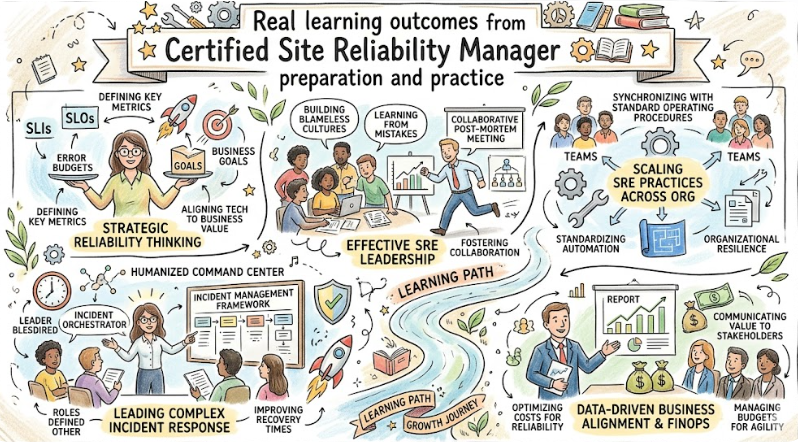
The Certified Site Reliability Manager (CSRM) is a professional designation designed for those who lead SRE teams. It is not just about writing code or fixing servers. Instead, focus is placed on the management of service level objectives (SLOs), error budgets, and team culture. Technical knowledge is combined with leadership skills in this program. A framework is provided to ensure that reliability is balanced with the need for rapid feature delivery. It is widely recognized as a standard for modern operations management.
Why it matters today?
Complex distributed systems are used by almost every major company. These systems often fail in unpredictable ways. A traditional management approach often fails because it does not account for the high velocity of change in cloud environments. The Certified Site Reliability Manager certification is valued because it teaches how to manage these uncertainties. Better uptime is achieved when a manager knows how to guide a team through post-mortems and capacity planning. Business goals are aligned with technical health through the practices taught in this program.
Why Certified Site Reliability Manager certifications are important
Career growth is often stalled when a person remains focused only on individual technical tasks. To move into leadership, a broader perspective is required. This certification is important because it validates a person’s ability to oversee complex operations. Consistency in SRE practices is ensured across an entire organization when managers are certified. It is also found that certified managers are better equipped to handle high-pressure incidents without causing burnout in their teams. Trust is built with stakeholders when a formal certification is held by the leadership.
Why choose SRESchool?
Top-tier education is provided by SRESchool for those who are serious about reliability. A deep focus on real-world scenarios is maintained throughout their courses. Unlike other platforms that only focus on theory, practical application is prioritized here. The curriculum is updated regularly so that the latest industry trends are always included. Support is offered by mentors who have spent years in the field. When SRESchool is chosen, a community of reliability experts is joined, which helps in long-term career networking.
Certification Deep-Dive: Certified Site Reliability Manager
What is this certification?
This certification is a leadership-focused program. It is designed to teach the principles of managing site reliability teams and implementing SRE culture across large organizations.
Who should take this certification?
It is recommended for Engineering Managers, Team Leads, Senior SREs, and DevOps Architects. Anyone who is responsible for system uptime and team performance will find it highly beneficial.
Certification Overview Table
| Track | Level | Who it’s for | Prerequisites | Skills Covered | Recommended Order |
| SRE | Management | Team Leads & Managers | SRE Fundamentals | SLO/SLA Management, Incident Leadership, Culture | Post-SRE Practitioner |
Skills you will gain
- The ability to define and manage Error Budgets is developed.
- Knowledge of Incident Command Systems is acquired.
- Expertise in building a blameless culture is gained.
- Skills in capacity planning and forecasting are sharpened.
- Understanding of toil reduction strategies is mastered.
- Proficiency in aligning SRE metrics with business KPIs is achieved.
Real-world projects you should be able to do after this certification
- An SRE roadmap for a mid-sized organization can be designed.
- A multi-team incident response protocol can be implemented.
- Error budget policies for different product tiers can be created.
- A toil audit and automation strategy can be conducted for a legacy system.
- A post-mortem process that drives systemic improvement can be established.
Preparation plan
7–14 days plan
A quick review of the SRE Handbook is conducted. Focus is placed on the core definitions of SLOs and SLAs. Mock exams are taken to identify weak areas. Key management frameworks are memorized.
30 days plan
A deeper study of incident management is performed. Real-world case studies of system failures are analyzed. Each chapter of the official curriculum is read twice. Practice questions are solved daily.
60 days plan
A comprehensive approach is taken. Labs are completed to understand the technical constraints faced by teams. Mentorship sessions are attended. A full-scale project simulation is executed to test management decisions.
Common mistakes to avoid
- Too much focus is placed on tools rather than culture.
- The importance of toil reduction is underestimated.
- Error budgets are treated as static numbers instead of dynamic guides.
- Communication with non-technical stakeholders is ignored.
Best next certification after this
- Same track: Advanced SRE Architecture.
- Cross-track: Certified DevSecOps Professional.
- Leadership / management: Certified FinOps Practitioner.
Choose Your Learning Path
DevOps Path
This path is best for those who want to bridge the gap between development and operations. Focus is placed on CI/CD pipelines and automation. It is ideal for engineers who want to speed up the delivery of software while maintaining quality.
DevSecOps Path
Security is integrated into every stage of the lifecycle in this path. It is designed for those who want to ensure that code is not only functional but also safe from vulnerabilities. It is perfect for security-conscious developers.
Site Reliability Engineering (SRE) Path
The application of software engineering principles to operations is the core of this path. It is best for those who enjoy solving complex scaling and stability problems. High system availability is the primary goal here.
AIOps / MLOps Path
Artificial intelligence is used to enhance IT operations in this path. It is suitable for those who want to manage machine learning models in production. It is a forward-looking path for data-driven professionals.
DataOps Path
The flow of data across an organization is managed and optimized in this path. It is best for data engineers and architects who want to ensure data quality and accessibility. Reliability in data pipelines is prioritized.
FinOps Path
Financial accountability is brought to the cloud in this path. It is intended for those who want to optimize cloud costs without sacrificing performance. It is ideal for those with an interest in both finance and technology.
Role → Recommended Certifications Mapping
| Role | Primary Certification | Secondary Certification |
| DevOps Engineer | Certified DevOps Professional | Certified DevSecOps Expert |
| Site Reliability Engineer | Certified SRE Practitioner | Certified Site Reliability Manager |
| Platform Engineer | Certified Kubernetes Architect | Certified SRE Professional |
| Cloud Engineer | Certified Cloud Architect | Certified FinOps Practitioner |
| Security Engineer | Certified DevSecOps Professional | Certified Cloud Security Specialist |
| Data Engineer | Certified DataOps Professional | Certified MLOps Engineer |
| FinOps Practitioner | Certified FinOps Professional | Certified Cloud Business Manager |
| Engineering Manager | Certified Site Reliability Manager | Certified DevOps Leader |
Next Certifications to Take
One same-track certification
The Advanced SRE Practitioner certification is a natural next step. It allows for a deeper dive into the technical intricacies of distributed systems and global scaling.
One cross-track certification
The Certified DevSecOps Professional program is recommended. A broader understanding of how security impacts reliability is gained through this course.
One leadership-focused certification
The Certified DevOps Leader certification should be considered. Skills in organizational change and large-scale transformation are developed in this program.
Training & Certification Support Institutions
DevOpsSchool
Comprehensive training programs are offered by DevOpsSchool. A wide variety of certifications in the DevOps space are supported. Hands-on learning is the primary focus.
Cotocus
Expert-led sessions are provided by Cotocus to help professionals master cloud technologies. Tailored corporate training solutions are also available. High-quality study materials are consistently delivered.
ScmGalaxy
A vast community for configuration management and DevOps is hosted by ScmGalaxy. Useful tutorials and industry updates are regularly shared. It is a great resource for continuous learning.
BestDevOps
Practical insights into modern operations are provided by BestDevOps. A focus is kept on the most in-demand tools and practices. Career guidance is offered to all students.
devsecopsschool.com
Specialized training in secure software development is found at devsecopsschool.com. Security is treated as a first-class citizen in all their courses. It is a hub for DevSecOps enthusiasts.
sreschool.com
Deep dives into site reliability engineering are conducted by sreschool.com. The Certified Site Reliability Manager program is one of their flagship offerings. Reliability is their core mission.
aiopsschool.com
The intersection of AI and IT operations is explored at aiopsschool.com. Knowledge on how to automate operations with machine learning is shared. It is designed for the next generation of engineers.
dataopsschool.com
Excellence in data management is promoted by dataopsschool.com. The lifecycle of data pipelines is covered in detail. It is a top choice for data professionals.
finopsschool.com
Cloud financial management is taught at finopsschool.com. Strategies for cost optimization are provided to cloud users. Efficiency and accountability are the main themes.
FAQs Section
- What is the difficulty level of these certifications?
The difficulty is generally considered moderate to high, as deep practical knowledge is required. - How much time is required for preparation?
A minimum of 30 to 60 days is usually suggested for a thorough understanding. - Are there any specific prerequisites?
A basic understanding of Linux and cloud computing is usually expected before starting. - In what sequence should certifications be taken?
The foundation level is typically completed before moving to professional or manager levels. - What is the career value of being certified?
Higher salary potential and access to leadership roles are common outcomes of certification. - Which job roles benefit the most?
SREs, DevOps engineers, and system architects gain the most immediate value. - Is the certification recognized globally?
Yes, these certifications are respected by major tech companies across the world. - How long is the certification valid?
Most certifications are valid for two to three years, after which renewal is required. - Are there hands-on labs included in the training?
Yes, practical labs are a core part of the learning experience provided. - Does the program cover cloud-specific tools?
General principles are taught, but common tools like Kubernetes and Terraform are often discussed. - Is there community support available?
Access to private forums and study groups is usually provided to students. - Can these certifications help in a career transition?
Yes, a clear path for moving from traditional IT to modern cloud roles is provided.
FAQs specifically focused on Certified Site Reliability Manager
- What is the main focus of the CSRM certification?
The management of SRE teams and the implementation of reliability culture are the primary focuses. - Is a technical background needed for CSRM?
Yes, a strong grasp of SRE technical principles is necessary to manage a team effectively. - How does CSRM differ from a standard DevOps cert?
CSRM is specifically focused on reliability and long-term system health rather than just delivery speed. - Are SLOs and SLAs covered in the CSRM exam?
Yes, a significant portion of the exam is dedicated to defining and managing these metrics. - Does CSRM help with budget management?
Yes, the concept of error budgets and how to use them for decision-making is a key topic. - What role does incident management play in CSRM?
Leading a team through major outages and conducting blameless post-mortems is deeply explored. - Can an aspiring manager take this course?
Yes, it is an excellent way for a senior engineer to prepare for a management role. - Is toil reduction a major part of the curriculum?
Strategies for identifying and eliminating repetitive manual work are heavily emphasized.
Testimonials
Arjun
A clear understanding of how to lead my team was gained. The focus on error budgets changed how we handle our deployments. Confidence in my management decisions has grown significantly.
Sarah
Real-world application was the best part of the program. Complex incident response protocols are now handled with ease. My career path is much clearer now.
Michael
Skill improvement was noticed by my peers immediately. The ability to align technical goals with business needs was developed. It was a great investment in my future.
Ananya
The study materials provided were excellent and easy to follow. A blameless culture was successfully implemented in my department. My team is now more productive and less stressed.
David
A deep sense of professional growth was felt after completing the certification. Leading large-scale reliability projects is no longer a daunting task. The support from the instructors was top-notch.
Conclusion
The Certified Site Reliability Manager certification is a Big asset for anyone looking to lead in the modern tech world. It is clear that reliability is the foundation of customer trust. By completing this program, a professional is prepared to handle the pressures of high-stakes environments. Long-term career benefits include not only better job opportunities but also the ability to build more resilient systems. Strategic learning should be prioritized to stay ahead in this fast-changing industry. A commitment to excellence in reliability is demonstrated when this certification is achieved.