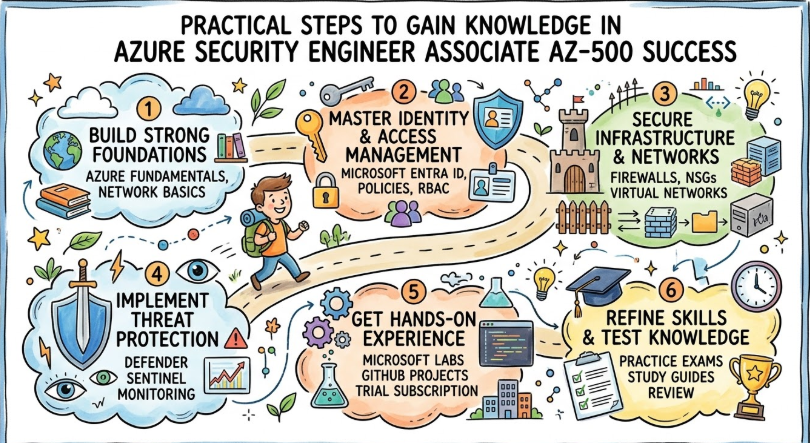
Introduction
In the current era of digital transformation, security is no longer considered an afterthought. As organizations migrate their critical workloads to the cloud, the protection of data, identity, and infrastructure has become the primary focus. The Microsoft Azure Security Engineer Associate (AZ-500) certification is recognized as a cornerstone for professionals who are tasked with securing cloud environments. It is designed to validate the skills required to implement security controls, maintain a security posture, and manage identity and access within the Azure ecosystem.
The importance of this certification in today’s software and automation ecosystem cannot be overstated. With the rise of cyber threats, specialized knowledge in cloud security is demanded by employers across the globe. For engineers, certifications serve as a formal validation of technical expertise. For managers, these credentials provide a benchmark to ensure that the team is capable of handling complex security challenges. Through the AZ-500, a deep understanding of integrated security solutions is gained, ensuring that cloud deployments remain resilient against vulnerabilities.
Certification Overview Table
| Track | Level | Who it’s for | Prerequisites | Skills Covered | Recommended Order |
| DevOps | Associate | DevOps Engineers | Azure Admin Skills | CI/CD Security, Automation | AZ-104 → AZ-400 |
| DevSecOps | Associate | Security Engineers | Cloud Fundamentals | Threat Protection, Identity | AZ-900 → AZ-500 |
| SRE | Specialist | Reliability Engineers | Systems Expertise | Monitoring, Incident Response | AZ-104 → AZ-500 |
| AIOps/MLOps | Associate | Data Scientists | Python/Azure Data | Model Security, AI Ethics | AI-900 → AI-102 |
| DataOps | Associate | Data Engineers | SQL/Data Storage | Data Encryption, Governance | DP-900 → DP-203 |
| FinOps | Specialist | Cloud Architects | Cloud Finance | Cost Management, Policy | AZ-900 → AZ-305 |
Why Choose DevOpsSchool?
It is often asked why a specific training provider should be selected for certification preparation. At DevOpsSchool, a comprehensive learning environment is provided. The curriculum is updated regularly to reflect the latest exam objectives. Hands-on labs are emphasized so that theoretical knowledge is converted into practical skills. Guidance is offered by industry veterans who have managed large-scale cloud security operations. Furthermore, lifetime access to course materials and a supportive community are provided to ensure long-term career success.
Certification Deep-Dive: Azure Security Engineer Associate (AZ-500)
What is this certification?
The AZ-500 certification is an associate-level credential offered by Microsoft. It is focused on the implementation of security controls and threat protection across identity, network, and data in the Azure cloud platform.
Who should take this certification?
This certification is intended for security engineers, cloud administrators, and DevOps professionals. It is also beneficial for anyone responsible for managing security postures and remediating vulnerabilities in an Azure environment.
Skills you will gain
- Management of identity and access using Microsoft Entra ID.
- Implementation of platform protection through network security and endpoint security.
- Configuration of security settings for data and applications.
- Operation of security monitoring and incident response using Microsoft Sentinel and Defender.
Real-world projects to be completed after this certification
- Zero Trust Architecture: A secure environment is built where every access request is verified based on identity and device health.
- Hybrid Identity Management: On-premises active directories are synchronized with the cloud to ensure seamless and secure authentication.
- Cloud Governance Implementation: Azure Policies are deployed to enforce security standards across all resource groups.
- Automated Threat Detection: A security information and event management (SIEM) system is configured to alert teams of suspicious activities in real-time.
Preparation Plan
7–14 Days Plan (The Intensive Review)
- Day 1-3: Focus is placed on Identity and Access Management (Microsoft Entra ID).
- Day 4-7: Platform Protection and Network Security are studied.
- Day 8-10: Security Operations and Data Security modules are completed.
- Day 11-14: Practice exams are taken, and weak areas are revisited.
30 Days Plan (The Balanced Approach)
- Week 1: Deep dive into Identity Management and Conditional Access.
- Week 2: Exploration of Virtual Network security, firewalls, and bastion hosts.
- Week 3: Configuration of Key Vault, storage security, and SQL database protection.
- Week 4: Extensive lab work and full-length mock tests are conducted.
60 Days Plan (The Master Path)
- Month 1: Comprehensive study of all theoretical concepts and documentation.
- Month 2: Focus is shifted toward building complex, multi-tier secure architectures in a lab environment, followed by rigorous testing.
Common mistakes to avoid
- Ignoring Hands-on Labs: Theoretical knowledge alone is insufficient for this exam.
- Neglecting Entra ID: A large portion of the exam is dedicated to identity, and this area must not be overlooked.
- Overlooking Updates: Microsoft frequently updates the exam syllabus; the latest study guide must always be consulted.
Best next certification after this
- Same Track: Microsoft Certified: Cybersecurity Architect Expert (SC-100).
- Cross-track: Azure DevOps Engineer Expert (AZ-400).
- Leadership / Management: Certified Information Systems Security Professional (CISSP).
Choose Your Learning Path
DevOps Learning Path
This path is designed for engineers who wish to integrate security into the CI/CD pipeline. The focus is placed on automation, infrastructure as code (IaC) security, and vulnerability scanning during the build phase.
DevSecOps Learning Path
This is the ideal path for specialists who bridge the gap between development and security operations. It is focused on continuous security monitoring and automated compliance checks.
Site Reliability Engineering (SRE) Learning Path
For SREs, the priority is system availability and resilience. This path emphasizes incident response, secure monitoring, and the automation of security patches to minimize downtime.
AIOps / MLOps Learning Path
As AI becomes more prevalent, the security of models and data becomes critical. This path covers the protection of machine learning pipelines and the use of AI for threat detection.
DataOps Learning Path
The integrity and confidentiality of data are the core of this path. It is tailored for those managing big data environments where encryption at rest and in transit is mandatory.
FinOps Learning Path
Security and cost management are often linked. This path explores how security policies can prevent unauthorized resource provisioning, thereby controlling cloud spend.
Role → Recommended Certifications Mapping
| Role | Recommended Certifications |
| DevOps Engineer | AZ-400, AZ-500, Certified Kubernetes Security Specialist (CKS) |
| Site Reliability Engineer | AZ-104, AZ-500, Professional Cloud Architect |
| Platform Engineer | AZ-104, AZ-500, Terraform Associate |
| Cloud Engineer | AZ-900, AZ-104, AZ-500 |
| Security Engineer | AZ-500, SC-300, SC-100 |
| Data Engineer | DP-203, AZ-500, Databricks Certified |
| FinOps Practitioner | FinOps Certified Practitioner, AZ-305 |
| Engineering Manager | AZ-900, AZ-500, CISM |
Next Certifications to Take
- Same-track: The SC-100 (Cybersecurity Architect) is recommended for those who wish to design high-level security strategies.
- Cross-track: The AZ-400 (DevOps Engineer Expert) is advised to understand how security fits into the broader development lifecycle.
- Leadership-focused: The CISM (Certified Information Security Manager) is suggested for those moving into management roles where policy and governance are key.
Training & Certification Support Institutions
DevOpsSchool
Comprehensive training programs for various cloud and DevOps certifications are provided here. A focus is maintained on real-world scenarios and project-based learning to ensure job readiness for every student.
Cotocus
Specialized consulting and training services are offered by Cotocus. The focus is on enabling organizations to adopt modern cloud practices through expert-led workshops and hands-on technical support.
ScmGalaxy
A vast repository of tutorials, blogs, and community forums is managed by ScmGalaxy. It serves as a primary resource for professionals seeking to stay updated on the latest trends in software configuration management and DevOps.
BestDevOps
Tailored coaching for high-level engineering roles is provided. This institution is known for its curated content that helps experienced professionals transition into specialized roles like SRE and DevSecOps.
devsecopsschool.com
A dedicated platform for security-focused engineering is found here. The curriculum is built around the “Security as Code” philosophy, ensuring that security is integrated early in the development cycle.
sreschool.com
Resources for site reliability engineering are centralized on this platform. The balance between feature development and system stability is taught through practical, reliability-focused modules.
aiopsschool.com
The intersection of Artificial Intelligence and IT Operations is explored. Training is provided on how to use machine learning to automate operations and improve system performance.
dataopsschool.com
Methods for improving the quality and cycle time of data analytics are taught. This site is essential for data engineers who want to implement agile practices in data management.
finopsschool.com
The focus is placed on cloud financial management. Learners are taught how to optimize cloud costs while maintaining high-performance and secure infrastructures.
FAQs Section
General FAQs
- Is the AZ-500 exam difficult?
The exam is considered moderately difficult and requires a strong grasp of both security concepts and Azure administration. - How much time is required for preparation?
It is usually observed that 4 to 8 weeks are needed depending on prior experience with the Azure platform. - What are the prerequisites for AZ-500?
There are no mandatory prerequisites, but a solid understanding of AZ-104 (Azure Administrator) is highly recommended. - In what order should certifications be taken?It is often suggested to start with AZ-900, follow with AZ-104, and then proceed to AZ-500.
- What is the career value of this certification?Great value is added to a resume, as cloud security is one of the highest-paying and most in-demand fields today.
- Which job roles are opened by this certification?Roles such as Azure Security Engineer, Cloud Security Architect, and DevSecOps Engineer are commonly attained.
- Is recertification required?Yes, Microsoft certifications must be renewed annually through a free online assessment to keep skills current.
- Does this certification cover coding?Basic scripting knowledge in PowerShell or Azure CLI is beneficial, though deep coding is not the primary focus.
- Are there labs in the actual exam?Performance-based testing (labs) may be included, where tasks must be performed within the Azure portal.
- What is the passing score?A minimum score of 700 out of 1000 is required to pass the exam.
- Can this exam be taken remotely?Yes, the option for online proctored exams is provided by Microsoft through Pearson VUE.
- How much does the exam cost?The standard pricing is 165 USD, though prices vary based on the country and available discounts.
AZ-500 Specific FAQs
- What is the weightage of Identity and Access?
Approximately 25-30% of the exam is focused on managing identity and access. - Is Microsoft Sentinel covered?
Yes, security operations including the use of Sentinel for threat hunting are integral parts of the syllabus. - Are containers and Kubernetes security included?
Basic container security and Azure Kubernetes Service (AKS) protection are covered in the platform protection section. - How is data encryption tested?
Questions regarding Azure Key Vault, Disk Encryption, and Always Encrypted for SQL are frequently asked. - Is network security a major topic?
?Yes, the configuration of NSGs, ASGs, Azure Firewall, and WAF is heavily tested. - Can one become a security engineer with only this cert?
While it is a great start, practical experience and a broader understanding of networking are also necessary. - What is the difference between AZ-500 and SC-200?
AZ-500 is focused on infrastructure security, while SC-200 is more focused on security operations and threat response. - Are third-party tools covered?
The exam is primarily focused on native Azure security tools and services.
Testimonials
Aarav
A deep understanding of cloud security was developed through this course. The transition from general administration to a security-focused role was made much easier.
Isha
Real-world application was the highlight of the training. The skills gained were immediately applied to secure our production environment in the cloud.
Meera
Confidence was significantly grown after clearing the AZ-500. The structure of the learning path provided a clear roadmap for my career progression.
Rohan
Skill improvement was noticed by the entire team. The ability to manage complex identity scenarios is now a core part of my daily operations.
Karan
Career clarity was achieved through the mentorship provided. The focus on practical labs ensured that the certification was not just a piece of paper.
Conclusion
The Azure Security Engineer Associate (AZ-500) certification is an essential milestone for any professional working within the Microsoft cloud ecosystem. It provides the technical foundation required to protect organizational assets in an increasingly hostile digital environment. The long-term career benefits include increased earning potential, access to specialized roles, and the ability to lead security initiatives. Strategic learning and disciplined certification planning are encouraged for everyone aiming to excel in the field of cloud security.