Introduction
Rapid delivery and high-quality code are now the standard. Azure DevOps is at the heart of this change. It is not just a tool; it is a way of working that brings developers and operations teams together. A Master in Azure DevOps certification is designed to prove that an individual can handle this complex ecosystem.
This certification matters because automation is no longer optional. In today’s cloud-driven market, manual processes are seen as risks. Companies need experts who can build secure, scalable, and automated pipelines. For engineers and managers, certifications are vital. They provide a structured way to learn and a clear signal to the industry that skills are up to date.
Certification Overview Table
| Track | Level | Who it’s for | Prerequisites | Skills Covered | Recommended Order |
| DevOps | Advanced | Engineers & Managers | Basic Cloud Knowledge | CI/CD, Boards, Repos, Artifacts | 1st |
| Automation | Expert | SREs & Developers | Scripting Knowledge | YAML Pipelines, Infrastructure as Code | 2nd |
| Security | Specialist | Security Engineers | DevOps Basics | DevSecOps, Compliance, Governance | 3rd |
Why Choose DevOpsSchool?
DevOpsSchool is chosen by many professionals because the focus is kept on real-world application. The labs are designed to mimic actual industry problems. Support is provided by trainers who have spent years in the field. The curriculum is updated regularly so that the latest Azure features are always included. It is considered a reliable partner for career growth in the DevOps space.
Certification Deep-Dive
Master in Azure DevOps Certification
What is this certification?
This is a comprehensive program that covers the entire Azure DevOps lifecycle. It is designed to turn a professional into a master of automation and collaboration using Microsoft’s suite of tools.
Who should take this certification?
It is recommended for Software Engineers, System Administrators, and Release Managers. Anyone who wants to lead a digital transformation using Azure should consider this path.
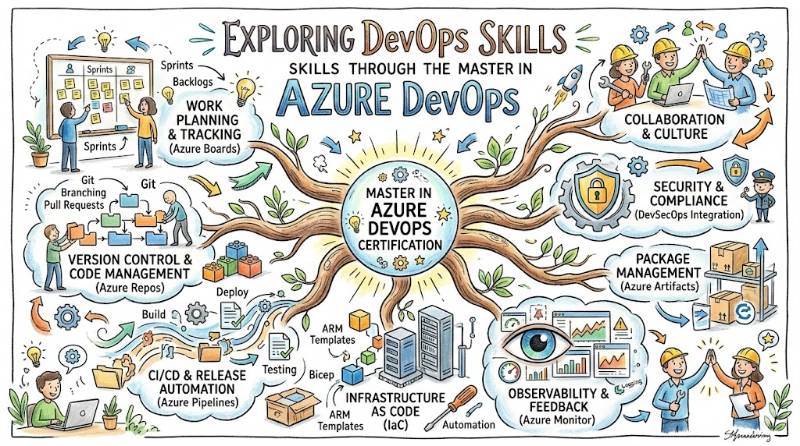
Skills you will gain
- Management of Azure Boards for project tracking.
- Configuration of Azure Repos for version control.
- Design of complex CI/CD pipelines in Azure Pipelines.
- Implementation of Azure Artifacts for package management.
- Automation of infrastructure using ARM templates or Bicep.
Real-world projects you should be able to do
- A full end-to-end automated deployment for a microservices app.
- Integration of automated testing into a release gate.
- Setup of a multi-stage environment with manual approvals.
Preparation Plan
- 7–14 days plan: Focus on the basics of Azure Boards and Repos. Understand the UI and basic terminology.
- 30 days plan: Start building YAML-based pipelines. Practice setting up build and release definitions.
- 60 days plan: Deep dive into security, governance, and scaling. Complete at least three full-scale projects.
Common mistakes to avoid
- Ignoring the importance of YAML and focusing only on the Classic editor.
- Skipping the governance and security aspects of the platform.
- Not practicing with real-world scenarios.
Best next certification after this
- Same track: Azure Solutions Architect Expert.
- Cross-track: Azure Security Engineer Associate.
- Leadership / management: ITIL Master or PMP.
Choose Your Learning Path
1. DevOps Path
This path is best for those focused on delivery speed. It covers the core tools needed to move code from a developer’s machine to production without friction.
2. DevSecOps Path
This is designed for security-minded engineers. Security checks are integrated directly into the Azure pipelines so that vulnerabilities are caught early.
3. Site Reliability Engineering (SRE) Path
The focus here is on stability and scale. It is best for those who want to use Azure Monitor and Application Insights to ensure high availability.
4. AIOps / MLOps Path
This path is meant for Data Scientists and Engineers. It teaches how to automate the training and deployment of machine learning models using Azure DevOps.
5. DataOps Path
Best for Data Engineers. It focuses on automating data pipelines and ensuring data quality across the Azure ecosystem.
6. FinOps Path
This is for those who manage cloud budgets. It teaches how to use Azure DevOps data to track costs and optimize spending.
Role → Recommended Certifications Mapping
- DevOps Engineer: Master in Azure DevOps, Docker and Kubernetes Certification.
- Site Reliability Engineer (SRE): Master in Azure DevOps, Azure Monitor Specialist.
- Platform Engineer: Master in Azure DevOps, Terraform Certification.
- Cloud Engineer: Master in Azure DevOps, Azure Administrator.
- Security Engineer: Master in Azure DevOps, Azure Security Engineer.
- Data Engineer: Master in Azure DevOps, Azure Data Engineer.
- FinOps Practitioner: Master in Azure DevOps, Cloud Cost Management.
- Engineering Manager: Master in Azure DevOps, Agile Leadership Certification.
Next Certifications to Take
For the DevOps Learner:
- Same-track: Certified Kubernetes Administrator (CKA).
- Cross-track: AWS Certified DevOps Engineer.
- Leadership-focused: Project Management Professional (PMP).
For the Security Learner:
- Same-track: Certified DevSecOps Professional.
- Cross-track: Certified Information Systems Security Professional (CISSP).
- Leadership-focused: Certified Information Security Manager (CISM).
Training & Certification Support Institutions
DevOpsSchool
Complete training programs are offered by DevOpsSchool. The focus is placed on hands-on labs and expert-led sessions. It is a well-known name for Master in Azure DevOps preparation.
Cotocus
A practical approach to learning is provided by Cotocus. Real-world scenarios are used to help engineers understand complex cloud concepts. Support is given for various global certifications.
ScmGalaxy
A vast library of resources and tutorials is maintained by ScmGalaxy. It serves as a community hub for SCM and DevOps professionals looking to upgrade their skills.
BestDevOps
Specialized bootcamps are conducted by BestDevOps. These sessions are designed for quick skill acquisition and career shifts into the DevOps domain.
devsecopsschool.com
Deep dives into security automation are offered here. The curriculum is built around integrating security into the CI/CD pipeline.
sreschool.com
Reliability and monitoring are the core focus areas. It is designed for engineers who want to specialize in high-availability systems.
aiopsschool.com
Instruction is provided on how artificial intelligence is used to enhance IT operations. It bridges the gap between AI and DevOps.
dataopsschool.com
The lifecycle of data management is covered here. It is suited for professionals looking to automate data workflows.
finopsschool.com
Education on cloud financial management is provided. It helps teams understand how to balance speed, cost, and quality.
FAQs Section
1. How difficult is the Master in Azure DevOps certification?
The difficulty is considered moderate to high. A good understanding of cloud concepts and automation is required.
2. How much time is needed to prepare?
Generally, 60 to 90 days are suggested for a thorough preparation if a few hours are dedicated daily.
3. Are there any prerequisites?
Basic knowledge of cloud computing and at least one programming language is recommended.
4. What is the recommended certification sequence?
It is suggested to start with Azure Fundamentals, followed by Azure Administrator, and then the Master program.
5. What is the career value of this certification?
High market demand is seen for certified professionals. It often leads to better job roles and higher salary packages.
6. Which job roles can be applied for?
Roles such as DevOps Engineer, Cloud Architect, and Release Manager are commonly available.
7. Is coding required for Azure DevOps?
Basic scripting and an understanding of YAML are necessary for building pipelines.
8. Can a non-technical person take this?
It is better suited for those with a technical background, but it can be learned with extra effort.
9. Is Azure DevOps better than Jenkins?
Both are powerful, but Azure DevOps is preferred by many for its integrated, all-in-one suite of tools.
10. How long is the certification valid?
Usually, these certifications are valid for one or two years, after which a renewal is needed.
11. Is there a global demand for this?
Yes, it is recognized globally by major tech hubs, including those in India and the US.
12. Does it help in getting a promotion?
Professional growth is often accelerated when a recognized certification is added to a profile.
Master in Azure DevOps Specific FAQs
13. What makes the “Master” program different?
It covers the entire ecosystem of Azure DevOps rather than just one specific tool.
14. Is the project work mandatory?
Practical application is highly encouraged to ensure the concepts are truly understood.
15. Does the program cover Bicep or Terraform?
Yes, Infrastructure as Code is a key part of the Master program.
16. Are Azure Boards covered in detail?
Management of projects using Boards is a core module of the certification.
17. Is training available for teams?
Corporate training sessions are often organized by the supporting institutions.
18. What is the pass percentage?
A high score is usually required, often around 700 out of 1000 in official exams.
19. Are practice tests provided?
Yes, practice exams are usually part of the training package.
20. Can I take the exam online?
Proctored online exams are available for candidates worldwide.
Testimonials
Aarav N.
“The transition to a DevOps role was made much easier. The real-world projects provided great confidence.”
Sanya K.
“Deep clarity was gained regarding Azure Pipelines. My team’s deployment speed has improved significantly.”
Vikram S.
“Complex cloud concepts were explained in a very simple way. The career path is now much clearer to me.”
Priya M.
“The security modules were very helpful. DevSecOps practices are now being implemented at my workplace.”
Rohan J.
“As a manager, a better understanding of the automation lifecycle was gained. It helped in planning our next project.”
Conclusion
The Master in Azure DevOps certification is a powerful tool for any software professional. It is not just about passing an exam; it is about gaining the skills to lead in a modern tech environment. Long-term career benefits include stability, growth, and the ability to work on cutting-edge projects. Strategic learning and careful certification planning are encouraged for everyone looking to stay relevant in the industry.