Introduction
The landscape of modern software development is being reshaped by the principles of automation, collaboration, and rapid delivery. In this evolving ecosystem, the DevOps Certified Professional (DCP) has emerged as a gold standard for individuals who aim to master the art of bridging the gap between development and operations. This guide is crafted to provide a deep understanding of the DCP program and how it serves as a catalyst for career transformation in the global tech market.
What is DevOps Certified Professional (DCP)?
The DevOps Certified Professional (DCP) is a comprehensive accreditation program designed to validate the technical and cultural competencies required for modern software delivery. It is not merely a certificate of attendance but a rigorous validation of an individual’s ability to implement high-velocity automation. The curriculum is structured to cover the entire lifecycle, ensuring that the principles of “Continuous Everything” are deeply understood and practiced.
Why it Matters in Today’s Software, Cloud, and Automation Ecosystem
In the current era, where cloud-native architectures and microservices are the norms, manual processes are viewed as significant risks. The DevOps Certified Professional (DCP) is essential because it provides a standardized framework for handling complex deployments. As organizations move toward AIOps and highly automated cloud environments, engineers who possess a certified understanding of these workflows are prioritized. The certification ensures that a professional can handle the scale and speed demanded by modern consumers without compromising on system stability.
Why Certifications are Important for Engineers and Managers
For engineers, certifications like the DCP act as a verified proof of skill, helping them bypass traditional barriers during hiring and promotion. It is a signal to the industry that the professional has been evaluated against a high standard. For managers, these certifications are vital for team building. When a team is composed of certified professionals, a common language is spoken, and best practices are followed by default. This leads to a reduction in technical debt and a significant increase in the reliability of the software being delivered.
2. Certification Overview Table
| Track | Level | Who it’s for | Prerequisites | Skills Covered | Recommended Order |
| Infrastructure & Automation | Professional | Engineers, Architects, Leads | Basic Linux & Scripting | CI/CD, IaC, Monitoring, Security | Start with this |
Why Choose DevOpsSchool?
When the decision is made to pursue professional growth, DevOpsSchool is often selected as the preferred partner. This is due to several key factors:
- Expert Mentorship: Training is provided by industry veterans who possess over two decades of hands-on experience in complex environments.
- Practical Lab Access: Theoretical knowledge is constantly supplemented with high-end lab environments where real-world scenarios are simulated.
- Updated Curriculum: The course content is frequently reviewed and updated to include the latest tools and methodologies used in the industry.
- Community Support: A vast network of alumni and professionals is made available to every student, ensuring that learning continues long after the certification is achieved.
- Career Guidance: Beyond the technical training, support is provided for resume building and interview preparation, making it a comprehensive solution for career advancement.
3. Certification Deep-Dive (DevOps Certified Professional)
What is this certification?
The DevOps Certified Professional (DCP) is a professional-grade credential that confirms an individual’s proficiency in automating the software delivery pipeline. It is recognized as a holistic program that integrates development, testing, and operations into a single, unified workflow.
Who should take this certification?
This program is intended for Software Developers, System Administrators, Cloud Architects, and QA Engineers. It is also highly recommended for technical leaders who are tasked with overseeing the digital transformation of their organizations.
Skills you will gain
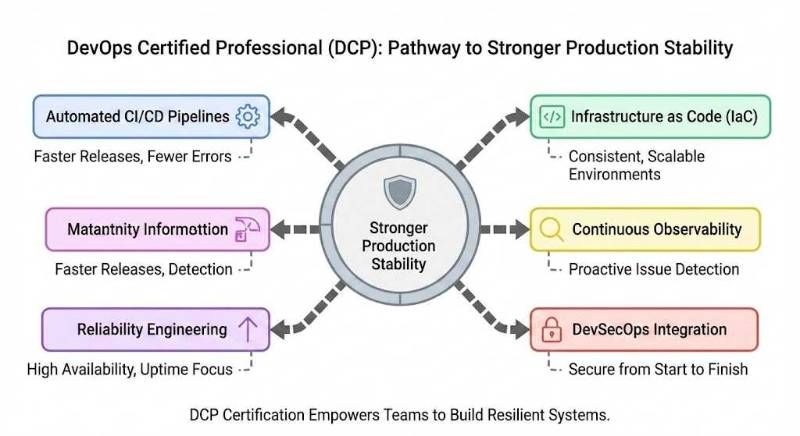
- Continuous Integration and Deployment: Mastery is achieved in building pipelines that automate the flow of code from a developer’s machine to a production server.
- Infrastructure as Code (IaC): Skills are developed in managing and provisioning infrastructure through machine-readable definition files.
- Containerization and Orchestration: A deep understanding of how to package applications and manage them at scale using modern orchestration tools is gained.
- Monitoring and Logging: Expertise is acquired in setting up observability frameworks that allow for real-time tracking of system health.
- Security Integration: The ability to weave security checks into the automated pipeline is developed, ensuring that “Shift-Left” security is a reality.
Real-world projects you should be able to do after this certification
- Zero-Downtime Deployment Pipeline: A fully automated system can be built where code updates are released without any interruption to the end-user.
- Auto-Scaling Cloud Infrastructure: A system is designed that automatically adjusts its capacity based on the volume of incoming traffic, optimizing both performance and cost.
- Self-Healing Systems: Automation is implemented to detect system failures and automatically trigger recovery processes without manual intervention.
- Automated Security Compliance: Pipelines are created that automatically reject any code that does not meet the organization’s security standards.
Preparation Plan
7–14 Days Plan (The Foundation)
During the first two weeks, focus is placed on the core concepts of the DevOps philosophy. Key terminologies are learned, and the fundamental tools for version control and basic automation are explored. The objective is to build a strong theoretical base before moving to practical labs.
30 Days Plan (The Practitioner)
In this phase, daily hands-on practice is mandated. Complex CI/CD pipelines are constructed, and various integration challenges are solved. The focus is shifted toward mastering containerization and basic cloud service integration. Mock tests are initiated to identify areas of weakness.
60 Days Plan (The Expert)
The final month is dedicated to advanced scenarios such as multi-cloud deployments and complex troubleshooting. High-level security protocols are integrated into the projects. Intensive review sessions are conducted, and full-length practice exams are completed to ensure readiness for the official certification.
Common mistakes to avoid
- Ignoring the Culture: Too much focus is often placed on tools while the cultural shift required for DevOps is overlooked.
- Lack of Hands-on Practice: Theoretical knowledge is frequently relied upon, leading to failure during practical troubleshooting scenarios.
- Skipping the Basics: Essential concepts like Linux administration and networking are sometimes ignored, which creates hurdles during advanced cloud management.
Best next certification after this
- Same track: Advanced Kubernetes or Cloud Solutions Architect.
- Cross-track: DevSecOps Certified Professional to specialize in security.
- Leadership / management: Certified DevOps Leader (CDL) for those aiming for executive roles.
4. Choose Your Learning Path
DevOps Path
This path is designed for those who wish to become the primary bridge between development and operations. It is best suited for engineers who want to master the end-to-end automation of the software lifecycle.
DevSecOps Path
The priority here is “Security as Code.” This path is ideal for security professionals and developers who want to ensure that every automated process is inherently secure from the start.
Site Reliability Engineering (SRE) Path
The focus is placed on system uptime and reliability. This path is intended for those who love large-scale systems and want to apply software engineering principles to operations tasks.
AIOps / MLOps Path
This represents the future of automation. It is best for data-driven professionals who want to use artificial intelligence to optimize IT operations or manage the lifecycle of machine learning models.
DataOps Path
In this path, the focus is on the reliability and speed of data pipelines. It is suited for data engineers who want to bring the discipline of DevOps to the world of data science and big data.
FinOps Path
The goal here is cloud financial management. This path is essential for those who want to ensure that technical speed does not lead to uncontrolled cloud spending.
5. Role → Recommended Certifications Mapping
- DevOps Engineer: DevOps Certified Professional (DCP) and Kubernetes Mastery.
- Site Reliability Engineer (SRE): SRE Professional and Advanced Monitoring Certification.
- Platform Engineer: DevOps Certified Professional (DCP) and Infrastructure as Code Specialist.
- Cloud Engineer: DCP followed by a Professional Cloud Architect designation.
- Security Engineer: DevSecOps Certified Professional.
- Data Engineer: DataOps Professional.
- FinOps Practitioner: FinOps Certified Professional.
- Engineering Manager: DevOps Leader and FinOps for Managers.
6. Next Certifications to Take
The following recommendations are provided based on current industry standards and the growth of the global tech market:
- Vertical Growth: For those staying in the same track, an Advanced Cloud Architect certification is recommended.
- Horizontal Growth: A cross-track certification in DevSecOps is suggested to broaden security expertise.
- Leadership Growth: For aspiring managers, a leadership-focused certification such as a DevOps Leader (DOL) is highly encouraged to understand team dynamics and strategy.
7. Training & Certification Support Institutions
DevOpsSchool
A premier institution where mentor-led training is provided for all levels of DevOps enthusiasts. The focus is kept on industrial readiness through intensive projects and real-world case studies.
Cotocus
Specialized training and consulting services are offered here. The institution is known for helping organizations and individuals transition to cloud-native technologies through structured learning paths.
ScmGalaxy
A comprehensive community and resource hub where knowledge regarding Source Code Management and Build engineering is shared. It serves as a vital support system for those entering the world of automation.
BestDevOps
Education is simplified here to ensure that even beginners can grasp complex DevOps concepts. Their curriculum is designed to lead students toward a successful career in automation and cloud computing.
Specialized Niche Institutions
- devsecopsschool.com: Dedicated training is provided for the integration of security into the DevOps lifecycle.
- sreschool.com: A focus is maintained on the principles of reliability and system performance engineering.
- aiopsschool.com: Training is offered on the use of AI to automate and optimize IT operations.
- dataopsschool.com: The lifecycle of data is the primary focus, teaching how to automate data pipelines effectively.
- finopsschool.com: Practical strategies for managing and reducing cloud costs are taught in this specialized institution.
8. FAQs Section
General Career FAQs
- What is the difficulty level of these certifications?
The difficulty is considered moderate but requires a strong commitment to practical labs. - How much time is required for preparation?
A period of 45 to 60 days is usually sufficient for a thorough preparation. - Are there any prerequisites for the DCP?
A basic understanding of the software development lifecycle and Linux commands is recommended. - In what sequence should I take these certifications?
The DCP is generally taken first to build a broad foundation before moving to niche tracks. - What is the career value of being certified?
An increase in job opportunities and salary potential is commonly observed after certification. - Does this certification help in finding global roles?
Yes, the DCP is globally recognized and valued by international recruiters. - Is coding a mandatory skill?
Basic scripting skills in languages like Python or Bash are essential for automation. - How long is the certification valid?
It is typically valid for 2 to 3 years, after which a renewal or advanced certification is suggested. - Can a fresher apply for the DCP?
Yes, provided they complete the foundational training and hands-on labs. - What are the top roles after DCP?
Roles such as DevOps Engineer, Automation Architect, and Release Manager are often attained. - Is cloud knowledge required?
Yes, a basic understanding of cloud platforms is necessary for the DCP. - Does this help in management roles?
- Technical credibility is gained, which is essential for leading engineering teams.
DevOps Certified Professional (DCP) Specific FAQs
- Is the DCP exam practical or theory-based?
A significant portion of the exam is dedicated to solving practical scenarios. - What is the passing score for the DCP?
A score of 70% is usually required to successfully pass the examination. - Are study materials provided?
Yes, comprehensive books, videos, and lab environments are provided by DevOpsSchool. - Can the exam be taken from home?
Yes, online proctored exams are available for global convenience. - What is the retake policy?
Candidates are allowed to retake the exam after a specific waiting period if they do not pass initially. - How is DCP different from cloud-vendor certs?
DCP is tool-agnostic and focuses on the universal principles of DevOps culture and automation. - Is it recognized in the Indian IT sector?
Yes, it is highly regarded by major Indian MNCs and tech startups. - Is there an alumni network?Access to an exclusive community of certified professionals is granted upon success.
9. Testimonials
- Aditi: “A significant improvement in my technical skills was observed after completing the DCP. The hands-on labs provided a level of clarity that I had not found elsewhere.”
- Kartik: “The DCP was instrumental in my transition to a senior DevOps role. Real-world application of the concepts was made possible through the excellent mentorship provided.”
- Ananya: “Career clarity was gained through this program. I now understand the entire delivery pipeline, which has made me a much more effective engineer.”
- Suresh: “The confidence growth I experienced during the 60-day plan was immense. I was able to implement a full CI/CD pipeline at my current company immediately.”
- Priyanka: “As a manager, the DCP helped me understand the technical hurdles my team faces. It has changed the way we plan our release cycles for the better.”
Conclusion
The DevOps Certified Professional (DCP) certification is a vital milestone for any professional in the modern software industry. It ensures that the individual is equipped with the skills and mindset required to lead in a world driven by automation and cloud computing. Long-term career benefits, including higher earning potential and job stability, are secured through this accreditation. Strategic learning and dedicated preparation are encouraged for all aspiring tech leaders.