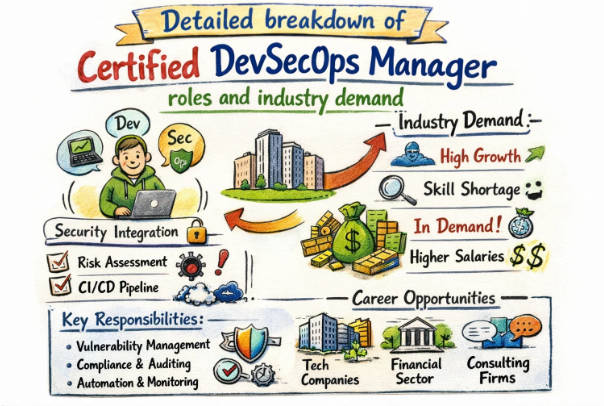
Introduction
A high level of trust is built between a company and its users when security is treated as a core feature of every product. In many organizations, a gap is often found between the speed of development and the requirements of safety. To bridge this gap, a specific type of leadership is required. The role of a Certified DevSecOps Manager in this space is not just about technical checks; it is about fostering a culture where every team member feels responsible for the integrity of the system. This guide is prepared to provide a clear path for those who wish to lead these critical initiatives.
What is a Certified DevSecOps Manager?
A professional who holds this title is responsible for the oversight of security integration within the automated software lifecycle. Guidance is provided to teams to ensure that security is not an afterthought but a continuous process. Strategy is developed to align technical security goals with the broader objectives of the business. It is a role where leadership, governance, and a deep understanding of automated pipelines are combined to protect digital assets.
Why it Matters Today?
Data protection is no longer a choice; it is a fundamental requirement for business survival. When security is managed effectively, the risk of a major breach is significantly lowered. The speed at which software is delivered continues to increase, which means manual security checks are no longer sufficient. A manager is needed to ensure that automated tools are used correctly and that compliance is maintained without creating bottlenecks for the engineering teams.
Why Certified DevSecOps Manager Certifications are Important
A standardized level of expertise is verified through professional certification. It is often observed that certified managers are better equipped to handle complex security challenges in cloud environments. A clear framework for decision-making is provided by the certification curriculum. Furthermore, the credibility of a leader is enhanced when a globally recognized body validates their skills in managing security-focused operation
Why Choose Devsecopsschool?
In Devsecopsschool A high level of professional growth is achieved through a curriculum that is shaped by the collective wisdom of industry veterans. Practical application is prioritized over abstract theory to ensure that every student is prepared for the complexities of modern security leadership. A diverse community of experts is made available to provide continuous support and mentorship beyond the classroom. The gap between technical execution and strategic management is bridged through specialized training that is recognized by major organizations worldwide. A commitment to long-term success is demonstrated by the quality of the resources and the personalized guidance that is offered to every participant.
Deep-Dive into Certified DevSecOps Manager
What is this certification?
This is a leadership-focused program that prepares individuals to manage the security aspects of a DevOps pipeline. A focus is placed on policy management, risk mitigation, and team coordination.
Who should take this certification?
Individuals who are currently in engineering roles and wish to move into leadership should take this path. It is also highly recommended for current managers who need to understand how security is automated in modern cloud environments.
Certification Overview Table
| Track | Level | Who it’s for | Prerequisites | Skills Covered | Recommended Order |
| DevSecOps | Management | Engineering Leads | Basic DevOps Flow | Risk Governance, Policy | After DevSecOps Pro |
| DevOps | Foundation | Software Engineers | Coding Basics | CI/CD, Automation | First |
| SRE | Intermediate | Systems Engineers | Cloud Knowledge | Reliability, Uptime | Second |
| AIOps | Advanced | Data Leads | Math & DevOps | Predictive Ops | Fifth |
| DataOps | Intermediate | Data Architects | Database Basics | Data Security | Third |
| FinOps | Advanced | Cloud Leads | Finance Basics | Cost Governance | Fourth |
Skills You Will Gain
- The ability to design security policies that are enforced by automation.
- Expertise in managing communication between development and security teams.
- Knowledge of how to implement compliance checks within a pipeline.
- Skills in auditing automated systems for security vulnerabilities.
- The capability to lead incident response efforts at a management level.
- An understanding of how to manage security budgets and resources effectively.
Real-World Projects to be Done After This Certification
- A security audit framework for a continuous delivery pipeline is created.
- A company-wide policy for container security is developed and implemented.
- An automated reporting system for compliance standards is established.
- A cross-team training program for secure coding practices is designed.
Preparation Plan
7–14 Days Plan
An intensive review of the exam modules is conducted. The official documentation is read thoroughly each day. Mock tests are taken to assess readiness and identify weak areas.
30 Days Plan
Time is allocated daily to study one specific domain of the certification. Practical scenarios are reviewed to understand management decisions. A final week of intensive revision is completed before the exam.
60 Days Plan
A deep dive into each topic is performed with an emphasis on long-term retention. Case studies from the industry are analyzed. Peer discussions are held to gain different perspectives on security leadership.
Common Mistakes to Avoid
- Too much focus is placed on tools rather than the people and processes.
- The importance of documentation in the management role is overlooked.
- Feedback from the development team is ignored when setting security policies.
- Compliance is treated as a one-time event rather than a continuous cycle.
Best Next Certification After This
- Same Track: Certified DevSecOps Professional (to maintain technical depth).
- Cross-Track: Site Reliability Engineering (to lead reliability initiatives).
- Leadership / Management: Master in DevOps Engineering (for a complete leadership overview).
Choose Your Learning Path
DevOps Learning Path
This path is chosen by those who want to master the flow of software from code to production. The focus is on speed, automation, and high-quality delivery.
DevSecOps Learning Path
This is intended for professionals who believe that security is the most important part of the pipeline. It covers everything from basic testing to advanced security management.
Site Reliability Engineering (SRE) Path
This path is for those who are passionate about system stability. It teaches how to manage scale and ensure that services remain available to users.
AIOps / MLOps Path
This track is for engineers who want to use data and machine learning to improve operations. It focuses on automation through intelligent systems.
DataOps Path
The management of data quality and security is the focus here. It is ideal for those working in data-heavy environments.
FinOps Path
This path is for individuals who want to manage the financial health of cloud operations. It combines technical architecture with financial accountability.
Role → Recommended Certifications Mapping
| Role | Same-Track Recommendation | Cross-Track Recommendation | Leadership Focused |
| DevOps Engineer | Certified DevOps Professional | SRE Foundation | Certified DevOps Manager |
| SRE | SRE Practitioner | DevSecOps Professional | SRE Manager |
| Platform Engineer | Kubernetes Specialist | FinOps Professional | Platform Lead |
| Cloud Engineer | Cloud Security Expert | DataOps Foundation | Cloud Architect |
| Security Engineer | DevSecOps Professional | AIOps Foundation | DevSecOps Manager |
| Data Engineer | DataOps Professional | MLOps Foundation | Data Manager |
| FinOps Practitioner | FinOps Certified | DevOps Professional | IT Finance Manager |
| Engineering Manager | DevSecOps Manager | SRE Foundation | Master in DevOps Engineering |
Training & Certification Support Institutions
DevOpsSchool
A wide range of certification programs is offered by this institution. A focus on practical, hands-on learning ensures that students are ready for the industry. Support is provided by a team of experienced mentors.
Cotocus
Enterprise-level training and consulting are delivered to organizations worldwide. Custom learning paths are created to help teams transition to modern cloud practices.
ScmGalaxy
A massive repository of technical resources and guides is maintained. It serves as a community hub for professionals looking to stay updated on the latest DevOps trends.
BestDevOps
Quick and efficient training modules are provided for busy professionals. The focus is on delivering high-value content that helps in immediate career advancement.
devsecopsschool.com
Security is woven into the development process through the specialized training provided on this platform. A focus is maintained on how to lead teams and automate security checks within a pipeline.
sreschool.com
The reliability and uptime of complex systems are prioritized through the detailed courses offered here. Guidance is shared on how to manage incidents and ensure that services remain stable for every user.
aiopsschool.com
Artificial intelligence is applied to operations to improve efficiency through the advanced modules found on this site. Predictive insights and automated incident responses are taught to help teams handle large-scale environments.
dataopsschool.com
The flow of high-quality data is managed through the structured learning paths provided for data professionals. A focus is kept on ensuring that data security and integrity are maintained throughout the delivery cycle.
finopsschool.com
Financial control is brought to cloud operations through the specialized curriculum shared on this portal. Strategies are provided to help leaders balance technical requirements with budget management and cost optimization.
FAQs Section
1. Is the manager certification considered difficult?
A balance of technical and management questions is included, making it a moderate challenge for most.
2. How much time should be set aside for study?
A period of one to two months is usually sufficient for most candidates.
3. What knowledge is required before starting?
A basic understanding of the software development lifecycle and DevOps principles is recommended.
4. What is the best order for these certifications?
It is generally suggested that technical certifications are completed before moving into the manager track.
5. What is the value of this certification in the job market?
High demand is seen for leaders who can prove their expertise in secure automation.
6. Which roles are typically offered to certified managers?
Positions such as Security Manager, DevSecOps Lead, and Engineering Director are common.
7. Are cloud-specific tools covered in the exam?
General principles that apply to all major cloud providers are tested.
8. Will this help in achieving a salary increase?
Specialized skills in security management are often rewarded with better compensation.
9. How is the exam conducted?
The exam is proctored and can be taken from a home or office environment.
10. Is the certification valid globally?
Yes, it is recognized by employers in India and international markets.
11. How often should the certification be renewed?
Renewal is typically required every few years to ensure knowledge remains current.
12. Is there a community for certified professionals?
Access to a network of alumni and mentors is provided by the training institution.
Specific FAQs for Certified DevSecOps Manager
1. Is coding a major part of the manager exam?
The focus is placed on understanding scripts and logic rather than writing code from scratch.
2. How is risk governance taught?
Methods for identifying, evaluating, and mitigating technical risks are explored.
3. Is there a focus on specific security tools?
Industry-standard tools for scanning and monitoring are discussed as part of the curriculum.
4. Are team leadership strategies included?
Yes, the course covers how to manage communication and conflict between different departments.
5. How is the concept of “Shift Left” explained?
It is taught as a strategy to move security checks to the earliest possible stage of development.
6. Is the certification suitable for non-technical managers?
Some technical background is needed, but the course is designed to be accessible to those in leadership.
7. What kind of support is provided for the exam?
Study guides, practice questions, and mentor support are typically available.
8. Is there a focus on compliance standards like SOC2 or ISO?
The automated implementation of such standards is a key part of the training.
Testimonials
The way security is viewed in our organization was completely transformed after this course. The practical approach is highly valued. — Rohan
A clear path for career growth was found through this certification. The management modules provided great clarity. — Anjali
The ability to lead a technical team with confidence was gained. The mentors at the school were very helpful. — Vikram
Real-world application of security principles was the best part of the training. It is highly recommended for all leads. — Sanya
A deep understanding of automated compliance was achieved. This has been a great boost for my professional journey. — Kabir
Conclusion
The Certified DevSecOps Manager certification is a milestone for any engineering leader. A long-term career benefit is secured by mastering the balance between speed and security. It is encouraged that a strategic plan is created for learning and certification to stay relevant in a fast-changing industry. By focusing on both leadership and technical integrity, a professional can ensure that their organization remains secure and competitive.