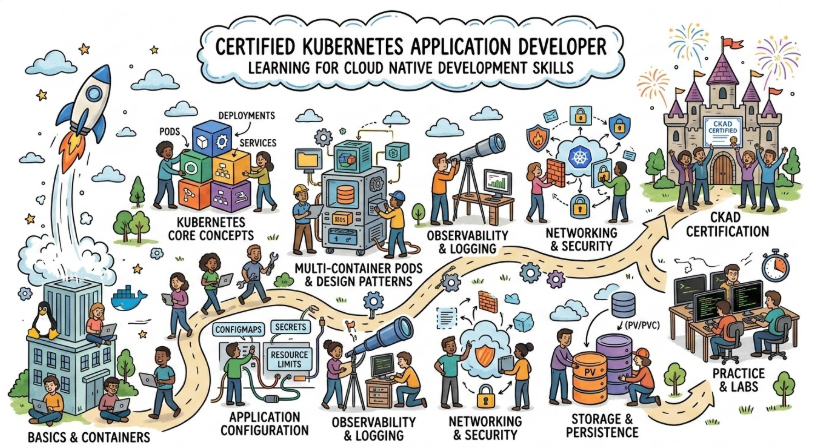
Introduction
The stability of a digital product is determined by how effectively its components are orchestrated within a cloud-native environment. For any professional involved in building modern software, the Certified Kubernetes Application Developer (CKAD) is recognized as the definitive benchmark for technical excellence. This certification is used to bridge the gap between simple coding and high-scale production deployment.
Within today’s automation-driven ecosystem, the importance of Kubernetes mastery is emphasized. As applications are shifted to the cloud, complex challenges regarding scaling, security, and networking are encountered. These hurdles are cleared using the principles taught within the CKAD curriculum. For engineers, a deeper understanding of containerized environments is gained. For managers, a team capable of building self-healing systems is secured.
Certifications are regarded as essential milestones for career progression. Theoretical knowledge is often found to be insufficient when high-stakes production issues arise. By pursuing the CKAD, a structured mastery of Kubernetes primitives is achieved. Confidence is built, and a professional’s value in the global market is significantly enhanced.
Certification Overview Table
| Track | Level | Who it’s for | Prerequisites | Skills Covered | Recommended Order |
| Cloud-Native Development | Professional | Developers, DevOps, Platform Engineers | Basic Linux & Container Knowledge | Pod Design, Deployment, Networking, Security, Storage | Recommended after basic Docker mastery |
Why Choose DevOpsSchool?
DevOpsSchool is chosen by thousands of professionals because a hands-on, mentor-led approach is prioritized. The curriculum is meticulously crafted to reflect the realities of the modern workplace. Practical labs are provided to ensure that every concept is not just learned but deeply understood. Guidance is offered by industry experts, and a community of like-minded learners is made available to every student. By choosing this institution, a path to long-term career success is established.
Certification Deep-Dive: Certified Kubernetes Application Developer (CKAD)
What is this certification?
The CKAD is a performance-based assessment conducted by the Cloud Native Computing Foundation. The ability to design, build, and configure cloud-native applications within Kubernetes is validated through this exam.
Who should take this certification?
- Software Developers: Those responsible for writing code that must run in containers.
- DevOps Professionals: Individuals tasked with automating the deployment of applications.
- System Architects: Professionals who design the structure of modern microservices.
- Engineering Managers: Leaders who wish to understand the technical constraints of their teams.
Skills you will gain
- Container Orchestration: The art of managing multiple containers seamlessly is mastered.
- Service Configuration: Knowledge of how services are exposed to the internet is acquired.
- Resource Management: Insights into how CPU and memory limits are set for stability are gained.
- Storage Solutions: The management of persistent data within ephemeral containers is learned.
- Troubleshooting: The ability to diagnose and fix failing applications in real-time is developed.
Real-world projects you should be able to do
- Microservices Migration: A monolithic application is successfully moved into a distributed Kubernetes cluster.
- Automated Scaling: A system that automatically scales based on user traffic is implemented.
- Health Monitoring: Self-healing mechanisms, such as Liveness and Readiness probes, are configured for high availability.
- Secure Networking: Strict rules are applied to ensure that only authorized traffic can access sensitive application components.
Preparation Plan
7–14 Days Plan (The Intensive Review)
- The official Kubernetes documentation is reviewed daily.
- Speed and accuracy with
kubectlare practiced in a lab environment. - Mock exams are completed to ensure that time management is optimized.
30 Days Plan (The Balanced Approach)
- In the first two weeks, core concepts like Pods, Jobs, and Deployments are mastered.
- During the third week, advanced topics such as Network Policies and Ingress are explored.
- The final week is dedicated to simulating the exam environment multiple times.
60 Days Plan (The Comprehensive Mastery)
- The first month is spent building a solid foundation in Linux and Docker.
- In the second month, the CKAD curriculum is followed step-by-step.
- A personal project is deployed on a Kubernetes cluster to solidify practical understanding.
Common mistakes to avoid
- Over-reliance on YAML editors: Time is often wasted by manual editing; imperative commands are preferred.
- Ignoring Contexts: Exam questions are often failed because the wrong cluster context was used.
- Lack of Speed: Even when the solution is known, the exam is failed if the answers are not provided quickly enough.
Best next certification after this
- Same track: Certified Kubernetes Administrator (CKA).
- Cross-track: Certified Kubernetes Security Specialist (CKS).
- Leadership / management: Certified DevOps Leader.
Choose Your Learning Path
1. DevOps Path
This path is intended for those who wish to focus on the automation of the entire software delivery lifecycle. Continuous integration and delivery are the primary focus areas.
2. DevSecOps Path
Security is integrated into every layer of the application development process. Vulnerability scanning and runtime security are prioritized.
3. Site Reliability Engineering (SRE) Path
System uptime and reliability are the main objectives. Strategies for handling massive scale and minimizing downtime are developed.
4. AIOps / MLOps Path
Machine learning models are deployed and managed at scale. The specific resource needs of AI-driven applications are addressed.
5. DataOps Path
Data pipelines are managed within the Kubernetes ecosystem. Consistency and speed of data flow are ensured for analytics teams.
6. FinOps Path
Cloud costs are analyzed and optimized. The financial impact of resource allocation within Kubernetes is managed effectively.
Role → Recommended Certifications Mapping
- DevOps Engineer: CKAD, CKA, and HashiCorp Terraform.
- Site Reliability Engineer (SRE): CKAD, Prometheus Certified Associate, and CKA.
- Platform Engineer: CKAD, ArgoCD Associate, and CKS.
- Cloud Engineer: CKAD and AWS Solutions Architect.
- Security Engineer: CKAD, CKS, and DevSecOps Foundation.
- Data Engineer: CKAD and Big Data certifications.
- FinOps Practitioner: CKAD and FinOps Certified Professional.
- Engineering Manager: CKAD and Project Management Professional.
Next Certifications to Take
For the Developer Track:
- Same-track: Certified Kubernetes Administrator.
- Cross-track: AWS Certified Developer Associate.
- Leadership: Professional Scrum Master.
For the Security Track:
- Same-track: Certified Kubernetes Security Specialist.
- Cross-track: Azure Security Engineer.
- Leadership: Certified Information Systems Security Professional.
Training & Certification Support Institutions
DevOpsSchool
At DevOpsSchool, comprehensive training for all major DevOps tools is provided. A vast library of resources and expert-led sessions are made available to learners. Career goals are reached through their structured roadmap and 24/7 support system.
Cotocus
Cotocus is recognized for its specialized consulting and training programs. Real-world scenarios are used to teach complex cloud-native technologies. A focus on practical implementation ensures that students are ready for the job market immediately.
ScmGalaxy
ScmGalaxy serves as a massive knowledge hub for the community. Articles, tutorials, and certification guides are published regularly. It is an ideal platform for staying updated with the latest trends in software configuration management.
BestDevOps
BestDevOps offers curated courses designed for rapid skill acquisition. Unnecessary fluff is avoided to ensure that only relevant, high-impact skills are taught. It is a preferred choice for busy professionals looking to upskill quickly.
devsecopsschool.com
The focus at devsecopsschool.com is entirely on the security aspect of the DevOps pipeline. Modern security tools and methodologies are explored in depth to prepare engineers for the rising threat landscape.
sreschool.com
The principles of reliability and system performance are taught at sreschool.com. Students are trained to build systems that are not only functional but also highly resilient to failure.
aiopsschool.com
At aiopsschool.com, the intersection of AI and operations is explored. The knowledge needed to automate complex IT operations using artificial intelligence is provided to advanced learners.
dataopsschool.com
Data management lifecycles are the primary focus at dataopsschool.com. Engineers are trained to handle large-scale data processing within modern cloud environments.
finopsschool.com
Cloud financial management is simplified at finopsschool.com. Strategies for optimizing cloud spend and ensuring accountability across teams are shared with participants.
FAQs Section
1. Is the CKAD exam difficult?
The exam is considered moderately difficult because it is purely hands-on. Success is determined by practical ability rather than memorization.
2. How much time is needed for preparation?
Typically, 4 to 8 weeks are required if consistent practice is maintained.
3. What are the prerequisites?
Official prerequisites are not required, but experience with Linux and Docker is highly beneficial.
4. Can CKA be taken after CKAD?
Yes, taking CKA after CKAD is often recommended as many concepts are shared between the two.
5. Is the certification recognized globally?
The CKAD is recognized worldwide as a top-tier validation of Kubernetes expertise.
6. Where is the exam taken?
The exam is taken online from any location that meets the technical and environmental requirements.
7. How long does the certification last?
A validity period of three years is assigned to the CKAD certificate.
8. Is a retake provided if the first attempt is failed?
One free retake is usually included in the exam purchase, allowing for a second attempt if needed.
9. Is coding required for the exam?
Writing complex code is not required, but the ability to structure YAML files correctly is essential.
10. How is the exam graded?
The exam is graded based on the completion of tasks within a live Kubernetes environment.
11. Does this certification help in salary growth?
A significant increase in salary is often reported by professionals after achieving this certification.
12. What tools are allowed during the exam?
The official Kubernetes documentation is allowed to be accessed during the test.
Additional CKAD Specific FAQs
13. What version of Kubernetes is used?
The exam environment is updated regularly to reflect recent stable versions of Kubernetes.
14. Are multiple clusters used in the exam?
Yes, multiple clusters are provided, and context switching is required for different tasks.
15. Is Helm included in the CKAD?
Basic Helm commands are now part of the CKAD syllabus and must be practiced.
16. How many questions are there?
Usually, 17 to 20 tasks are presented to be completed within 120 minutes.
17. What is the passing percentage?
A score of 66% or higher must be achieved to pass the CKAD exam.
18. Can a private terminal be used?
No, a browser-based terminal environment provided by the exam proctor must be used.
19. Are persistent volumes covered?
Yes, the creation and configuration of PersistentVolumes and Claims are important topics.
20. Is the exam proctored?
The exam is live-proctored via webcam and screen sharing to ensure integrity.
Testimonials
Aarav (DevOps Engineer)
“A complete shift in my career was experienced after the CKAD was completed. Complex application deployments are now managed with ease, and my technical contributions are highly valued by my team.”
Meera (SRE)
“The practical skills gained through this certification have made a massive difference. System failures are now diagnosed and fixed much faster, leading to improved uptime for our clients.”
John (Cloud Engineer)
“The confidence gained from passing this hands-on exam is incomparable. My ability to design scalable cloud solutions was validated, and several new job offers were received.”
Siddharth (Security Engineer)
“The relationship between application development and cluster security is much better understood now. This certification provided the foundation needed to move into DevSecOps.”
Priyanka (Engineering Manager)
“By earning this certification, a better understanding of the developer’s daily challenges was achieved. It has allowed for more realistic project timelines and better resource planning.”
Conclusion
The Certified Kubernetes Application Developer (CKAD) is more than just a credential; it is a transformation of one’s professional identity. By mastering the art of application development within Kubernetes, a future in the cloud-native world is secured. Whether career growth, technical excellence, or higher compensation is sought, the path is cleared through this certification. Strategic planning and dedicated learning are encouraged for all who wish to lead in the modern era of software engineering.