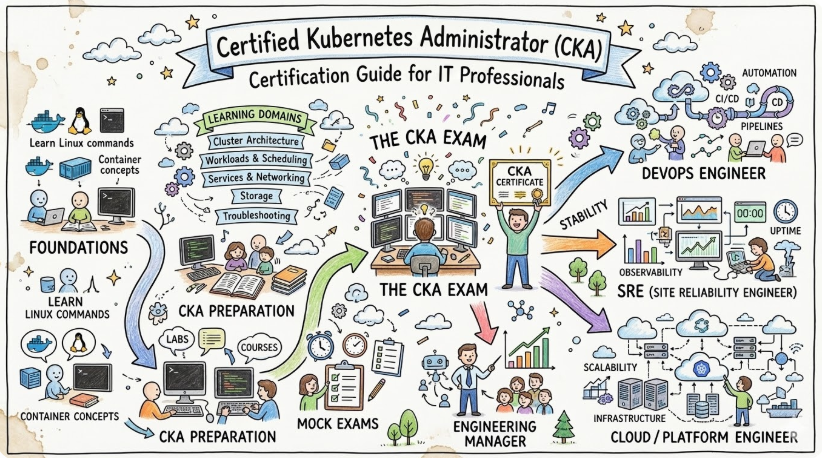
Introduction
IT infrastructure has been completely redefined by the rise of container orchestration. At the very center of this transformation, Kubernetes is positioned as the primary engine for scaling applications. For professionals who are tasked with maintaining these complex systems, the Certified Kubernetes Administrator (CKA) is recognized as the gold standard of technical validation.
What is Certified Kubernetes Administrator (CKA)?
A specialized, performance-based evaluation is represented by the Certified Kubernetes Administrator (CKA) program. This certification is managed by the Cloud Native Computing Foundation (CNCF). Unlike theoretical exams, this assessment is conducted in a live, command-line environment. The ability to configure and manage production-ready Kubernetes clusters is measured through practical tasks. It is widely considered a benchmark for operational excellence in the cloud-native world.
Why it matters in today’s software, cloud, and automation ecosystem
The manual management of servers is being replaced by automated, resilient systems. Kubernetes is utilized by organizations of all sizes to ensure that applications are always available and easily updated. Because of this, a deep understanding of the control plane and worker nodes is required. The CKA is valued because it proves that an engineer can handle the actual “plumbing” of the cloud. Without these skills, the benefits of the cloud—such as speed and reliability—cannot be fully realized.
Why certifications are important for engineers and managers
A structured validation of skills is provided through formal certification. For engineers, a clear learning roadmap is established, ensuring that no critical knowledge gaps are left behind. For managers, the hiring process is simplified when a candidate holds a CKA. It is viewed as a guarantee that the individual can perform real-world tasks from day one. In the global market, certifications are used to standardize technical expectations across different teams and regions.
Certification Overview Table
| Track | Level | Who it’s for | Prerequisites | Skills Covered | Recommended Order |
| Infrastructure & Ops | Professional | Cloud & SysOps Engineers | Linux CLI & Containers | Networking, Storage, Cluster Setup | Post-KCNA / Pre-CKS |
Why Choose DevOpsSchool?
Success in the tech industry is often determined by the quality of mentorship received. DevOpsSchool is preferred by many because a practical, hands-on approach to learning is maintained. The complexities of Kubernetes are simplified through real-world scenarios and expert-led guidance. A community-driven learning environment is provided, where students are supported through every challenge. The curriculum is designed to go beyond the exam syllabus, ensuring that actual operational readiness is achieved. By choosing this institution, a strong foundation in automation and orchestration is built, which is essential for long-term career growth.
Certification Deep-Dive
Certified Kubernetes Administrator (CKA)
What is this certification?
The CKA is an intensive practical exam where a series of tasks must be completed in a terminal. It is focused on the administrative side of Kubernetes, including installation and troubleshooting.
Who should take this certification?
- Engineers who are responsible for cluster uptime.
- System administrators transitioning to “Infrastructure as Code” roles.
- Platform engineers building internal developer portals.
- Technical leads who oversee containerized deployments.
Skills you will gain
- Cluster Resilience: Methods for ensuring high availability are mastered.
- Traffic Management: Knowledge of Ingress and Services is deepened.
- Data Persistence: Management of Persistent Volumes and Claims is learned.
- System Security: Role-Based Access Control (RBAC) is implemented.
- Diagnostics: Advanced logging and monitoring techniques are practiced.
- Automation: The use of declarative files for resource management is perfected.
Real-world projects you should be able to do after this certification
- A multi-node cluster is deployed on public or private cloud infrastructure.
- A secure communication layer between microservices is established.
- Automated backup and recovery strategies for cluster data are created.
- Resource limits and quotas are configured to prevent system crashes.
Preparation Plan
- 7–14 days plan: This accelerated path is intended for experienced users. Most of the time is spent on time-management drills. Documentation navigation is practiced extensively. Mock exams are taken daily to build muscle memory in the terminal.
- 30 days plan: The first two weeks are dedicated to understanding core components like ETCD and the API Server. The third week is used for networking and storage labs. The final week is reserved for troubleshooting scenarios and speed tests.
- 60 days plan: This is the recommended path for beginners. The first month is focused on Linux fundamentals and container basics. The second month is entirely dedicated to the Kubernetes syllabus, with hands-on practice sessions scheduled every other day.
Common mistakes to avoid
- Over-complication: Simple solutions are often overlooked during the stress of the exam.
- Context Errors: Commands are frequently executed in the wrong cluster by mistake.
- Manual Edits: Direct edits to live resources are made when a YAML file should have been used instead.
- Documentation Reliance: Too much time is wasted searching the official site for basic syntax.
Best next certification after this
- Same track: Certified Kubernetes Security Specialist (CKS).
- Cross-track: HashiCorp Certified: Terraform Associate.
- Leadership / management: ITIL 4 Foundation.
Choose Your Learning Path
1. DevOps Path
This path is chosen by those who want to automate the entire software delivery process. The integration of code and infrastructure is the main focus here.
- Best for: CI/CD Specialists and Automation Engineers.
2. DevSecOps Path
A “security-first” mindset is developed in this track. It is designed for those who believe that security should be built into the cluster from the start.
- Best for: Security Engineers and Compliance Officers.
3. Site Reliability Engineering (SRE) Path
The balance between new features and system stability is managed here. Advanced observability and incident response are the key pillars.
- Best for: Reliability Engineers and Operations Leads.
4. AIOps / MLOps Path
Machine learning workloads are brought into the Kubernetes ecosystem. This path explores how clusters are tuned for data-intensive processing.
- Best for: Data Scientists and ML Infrastructure Engineers.
5. DataOps Path
The delivery of data is treated like a software product. Reliable data pipelines and storage management are the primary goals.
- Best for: Data Engineers and Database Administrators.
6. FinOps Path
The financial impact of cloud infrastructure is studied in this path. Cost visibility and optimization are achieved through technical controls.
- Best for: Cloud Architects and IT Finance Managers.
Role → Recommended Certifications Mapping
- DevOps Engineer: CKA + Jenkins Certification + Terraform Associate.
- Site Reliability Engineer (SRE): CKA + Prometheus Certified Associate + Chaos Engineering basics.
- Platform Engineer: CKA + CKS + ArgoCD or Flux expertise.
- Cloud Engineer: CKA + AWS/Azure Solutions Architect Associate.
- Security Engineer: CKA + CKS + Certified Cloud Security Professional (CCSP).
- Data Engineer: CKA + Google Professional Data Engineer.
- FinOps Practitioner: CKA + FinOps Certified Practitioner.
- Engineering Manager: CKA + PMP + Management training.
Next Certifications to Take
Strategic growth is achieved by looking beyond the current goal. The following recommendations are based on global industry trends.
- Same-track Recommendation: The Certified Kubernetes Security Specialist (CKS) is the natural progression. It is designed to harden the skills learned in the CKA by focusing on vulnerability management.
- Cross-track Recommendation: The HashiCorp Terraform Associate is suggested. Infrastructure as Code is the companion to orchestration, and this certification proves proficiency in that area.
- Leadership-focused Recommendation: The Certified ScrumMaster (CSM) is advised for those moving into people management. Agile methodologies are essential for leading modern technical teams.
Training & Certification Support Institutions
DevOpsSchool
An extensive range of professional training is offered by this organization. The focus is placed on career-oriented skills that are directly applicable in the workplace. Mentorship is provided by industry veterans to ensure that every student succeeds.
Cotocus
Highly specialized technical training is provided for modern IT tools. Custom learning paths are created to help professionals reach their career goals quickly. Quality and practical knowledge are always prioritized here.
ScmGalaxy
A comprehensive resource for configuration management and automation is found at this site. Valuable insights into the DevOps lifecycle are shared through articles and tutorials. It is used as a learning hub by thousands of engineers worldwide.
BestDevOps
Curated content and training for DevOps professionals are delivered through this platform. The learning process is made efficient by focusing on the most important technical concepts. It is an ideal choice for fast-track career growth.
devsecopsschool.com
A dedicated focus on security within the DevOps pipeline is maintained by this school. Students are taught how to secure modern applications using the latest industry standards. It is the go-to place for security specialization.
sreschool.com
The principles of reliability and system performance are taught here. Specialized courses are offered for those who want to master the art of keeping systems running at scale.
aiopsschool.com
The intersection of Artificial Intelligence and IT operations is explored at this institution. Training on how to use AI to automate complex infrastructure tasks is provided to students.
dataopsschool.com
The automation of data management is the central theme of this school. Methods for improving data quality and delivery speed are covered in depth for data professionals.
finopsschool.com
Cloud cost management and optimization are the main subjects taught here. Financial accountability in the cloud is promoted through technical and operational training.
FAQs Section
CKA General FAQs
- Is the CKA exam open book?
Only the official Kubernetes documentation is allowed to be accessed during the exam. - How long is the exam session?
A period of 120 minutes is allocated for the completion of the tasks. - Are the questions multiple-choice?
No, the exam consists entirely of performance-based tasks in a live terminal. - What is the cost of the CKA exam?
The standard fee is around 395 USD, but discounts are often available. - Is there a prerequisite for CKA?
No prior certifications are required to sit for the CKA exam. - How is the exam proctored?
The exam is monitored remotely via a webcam and screen sharing. - What happens if the exam is failed?
One free retake is typically provided by the Linux Foundation. - How soon are the results released?
Results are usually delivered via email within 24 hours of completion. - Can a Windows machine be used?
Yes, as long as a stable internet connection and a compatible browser are available. - Is the CKA harder than the CKAD?
The CKA is often considered more difficult because it includes cluster-level administration. - How is the certificate delivered?
A digital certificate and badge are issued upon successful completion. - Are there any age restrictions?
Candidates must be at least 18 years old to take the exam.
CKA Technical & Value FAQs
- Is ETCD backup covered in CKA?
Yes, the backup and restoration of the ETCD database is a core task. - How many clusters are used in the exam?
Multiple clusters are provided, and candidates must switch between them correctly. - Is vim knowledge necessary?
Proficiency in a text editor like vim or nano is absolutely required. - Is networking the hardest part?
For many, CNI configuration and troubleshooting are considered the most challenging sections. - Does the CKA help with salary growth?
A significant increase in salary is often reported by professionals after getting certified. - Is the exam based on a specific cloud provider?
No, the exam is cloud-agnostic and focused on core Kubernetes. - What version of Kubernetes is tested?
The exam is updated every few months to reflect the current stable release. - Can aliases be used in the exam?
Yes, setting up shell aliases is encouraged to save time during the tasks.
Testimonials
- Suresh, DevOps Lead: “The depth of understanding gained during the CKA process was immense. Complex cluster issues are now handled with ease and confidence.”
- Priya, SRE Engineer: “A structured approach to Kubernetes was provided by this certification. The impact on daily operations has been noticed by the entire team.”
- Arjun, Cloud Architect: “The CKA was found to be the most practical exam ever taken. Real-world applications are much easier to design now.”
- Meera, Platform Engineer: “Career clarity was achieved through this learning path. The ability to build secure platforms has been greatly enhanced.”
- Karan, Engineering Manager: “The technical grounding provided by the CKA is invaluable. Better decisions are made regarding our cloud infrastructure every day.”
Conclusion
The journey toward becoming a Certified Kubernetes Administrator (CKA) is one of the most rewarding paths in modern technology. It is not merely an academic achievement, but a practical demonstration of skill. Long-term benefits, such as increased marketability and technical authority, are gained by those who complete it. A commitment to continuous learning is required to stay relevant in this fast-paced field. By planning strategically and using the right resources, a successful career in cloud orchestration is well within reach.