Introduction
The methodology used to build and deliver software has undergone a significant transformation. In earlier periods, the tasks of development and operations were handled by separate entities, which often resulted in friction and delayed releases. The Master in DevOps Engineering (MDE) is presented as a solution to these historical challenges. It is a framework designed to integrate these functions into a single, cohesive workflow that prioritizes speed without sacrificing the stability of the system.
In the current technological landscape, the role of automation has become central to every successful software project. It is no longer viewed as a secondary task but as a primary requirement for any organization that seeks to maintain a competitive edge. The MDE program is structured to provide the deep technical expertise needed to manage these complex, automated ecosystems. It focuses on the bridge between writing code and maintaining the infrastructure that supports it.
For both individual engineers and those in management roles, the pursuit of specialized certifications is highly valued. A certification such as the MDE acts as a formal validation of a professional’s capabilities. It provides a standardized measure of knowledge that is recognized across the industry. For a manager, it offers assurance that the team is equipped with the necessary skills to handle production-grade challenges. For the engineer, it provides a clear path for professional growth and increased responsibility.
2. Summary of the MDE Certification Program
| Educational Track | Proficiency Level | Targeted Audience | Necessary Prerequisites | Core Competencies | Sequence |
| Master in DevOps | Expert Tier | Engineers & Leads | Linux & Scripting | CI/CD, IaC, Kubernetes | Primary |
Official Provider: DevOpsSchool
What Makes DevOpsSchool the Preferred Choice for Professionals?
The selection of a training institution is a decision that significantly impacts the quality of one’s education. DevOpsSchool is frequently chosen because its curriculum is rooted in practical application rather than just theoretical concepts. The training is delivered by individuals who have spent decades dealing with real-world infrastructure issues.
The learning environment provided by this institution is designed to be immersive. Access to specialized labs is given, allowing participants to experiment with tools in a safe yet realistic setting. Furthermore, the focus is not limited to technical tools; significant attention is paid to the cultural and organizational changes required for a successful DevOps implementation. This balanced approach ensures that learners are prepared for both the technical and human aspects of the role.
3. Detailed Exploration of the MDE Framework
What is the nature of this certification?
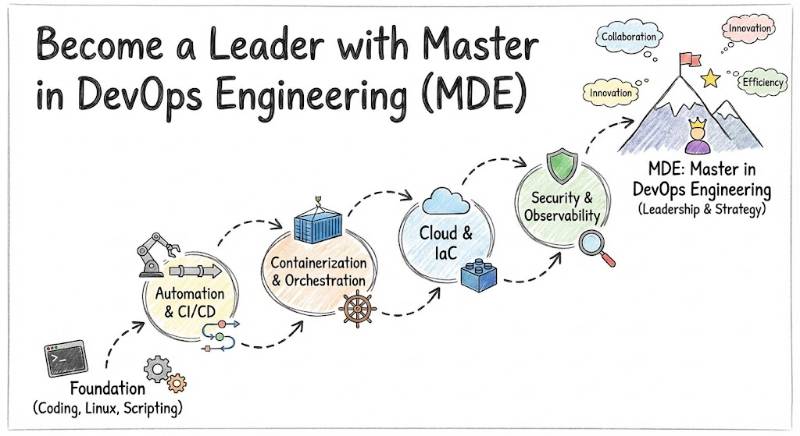
The Master in DevOps Engineering (MDE) is an extensive educational program that covers every phase of the software delivery lifecycle. It is intended to take a professional beyond basic automation and into the realm of architectural design and system orchestration.
Who is encouraged to pursue this path?
This program is ideally suited for software developers who wish to have a deeper understanding of how their code is deployed and maintained. It is also highly recommended for system administrators and cloud engineers who are looking to move into high-level automation roles. Technical leaders who oversee engineering teams will also find the curriculum beneficial for strategic planning.
Competencies that are acquired
- Advanced Versioning Strategies: A deep understanding of Git is developed, enabling the management of complex codebases across large teams.
- Orchestration of Continuous Pipelines: The skill to design, build, and troubleshoot end-to-end CI/CD pipelines is mastered.
- Management of Infrastructure via Code: Proficiency in tools like Terraform is gained, allowing infrastructure to be treated with the same rigor as application code.
- Containerization at Scale: Expertise in Docker and the management of Kubernetes clusters is established for handling microservices.
- Observability and Monitoring: The ability to implement comprehensive logging and monitoring systems is cultivated to ensure system health.
- Security Integration: Knowledge is gained on how to embed security protocols directly into the automated pipeline.
Practical projects to be completed
- Development of a Global CI/CD Framework: A pipeline is constructed that handles code testing, security scanning, and deployment across multiple environments.
- Automated Cloud Provisioning: Scripts are written to automatically set up and configure entire virtual data centers in the cloud.
- Implementation of Self-Healing Clusters: A Kubernetes environment is configured to automatically detect and recover from service failures.
- Creation of Operational Dashboards: Real-time data visualization tools are deployed to provide insights into application performance and user behavior.
Recommended Preparation Timeline
- The 14-Day Foundation Phase: During the first two weeks, a heavy emphasis is placed on the core pillars. This includes a thorough review of Linux internals and networking protocols. The basic commands and workflows of version control systems are also solidified during this period.
- The 30-Day Implementation Phase: The focus is shifted toward the practical application of automation tools. Configuration management is explored in detail, and the first simple CI/CD pipelines are built. The goal during this month is to move from manual tasks to scripted operations.
- The 60-Day Mastery Phase: The final month is dedicated to complex orchestration and cloud-native technologies. Deep dives into Kubernetes and infrastructure-as-code are conducted. Extensive time is spent in the labs to ensure that all tools can be integrated into a single, functioning system.
Frequent Errors to Avoid
- Focusing on Tools Over Principles: It is often seen that learners spend too much time on a specific software version while ignoring the underlying engineering principles.
- Neglecting the Importance of Security: Security is sometimes treated as a final step, whereas it should be integrated into every phase of the learning process.
- Insufficient Laboratory Practice: Reading documentation is necessary, but mastery is only achieved through repeated practice in a lab environment.
Subsequent Educational Steps
- In the Same Category: Certified Kubernetes Administrator (CKA).
- In a Related Category: Site Reliability Engineering (SRE) Advanced.
- In Leadership: Technical Management for Engineering Teams.
4. Selecting a Specialized Technical Track
The DevOps Track
This track is intended for those who wish to be at the center of the software delivery process. It is best suited for individuals who enjoy optimizing workflows and removing bottlenecks in the production cycle. The primary objective is to ensure a smooth and rapid flow of code from development to the end-user.
The DevSecOps Track
This specialized path is pursued by those who have a strong interest in cybersecurity. It is designed for engineers who want to ensure that every automated process is secure by default. It is particularly valuable for those working in highly regulated sectors where data protection is a top priority.
The Site Reliability Engineering (SRE) Track
The SRE track is chosen by engineers who are passionate about the stability and performance of large-scale systems. The focus is placed on creating resilient architectures that can withstand high traffic and unexpected failures. It involves a blend of software engineering and operational tasks.
The AIOps and MLOps Track
This is a modern track that addresses the needs of data science and machine learning. It is intended for those who wish to automate the deployment and lifecycle management of AI models. It bridges the gap between traditional operations and advanced data science.
The DataOps Track
The DataOps track is focused on the reliability and speed of data delivery. It is best for professionals who manage large data warehouses or real-time data processing systems. The principles of versioning and testing are applied to the data itself.
The FinOps Track
As cloud expenditures continue to rise, the FinOps track has become essential. It is designed for those who want to balance the technical needs of a project with the financial constraints of the business. It focuses on cost optimization and cloud resource management.
5. Aligning Certifications with Industry Designations
- DevOps Engineer: Master in DevOps Engineering (MDE) is the primary recommendation.
- Site Reliability Engineer: SRE Foundation and Performance Engineering certifications are advised.
- Platform Engineer: Infrastructure as Code and Kubernetes Specialist paths are suggested.
- Cloud Infrastructure Engineer: Multi-Cloud Architecture and MDE certifications are highly relevant.
- Security Architect: Certified DevSecOps Professional is the recommended choice.
- Data Automation Engineer: DataOps and Big Data Orchestration certifications are preferred.
- Cloud Cost Manager: FinOps Certified Practitioner is the ideal track.
- Director of Engineering: DevOps Leader and Strategic IT Governance certifications are suggested.
6. Advancing Your Educational Roadmap
A commitment to continuous education is a hallmark of a successful professional. The following suggestions are based on the current trends observed in global markets.
- For Same-Track Growth: A deep dive into Advanced Container Orchestration is recommended to refine technical skills.
- For Cross-Track Growth: Moving into the SRE domain is suggested to gain a better understanding of system availability and resilience.
- For Leadership Growth: Pursuing a certification in Strategic DevOps Leadership is advised for those aiming for executive roles.
7. Leading Organizations for Technical Training
DevOpsSchool
This organization is widely recognized for its comprehensive training modules. A strong emphasis is placed on practical, lab-based learning that prepares students for the challenges of the modern workplace.
Cotocus
Cotocus is known for its high-level consulting and specialized training programs. It provides tailored educational paths for both individuals and corporate teams looking to adopt advanced automation techniques.
ScmGalaxy
This is a prominent community resource that offers a vast array of tutorials and technical documentation. It serves as an essential knowledge base for those working in software configuration and delivery.
BestDevOps
Practical career guidance and skill development are the core offerings of this portal. It is particularly valued by those who are looking to transition from traditional roles into modern DevOps positions.
devsecopsschool.com
This platform is dedicated to the intersection of security and automation. It provides the specialized knowledge required to build secure delivery pipelines in a cloud-native world.
sreschool.com
A focus on the principles of reliability and system performance is maintained here. It is a primary source for those seeking to master the SRE discipline.
aiopsschool.com
The use of artificial intelligence in IT operations is the primary subject of study at this institution. It prepares learners for the next generation of self-managing infrastructure.
dataopsschool.com
This school provides training on how to apply the rigor of DevOps to data management. It is designed for engineers who want to improve the quality and speed of data workflows.
finopsschool.com
Financial accountability in the cloud is taught by this institution. It helps professionals understand the cost implications of their technical decisions and how to optimize them.
8. Commonly Asked Questions about DevOps Mastery
General Industry Questions
- Is it possible to learn these skills without prior coding knowledge?
While it is more challenging, a foundation in basic scripting can be built during the early stages of training. - How do these certifications impact salary expectations?
It is observed that certified professionals often command higher salaries due to their verified expertise. - What is the role of cloud platforms in this field?
Cloud platforms provide the infrastructure that is managed and automated by these methodologies. - Is Linux more important than Windows in this context?
A majority of the tools used in this field are optimized for Linux-based environments. - How often do the tools in this field change?
The tools evolve regularly, which is why a focus on core principles is encouraged over memorizing specific software. - Can a project manager benefit from an MDE certification?
Yes, it allows for a much better understanding of the technical constraints and timelines of the team. - What is the difference between a pipeline and a script?
A pipeline is a series of automated steps, while a script is a single set of instructions used within those steps. - Is remote work common for these roles?
Yes, the nature of the work allows for a high degree of flexibility and remote collaboration. - How much time should be spent in the labs?
It is suggested that at least sixty percent of study time be spent on practical exercises. - What is the significance of “Infrastructure as Code”?
it allows for environments to be reproduced exactly and managed using version control. - Do I need to be an expert in every tool?
No, a broad understanding of the ecosystem is more important than being an expert in every single tool. - Is there a community for support during the learning process?
Most major training providers offer access to forums and peer groups for assistance.
Questions Focused on the MDE Program
- What is the primary objective of the MDE certification?
The goal is to produce engineers who can design and manage complete, automated software lifecycles. - Is the MDE program suitable for professionals in India?
Yes, it is designed to meet the requirements of both the Indian and global technology markets. - Are real-world scenarios used in the training?
The curriculum is built entirely around scenarios that are commonly encountered in production environments. - How is the certification exam conducted?
The assessment typically involves a combination of theoretical questions and practical lab tasks. - Does the MDE program cover multi-cloud environments?
Yes, the principles taught are applicable across all major cloud providers. - What kind of background is ideal for starting MDE?
A background in software development or system administration is considered highly beneficial. - Is there any support provided for career placement?
Many training institutions offer guidance on resume building and interview preparation as part of their support. - How long does the certification remain valid?
It is generally recommended that a professional refreshes their certification every few years to stay current with new technologies.
9. Insights from Past Participants
Siddharth
“A marked difference in the way production issues are handled was observed after completing the MDE program. The ability to automate repetitive tasks has led to a much more efficient workflow.”
Meera
“The structured approach provided by the certification allowed for a clear understanding of the entire CI/CD lifecycle. This has resulted in a significant boost in professional confidence during team discussions.”
Arjun
“The transition into a cloud-focused role was made much smoother by the practical labs. The skills gained in infrastructure-as-code have been applied immediately to ongoing projects.”
Priya
“A better understanding of the relationship between security and operations was developed. The knowledge of automated scanning tools has helped in making the delivery process much more robust.”
Rohan
“The management-focused insights from the course have allowed for better coordination between the development and operations teams. The deployment frequency of the department has seen a noticeable increase.”
Conclusion
The decision to pursue a Master in DevOps Engineering (MDE) is seen as a strategic move for any professional in the software industry. It is a commitment to mastering the modern methods of software delivery and infrastructure management. Long-term career growth is often secured by those who take the time to validate their skills through such comprehensive programs. A focused approach to learning and a clear plan for certification are encouraged for anyone looking to excel in this field.