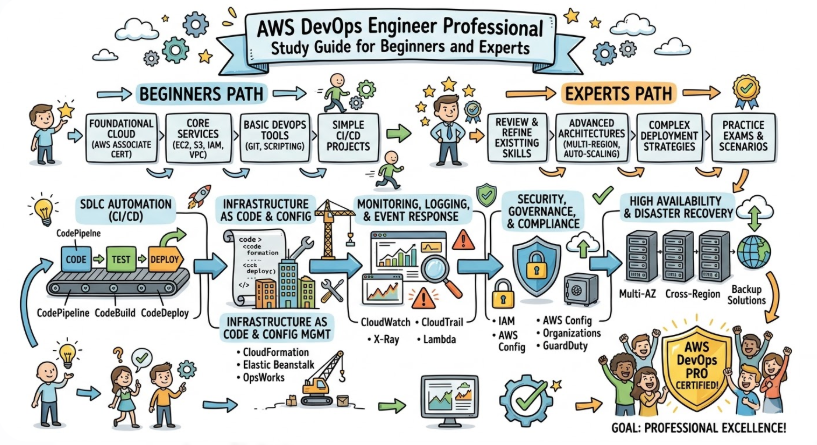
Introduction
The AWS DevOps Engineer – Professional is considered one of the most respected and challenging certifications available in the industry today. It is intended to validate a professional’s ability to automate the testing, deployment, and monitoring of both infrastructure and applications on the AWS platform. It is not merely a test of tool knowledge; instead, it is an assessment of how complex systems are built to run themselves with minimal human intervention. Expertise is required in areas such as continuous delivery and high-availability systems.
Why it matters in today’s ecosystem
In the current fast-paced market, a constant demand for faster feature releases is seen across all sectors. Automation is identified as the only reliable method to achieve this speed without compromising system stability. By obtaining this certification, it is proven that an engineer understands how to utilize AWS services to create high-speed and reliable delivery pipelines. Concepts like security, compliance, and governance are also deeply integrated into this curriculum.
Why certifications are important
For an engineer, a certification is utilized as a structured learning path that ensures no gaps are left in their technical knowledge. For an engineering manager, these credentials are used as a benchmark to ensure that the team is following industry best practices. In competitive markets across India and the globe, this badge is treated as a trusted indicator of professional expertise. It is often found that certified teams are more efficient in handling production-level incidents.
Certification Overview Table
| Track | Level | Who it’s for | Prerequisites | Skills Covered | Recommended Order |
| DevOps | Professional | DevOps & Cloud Engineers | AWS Associate Level | CI/CD, HA, Automation, Monitoring | After AWS SysOps or Developer Associate |
Provider: DevOpsSchool
Why Choose DevOpsSchool?
When preparation for a professional-level exam is undertaken, the right guidance is deemed essential. At DevOpsSchool, a hands-on environment is provided where theoretical concepts are transformed into practical skills. The trainers are selected based on their understanding of real-world challenges that are faced by engineers daily. A focus is placed on deep technical understanding rather than simple exam memorization. This approach is used to help individuals build a long-term career rather than just passing a single test. The community support and frequently updated curriculum make it a preferred choice for thousands of learners globally.
Certification Deep-Dive: AWS DevOps Engineer – Professional
What is this certification?
This is a professional-tier exam that is used to test a person’s mastery of managing and operating distributed systems on AWS. Great emphasis is placed on automation, governance, and the management of highly available cloud environments.
Who should take this certification?
- It is recommended for DevOps Engineers who have already spent significant time working with AWS.
- It is suitable for System Administrators who are looking to transition into the field of automation.
- It is designed for Software Developers who are responsible for their own application deployments.
- It is taken by Cloud Architects who wish to specialize in automated delivery pipelines.
Skills you will gain
- The ability to set up complex Continuous Delivery systems on AWS is developed.
- Knowledge of how to implement automated security controls and compliance checks is gained.
- Skills in monitoring and logging distributed systems are enhanced.
- Expertise in designing systems that are both highly available and scalable is achieved.
- A deep understanding of managing infrastructure as code (IaC) is provided.
Real-world projects you should be able to do
- A multi-region deployment pipeline for a global application can be built.
- Automated security patching across hundreds of EC2 instances can be implemented.
- A self-healing infrastructure that automatically restarts failed services is created.
- A centralized logging and auditing dashboard for microservices is established.
Preparation Plan
7–14 Days Plan (The Quick Review)
- Focus is placed on core services like AWS CodePipeline, CodeBuild, and CodeDeploy.
- Whitepapers regarding DevOps and Blue/Green deployments are reviewed.
- Two full-length practice exams are taken to identify any remaining weak areas.
30 Days Plan (The Balanced Path)
- The first two weeks are spent practicing Infrastructure as Code using CloudFormation or CDK.
- The third week is dedicated to studying monitoring tools like CloudWatch and X-Ray.
- The final week is used for taking mock tests and reviewing incorrect answers.
60 Days Plan (The Deep Dive)
- During the first month, hands-on labs for every service mentioned in the guide are completed.
- The second month is used for a detailed study of security, governance, and deployment strategies.
- The plan is concluded with intense mock exams and the reading of official documentation.
Common mistakes to avoid
- The difficulty of the “Professional” level is often underestimated by candidates.
- Insufficient time is spent with the actual AWS console and Command Line Interface (CLI).
- Only the tools are focused on, while the underlying DevOps philosophy is ignored.
- Official exam readiness guides and documentation are sometimes skipped.
Best next certification after this
- Same Track: The AWS Certified Security – Specialty is often pursued next.
- Cross-Track: The Certified Kubernetes Administrator (CKA) is highly recommended.
- Leadership / Management: The AWS Certified Solutions Architect – Professional is seen as a natural progression.
Choose Your Learning Path
1. DevOps Path
This path is chosen by engineers who wish to master the entire software lifecycle. It is centered around the concepts of Continuous Integration, Continuous Delivery, and infrastructure management.
2. DevSecOps Path
This is the ideal path for professionals who are focused on security. In this track, security measures are integrated directly into the automation pipeline from the very beginning.
3. Site Reliability Engineering (SRE) Path
This path is preferred by those who value system stability. Software engineering principles are used to solve operational problems and maintain high levels of uptime.
4. AIOps / MLOps Path
This track is designed for data science and AI teams. The deployment and monitoring of Machine Learning models are automated using these specialized practices.
5. DataOps Path
This is the recommended path for data engineers. It is used to improve the quality of data and reduce the time required for data analytics cycles.
6. FinOps Path
This path is taken by those interested in the financial management of the cloud. It is focused on optimizing cloud costs and ensuring financial accountability within teams.
Role → Recommended Certifications Mapping
- DevOps Engineer: The AWS DevOps Professional and CKA certifications are recommended.
- Site Reliability Engineer (SRE): The AWS DevOps Professional and Terraform Associate are suggested.
- Platform Engineer: The AWS Solutions Architect Pro and Kubernetes certifications are advised.
- Cloud Engineer: The AWS SysOps Associate and AWS DevOps Professional are often required.
- Security Engineer: The AWS Security Specialty and DevSecOps Foundation are suggested.
- Data Engineer: The AWS Data Analytics Specialty is viewed as the primary goal.
- FinOps Practitioner: The FinOps Certified Practitioner credential is recommended.
- Engineering Manager: The AWS Cloud Practitioner and PMP certifications are often chosen.
Next Certifications to Take
For the DevOps Learner:
- One same-track certification: The AWS Certified Security – Specialty is identified as a valuable addition.
- One cross-track certification: The Certified Kubernetes Security Specialist (CKS) is suggested for deeper container security knowledge.
- One leadership-focused certification: The TOGAF certification is recommended for those looking toward enterprise architecture roles.
Training & Certification Support Institutions
DevOpsSchool
A leadership position in DevOps training is held by this institution. Deep technical workshops and real-world projects are provided to all students. It is often chosen by working professionals for its highly practical and hands-on teaching style.
Cotocus
Cotocus is recognized for its specialized consulting and training services. Modern cloud practices are taught to individuals and organizations through expert-led sessions. A focus is maintained on ensuring that the latest industry standards are always followed.
ScmGalaxy
A massive knowledge base for Source Code Management and DevOps is provided by this platform. A combination of tutorials, blogs, and certification paths is offered to the community. It is used as a primary resource for self-paced learning.
BestDevOps
This is a dedicated training center where the focus is placed entirely on DevOps excellence. Curated content and mentorship are provided to those who are aiming to pass professional-level exams. It is known for its clear and concise study materials.
devsecopsschool.com
This portal is exclusively dedicated to the integration of security within DevOps. Niche courses are offered for security engineers who wish to learn how to automate their security workflows. It is considered a pioneer in DevSecOps education.
sreschool.com
Training on the principles of Site Reliability Engineering is provided by this site. It is used by those who want to learn how to manage and maintain large-scale systems effectively. Reliability is treated as the most important feature.
aiopsschool.com
The gap between Artificial Intelligence and Operations is bridged by this institution. It is taught how AI can be used to improve IT operations and enhance automation. It is designed for forward-thinking professionals.
dataopsschool.com
This is a specialized school that is focused on data professionals. Methodologies used to streamline the delivery of data are taught here. It is used to help teams manage data pipelines more efficiently.
finopsschool.com
The art of cloud financial management is taught at this school. It is considered essential for anyone who is responsible for controlling cloud spending in large organizations. Cost transparency is emphasized.
FAQs Section
General FAQs
- Is this exam difficult?
It is considered one of the most difficult AWS exams because long, scenario-based questions are used. - How much time is required for preparation?
Usually, a period of 2 to 4 months is needed depending on current experience. - Are there any prerequisites?
Although not mandatory, it is suggested that an Associate-level certification be obtained first. - In what order should the exams be taken?
It is recommended to complete the Developer or SysOps Associate before attempting the Professional level. - What is the career value of this certification?
A significant increase in market value is observed, and doors to senior roles are opened. - Does it help in securing a job?
It is used as a strong validation of skills during the initial screening process by recruiters. - What job roles can be applied for? ?
Roles such as Senior DevOps Engineer, Cloud Architect, or SRE are commonly attained. - Is the certification valid permanently?
No, it is required to be renewed every three years to remain active. - Can the exam be taken from home?
Yes, an online proctored exam option is provided by AWS. - Is deep coding required? ?
An understanding of scripts and configuration files is needed, but deep application coding is not the focus. - How many questions are included?
Generally, 75 questions are answered within a 180-minute time limit. - Is the investment worth it?
Given the salary increases often reported, the investment is seen as highly beneficial.
AWS DevOps Engineer – Professional Specific FAQs
- Which AWS services are prioritized?
Heavy focus is placed on CodePipeline, CloudFormation, and OpsWorks. - What percentage is dedicated to security?
Approximately 20% of the exam is focused on security and compliance. - Is Kubernetes covered in the exam?
While EKS is an AWS service, the primary focus remains on native AWS automation tools. - Are whitepapers required reading?
Yes, official whitepapers are considered essential for understanding complex scenarios. - Are all questions multiple-choice?
Yes, but some questions require multiple correct responses to be selected. - What is the minimum passing score?
A score of at least 750 out of 1000 must be achieved. - Can the Associate level be skipped?
It is technically possible, but the Professional exam is made much more difficult without that foundation. - How are long questions managed?
It is advised to read the last sentence first to identify the actual problem being asked.
Testimonials
Aarav, DevOps Engineer
A deep level of knowledge was gained through this certification. My ability to handle automated rollbacks and disaster recovery was greatly improved.
Priya, SRE
The confidence to manage large production environments was provided by this course. System downtime has been reduced at my workplace due to the monitoring skills learned.
John, Cloud Engineer
It was finally understood how multi-account environments should be managed. A move into a senior role was achieved much faster than expected.
Siddharth, Security Engineer
Integrating security into the pipeline was previously a challenge. It was made much easier through the study of AWS Config and GuardDuty during this track.
Meera, Engineering Manager
The whole team was encouraged to complete this certification. A common standard of excellence was created, and our deployments are now much smoother.
Conclusion
The AWS DevOps Engineer – Professional certification is not just seen as a credential; it is viewed as a rigorous journey of transformation. In an industry where automation has become the standard, this certification ensures that an engineer remains relevant and skilled. By following a structured learning path and utilizing the support of institutions like DevOpsSchool, long-term success is made possible. The future of cloud automation is built by those who take the time to master these complex systems today.