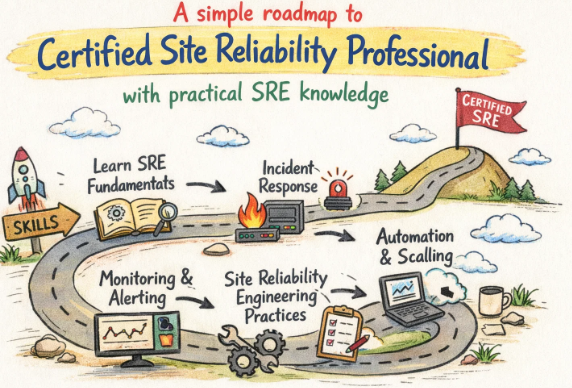
Introduction
Reliability is not seen as just a feature; it is treated as a core requirement for any successful product. When systems fail, revenue is lost and trust is damaged. Therefore, the role of a Site Reliability Professional is highly valued across global markets, including India. This guide is designed to explain how this certification can be used to transform a career from standard operations to high-level system engineering.
what is certified site reliability professional
The Certified Site Reliability Professional is a specialized designation that is awarded to individuals who demonstrate a deep understanding of SRE principles. It is not just about learning a few tools. Instead, it focuses on the application of software engineering mindsets to solve operational problems. Complex manual tasks are replaced with automated solutions. System health is measured using precise metrics, and failures are treated as opportunities for learning rather than reasons for blame.
This program is structured to bridge the gap between development and operations. It ensures that the concepts of error budgets, service level objectives, and toil reduction are fully understood and applied. By achieving this certification, a professional is recognized as someone who can manage large-scale systems with confidence and precision.
why it matters today?
In the modern era of cloud computing and microservices, systems have become incredibly complex. A single failure in one small component can lead to a massive outage for the entire platform. Because of this complexity, traditional ways of managing servers are no longer effective. The need for a standardized approach to reliability has led to the rise of SRE as a dominant force in the industry.
Business goals are now directly tied to system uptime. If a website is slow or down, customers will quickly move to a competitor. Therefore, professionals who know how to keep systems stable while allowing for rapid changes are in high demand. The Certified Site Reliability Professional program matters because it provides the framework needed to handle these high-pressure environments. It teaches how to manage risk in a way that does not slow down innovation.
why certified site reliability professional certifications are important
Certifications are often used as a benchmark for skill and dedication. For an engineer, being certified means that their knowledge has been validated by an external, expert body. This is particularly important in SRE because the field requires a mix of different skills, ranging from coding to networking and system architecture.
- Standardization of Knowledge: A common language is provided by the certification, which helps teams communicate more effectively about reliability goals.
- Career Advancement: Many high-paying roles in top-tier tech companies are reserved for those who hold recognized certifications. It acts as a filter for hiring managers.
- Proof of Competence: Real-world scenarios are used in the training, meaning that a certified professional is seen as someone who can handle actual production incidents.
- Global Recognition: The skills learned are applicable in any market, making it easier for engineers to find opportunities across different countries.
why choose sreschool ?
When a training provider is being selected, the quality of the content and the experience of the instructors are the most important factors. SRESchool is chosen by thousands of professionals because the curriculum is built on real-world practicalities rather than just theoretical concepts. The focus is always kept on what actually works in a production environment.
Support is provided throughout the learning journey, ensuring that every student understands the difficult concepts before moving forward. The labs are designed to mimic the challenges faced by engineers at major tech firms. By choosing SRESchool, a commitment is made to high-quality education that leads to tangible career results. The path to becoming a reliability expert is made clearer and more achievable through their structured approach.
certification deep-dive
what is this certification?
The Certified Site Reliability Professional is a professional-grade program that validates an individual’s ability to apply software engineering practices to IT infrastructure and operations. It focuses on automation, monitoring, and the creation of highly scalable and reliable systems.
who should take this certification?
This program is intended for software engineers who want to move into operations, as well as DevOps and systems engineers who wish to specialize in reliability. It is also highly beneficial for technical leads and managers who oversee large-scale cloud environments.
certification overview table
| Track | Level | Who it’s for | Prerequisites | Skills Covered | Recommended Order |
| SRE | Professional | System/Cloud Engineers | Basic Linux & Coding | SLOs, SLIs, Automation | First |
| DevOps | Associate | Software Developers | Understanding of SDLC | CI/CD, Scripting | Second |
| DevSecOps | Expert | Security Professionals | DevOps knowledge | Security Automation | Third |
| AIOps/MLOps | Specialist | Data Scientists | Python & Cloud | Model Monitoring | Fourth |
| DataOps | Specialist | Data Engineers | SQL & Data Pipeline | Pipeline Reliability | Fifth |
| FinOps | Practitioner | Finance/Ops Managers | Cloud Billing knowledge | Cost Optimization | Sixth |
skills you will gain
- The ability to define and monitor Service Level Indicators (SLIs) and Service Level Objectives (SLOs) is developed.
- Complex operational tasks are automated using scripting and modern configuration management tools.
- Incident response protocols are mastered, ensuring that system downtime is minimized.
- Root cause analysis is performed through blameless post-mortems to prevent recurring issues.
- Large-scale distributed systems are designed and managed for maximum scalability.
- The concept of Error Budgets is applied to balance the need for speed with the need for stability.
real-world projects you should be able to do after this certification
- An automated incident alerting system is built and integrated with communication platforms.
- A comprehensive monitoring dashboard is designed to track system health in real-time.
- A “chaos engineering” experiment is conducted to test the resilience of a cloud-native application.
- Manual deployment processes are replaced with a fully automated, blue-green deployment pipeline.
- A legacy infrastructure is migrated to a containerized environment with high availability.
preparation plan
7–14 days plan
In this short timeframe, the focus is placed entirely on the core pillars of SRE. The official study guide is read thoroughly. Key definitions such as SLOs, SLIs, and Toil are memorized. Practice exams are taken daily to identify weak areas. This is an intensive review intended for those who already have significant hands-on experience.
30 days plan
A more balanced approach is taken here. The first two weeks are spent watching video modules and reading technical documentation. The third week is dedicated to hands-on labs where automation scripts are written. The final week is used for review and taking multiple mock tests to build confidence.
60 days plan
This is the most recommended path for deep learning. The first month is spent understanding the philosophy of SRE and practicing Linux and networking basics. The second month involves building complex projects and troubleshooting simulated production failures. Every concept is explored in detail to ensure mastery.
common mistakes to avoid
- The cultural aspect of SRE is often ignored in favor of just learning tools.
- The importance of blameless culture is underestimated during incident reviews.
- Monitoring is confused with observability, leading to poor system visibility.
- Automation is applied to broken processes instead of fixing the process first.
best next certification after this
- Same track: The Advanced SRE Architect certification is recommended for deeper technical mastery.
- Cross-track: The Certified DevSecOps Professional is a great choice to add a security focus to reliability skills.
- Leadership / management: A course in Strategic Engineering Management is suggested for those moving into leadership roles.
choose your learning path
DevOps Path
This path is best for those who want to focus on the speed of delivery. It emphasizes the integration of development and operations teams. It is ideal for developers who want to understand the full lifecycle of their code.
DevSecOps Path
Security is the main focus here. It is best for professionals who want to ensure that every stage of the delivery pipeline is secure by design. It is highly recommended for security engineers moving into cloud environments.
Site Reliability Engineering (SRE) Path
Reliability and scalability are prioritized in this path. It is perfect for engineers who enjoy solving complex system puzzles and building automated solutions for large-scale infrastructure.
AIOps / MLOps Path
Artificial intelligence and machine learning are used to improve operations. This path is best for data-focused engineers who want to manage the lifecycle of machine learning models in production.
DataOps Path
The reliability of data pipelines is the core of this path. It is best for data engineers and architects who need to ensure that data is accurate and available for business intelligence.
FinOps Path
Cloud cost management is the focus. This path is best for professionals who need to balance technical performance with financial efficiency and budget constraints.
role → recommended certifications mapping
| Role | Primary Certification | Secondary Certification | Recommended Skillset |
| DevOps Engineer | Certified DevOps Master | SRE Professional | CI/CD, Git, Scripting |
| SRE | Certified SRE Professional | AIOps Specialist | SLOs, Monitoring, Python |
| Platform Engineer | Cloud Architect | SRE Professional | Kubernetes, IaC, Networking |
| Cloud Engineer | Certified Cloud Professional | DevOps Associate | AWS/Azure, Storage, Security |
| Security Engineer | Certified DevSecOps Prof. | SRE Professional | Vulnerability Scanning, IAM |
| Data Engineer | Certified DataOps Prof. | MLOps Specialist | ETL, SQL, Pipeline Automation |
| FinOps Practitioner | Certified FinOps Prof. | Cloud Associate | Billing APIs, Cost Reporting |
| Engineering Manager | SRE Management | FinOps Practitioner | Strategic Planning, Budgeting |
next certifications to take
One same-track certification
The Advanced Site Reliability Architect program is chosen by many to deepen their understanding of distributed systems. It provides the skills needed to design infrastructure that can handle millions of concurrent users without failure.
One cross-track certification
The Certified DevSecOps Professional is often pursued to ensure that reliability does not come at the cost of security. It teaches how to embed automated security checks into the existing SRE workflows.
One leadership-focused certification
The Technical Leadership and Strategy certification is recommended for those looking to lead SRE teams. It focuses on the soft skills and organizational changes required to implement a successful reliability culture.
training & certification support institutions
DevOpsSchool
Complete training programs for various automation and cloud technologies are offered by this institution. A focus is maintained on helping students achieve career growth through practical, lab-based learning experiences.
Cotocus
A wide range of consulting and training services in the DevOps and SRE space is provided by Cotocus. They are known for their customized approach to corporate training and their focus on modern infrastructure tools.
ScmGalaxy
Information regarding software configuration management and DevOps tools is shared through this platform. It serves as a community hub where professionals can find resources, tutorials, and certification guidance.
BestDevOps
Specialized courses that target the specific needs of modern engineering teams are provided here. The curriculum is updated regularly to reflect the latest changes in the technology landscape.
devsecopsschool.com
Deep technical training in the field of security-integrated DevOps is provided. The importance of shifting security to the left in the development process is emphasized in every course.
sreschool.com
The core principles of site reliability are taught through a mix of theory and intensive practical exercises. It is recognized as a leader in SRE education for global professionals.
aiopsschool.com
The intersection of artificial intelligence and IT operations is explored here. Training is provided on how to use machine learning to predict and prevent system failures automatically.
dataopsschool.com
Professional education for managing complex data environments is delivered. The goal is to improve the quality and speed of data delivery within large organizations.
finopsschool.com
The financial aspects of cloud computing are taught, helping organizations optimize their spending. It provides the tools needed to create a culture of financial accountability in engineering teams.
faqs section
1. What is the difficulty level of this certification?
The certification is considered to be of a moderate to high difficulty level. It requires a solid understanding of both software development and system operations.
2. How much time is required to prepare?
A minimum of 30 to 60 days is usually required for someone with a technical background to feel fully prepared for the exam.
3. What are the prerequisites for the course?
A basic understanding of Linux command-line operations and at least one programming language like Python or Go is highly recommended.
4. In what sequence should these certifications be taken?
It is generally suggested that the SRE certification is taken first, followed by DevOps and then specialized tracks like DevSecOps or AIOps.
5. What is the career value of being a Certified Site Reliability Professional?
Significant salary increases and access to roles at top-tier technology companies are often reported by those who achieve this certification.
6. What job roles can be applied for after certification?
Roles such as Site Reliability Engineer, Cloud Architect, Systems Engineer, and Platform Engineer are all within reach after completing the program.
7. Is the certification recognized globally?
Yes, the standards taught in this program are used by major tech companies all over the world, making the certification highly portable.
8. Does the course include hands-on labs?
Extensive practical labs are included to ensure that the theoretical concepts can be applied to real-world infrastructure.
9. How long does the certification remain valid?
The certification is typically valid for two to three years, after which a renewal or advanced certification is recommended.
10. Is there support provided during the training?
Technical support and mentorship are provided by instructors to help clear any doubts during the learning process.
11. Can a manager take this certification?
Yes, it is very useful for managers who want to understand the technical challenges faced by their SRE teams.
12. Are there mock exams available?
Multiple mock exams are provided as part of the preparation material to help students get used to the exam format.
Certified Site Reliability Professional FAQs
1. What is the main focus of the Certified Site Reliability Professional exam?
The exam is focused on the practical application of SRE principles like automation, monitoring, and incident response in production environments.
2. How is the exam conducted?
The exam is conducted online through a secure proctoring system, allowing candidates to take it from any location.
3. Are there any coding questions in the exam?
While deep coding is not the main focus, the ability to read and understand automation scripts is tested during the evaluation.
4. What is the passing score for the certification?
A score of 70% or higher is generally required to be awarded the Certified Site Reliability Professional designation.
5. Can the exam be retaken if the first attempt is failed?
Yes, retake options are available, though a waiting period and an additional fee may be required depending on the policy.
6. Is there a physical certificate provided?
A digital certificate is issued immediately upon passing, and a physical copy can often be requested for a small fee.
7. Does the certification cover multi-cloud environments?
Yes, the principles taught are vendor-neutral and can be applied to AWS, Azure, Google Cloud, or on-premises systems.
8. How often is the certification curriculum updated?
The curriculum is reviewed annually to ensure that it includes the latest industry best practices and emerging technologies.
testimonials
Arjun
The understanding of how to manage system uptime was completely changed by this program. The concepts of SLOs are now applied daily in the workplace.
Sneha
The career path became much clearer after the certification was completed. A move from a generalist role to a specialized SRE position was made possible.
Rohan
Confidence in handling production incidents was greatly increased through the practical labs. The blameless post-mortem approach is now a standard practice in the team.
Priya
A deep understanding of automation was gained, which allowed for the removal of several hours of manual toil every week. The real-world application of the course is impressive.
Vikram
The ability to design scalable systems was mastered through this guide. The certification has proven to be a valuable asset during technical interviews.
conclusion
The Certified Site Reliability Professional certification not be for anyone looking to excel in the modern tech landscape. It provides a structured way to master the balance between innovation and stability. Long-term career benefits include higher earning potential and the ability to work on the most challenging and rewarding projects in the industry. Strategic learning and careful certification planning are encouraged for every engineer who wishes to stay relevant and successful. By following the paths outlined in this guide, a solid foundation for a future-proof career is built.