Introduction
In the modern era of enterprise computing, the shift toward cloud-centric infrastructure is being led by AWS. For any professional aiming to master this domain, the AWS Certified Solutions Architect – Associate is considered a foundational milestone. It is recognized that as businesses move away from physical hardware, the ability to design virtual environments becomes a primary requirement for success.
This certification is valued because it provides a structured methodology for building systems that are both resilient and efficient. For software developers, systems engineers, and technology managers, a deep comprehension of the AWS ecosystem is required to drive digital transformation. It is understood that certifications act as a formal verification of one’s ability to handle high-stakes architectural decisions in a global market.
Certification Overview Table
| Track | Level | Who it’s for | Prerequisites | Skills Covered | Recommended Order |
| System Design | Associate | Engineers & IT Managers | Basic Cloud Knowledge | Scalability, Security, Cost, Networking | After Cloud Practitioner |
Why Choose DevOpsSchool?
When a journey toward technical mastery is begun, the choice of a training partner is viewed as critical. DevOpsSchool is preferred by many because a heavy emphasis is placed on the practical application of the AWS Well-Architected Framework. An environment is created where learners are challenged with real-world scenarios through guided laboratory sessions. Support is provided by experienced mentors, ensuring that every architectural concept is fully internalized. Furthermore, a commitment to long-term career growth is maintained through continuous community engagement.
Certification Deep-Dive
What is this certification?
The AWS Certified Solutions Architect – Associate is a professional credential that validates the expertise required to design and deploy robust applications on the AWS platform. A mastery of core cloud services is demonstrated through this certification.
Who should take this certification?
It is recommended that this exam be attempted by individuals who are responsible for the design of cloud systems. This includes developers, administrators, and those in leadership roles who must understand the technical foundations of their infrastructure.
Skills you will gain
- The ability to design high-availability and fault-tolerant systems is developed.
- Knowledge of AWS compute, storage, and database services is acquired.
- Strategies for implementing secure cloud environments are mastered.
- Competence in optimizing operational costs is gained.
- Expertise in disaster recovery and data migration is established.
Real-world projects you should be able to do
- A scalable web application is built using auto-scaling and load balancing.
- A serverless data processing system is designed using AWS Lambda.
- A secure network infrastructure is configured using VPC and private subnets.
- A highly resilient database architecture is implemented across multiple zones.
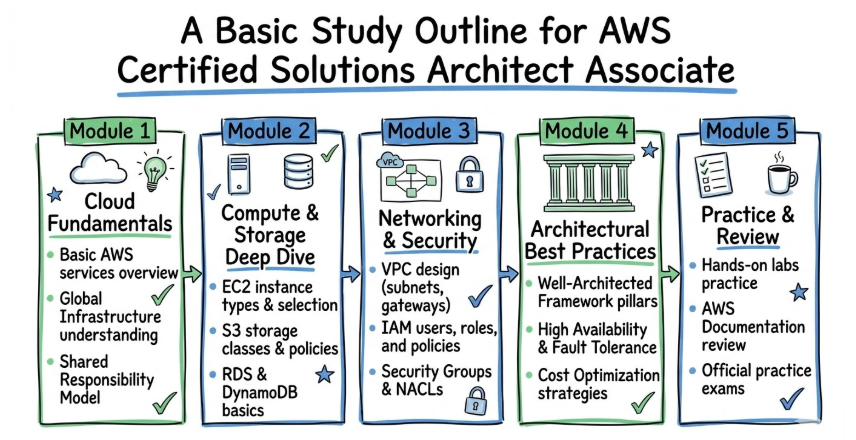
Preparation Plan
7–14 Days Plan (The Intensive Review)
- A deep review of the official exam blueprints is conducted.
- Practice tests are utilized daily to pinpoint areas of weakness.
- Core services such as IAM, VPC, and S3 are revisited for clarity.
30 Days Plan (The Focused Path)
- Day 1-10: Concentration is placed on compute and storage solutions.
- Day 11-20: Security protocols and networking configurations are studied.
- Day 21-30: Comprehensive mock exams are completed to build testing speed.
60 Days Plan (The Mastery Path)
- Month 1: Every AWS service in the exam scope is explored through hands-on labs.
- Month 2: Real-world architectural scenarios are simulated and analyzed. Final review sessions are held to ensure total readiness.
Common mistakes to avoid
- Hands-on practice is often neglected in favor of reading text.
- The importance of the AWS Well-Architected Framework is sometimes ignored.
- Time management during the actual examination is frequently underestimated.
- Relying on outdated study materials is a common pitfall.
Best next certification after this
- Same Track: AWS Certified Solutions Architect – Professional.
- Cross-Track: AWS Certified Developer – Associate.
- Leadership: Specialized training in technical management or cloud finance.
Choose Your Learning Path
DevOps Path
This path is chosen by those who seek to automate the software lifecycle. A focus is placed on the integration of cloud architecture with CI/CD tools.
DevSecOps Path
Security is made the primary focus in this track. It is designed for professionals who ensure that security is embedded into every layer of the automation pipeline.
Site Reliability Engineering (SRE) Path
The balance between uptime and performance is managed here. This path is ideal for those who focus on system stability and incident response.
AIOps / MLOps Path
Artificial intelligence is used to optimize operations in this path. It is followed by those who manage machine learning workloads in the cloud.
DataOps Path
The lifecycle of data is the primary concern here. It is preferred by data engineers who design scalable pipelines for analytics.
FinOps Path
Financial accountability in the cloud is mastered in this track. This path is followed by those who manage cloud budgets and resource efficiency.
Role → Recommended Certifications Mapping
- DevOps Engineer: AWS Associate Architect + Certified DevOps Engineer Professional.
- SRE: AWS Associate Architect + AWS SysOps Administrator.
- Platform Engineer: AWS Associate Architect + Certified Kubernetes Administrator (CKA).
- Cloud Engineer: AWS Associate Architect + Advanced Networking Specialty.
- Security Engineer: AWS Associate Architect + AWS Security Specialty.
- Data Engineer: AWS Associate Architect + AWS Data Analytics Specialty.
- FinOps Practitioner: AWS Associate Architect + Cloud Financial Management training.
- Engineering Manager: AWS Associate Architect + AWS Cloud Practitioner.
Next Certifications to Take
A structured growth path is recommended for every professional:
- Vertical Growth: The AWS Certified Solutions Architect – Professional is taken for advanced mastery.
- Horizontal Growth: The Certified Kubernetes Administrator (CKA) is pursued for container expertise.
- Leadership Focus: Certifications in technical management are recommended to prepare for leadership roles.
Training & Certification Support Institutions
DevOpsSchool
Extensive training programs are offered by this institution. A commitment to project-based learning is maintained throughout the curriculum.
Cotocus
Specialized consulting and training services are provided. Technical growth is fostered through workshops led by industry experts.
ScmGalaxy
A vast repository of technical knowledge is offered. It is utilized as a primary source for learning configuration management.
BestDevOps
Simplified roadmaps for career transitions are created. The goal is to make complex cloud technologies accessible to everyone.
devsecopsschool.com
A dedicated focus on security integration is maintained. Training is provided on how to secure cloud environments effectively.
sreschool.com
Reliability engineering principles are taught in detail. This institution focuses on building systems that are both resilient and performant.
aiopsschool.com
The intersection of AI and operations is explored. Professionals are trained to use predictive analytics for infrastructure management.
dataopsschool.com
Data management and pipeline automation are the core focus areas. It is designed for those specializing in cloud data architectures.
finopsschool.com
Cloud financial accountability is the primary subject. Professionals are taught how to optimize costs and maximize ROI.
FAQ Section
1. Is the AWS Solutions Architect Associate exam considered a difficult challenge?
A moderate level of difficulty is generally assigned to this exam. It is designed to test the application of architectural principles to real-world scenarios.
2. What is the recommended duration for an effective study plan?
For most working professionals, a period of 8 to 12 weeks is considered ideal for balanced preparation.
3. Are there any mandatory certifications required before this one?
No formal prerequisites are mandated by AWS, though a basic understanding of cloud concepts is highly recommended.
4. What is the ideal sequence for progressing through AWS certifications?
The path is usually started with the Cloud Practitioner, followed by the Solutions Architect Associate level.
5. How is the career value of this credential measured?
Value is seen through increased marketability, higher salary potential, and the ability to handle senior-level architectural roles.
6. Which job roles are most commonly associated with this certification?
Positions such as Cloud Architect, Systems Designer, and Technical Lead are frequently filled by certified professionals.
7. Is a background in coding necessary for success in this exam?
Deep programming skills are not required, but a basic familiarity with scripting and JSON is viewed as an advantage.
8. How often is the exam updated to reflect technological shifts?
AWS updates the exam content periodically to ensure that the certification remains relevant to current industry trends.
9. Can the certification exam be attempted remotely?
Yes, the convenience of taking the exam from home is provided through online proctored testing services.
10. What is the standard validity period for the certificate?
A three-year validity period is assigned to the certification, after which a recertification process is required.
11. Is there a specific passing threshold for the test?
A scaled score of 720 out of 1000 must be achieved to pass the examination successfully.
12. Why is DevOpsSchool recommended for this specific training?
DevOpsSchool is chosen because the training is built around real-world industry cases and expert mentorship.
Additional AWS SAA Focused FAQs
13. Which architectural pillar is given the most weight in the exam?
The design of resilient architectures is often given the highest priority in the scoring process.
14. Are serverless technologies like Lambda included in the scope?
Yes, serverless architecture is a major component of the modern exam and is thoroughly tested.
15. How much emphasis is placed on Virtual Private Clouds (VPC)?
The VPC is considered the foundation of AWS networking and is a critical topic for every candidate.
16. Are cost-management strategies a core part of the questions?
A significant portion of the exam is dedicated to cost optimization and choosing the right resource types.
17. What is the current fee for taking the Associate exam?
A standard fee of 150 USD is charged per attempt, though local taxes may apply.
18. How does the Associate level differ from the SysOps Administrator exam?
The Architect exam focuses on “design,” while the SysOps exam is more focused on “operational deployment.”
19. Is the AWS Well-Architected Framework a necessary study resource?
Yes, the pillars of the framework are considered the backbone of the exam and must be mastered.
20. What is the best method for retaining complex service details?
The most effective method is found to be consistent hands-on practice within the AWS Management Console.
Testimonials
Aarav Malhotra
“A complete shift in technical perspective was experienced after this course. The architectural concepts were explained with incredible simplicity.”
Meera Nair
“Great clarity was gained regarding cloud security and networking. Confidence in managing production environments has increased significantly.”
Arjun Das
“The practical roadmap provided was very effective. The transition to a cloud-certified professional was made seamless.”
Sneha Kulkarni
“High-quality mentorship was received throughout the training. The focus on real-world projects helped me pass on the first attempt.”
Rohan Joshi
“Valuable insights into cloud cost optimization were gained. This certification has already opened new career doors for me.”
Conclusion
The AWS Certified Solutions Architect – Associate certification is considered a cornerstone for any professional in the cloud era. A foundation is built that supports long-term career growth and technical excellence. By pursuing this credential, a commitment is made to mastering the technologies that power the modern digital world. Strategic planning and dedicated learning are encouraged to ensure a successful and rewarding career in cloud architecture.