Introduction
Decentralized Identity (DID) platforms represent a major shift in how we manage digital life. For decades, our online identities have been owned by giant corporations like Google, Facebook, or government agencies. When you “Login with Google,” you are essentially asking a third party for permission to use your own identity. Decentralized identity changes this by giving the user—not the platform—full ownership. Using a technology called Self-Sovereign Identity (SSI), DID platforms allow individuals and organizations to generate their own unique identifiers and store “Verifiable Credentials” (like a digital driver’s license or a university degree) in their own private wallets.
This is important because it eliminates “identity honeypots”—centralized databases that hackers love to attack. In a decentralized world, there is no central database of passwords to steal. Use cases are broad: from a worker instantly proving their certifications to a new employer without calling their old school, to a patient sharing medical records with a doctor while keeping their personal data private. When choosing a DID platform, look for interoperability (does it work with different wallets?), standard compliance (W3C standards are the gold standard), and ease of use for your developers or employees.
Best for: Security-conscious enterprises, government agencies looking to modernize licensing, healthcare providers managing patient privacy, and Web3 developers building decentralized applications (dApps). It is ideal for industries where high-trust verification is a daily requirement.
Not ideal for: Small businesses with very basic login needs that don’t handle sensitive data. Traditional social logins or standard multi-factor authentication (MFA) might be simpler and more cost-effective for low-risk scenarios.
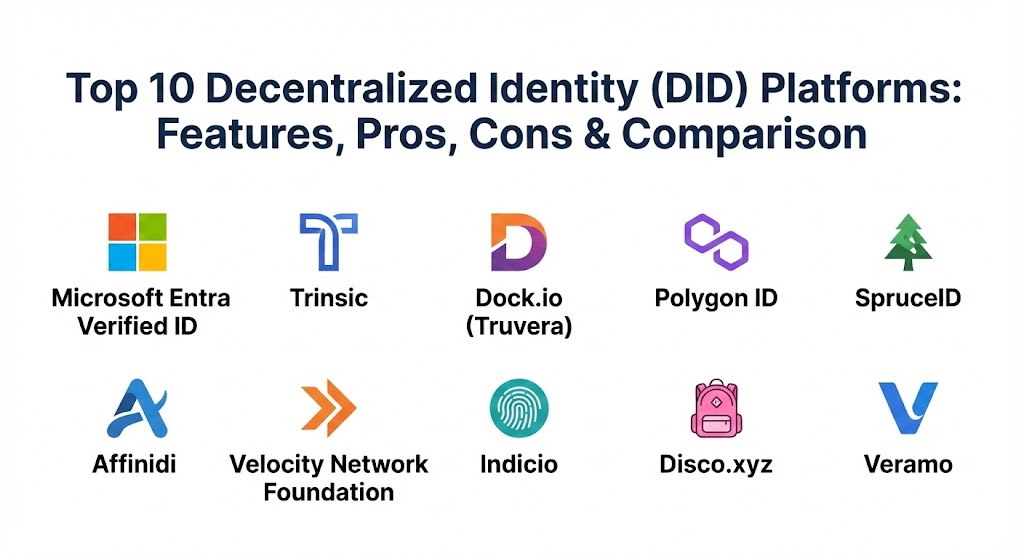
Top 10 Decentralized Identity (DID) Platforms
1 — Microsoft Entra Verified ID
Part of the broader Microsoft Entra suite, this platform allows organizations to issue and verify digital credentials based on open standards. It is designed to work seamlessly within the Microsoft 365 ecosystem, making it a top choice for corporate workforce management.
- Key features:
- Built-in integration with Microsoft Azure and Entra ID (formerly Azure AD).
- “Face Check” biometric verification for high-assurance identity tasks.
- Automated credential issuance and revocation workflows.
- User-owned identity wallets (Microsoft Authenticator).
- Support for W3C Verifiable Credentials and OpenID Connect (OIDC).
- Zero-trust architecture alignment for secure remote access.
- Pros:
- The best choice for enterprises already using the Microsoft ecosystem.
- Highly scalable and backed by enterprise-grade security and reliability.
- Cons:
- Can be complex for smaller businesses to set up.
- Advanced security features are often locked behind premium licensing tiers.
- Security & compliance: SOC 2, ISO 27001, GDPR, and FedRAMP high-level certification.
- Support & community: Extensive documentation, 24/7 enterprise support, and a massive global partner network.
2 — Trinsic
Trinsic is a developer-first platform known for its “Identity Acceptance Network.” It provides a single API that allows developers to accept and verify hundreds of different digital IDs from around the world without having to build individual integrations for each one.
- Key features:
- API-first architecture for rapid deployment of identity verification.
- “Zero-access” encryption where Trinsic itself cannot access user data at rest.
- Support for government-issued digital IDs (mDLs) and bank IDs globally.
- Market intelligence tools to track digital ID adoption across countries.
- Standard-agnostic approach, supporting W3C, OID4VP, and more.
- Pros:
- Significantly reduces the time to market for developers building identity products.
- Handles the complex legal and technical “plumbing” of global ID schemes.
- Cons:
- Pricing can be higher than raw open-source alternatives.
- Heavily focused on developers rather than non-technical business users.
- Security & compliance: SOC 2 Type II, GDPR, and localized data residency options.
- Support & community: Excellent developer documentation, SDKs for major languages, and active technical forums.
3 — Dock.io (Truvera)
Dock is a decentralized identity management platform that offers the Truvera suite. It focuses on high-speed credential issuance and a unique monetization model that allows organizations to earn revenue when the credentials they issue are verified elsewhere.
- Key features:
- Blockchain-backed “anchoring” for tamper-proof, permanent verification.
- Selective disclosure using BBS+ signatures (share “Age > 18” without showing birth date).
- Truvera API for 12x faster deployment than building on raw open-source code.
- White-label mobile wallet SDK for organizations to brand their own apps.
- Support for reusable KYB (Know Your Business) checks to save costs.
- Pros:
- Leading-edge privacy features like range proofs and zero-knowledge proofs.
- Clear path to ROI through their credential verification monetization model.
- Cons:
- Uses a proprietary blockchain for anchoring, which some might see as a dependency.
- The mobile experience depends heavily on the quality of the organization’s implementation.
- Security & compliance: GDPR-aligned architecture and open-source audit logs on the Dock blockchain.
- Support & community: GitHub-based community, detailed whitepapers, and direct professional consultation.
4 — Polygon ID
Polygon ID is a privacy-focused identity solution leveraging the power of Zero-Knowledge Proofs (ZKPs). It is built into the Polygon blockchain ecosystem but is designed to be multi-chain and interoperable across Web2 and Web3.
- Key features:
- Heavy use of ZKPs to prove claims without revealing underlying personal data.
- On-chain verification that interacts directly with smart contracts.
- Developer-friendly SDKs for web and mobile (Wallet SDK).
- Cost-efficient model that avoids high minting fees common in NFTs.
- Multi-chain support for any EVM-compatible blockchain.
- Pros:
- Deeply integrated with the decentralized app (dApp) ecosystem for Web3 users.
- Ensures massive privacy by never putting personal data on-chain.
- Cons:
- Requires users to be somewhat familiar with blockchain wallets.
- Primarily oriented toward Web3 and developer-centric use cases.
- Security & compliance: Open-source technology stack adhering to W3C and DID standards.
- Support & community: Large developer community, extensive GitHub resources, and active Discord channels.
5 — SpruceID
SpruceID provides digital identity infrastructure focused on public services and governments. They are the team behind major projects like the California Mobile Driver’s License, prioritizing long-term stability and high trust.
- Key features:
- “Sign-In with Ethereum” (SIWE) and other blockchain-based authentication tools.
- Credential wallets that can integrate with Apple and Google wallets.
- On-device verification ensuring that data never stays in a central database.
- Infrastructure designed for decades of use, avoiding “vendor lock-in.”
- Support for high-assurance documents like mDLs (Mobile Driver’s Licenses).
- Pros:
- Proven at the scale of millions of users in government deployments.
- Strong focus on interoperability and following strict public sector standards.
- Cons:
- Less focus on “out-of-the-box” software for small businesses.
- Implementation usually requires significant partnership and integration work.
- Security & compliance: Aligned with NIST 800-63-3 standards, SOC 2, and HIPAA.
- Support & community: Professional service teams and a robust library of technical documentation.
6 — Affinidi
Affinidi provides a “Holistic Identity” vision, offering a suite of tools that integrate data from multiple sources while giving users full consent over what they share. They focus heavily on the “Trust Network” concept.
- Key features:
- Affinidi Login for passwordless, one-tap onboarding experiences.
- Affinidi Vault where users can store and even monetize their personal data.
- Affinidi Elements for scalable managed tech stack development.
- Affinidi Concierge, a personalized AI that manages data based on user values.
- Connectors for secure integration with various legacy data sources.
- Pros:
- Unique vision that combines identity with data monetization and AI.
- Excellent for building data-rich applications where user trust is the product.
- Cons:
- The “ecosystem” approach might feel restrictive to some developers.
- AI features are relatively new and still gaining broad market evidence.
- Security & compliance: GDPR and CCPA aligned; features strong consent management tools.
- Support & community: High-quality documentation and active developer webinars.
7 — Velocity Network Foundation
Velocity is a “public utility” network for the global labor market. It is specifically designed to allow people to own their career records—including skills, education, and employment history—and share them instantly with employers.
- Key features:
- Credential Agent software for organizations to issue verifiable career data.
- Velocity Mobile Wallet for individuals to claim and store their career records.
- Uses a Reputation-Based Consensus mechanism on its own blockchain.
- Native $VELOCITY token used for network settlement and transaction fees.
- Legal and operational rulebooks to ensure consistency across the network.
- Pros:
- The specialized focus on the labor market makes it very powerful for HR and hiring.
- Creates a truly global, standardized way to verify professional skills.
- Cons:
- Users and organizations must be willing to participate in their specific network token economy.
- Niche focus means it’s less applicable for general-purpose identity tasks.
- Security & compliance: W3C compliant; governed by a non-profit foundation to ensure neutrality.
- Support & community: Strong community of HR-tech providers and enterprise-level governance.
8 — Indicio
Indicio focuses on “Portable Identity” and fraud prevention. They provide the infrastructure for companies to turn physical documents like passports into tamper-proof digital credentials that work globally.
- Key features:
- Indicio Proven infrastructure for issuing and verifying credentials instantly.
- Regula biometric integration for checking physical IDs against digital ones.
- Supports mDL (mobile driver’s license) and ICAO Digital Travel Credentials.
- Zero-knowledge proof support for maximum data privacy.
- Interoperable with the EU Digital Identity Wallet (EUDI).
- Pros:
- Excellent for travel, immigration, and high-security border crossing scenarios.
- Combines hardware-grade biometric checks with decentralized digital security.
- Cons:
- Heavily geared towards high-assurance and regulated industries.
- May be more infrastructure-heavy than what a light SaaS startup needs.
- Security & compliance: High adherence to ICAO and ISO standards for travel and government documents.
- Support & community: Expert consulting services and active participation in global standards bodies.
9 — Disco.xyz
Disco (short for Distributed Confidence) aims to be the “data backpack” for the digital world. It focuses on the social and relational side of identity, allowing users to collect “vouches” and social proofs.
- Key features:
- Private-by-default credentials that the user can choose to make public.
- “Data Backpack” to carry profiles across Twitter, Discord, and Web3 apps.
- Integration with Ceramic, a decentralized data network.
- No-gas-fee issuance and management of credentials.
- Support for “vouches” to prove community memberships and skills.
- Pros:
- Very low friction and cost for users compared to on-chain NFT badges.
- Great for community building, DAOs, and social networks.
- Cons:
- Less focused on formal/government identity compared to others on this list.
- Still in an earlier stage of adoption for enterprise-level use cases.
- Security & compliance: Blockchain-agnostic and relies on cryptographic signatures for verification.
- Support & community: Strong social presence, Discord-first community, and developer-friendly tools.
10 — Veramo
Veramo is a modular JavaScript framework that allows developers to build decentralized identity agents into any application. It is highly flexible and acts as a “building block” for custom identity systems.
- Key features:
- Plugin-based architecture to add new DID methods or credential formats.
- Cross-platform support (Web, Node.js, React Native).
- Support for many different decentralized networks (Ethereum, IPFS, etc.).
- DID Agent capable of managing keys, DIDs, and credentials.
- Highly customizable for unique business logic.
- Pros:
- Total control for developers to build exactly what they need.
- No vendor lock-in; you own the entire implementation.
- Cons:
- Requires a high level of technical expertise to build and maintain.
- You are responsible for your own security audits and compliance mapping.
- Security & compliance: Varies based on implementation; the framework itself is open-source and audited.
- Support & community: Strong GitHub community and extensive documentation for technical users.
Comparison Table
| Tool Name | Best For | Platform(s) Supported | Standout Feature | Rating |
| Microsoft Entra | Large Enterprises | Azure / Office 365 | Face Check Biometrics | 4.7 / 5 |
| Trinsic | App Developers | Cloud / API-first | Acceptance Network | 4.8 / 5 |
| Dock.io | Privacy & ROI | Web / Mobile SDK | Verification Monetization | 4.6 / 5 |
| Polygon ID | Web3 & Privacy | EVM Blockchains | Zero-Knowledge Proofs | 4.5 / 5 |
| SpruceID | Government / Scale | Apple/Google Wallets | Proven Public Projects | 4.7 / 5 |
| Affinidi | Data Monetization | Cloud / Web | Affinidi Concierge AI | 4.3 / 5 |
| Velocity Network | HR & Hiring | Web / Job Platforms | Skill Ownership | 4.4 / 5 |
| Indicio | Travel & Gov | Mobile / Gov Systems | Biometric Binding | 4.6 / 5 |
| Disco.xyz | Social & Web3 | Ceramic / Social Apps | “Data Backpack” | 4.2 / 5 |
| Veramo | Custom Building | JS Framework / Multi | Plugin Architecture | 4.5 / 5 |
Evaluation & Scoring of Decentralized Identity Platforms
| Category | Weight | Avg Score (1-10) | Evaluation Criteria |
| Core Features | 25% | 8.8 | Standards compliance (W3C), issuance, and verification tools. |
| Ease of Use | 15% | 7.5 | Developer experience (SDKs/APIs) and end-user wallet UI. |
| Integrations | 15% | 8.2 | Connection to legacy IAM, cloud providers, and blockchains. |
| Security | 10% | 9.5 | Cryptographic strength, ZKP usage, and biometric binding. |
| Performance | 10% | 8.0 | Verification speed, transaction latency, and network uptime. |
| Support | 10% | 8.5 | Documentation depth, community help, and enterprise SLAs. |
| Price / Value | 15% | 7.8 | Cost of issuance vs. long-term savings from fraud reduction. |
Which Decentralized Identity Platform Is Right for You?
Choosing the right DID platform is about matching your specific business problem to the tool’s strengths.
- Solo Users vs SMB vs Mid-market vs Enterprise: Solo users or small startups should look for low-code or API-first solutions like Trinsic or Disco.xyz. Mid-market companies building specific products might prefer the flexibility of Dock.io or Polygon ID. Global enterprises and government entities will find the most value in robust, certified platforms like Microsoft Entra, Indicio, or SpruceID.
- Budget-conscious vs Premium Solutions: If you have zero budget, Veramo is the ultimate free tool if you have the engineering talent. For companies that want to buy their way into a working solution, Trinsic and Microsoft provide “turnkey” experiences that save internal costs.
- Feature Depth vs Ease of Use: If you need deep privacy tech (like proving age without birth date), Dock.io and Polygon ID are the leaders. If you just want a simple “login with my verifiable ID” button, Trinsic or Affinidi are much easier to implement.
- Integration and Scalability Needs: If you are already on Azure, Microsoft Entra is a no-brainer. If you are building for the future of the internet (Web3), Polygon ID and Disco.xyz scale best within that decentralized environment.
Frequently Asked Questions (FAQs)
1. What is a “Self-Sovereign Identity” (SSI)?
SSI is the philosophy behind DID platforms. It means the user is the only one who owns and controls their identity data. No central company can “turn off” your identity or see who you are proving your data to.
2. Is decentralized identity the same as blockchain?
Not exactly. Decentralized identity uses blockchain as a “registry” to store public keys and verification rules, but your personal data (like your name or address) is never stored on the blockchain. It stays in your private wallet.
3. Does this replace passwords?
Yes. Instead of a password, you present a cryptographically signed “proof” from your wallet. This is much more secure because there is no password stored on a server for a hacker to steal.
4. How much do these platforms cost?
Some are free for small volumes (like Microsoft’s first 50,000 transactions), while others charge per “issuance” or “verification.” Generally, they are cheaper than the current cost of manual document checks.
5. Are they legal for government use?
Yes. Many countries are passing laws (like the EU’s eIDAS 2.0) that officially recognize decentralized identifiers and verifiable credentials for government and financial services.
6. What happens if I lose my phone/wallet?
Most platforms have “social recovery” or “cloud backup” features. Because your identity is based on a DID anchored on a network, you can usually restore your credentials to a new device using your private recovery keys.
7. Can these tools work with physical ID cards?
Yes. Platforms like Indicio specialize in taking a scan of a physical passport or license and turning it into a digital “verifiable credential” that is just as legally valid as the plastic card.
8. What is a “Verifiable Credential” (VC)?
A VC is a digital version of a document. It contains information (like “this person is a licensed doctor”), a digital signature from the issuer (like the Medical Board), and a proof that it belongs to the holder.
9. Can I use these for my employees?
Absolutely. Many companies use these platforms to issue employee badges that workers can use to access the office, log into software, or even get discounts at local shops without the company tracking every move.
10. What is the biggest mistake when starting with DID?
The biggest mistake is trying to build the entire infrastructure from scratch. Using an established platform like the ones listed above saves years of development time and ensures you are following global security standards.
Conclusion
The future of digital identity is moving away from centralized control and toward user ownership. Decentralized Identity (DID) platforms are the engines driving this change. They offer a way to make the internet safer, faster, and more private for everyone.
There is no “one-size-fits-all” winner. If you are a corporate giant, Microsoft Entra is likely your starting point. If you are an agile developer, Trinsic or Dock.io might be your best partners. The key is to stop treating identity as something you “own” on your servers and start treating it as something you “verify” with the user’s permission. By adopting these platforms now, you are building a foundation of trust that will last for the next era of the web.