Introduction
A Crypto Custody Platform is a specialized financial service or software infrastructure designed to secure, manage, and safeguard large volumes of digital assets. Unlike a standard retail wallet, these platforms are built with institutional-grade security, regulatory compliance, and complex governance workflows.
Crypto custody platforms are the bedrock of the institutional digital asset economy. Their primary importance lies in eliminating the “single point of failure” risk associated with private key management. In the decentralized world, losing a private key means losing the assets forever. Custody platforms solve this by using advanced technologies like Multi-Party Computation (MPC) or hardware-isolated Cold Storage to ensure that no single individual can authorize a transfer without a predetermined quorum.
Key Real-World Use Cases:
- Institutional Investing: Hedge funds and pension funds require “qualified custodians” to meet legal mandates for asset safekeeping.
- Tokenization: Companies managing tokenized real-world assets (RWA) use these platforms to secure the underlying digital representations.
- Corporate Treasury: Businesses holding Bitcoin or stablecoins on their balance sheets need multi-user approval workflows for treasury management.
- Staking & Governance: Modern custodians allow users to earn yield through staking or participate in DAO voting directly from the secure vault.
When evaluating a platform, one must look beyond simple storage. Key criteria include the regulatory status of the provider, the depth of asset support, the speed of withdrawals, and the insurance coverage provided against both internal and external threats.
Best for:
- Institutional Players: Asset managers, family offices, and banks that require regulatory compliance and high-touch support.
- Crypto-Native Enterprises: Exchanges and OTC desks needing high-speed, high-volume transaction security.
- Regulated Entities: Organizations in jurisdictions like the US, EU, or Singapore that must use licensed, audited custodians.
Not ideal for:
- Retail Hobbyists: Individual traders with small holdings are better served by hardware wallets (like Ledger or Trezor) or basic exchange accounts.
- Extreme Decentralization Advocates: Those who strictly follow the “not your keys, not your coins” philosophy and prefer total self-sovereignty over institutional convenience.
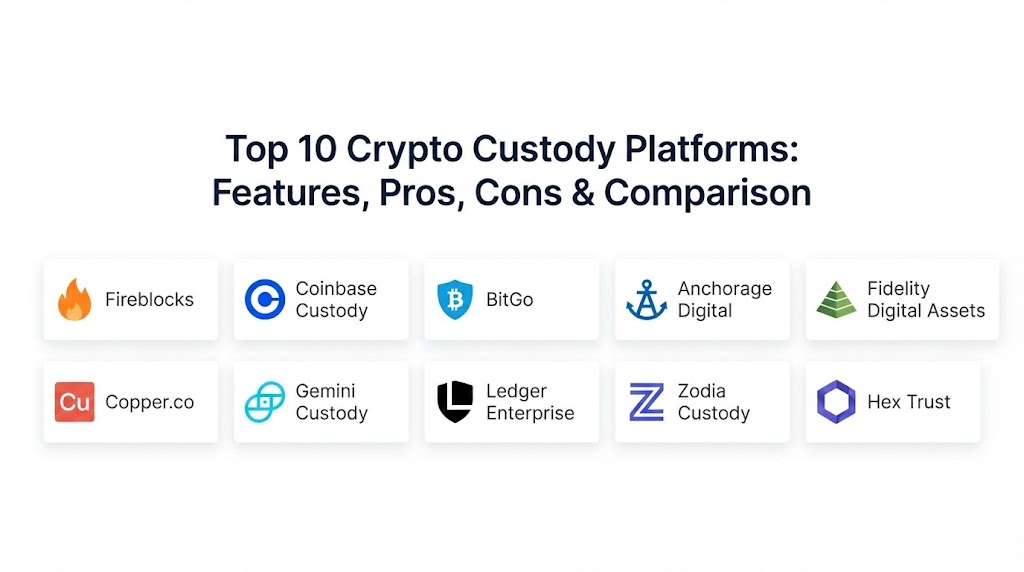
Top 10 Crypto Custody Platforms Tools
1 — Fireblocks
Fireblocks is a high-speed infrastructure provider that revolutionized the industry with its MPC-CMP technology. It is designed for businesses that need to move assets frequently and securely across a vast network of exchanges and counterparties.
- Key features:
- MPC (Multi-Party Computation) wallet infrastructure.
- The “Fireblocks Network” for instant, off-chain settlements.
- Policy Engine for automated transaction approval rules.
- Support for over 1,500 digital assets.
- Wallet-as-a-Service (WaaS) for developers building their own apps.
- Embedded DeFi and Staking access.
- Pros:
- Unrivaled transaction speed; assets are ready for trading in seconds.
- Eliminates the risk of “copy-paste” errors with its secure transfer network.
- Cons:
- Pricing is prohibitively expensive for small startups or solo operations.
- Complexity: Requires a dedicated technical team to manage the API and policies effectively.
- Security & compliance: SOC 2 Type II, ISO 27001/27017/27018/22301, and GDPR compliant.
- Support & community: 24/7 enterprise support, comprehensive developer documentation, and a highly active institutional user base.
2 — Coinbase Custody
Coinbase Custody is a subsidiary of the publicly traded Coinbase Global, Inc. It is a fiduciary and “Qualified Custodian” under New York State Banking Law, making it a favorite for US-based institutional investors and ETFs.
- Key features:
- Segregated cold storage in air-gapped vaults.
- Qualified Custodianship status (NYDFS regulated).
- Institutional-grade staking and governance voting.
- Integration with Coinbase Prime for seamless trading and liquidity.
- Direct insurance coverage for assets under management.
- Detailed institutional reporting and audit trails.
- Pros:
- Deeply trusted brand with a long history of regulatory transparency.
- Best-in-class insurance policy for cold-stored assets.
- Cons:
- Withdrawal times can be slower due to the high-security cold storage nature.
- Custody fees are often higher than more automated, software-based competitors.
- Security & compliance: SOC 1 & 2 Type II certified. Regulated as a trust company by the NYDFS.
- Support & community: High-touch, dedicated account managers for large institutional clients.
3 — BitGo
BitGo pioneered the multi-signature (Multi-sig) wallet and has evolved into a comprehensive financial services provider for digital assets. It secures a significant percentage of all global Bitcoin transactions.
- Key features:
- Multi-signature and MPC-based wallet options.
- Qualified Custody via BitGo Trust Company.
- Insurance up to $250 million through Lloyd’s of London.
- Off-exchange settlement via the Go Network.
- Institutional-grade NFT and DeFi custody support.
- Pros:
- Extremely robust security record with no major platform breaches since inception.
- Flexible deployment: Choose between self-managed or fully custodial vaults.
- Cons:
- The user interface can feel dated and complex for non-technical users.
- Premium features like custom insurance can significantly increase costs.
- Security & compliance: SOC 2 Type II, ISO 27001. Regulated in multiple jurisdictions (NY, SD, Germany).
- Support & community: 24/7 global support, extensive documentation, and training webinars.
4 — Anchorage Digital
Anchorage Digital became the first crypto company to receive a federal bank charter from the US OCC. It is the premier choice for organizations that need “bank-grade” digital asset services.
- Key features:
- Biometric-based transaction approvals (eliminating password risks).
- Hardware-backed security that doesn’t rely on slow cold storage.
- Integrated stablecoin issuance and settlement.
- Federal oversight as a National Trust Bank.
- Advanced staking, lending, and governance participation.
- Pros:
- The highest level of US federal regulatory approval available.
- Balances cold-storage security with the speed of online accessibility.
- Cons:
- Extremely selective client onboarding; not accessible to smaller firms.
- Very focused on the US regulatory perimeter, which may limit some international DeFi use cases.
- Security & compliance: OCC-regulated (Federal Bank Charter), SOC 1 & 2 compliant.
- Support & community: Top-tier institutional support with dedicated government and finance experts.
5 — Fidelity Digital Assets
A division of the global financial giant Fidelity Investments, this platform provides Bitcoin and Ethereum custody and execution services for institutional investors.
- Key features:
- Offline, vaulted storage with geographic distribution.
- Internal execution platform for deep liquidity.
- Institutional-grade cybersecurity monitoring and protocols.
- Direct integration for existing Fidelity institutional clients.
- Advanced reporting for tax and regulatory compliance.
- Pros:
- The “safe pair of hands” for traditional finance (TradFi) institutions.
- Strong emphasis on physical security and risk management.
- Cons:
- Limited asset selection (primarily focused on Bitcoin and Ethereum).
- Not suitable for agile Web3 startups or NFT collectors.
- Security & compliance: Regulated as a New York State limited liability trust company.
- Support & community: World-class customer service with a focus on high-net-worth and institutional segments.
6 — Copper.co
Based in London, Copper has gained massive traction among European and Asian institutions, particularly for its innovative ClearLoop technology that reduces counterparty risk.
- Key features:
- ClearLoop: Off-exchange settlement and clearing.
- MPC-based custody architecture.
- Support for over 500 tokens and 40+ blockchains.
- Comprehensive staking and DeFi “Connect” features.
- Dedicated NFT custody dashboard.
- Pros:
- ClearLoop is a game-changer for traders who want to keep assets in custody while trading on exchanges.
- Highly intuitive and modern user interface.
- Cons:
- Less established in the North American regulatory market compared to Anchorage or Coinbase.
- Counterparty risks associated with exchange integrations.
- Security & compliance: SOC 2 Type II, ISO 27001. Registered with the UK’s FCA and other regional bodies.
- Support & community: Professional onboarding and 24/7 technical support.
7 — Gemini Custody
Gemini, founded by the Winklevoss twins, is another NYDFS-regulated titan known for its “security first” culture and user-friendly institutional tools.
- Key features:
- Instant liquidity between cold storage and the Gemini exchange.
- High insurance coverage ($200 million for cold storage).
- Customized sub-accounts for complex organizational structures.
- Hardware security modules (HSMs) for key protection.
- Whitelisting and multi-user governance.
- Pros:
- Excellent balance of high-level security and ease of use.
- Transparent fee structure and strong regulatory alignment.
- Cons:
- Smaller range of tradable assets than specialized infrastructure providers.
- Some services are restricted in certain global jurisdictions (e.g., EU/UK derivatives).
- Security & compliance: SOC 1 & 2 Type II. Regulated by the NYDFS.
- Support & community: Robust help center and dedicated institutional support teams.
8 — Ledger Enterprise
Building on the success of its retail hardware wallets, Ledger Enterprise offers a “governance-first” platform that combines hardware security with scalable cloud management.
- Key features:
- Hardware-based key storage (HSMs).
- Highly customizable governance and approval workflows.
- Broad support for over 5,000 tokens and NFTs.
- Web3 and DeFi gateway with built-in security checks.
- Clear-signing capabilities to prevent malicious contract interactions.
- Pros:
- The “gold standard” in hardware security applied to the enterprise level.
- The best support for diverse NFT and exotic token portfolios.
- Cons:
- Hardware dependency can introduce different operational risks (e.g., physical management of devices).
- Manual signing for certain cold-stored transactions can be slower.
- Security & compliance: SOC 2 Type II. FIPS 140-2 Level 3 hardware security.
- Support & community: Professional onboarding and high-quality technical documentation.
9 — Zodia Custody
A venture by Standard Chartered and Northern Trust, Zodia is a bank-backed custodian designed to provide traditional banking security to the digital asset world.
- Key features:
- Bank-grade risk management and governance.
- Segregated asset storage (assets never appear on Zodia’s balance sheet).
- Staking and yield generation within a regulated framework.
- Interchange: Secure transfer between custody and trading venues.
- Institutional reporting and tax assistance.
- Pros:
- Unrivaled institutional pedigree; backed by global banking giants.
- Highly compliant with “Travel Rule” and AML/KYC requirements globally.
- Cons:
- Can be slow to add support for new, trending tokens.
- More rigid and bureaucratic than crypto-native startups.
- Security & compliance: Regulated by the FCA (UK) and registered in various EU jurisdictions.
- Support & community: Dedicated institutional client service teams.
10 — Hex Trust
Hex Trust is the leading institutional custodian in the Asia-Pacific region, providing a bridge between traditional finance and the decentralized ecosystem.
- Key features:
- “Hex Safe” proprietary custody infrastructure.
- Institutional-grade staking and NFT management.
- Full connectivity via APIs and SWIFT/FIX interfaces.
- FIPS 140-2 Level 3 HSM security.
- Support for GameFi and Metaverse assets.
- Pros:
- Deep expertise in the APAC regulatory environment (Hong Kong, Singapore, Dubai).
- Excellent for businesses focused on the gaming and NFT sectors.
- Cons:
- Smaller presence in North America and Western Europe.
- Platform can feel overly specialized for niche Asian markets.
- Security & compliance: SOC 2 Type II compliant. Licensed in multiple APAC jurisdictions.
- Support & community: Responsive account management and technical support teams.
Comparison Table
| Tool Name | Best For | Platform(s) Supported | Standout Feature | Rating |
| Fireblocks | High-volume trading | Web, API | Secure Transfer Network | 4.8 / 5 |
| Coinbase Custody | US-regulated ETFs | Web, API | Qualified Custodianship | 4.7 / 5 |
| BitGo | Multi-sig users | Web, Desktop | Go Network Settlement | 4.6 / 5 |
| Anchorage Digital | Banks & Gov | Mobile, API | Federal Bank Charter | 4.9 / 5 |
| Fidelity Digital | TradFi Institutions | Web | Institutional Pedigree | 4.4 / 5 |
| Copper.co | European Traders | Web, Mobile | ClearLoop Technology | 4.7 / 5 |
| Gemini Custody | Ease of Use | Web, Mobile | Exchange Integration | 4.5 / 5 |
| Ledger Enterprise | NFT & Hardware fans | Desktop, API | Hardware Root of Trust | 4.6 / 5 |
| Zodia Custody | Bank-backed security | Web, API | Standard Chartered Backing | 4.5 / 5 |
| Hex Trust | APAC-focused funds | Web, API | GameFi & NFT Support | 4.4 / 5 |
Evaluation & Scoring of Crypto Custody Platforms
| Criteria | Weight | Focus Areas |
| Core Features | 25% | Asset support, staking, DeFi access, and cold/hot options. |
| Ease of Use | 15% | UI/UX, onboarding speed, and workflow management. |
| Integrations | 15% | API quality, exchange connectivity, and TradFi rails. |
| Security & Compliance | 10% | Regulations, MPC/Multi-sig tech, and audit history. |
| Performance | 10% | Withdrawal speed and network uptime. |
| Support & Community | 10% | 24/7 availability and technical documentation. |
| Price / Value | 15% | Asset under custody (AUC) fees and startup costs. |
Which Crypto Custody Platforms Tool Is Right for You?
Choosing a custodian is a high-stakes decision that depends on your specific organizational profile.
Solo Users vs SMB vs Mid-Market vs Enterprise
- Solo High-Net-Worth: Look for user-friendly platforms like Gemini Custody or Coinbase.
- SMBs/Startups: Fireblocks (Essentials plan) or Ledger Enterprise offer the best scalability as you grow.
- Mid-Market Funds: Copper.co or BitGo provide a good balance of trading speed and qualified custody.
- Large Enterprise/Banks: Anchorage Digital, Fidelity, or Zodia are the only choices that meet the rigorous compliance standards of major corporations.
Budget-Conscious vs Premium Solutions
- Budget: Amazon Managed Blockchain (for infrastructure) or basic exchange sub-accounts are cheaper but offer fewer protections.
- Premium: Anchorage and IBM Hyper Protect provide “gold-standard” security that comes with a significant price tag.
Feature Depth vs Ease of Use
If you need to interact with every new DeFi protocol and NFT drop, Fireblocks or Ledger Enterprise are the depth leaders. If you simply want to buy and hold Bitcoin for ten years, Fidelity or Coinbase Custody provide a much simpler, more hands-off experience.
Frequently Asked Questions (FAQs)
What is the difference between a hot and cold wallet?
A hot wallet is connected to the internet, allowing for fast transactions but higher risk. A cold wallet is offline (air-gapped), making it nearly impossible to hack remotely but slower to access.
What is a “Qualified Custodian”?
A qualified custodian is a financial institution that is legally authorized to hold assets on behalf of clients, meeting strict regulatory and capital requirements set by government bodies like the SEC or NYDFS.
Does insurance cover everything?
No. Insurance usually covers “commercial crime” (theft, internal fraud, or hacking). It does not cover market losses (if the price of Bitcoin drops) or user errors like sending funds to the wrong address.
What is MPC (Multi-Party Computation)?
MPC is a cryptographic technique where a private key is never fully created in one place. Instead, “key shares” are distributed among several parties, and a transaction is signed without ever bringing the whole key together.
How long does a withdrawal take?
On high-speed platforms like Fireblocks, it can be nearly instant. On high-security cold storage platforms like Fidelity, it can take anywhere from a few hours to 48 hours.
Can a custodian use my assets (Rehypothecation)?
Regulated custodians generally operate on a “full reserve” basis, meaning they cannot lend out your assets without your explicit permission. Always check your service agreement.
Are NFTs supported?
Yes, most modern custodians like BitGo, Ledger, and Hex Trust have dedicated dashboards for securing high-value NFT collections and tokenized real estate.
What happens if the custodian goes bankrupt?
With a regulated custodian, your assets are typically held in “segregated accounts,” meaning they are not part of the custodian’s estate and should be returned to you in the event of bankruptcy.
Do I still need a hardware wallet?
If you are an institution using an enterprise platform, the platform replaces the need for a personal hardware wallet, though some (like Ledger) use hardware as an extra security layer.
What is the “Travel Rule”?
The Travel Rule requires financial institutions to share specific information about the originators and beneficiaries of cryptocurrency transfers above a certain threshold to prevent money laundering.
Conclusion
Choosing the right crypto custody platform is no longer just about picking the “safest” vault. It is about finding a partner that fits your operational needs, regulatory jurisdiction, and future growth plans.
For those prioritizing US federal regulation, Anchorage Digital stands alone. For high-speed trading and DeFi, Fireblocks remains the king of infrastructure. If you are a traditional institution making your first foray into crypto, Fidelity and Coinbase Custody offer the most familiar and trusted paths.
Ultimately, the best tool is the one that allows you to sleep at night knowing your digital assets are safe, while still providing the agility to participate in the fast-moving global digital economy.