Introduction
Blockchain platforms are the digital foundations that allow people and businesses to build and run decentralized applications. In simple terms, a blockchain is like a shared digital notebook that many people can see and write in, but nobody can erase or change what has already been written. These platforms provide the tools, rules, and security needed to make this “notebook” work. They allow for the creation of smart contracts—which are digital agreements that happen automatically when certain conditions are met—without needing a middleman like a bank or a lawyer to watch over the process.
Using these platforms is very important because they provide a way to handle data and money with a high level of trust and transparency. Because every transaction is recorded and cannot be changed, it is much harder for fraud or mistakes to go unnoticed. Real-world uses for these platforms range from tracking where food comes from in a supply chain and making fast international payments to creating digital art and secure voting systems. When you are looking for a platform, you should check how fast it can process transactions, how much it costs to use, how many other people are already using it, and how easy it is for developers to build on it.
Best for: These platforms are ideal for software developers, business owners looking to modernize their systems, and large companies in finance, logistics, and healthcare. They are great for any organization that needs a secure, unchangeable record of events or transactions shared across different partners.
Not ideal for: Small businesses that just need a simple website or a basic database likely do not need the complexity of a blockchain. If your project doesn’t require high security, transparency, or shared data across multiple parties, a traditional database will be much faster and cheaper to use.
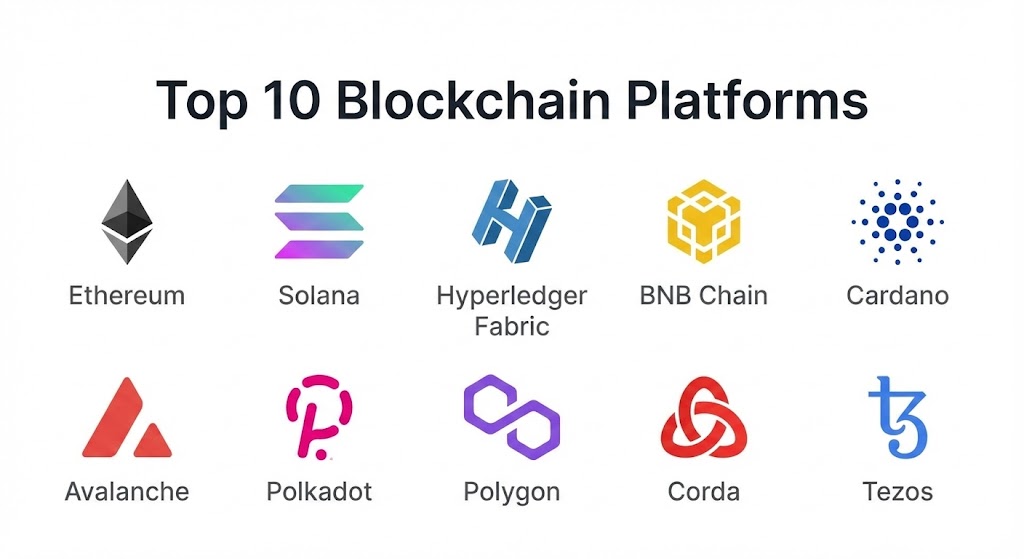
Top 10 Blockchain Platforms
1 — Ethereum
Ethereum is the most popular and widely used platform for building smart contracts and decentralized apps. It was the first platform to really show the world that blockchain could be used for more than just money, and it currently hosts the largest number of projects in the world.
- Key features:
- Supports a special coding language called Solidity for making smart contracts.
- Uses a huge network of computers to keep the system safe and running.
- Allows anyone to create their own digital tokens on top of the network.
- Has a very large ecosystem of tools for developers to use.
- Uses a system where users pay “gas fees” to complete transactions.
- Supports decentralized finance and digital collectibles.
- Continuously updates to become faster and more energy-efficient.
- Pros:
- It has the biggest community, which means it is easy to find help and tutorials.
- Almost every other blockchain tool is designed to work with Ethereum first.
- Cons:
- When many people use it at once, the transaction fees can become very expensive.
- It can sometimes be slower than newer platforms during busy times.
- Security & compliance: High. It uses advanced encryption and a global network of validators. Compliance depends on the specific app built on it.
- Support & community: Massive. There are millions of developers, extensive documentation, and endless online forums for support.
2 — Solana
Solana is known for being incredibly fast and very cheap to use. It was designed to solve the speed and cost problems found in older blockchains, making it a favorite for apps that need to handle thousands of transactions every second.
- Key features:
- Uses a unique “Proof of History” system to keep time and stay fast.
- Can process thousands of transactions every single second.
- Transaction costs are usually just a tiny fraction of a penny.
- Designed to scale as hardware gets better without becoming slower.
- Supports smart contracts using popular coding languages like Rust.
- Built for high-speed trading and gaming apps.
- Energy-efficient design compared to older blockchain types.
- Pros:
- It is one of the fastest platforms available today.
- The extremely low fees make it great for apps that handle many small transactions.
- Cons:
- The network has occasionally stopped working for short periods in the past.
- It requires very powerful and expensive computers to help run the network.
- Security & compliance: Strong encryption is used. Audit logs are transparent on the ledger.
- Support & community: Rapidly growing. Excellent documentation and a very active community of builders and fans.
3 — Hyperledger Fabric
Hyperledger Fabric is different because it is a “private” blockchain. Instead of being open to everyone, it is designed for businesses that want to share data only with specific, trusted partners. It is backed by big names like IBM.
- Key features:
- Allows businesses to keep certain information private from other members.
- No digital currency or “tokens” are required to use the system.
- Very modular, meaning you can swap out different parts of the system easily.
- Designed to handle high-speed business transactions.
- Allows for “channels” where only specific members can see certain data.
- Works well with existing business software and identity systems.
- Focused on supply chain, trade finance, and healthcare records.
- Pros:
- Perfect for companies that must follow strict privacy and data laws.
- Since it is private, it doesn’t have the high fees found on public networks.
- Cons:
- It is much more complex to set up and manage than a public blockchain.
- It doesn’t have the “public trust” factor that comes with open networks.
- Security & compliance: Enterprise-grade. Supports internal audit logs, encryption, and permissioned access.
- Support & community: Excellent. Backed by the Linux Foundation with professional enterprise support available.
4 — Binance Smart Chain (BNB Chain)
This platform was created to be a faster and cheaper alternative to Ethereum while still being compatible with Ethereum’s tools. It is very popular for people who want to trade digital assets without paying high fees.
- Key features:
- Works perfectly with Ethereum tools and smart contracts.
- Much faster and cheaper than the original Ethereum network.
- Backed by one of the largest digital asset exchanges in the world.
- Uses a system where a small group of trusted people verify transactions.
- Very easy for developers to move their projects from Ethereum to here.
- High liquidity, meaning it’s easy to buy and sell assets.
- Supports a wide variety of financial apps.
- Pros:
- Very user-friendly and easy for beginners to start using.
- The low cost makes it accessible for small-scale projects.
- Cons:
- It is more “centralized” than Ethereum, meaning a smaller group has more control.
- It relies heavily on the success of the company that created it.
- Security & compliance: Good encryption and standard ledger security. Compliance is the responsibility of the app creator.
- Support & community: Very large and active, with lots of help available from the exchange’s own resources.
5 — Cardano
Cardano is a platform that focuses heavily on science, research, and security. Every update to the platform is reviewed by experts and academics before it is released to make sure it is as safe and reliable as possible.
- Key features:
- Built using a “research-first” approach with peer-reviewed methods.
- Designed to be very energy-efficient and sustainable.
- Uses a unique two-layer system to handle transactions and smart contracts.
- Focuses on providing digital identity for people in developing countries.
- Highly secure and resistant to common blockchain attacks.
- Built using a very reliable programming language called Haskell.
- Slow and steady update process to ensure maximum safety.
- Pros:
- It is widely considered one of the most secure and well-thought-out platforms.
- The community is very loyal and focused on long-term goals.
- Cons:
- Because they move slowly to be safe, new features take a long time to arrive.
- The programming language it uses can be difficult for some developers to learn.
- Security & compliance: Very high. Built for long-term stability and regulatory friendliness.
- Support & community: Strong academic and developer community with clear, detailed documentation.
6 — Avalanche
Avalanche is a platform built for speed and flexibility. Its standout feature is that it allows people to create their own “sub-networks,” which are like smaller blockchains that still use the main platform’s security.
- Key features:
- Transactions are usually finalized in less than two seconds.
- Allows for the creation of custom private or public blockchains.
- Can handle a very high number of transactions at once.
- Compatible with all of the popular tools used for Ethereum.
- Highly decentralized, with many different people helping to run the network.
- Very low energy usage.
- Great for both financial apps and business use cases.
- Pros:
- The “sub-net” feature is perfect for companies that need their own customized space.
- It is one of the fastest platforms to confirm that a transaction is complete.
- Cons:
- Setting up and managing a sub-net can be technically challenging.
- It is a newer platform, so it doesn’t have as many apps as Ethereum yet.
- Security & compliance: Uses a unique “consensus” system that is very hard to attack. Supports various compliance needs via sub-nets.
- Support & community: Growing quickly with a very active developer group and good technical guides.
7 — Polkadot
Polkadot is designed to be a “blockchain of blockchains.” Its main goal is to allow different blockchains to talk to each other and share information securely, even if they were built differently.
- Key features:
- Connects many different blockchains into one single network.
- Allows for the transfer of any type of data, not just money, between chains.
- Highly scalable because many chains can work at the same time.
- Can be updated without needing to stop or split the network.
- Provides shared security for all the chains connected to it.
- Developers can build their own custom “parachains” for specific tasks.
- Focused on the future of an interconnected decentralized web.
- Pros:
- It solves the problem of blockchains being “islands” that can’t talk to each other.
- It gives developers a lot of freedom to build exactly what they need.
- Cons:
- The system is very complex and can be hard for non-experts to understand.
- There is a limit to how many chains can connect at once, and it can be expensive.
- Security & compliance: Very high. Security is shared across the whole network.
- Support & community: Large and very technical community. Documentation is deep but complex.
8 — Polygon
Polygon is what people call a “Layer 2” platform. It sits on top of Ethereum to make it faster and cheaper, allowing users to enjoy Ethereum’s security without the high costs and slow speeds.
- Key features:
- Offers a variety of different ways to make Ethereum faster.
- Transactions cost pennies and happen almost instantly.
- Perfectly compatible with everything built for Ethereum.
- Used by many famous brands like Starbucks and Nike for their digital projects.
- Very easy for users to move their assets back and forth from Ethereum.
- Highly energy-efficient.
- Provides a whole suite of tools for businesses to build their own networks.
- Pros:
- It is the most popular choice for apps that want to stay close to Ethereum.
- It is very easy for users to get started because the tools are so familiar.
- Cons:
- It still relies on Ethereum to stay secure, so if Ethereum has trouble, Polygon might too.
- There are many different parts to Polygon, which can be confusing for new developers.
- Security & compliance: Benefits from Ethereum’s security. Audit logs and encryption are standard.
- Support & community: Huge. Very active on social media and lots of developer support available.
9 — Corda
Corda is a blockchain platform built specifically for the world of finance and big business. Like Hyperledger, it is private, but it focuses heavily on how legal agreements and contracts work in the real world.
- Key features:
- Only shares data with the specific people involved in a transaction.
- Designed to follow existing financial laws and regulations.
- No unnecessary data is shared with the whole network.
- Works directly with existing programming languages like Java.
- Focuses on “real-world” identity, not anonymous users.
- Built to handle complex financial agreements like insurance or loans.
- Allows for easy auditing by government regulators.
- Pros:
- It is the most “bank-friendly” platform available.
- It is designed to be legally binding and compliant with global rules.
- Cons:
- It is not a “true” public blockchain, which some people do not like.
- It has a smaller community compared to public platforms like Ethereum.
- Security & compliance: Top-tier. Built for SOC 2, GDPR, and banking-level security.
- Support & community: Excellent enterprise support provided by the company R3.
10 — Tezos
Tezos is a platform that is famous for its ability to “self-amend.” This means it can upgrade itself automatically when the community agrees on a change, without needing to shut down or start a new version of the blockchain.
- Key features:
- Has a built-in voting system for the community to decide on upgrades.
- Uses a system called “Formal Verification” to prove smart contracts are safe.
- Very energy-efficient and environmentally friendly.
- Popular for digital art and high-end collectibles.
- Built for long-term stability and avoiding network splits.
- Allows users to help secure the network and earn rewards easily.
- Focuses on institutional and high-value use cases.
- Pros:
- The self-upgrading feature means it stays modern without messy transitions.
- It is one of the safest platforms for writing complex smart contracts.
- Cons:
- It has grown more slowly than some of its competitors.
- The ecosystem of apps is smaller than Ethereum’s.
- Security & compliance: High. Formal verification helps prevent expensive bugs and hacks.
- Support & community: Dedicated community with strong support from foundations and art groups.
Comparison Table
| Tool Name | Best For | Platform(s) Supported | Standout Feature | Rating |
| Ethereum | General Dapps | Web, Mobile, Desktop | Largest ecosystem | N/A |
| Solana | High-speed apps | Web, Mobile | Extreme speed/low cost | N/A |
| Hyperledger | Private Enterprise | Linux, Windows, Mac | Private data channels | N/A |
| BNB Chain | Low-cost finance | Web, Mobile | Exchange integration | N/A |
| Cardano | Secure research | Linux, Windows, Mac | Peer-reviewed safety | N/A |
| Avalanche | Custom networks | Web, Linux | Sub-network flexibility | N/A |
| Polkadot | Interoperability | Web, Linux | Cross-chain talking | N/A |
| Polygon | Ethereum scaling | Web, Mobile | Fast/Cheap Ethereum | N/A |
| Corda | Banking/Finance | JVM (Java), Cloud | Legal/Banking focus | N/A |
| Tezos | Secure Art/NFTs | Web, Mobile | Self-upgrading code | N/A |
Export to Sheets
Evaluation & Scoring of Blockchain Platforms
Choosing the right platform requires looking at many different factors. We have scored these based on what matters most to most users.
| Criteria | Weight | Explanation |
| Core Features | 25% | Ability to run smart contracts, handle tokens, and scale. |
| Ease of Use | 15% | How simple is it for developers and end-users to get started? |
| Integrations | 15% | Does it work with existing tools, wallets, and exchanges? |
| Security & Compliance | 10% | Resistance to hacks and ability to follow laws. |
| Performance | 10% | Transaction speed and network reliability. |
| Support & Community | 10% | Availability of help, guides, and other active projects. |
| Price / Value | 15% | Cost of transactions and setup fees versus the benefits. |
Export to Sheets
Which Blockchain Platform Tool Is Right for You?
The “best” platform depends entirely on who you are and what you are trying to build.
Solo Users and Hobbyists
If you are just starting out and want to learn, Ethereum is the best place to begin because there is so much help available. If you want to try out apps without spending much money, Polygon or Solana are excellent choices because they are very cheap and easy to use.
Small and Medium Businesses (SMBs)
For smaller businesses looking to build a customer-facing app, Polygon or Avalanche offer a great balance of low costs and professional tools. They are fast enough for most needs and have a lot of momentum in the industry.
Mid-Market to Enterprise
Large companies usually need one of two things: public trust or private security. If you want to show the public you are transparent, Ethereum or Tezos are great. If you need to keep your customer data private and only share it with partners, Hyperledger Fabric or Corda are the standard choices for big business.
Budget and Scalability Needs
If your project is going to handle millions of transactions, you must choose a platform built for speed like Solana or Avalanche. If you have a very tight budget for transaction fees, avoid the main Ethereum network and use Polygon or BNB Chain instead.
Security and Compliance Requirements
For projects where a single mistake could be a disaster (like a bank or a voting system), Cardano and Tezos are the top picks due to their focus on high-level security and proven code. If you need to follow strict banking rules, Corda is specifically built for that purpose.
Frequently Asked Questions (FAQs)
1. What exactly is a blockchain platform? It is a digital infrastructure that allows people to record data and run programs (smart contracts) in a way that is secure, transparent, and cannot be changed by any single person.
2. Is a blockchain platform the same as a cryptocurrency? Not exactly. The platform is the technology (like the road), while the cryptocurrency is often the “token” used to pay for using that technology (like the toll you pay to drive on the road).
3. Are these platforms safe from hackers? Most major platforms are very safe because they are run by thousands of computers. However, the “smart contracts” built on them by people can sometimes have mistakes that hackers can exploit.
4. How much does it cost to use these platforms? It varies. On some, like Ethereum, a transaction can cost several dollars. On others, like Solana or Polygon, it costs less than a penny.
5. Do I need to be a programmer to use them? To build on them, yes, you usually need to know how to code. But to use the apps built on them, you just need a digital “wallet” and a little bit of the platform’s currency.
6. Which platform is the fastest? Currently, Solana is one of the fastest, often handling thousands of transactions per second. Avalanche and Polygon are also very quick.
7. Can a blockchain be private? Yes. Platforms like Hyperledger Fabric and Corda are designed to be “permissioned,” meaning only people with an invitation can join and see the data.
8. Are blockchain platforms bad for the environment? Old ones like Bitcoin used a lot of energy, but most of the platforms on this list (like Ethereum, Solana, and Cardano) now use very little energy—about the same as a normal computer network.
9. Can I move my data from one blockchain to another? It’s difficult, but tools like Polkadot are being built specifically to help different blockchains talk to each other and share data.
10. What is a smart contract? It is a program that lives on the blockchain. It automatically follows instructions when certain things happen, like “send money to the seller only after the buyer confirms they received the package.”
Conclusion
In simple terms, there is no single blockchain platform that is “the winner” for everyone. The industry is still growing, and different platforms have been built to solve different problems. If you need the biggest community and most trust, Ethereum is your best bet. If you need speed and low costs above all else, Solana is the way to go. For businesses that need privacy and legal compliance, Hyperledger or Corda are the most reliable partners.
When choosing, the most important thing is to think about your specific needs: Do you need to be fast? Do you need to be private? Or do you need to be where all the other people are? By focusing on those questions, you can find the foundation that will help your project succeed in the long run. The world of blockchain is big and exciting, and picking the right platform is the first step toward building something great.