Introduction
Federated Learning Platforms are special types of software that allow people to train artificial intelligence models without having to share their private data. In the past, if you wanted to teach a computer how to recognize a disease or predict a stock price, you had to move all your data into one big central pile. Federated learning changes this. It brings the “learning” process to the data wherever it sits—like on your phone, a hospital’s private server, or a bank’s computer—and only sends back small, anonymous updates to improve the main AI model.
These platforms are becoming very important because they help solve the “data silo” problem. Many companies have valuable information but cannot share it because of privacy laws or security risks. By using federated learning, these organizations can collaborate and build smarter AI together while keeping their own data 100% private and secure.
Key Real-World Use Cases
- Healthcare Research: Different hospitals can train a single model to detect rare cancers without ever sharing sensitive patient records with each other.
- Mobile Apps: Smartphone keyboards learn your typing habits and suggest the next word without sending your private messages to a central server.
- Financial Fraud: Banks can collaborate to identify new types of credit card fraud by training models on their collective data patterns while keeping customer identities hidden.
- Smart Manufacturing: Factories can share “lessons learned” from their machine sensors to predict when a part might break, without revealing their secret production processes.
What to Look For When Choosing Tools
When looking for a federated learning platform, you should check how easy it is to set up and if it works with the AI libraries you already use, like PyTorch or TensorFlow. You also need to look at how the tool handles “security.” Some tools use advanced math like “Differential Privacy” or “Homomorphic Encryption” to make sure the model updates themselves don’t accidentally leak secrets. Finally, consider if the tool can handle many participants (scalability) and if it has a helpful community to support you.
Best for: Large organizations in regulated industries like finance, healthcare, and government. It is also perfect for tech companies that want to build privacy-first mobile apps and research teams who need to collaborate across different institutions.
Not ideal for: Individual hobbyists who have all their data on one laptop or small businesses that don’t have privacy concerns. If you can easily centralize your data without breaking any laws, traditional machine learning is often faster and cheaper.
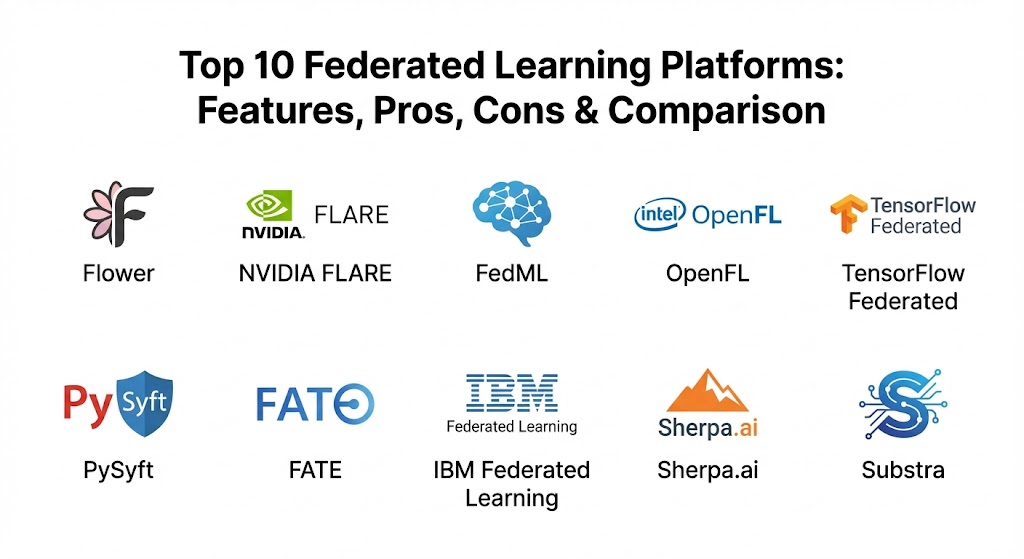
Top 10 Federated Learning Platforms Tools
1 — Flower (Flower Labs)
Flower is one of the most popular open-source frameworks for federated learning. It is designed to be “framework-agnostic,” which means it doesn’t care if you use PyTorch, TensorFlow, or even simple Scikit-learn. It focuses on being very easy for developers to start using while still being powerful enough to handle millions of devices.
- Key Features:
- Works with almost any machine learning library.
- Scales from a few servers to millions of mobile devices.
- Support for both Python and mobile platforms like Android and iOS.
- Customizable “strategies” for how the AI models are merged.
- Built-in simulation mode to test your ideas before going live.
- Detailed logging to track how well the training is going.
- Lightweight design that doesn’t slow down the host device.
- Pros:
- Extremely easy to set up and get a basic project running in minutes.
- Very flexible, allowing you to use your existing code with minimal changes.
- Cons:
- Does not include as many built-in “privacy-math” features as some other tools.
- Relies on the developer to handle some of the deeper security networking.
- Security & compliance: Supports SSL/TLS for secure communication and provides hooks for implementing custom encryption; GDPR compliant by design.
- Support & community: Very active community on Slack and GitHub; excellent documentation and many video tutorials for beginners.
2 — NVIDIA FLARE
NVIDIA FLARE (Federated Learning Application Runtime Environment) is a production-ready tool built by the experts at NVIDIA. It is specifically designed for industries where security is the top priority, such as medical imaging and financial services. It provides a robust “backbone” that manages the complicated parts of running AI across different locations.
- Key Features:
- Industrial-grade runtime for stable and reliable training.
- Built-in support for advanced privacy like Differential Privacy.
- Flexible controller/worker architecture for complex workflows.
- Management console to watch and control all training participants.
- Advanced security features like mutual authentication (mTLS).
- Pre-built templates for common healthcare and medical AI tasks.
- Support for “Streaming” training to handle large datasets.
- Pros:
- Highly stable and built to run in real-world professional environments.
- Excellent security features that come “ready to use” out of the box.
- Cons:
- Has a steeper learning curve than simpler tools like Flower.
- Can feel a bit heavy if you are only doing a small research project.
- Security & compliance: SOC 2 ready, supports SSO, end-to-end encryption, and role-based access control (RBAC).
- Support & community: Strong enterprise support from NVIDIA; professional documentation and active developer forums.
3 — FedML
FedML is a unified platform that tries to cover the entire journey of federated learning, from research to actual deployment. It focuses on making “MLOps” (the operations side of AI) easier by providing a cloud-based dashboard where you can manage your experiments across edge devices, clouds, and on-premise servers.
- Key Features:
- Unified platform for cross-device and cross-silo training.
- User-friendly cloud dashboard to monitor all active models.
- Support for Large Language Models (LLMs) through specialized modules.
- Built-in “Secure Aggregation” to hide model updates from the server.
- Lightweight mobile SDK for training on smartphones and IoT devices.
- Automated deployment tools to push models to production.
- Collaboration tools for different companies to join a single project.
- Pros:
- The web dashboard makes it very easy to see what is happening across many devices.
- Offers a lot of specialized “apps” for different industries like finance.
- Cons:
- Some of the most advanced features might require a paid account.
- The interface has many options which can be confusing for a brand-new user.
- Security & compliance: Supports secure multi-party computation (MPC), encryption at rest, and audit logs.
- Support & community: Growing community on Discord; provides a “University” section with many guides and research papers.
4 — OpenFL (Intel)
OpenFL is an open-source project started by Intel that focuses on “secure aggregation.” It is built to work well in environments where you don’t fully trust the central server or the other participants. It is especially strong when used with secure hardware features like Intel SGX (Software Guard Extensions).
- Key Features:
- Strong focus on “Trusted Execution Environments” (TEEs).
- Flexible “Director/Envoy” architecture for managing participants.
- Interactive Python API that feels familiar to data scientists.
- Support for many different AI frameworks like PyTorch and Keras.
- Built-in tools to handle “unreliable” network connections.
- Detailed certificates for every participant to ensure identity.
- Easy integration with existing data science notebooks.
- Pros:
- Excellent for high-security projects where hardware-level protection is needed.
- Very transparent and follows open standards for security.
- Cons:
- Best features require specific Intel hardware to get the full security benefit.
- The community is smaller compared to Flower or NVIDIA FLARE.
- Security & compliance: Hardware-based isolation (SGX), mutual TLS, and detailed audit trails for compliance.
- Support & community: Managed through GitHub; clear technical documentation but fewer “how-to” videos for non-experts.
5 — TensorFlow Federated (TFF)
Created by Google, TFF is the research-focused platform that helped start the federated learning movement. It is designed for experts who want to invent new federated algorithms. It is very powerful but also quite technical, as it uses a special “functional” way of writing code that is different from normal Python.
- Key Features:
- Deeply integrated with the Google TensorFlow ecosystem.
- Provides two layers: one for high-level tasks and one for low-level math.
- Large library of pre-built federated algorithms to study.
- Excellent for simulating huge networks of devices on a single computer.
- Support for complex privacy-preserving math operations.
- Detailed visualization tools for model performance.
- Backed by some of the world’s leading AI researchers.
- Pros:
- The absolute best tool for academic research and building new algorithms.
- If you already use TensorFlow, the integration is seamless.
- Cons:
- Very difficult for beginners to learn due to its unique coding style.
- Focuses more on “research” and “simulation” than on “real-world production.”
- Security & compliance: Includes experimental support for secure aggregation and differential privacy; GDPR compliant.
- Support & community: Large community of researchers; very deep and technical documentation.
6 — PySyft (OpenMined)
PySyft is a unique tool created by the OpenMined community. It is not just about federated learning; it is about “Privacy-Preserving Data Science.” It allows you to perform calculations on data you are not allowed to see. It is very popular in the medical and social science research communities.
- Key Features:
- “Data-centric” approach where you send code to the data.
- Strong focus on Differential Privacy and Secure Multi-Party Computation.
- Works as an extension to PyTorch and other popular libraries.
- Includes a “Data Owner” and “Data Scientist” workflow.
- Zero-knowledge proofs to verify that calculations were done correctly.
- Support for “Duet” mode to collaborate directly with another person.
- Peer-to-peer communication options.
- Pros:
- Has the strongest “privacy-first” philosophy of all the tools listed.
- Very human-friendly community that cares about ethical AI.
- Cons:
- Can be slower than other platforms due to the heavy encryption math.
- The software is updated frequently, so code can sometimes break between versions.
- Security & compliance: Uses advanced cryptography (SMPC, DP); designed specifically for HIPAA and GDPR sensitive data.
- Support & community: One of the largest and most helpful Slack communities in the AI world; many free courses.
7 — Duality Technologies
Short description: Duality Technologies takes federated learning a step further by combining it with fully homomorphic encryption, a form of math that lets computations happen directly on encrypted data.
This means organizations don’t just keep their raw data in place—the model updates themselves can stay encrypted the whole way through, so no party, including the server, ever sees anything in the clear.
Key Features:
- Combines federated learning with homomorphic encryption for an added layer of protection on model updates.
- Purpose-built for cross-institutional collaboration in finance, healthcare, and government.
- Secure multi-party computation tools for joint data analysis without data movement.
- Enterprise dashboard for managing participants, permissions, and governance across organizations.
- Works alongside confidential computing environments for defense-in-depth security.
- Pre-built workflows for common regulated use cases like credit risk and clinical research.
- Integrates with existing cloud infrastructure and major data science tools.
Pros:
- Layers cryptographic privacy on top of federated learning instead of relying on federation alone.
- Strong fit for organizations that must meet strict regulatory requirements around data sharing.
Cons:
- The added encryption layer can mean more setup and configuration than lighter-weight tools like Flower.
- Best suited for regulated, cross-institutional use cases rather than simple single-team projects.
Security & compliance: Uses homomorphic encryption and secure multi-party computation; built for HIPAA, GDPR, and financial-services compliance requirements.
Support & community: Dedicated enterprise onboarding and support for regulated industries; recognized by industry analysts as a leader in privacy-enhancing technology.
8 — FATE (Webank)
FATE (Federated AI Technology Enabler) is a massive project designed for “industrial-scale” federated learning. It is one of the few tools that supports “Vertical Federated Learning,” which is when two companies have different information about the same people and want to combine it safely.
- Key Features:
- Support for Horizontal, Vertical, and Transfer federated learning.
- High-level graphical interface to build AI workflows without code.
- Production-ready features like Kubernetes support for scaling.
- Pre-built algorithms for finance, such as credit scoring and risk.
- Secure multi-party computation built into the core.
- Governance tools to manage which companies can join the network.
- Detailed monitoring for large-scale enterprise deployments.
- Pros:
- The “Vertical” learning feature is unique and very powerful for business partnerships.
- Built to handle extremely large datasets in big corporate data centers.
- Cons:
- The setup is very complex and usually requires a team of engineers.
- The documentation can sometimes be hard to follow for English speakers.
- Security & compliance: Enterprise-grade security, including SSO, encryption, and full compliance with banking standards.
- Support & community: Strong backing from major tech companies; large community in Asia and growing globally.
9 — IBM Federated Learning
IBM offers a managed version of federated learning as part of its enterprise AI suite. This is a great choice for companies that don’t want to manage their own open-source servers and prefer a tool that comes with a “brand name” and a service agreement.
- Key Features:
- Managed service that handles the “aggregator” server for you.
- User-friendly interface for setting up federated experiments.
- Support for a wide range of common AI libraries.
- Built-in “Fusion” methods to combine models effectively.
- Integration with IBM’s other data and security tools.
- Detailed “Audit Logs” to show every step of the training process.
- Automatic handling of “heterogeneous” data (different formats).
- Pros:
- The easiest way for a large corporation to get started without technical headaches.
- Comes with professional support and guaranteed uptime.
- Cons:
- It is not free, unlike the open-source options.
- You are “locked in” to the IBM ecosystem.
- Security & compliance: ISO, SOC 2, HIPAA, and GDPR compliant; high-level enterprise encryption.
- Support & community: 24/7 professional technical support from IBM; dedicated account managers for big clients.
10 — Substra (Owkin)
Substra is a tool designed specifically for “Collaborative Research.” It is often used in the medical field where multiple pharmaceutical companies or universities want to work together. It focuses on “traceability,” meaning you can prove exactly who contributed what to the final AI model.
- Key Features:
- “Traceable” AI training where every action is recorded.
- Support for multi-cloud and cross-institutional projects.
- Strong focus on data sovereignty (keeping your data yours).
- Clean interface for managing research partnerships.
- Scalable architecture for deep learning models.
- Privacy-preserving by design with no raw data transfer.
- Designed to help with “trust” between different organizations.
- Pros:
- The best tool for collaborative research where “credit” and “auditing” are important.
- Very professional and built for long-term scientific projects.
- Cons:
- Not as focused on “real-time” mobile apps.
- Can be overkill if you just want to train a model quickly.
- Security & compliance: Built-in audit trails, secure data handling, and compliance with healthcare laws like HIPAA.
- Support & community: Active support for research institutions; clear technical manuals and professional onboarding.
Comparison Table
| Tool Name | Best For | Platform(s) Supported | Standout Feature | Rating |
| Flower | General use & Mobile | Linux, Mac, Win, iOS, Android | Multi-framework support | 4.7 |
| NVIDIA FLARE | Enterprise & Health | Linux, Mac, Windows | Industrial-grade stability | 4.6 |
| FedML | MLOps & Dashboards | Cloud, Edge, On-prem | Unified cloud dashboard | 4.5 |
| OpenFL | Hardware Security | Linux (Intel SGX focus) | Hardware-level isolation | N/A |
| TFF (Google) | Deep Academic Research | Linux, Mac, Windows | Advanced research math | 4.3 |
| PySyft | Privacy Advocates | Linux, Mac, Windows | Privacy-first philosophy | 4.4 |
| FATE | Large Business Partners | Linux, Kubernetes | Vertical Federated Learning | N/A |
| IBM FL | Managed Enterprise | IBM Cloud / SaaS | Fully managed service | 4.1 |
| Sherpa.ai | Ease of Use | Linux, Mac, Windows | High-level simple API | N/A |
| Substra | Medical Research | Linux, Cloud | Traceability & Auditing | N/A |
Evaluation & Scoring of Federated Learning Platforms
We have scored these tools based on the things that matter most to real-world users. This table explains how we reached our conclusions.
| Category | Weight | What We Look For |
| Core Features | 25% | Ability to handle different AI frameworks and learning styles. |
| Ease of Use | 15% | How quickly a human can learn the tool and get results. |
| Integrations | 15% | Does it work with PyTorch, Cloud providers, and mobile apps? |
| Security | 10% | Does it have encryption, privacy math, and audit logs? |
| Performance | 10% | How fast is the training and how much bandwidth does it use? |
| Support | 10% | Quality of documentation and helpfulness of the community. |
| Price / Value | 15% | Is the tool free (open-source) or worth the paid cost? |
Which Federated Learning Platforms Tool Is Right for You?
Choosing the right tool depends on your goals and your technical skills.
Solo Users vs. SMBs
If you are working alone or in a small team, Flower is almost always the best choice. It is simple to install, works with your existing code, and has a very friendly community. You won’t get stuck in confusing setup steps. Sherpa.ai is another great option if you want something that handles the privacy math for you automatically.
Mid-Market vs. Enterprise
For larger companies that need professional reliability, NVIDIA FLARE is the top choice. It is built to work in high-stakes environments like hospitals. If your company already uses a lot of cloud services, FedML is excellent because its dashboard lets you manage everything from one screen without having to check many different servers.
Budget-Conscious vs. Premium
If you have a zero-dollar budget, stick with Flower, PySyft, or OpenFL. These are all open-source and free to use forever. If you are a large bank or hospital and you want “peace of mind,” paying for IBM Federated Learning or the enterprise version of FedML is worth it because you get professional help if something goes wrong.
Feature Depth vs. Ease of Use
If you are a math expert who wants to invent a new way of doing AI, TensorFlow Federated (TFF) gives you the most depth. However, if you just want to get the job done quickly, Flower or Sherpa.ai are much easier to handle.
Frequently Asked Questions (FAQs)
1. Does federated learning mean the data is shared?
No. That is the whole point! The raw data (like your photos or bank records) stays on your device. Only “brain updates” (model weights) are sent to the central server.
2. Is it slower than regular machine learning?
Yes, usually. Because the data is spread out across different computers and the internet, it takes more time to send the updates back and forth compared to having all the data in one room.
3. Can the central server “see” my secrets in the updates?
Not if you use “Secure Aggregation.” These tools use math to mix your update with everyone else’s before the server can read it, so the server only sees the “average” result.
4. What is “Vertical Federated Learning”?
This is when two companies have different info on the same person (like a bank having your salary and a store having your shopping history). They can combine their knowledge without sharing the actual records.
5. Do I need special hardware to run these tools?
Most tools work on any normal computer or phone. However, some tools like OpenFL work even better if you have specific secure chips (like Intel SGX) in your computer.
6. Is federated learning good for small amounts of data?
It is actually better for large amounts of data spread across many places. If you only have a small amount of data, it is usually simpler just to use traditional machine learning.
7. Can I use these tools with ChatGPT-style models?
Yes. Modern platforms like FedML and NVIDIA FLARE now have special features specifically for training “Large Language Models” (LLMs) in a federated way.
8. What is “Differential Privacy”?
It is a technique where the tool adds a little bit of “noise” or random data to the updates. This makes it impossible for someone to figure out exactly what was in your original data.
9. Is this technology legal for healthcare (HIPAA)?
Yes, federated learning is one of the best ways to comply with HIPAA because the sensitive patient data never leaves the hospital’s secure network.
10. What is the most common mistake beginners make?
The biggest mistake is not checking the “network connection.” Federated learning depends on many devices talking to each other, so if the internet is slow or unstable, the training might fail.
Conclusion
Federated Learning Platforms are changing the way the world builds artificial intelligence. We no longer have to choose between “smart AI” and “private data.” These tools allow us to have both. By keeping data where it belongs and only sharing the knowledge gained from that data, we can build models that are more accurate, more diverse, and much more ethical.
When picking your tool, remember that there is no “one winner.” If you want simplicity, go with Flower. If you want enterprise-grade safety, choose NVIDIA FLARE. If you want to change the world of privacy research, look at PySyft. What matters most is that you start building with privacy in mind today, so that the AI of tomorrow is safe and helpful for everyone.