Introduction
Differential Privacy Toolkits are specialized sets of software tools and libraries that allow organizations to share information about a dataset without revealing any secrets about the specific individuals inside that data. Imagine you have a list of medical records. You want to know the average age of the patients, but you don’t want anyone to be able to figure out exactly who is on that list. These toolkits add a very specific, calculated amount of “mathematical noise” to the data. This noise is just enough to hide individual identities while keeping the overall patterns and totals accurate enough to be useful for researchers and businesses.
These toolkits are incredibly important because they solve a major trust problem. In the past, companies often tried to “anonymize” data by just removing names, but smart hackers could still figure out who people were by looking at other clues. Differential privacy is a much stronger, mathematical way to guarantee privacy. Real-world use cases include government agencies releasing census data, tech companies analyzing how people use their phones without seeing private messages, and hospitals sharing research on diseases while protecting patient records.
When choosing a toolkit, you should look for how easy it is to integrate with your current database, how much “accuracy” you lose when noise is added, and whether the tool is backed by a reliable team or a strong community.
Best for
These toolkits are best for data scientists, privacy engineers, and compliance officers working in highly regulated fields like healthcare, finance, and government. They are especially valuable for large enterprises and research institutions that handle massive amounts of sensitive personal information and need to stay on the right side of privacy laws.
Not ideal for
They are not ideal for small businesses with very simple data needs where basic “masking” is enough. They are also not a good fit for projects where every single individual data point must be 100% exact (like billing or payroll), because the “noise” added by differential privacy would make those specific numbers incorrect.
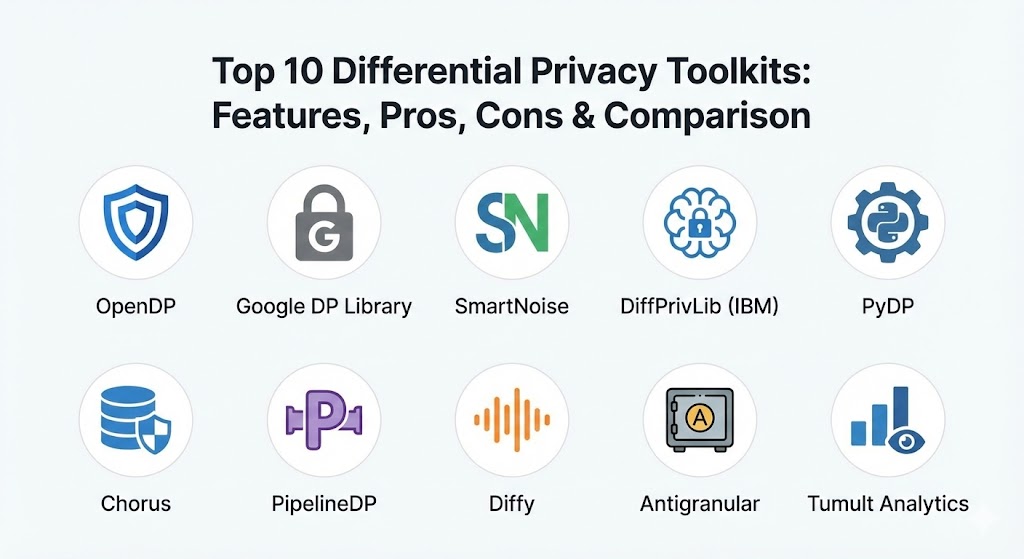
Top 10 Differential Privacy Toolkits
1 — OpenDP
OpenDP is a community-driven project that provides a collection of trustworthy and easy-to-use software for differential privacy. It is designed to be a “gold standard” for researchers and organizations who want to share data safely.
- Key features:
- A flexible library that works with many different types of data analysis.
- A modular design that lets users pick and choose the specific privacy methods they need.
- Strong mathematical proofs to ensure the privacy guarantees are real.
- Support for various programming languages through a core system.
- Tools to help measure exactly how much “privacy budget” is being used.
- High-speed performance even when working with very large files.
- Pros:
- It is backed by experts from top universities, so the science is very reliable.
- The community is very active, meaning the tool is constantly being improved.
- Cons:
- It can be a bit difficult for beginners to understand the mathematical concepts at first.
- Setting up the library to work with custom data structures requires some effort.
- Security & compliance: OpenDP is built to help organizations meet GDPR and other privacy rules. It focuses on transparency and audit-friendly math.
- Support & community: There is a large community of academics and developers. They offer extensive documentation and a forum for asking technical questions.
2 — Google Differential Privacy Library
This is a set of open-source libraries created by Google to help developers implement differential privacy in their own apps. It is built on the same technology Google uses to protect user data in its own products.
- Key features:
- Libraries available in popular languages like C++, Java, and Go.
- Pre-built functions for common math tasks like averages and counts.
- A “testing framework” to make sure your privacy settings are working correctly.
- Highly optimized code that doesn’t slow down your computer systems.
- Simple integration with existing database systems.
- Tools for “stochastic” noise generation to ensure randomness.
- Pros:
- It is very stable and has been tested on a massive scale by Google.
- The documentation is very clear and easy for most developers to follow.
- Cons:
- It may not have as many “experimental” features as some academic toolkits.
- Changing the core logic can be hard if you have very unique privacy needs.
- Security & compliance: Varies by implementation, but it is designed to help with SOC 2 and GDPR compliance by providing high-quality privacy controls.
- Support & community: Excellent documentation and a solid presence on developer forums. Direct support is limited to the open-source community.
3 — SmartNoise (by Microsoft & OpenDP)
SmartNoise is a collaboration between Microsoft and the OpenDP project. It is designed to make differential privacy accessible through common data tools like SQL and Python.
- Key features:
- A system that allows you to run “private” SQL queries on your data.
- Integration with popular data science tools like Spark and Pandas.
- A “validator” that checks if your query will accidentally reveal too much info.
- Built-in tools for visualizing how privacy affects your results.
- Support for “budget tracking” to limit how many times data can be queried.
- Cloud-ready features that work well in modern business environments.
- Pros:
- It is one of the easiest tools for people who already know how to use SQL.
- The collaboration between a tech giant and a top university makes it very trustworthy.
- Cons:
- Some of the advanced features are still being updated and changed.
- It can require a lot of computer memory for very complex queries.
- Security & compliance: Built with enterprise standards in mind. It supports modern security practices used in large corporations.
- Support & community: Supported by both Microsoft and the OpenDP community, offering a mix of corporate stability and academic expertise.
4 — DiffPrivLib (by IBM)
IBM’s Differential Privacy Library is a Python-based tool designed for data scientists and machine learning engineers. It aims to make it easy to build “private” AI models.
- Key features:
- A large collection of “private” versions of common machine learning tools.
- Tools for transforming data into a privacy-safe format automatically.
- Built-in mechanisms for adding different types of mathematical noise.
- A simple interface that feels familiar to anyone who uses Python.
- Detailed logs to track how privacy is being applied to each task.
- Support for high-dimensional data (data with many different categories).
- Pros:
- It is perfect for teams that focus on AI and machine learning.
- It is very lightweight and easy to install on a standard laptop.
- Cons:
- It is mostly focused on Python, so it might not work for teams using other languages.
- It may not be as fast as some of the C++ based tools for giant datasets.
- Security & compliance: HIPAA and GDPR friendly. IBM provides a strong framework for meeting regulatory requirements.
- Support & community: Good documentation and a steady stream of updates from IBM’s research team.
5 — PyDP
PyDP is a Python wrapper for Google’s differential privacy C++ library. It brings Google’s powerful privacy math to the world of Python users.
- Key features:
- Provides access to high-performance C++ math using simple Python code.
- Functions for calculating sums, variances, and standard deviations safely.
- A “bounded” system that prevents any single data point from having too much influence.
- Easy setup for data scientists who don’t want to learn complex C++.
- Frequent updates to stay in sync with Google’s core library.
- Pros:
- You get the speed of C++ with the simplicity of Python.
- It is completely free and open-source for everyone.
- Cons:
- Since it is a “wrapper,” there is a slight delay in getting new features from Google.
- Error messages can sometimes be confusing because they come from the underlying C++ code.
- Security & compliance: Follows the security standards of the Google library it is built upon.
- Support & community: Small but dedicated community of developers who maintain the project on a volunteer basis.
6 — Chorus
Chorus is a specialized tool designed specifically for running SQL queries with differential privacy. It acts as a “guard” between your user and your database.
- Key features:
- It rewrites your SQL queries to include privacy math automatically.
- Works with most popular database systems like PostgreSQL and MySQL.
- Doesn’t require you to change how your data is stored.
- Uses a “privacy budget” system to keep track of every query.
- Provides high accuracy for standard business reports.
- Pros:
- It is one of the few tools that works “on top” of your existing database.
- It is very practical for business analysts who are not math experts.
- Cons:
- It may not support every single complex SQL command.
- It can add a small amount of “wait time” to your queries.
- Security & compliance: Excellent for audit logs. It keeps a record of exactly who queried what and how much privacy was used.
- Support & community: Mainly an academic project, so support is mostly through documentation and research papers.
7 — PipelineDP
PipelineDP is a tool created by Google and OpenMined. It is designed for processing very large amounts of data using “pipelines” like Apache Spark or Beam.
- Key features:
- Built for “Big Data” that is too large for one computer to handle.
- Works seamlessly with common data processing frameworks.
- Allows for “partitioning” data while still keeping it private.
- Highly scalable for companies with billions of records.
- Uses Python, making it accessible to most data engineers.
- Pros:
- It is the best choice for giant companies with massive data warehouses.
- The collaboration with OpenMined adds a lot of focus on user privacy.
- Cons:
- It is a bit “overkill” for small projects or simple datasets.
- Setting up large data pipelines is a complex task for any team.
- Security & compliance: Designed for large-scale enterprise compliance needs.
- Support & community: Strong support from the OpenMined community, which is very passionate about privacy tech.
8 — Diffy
Diffy is a toolkit that focuses on making differential privacy work for “dynamic” data—data that changes all the time, like website traffic or stock prices.
- Key features:
- Special algorithms for data that comes in a constant stream.
- Low-latency processing so you get your results quickly.
- Automatic adjustment of “noise” as the data changes.
- A simple dashboard to monitor privacy levels in real-time.
- Support for multiple “noise” types depending on the data.
- Pros:
- It is perfect for real-time monitoring and live dashboards.
- It handles the “changing” nature of data better than static tools.
- Cons:
- It is a more niche tool compared to general libraries like OpenDP.
- The mathematical guarantees can be harder to calculate for live streams.
- Security & compliance: SOC 2 ready for companies that need to prove their live data is being handled safely.
- Support & community: Smaller community, but they provide very specialized technical documentation.
9 — Antigranular
Antigranular is a platform that combines differential privacy with “confidential computing.” It provides a secure environment where you can work on data without ever actually seeing it.
- Key features:
- A “Secure Enclave” where data is processed in a locked-down vault.
- Integrated differential privacy tools that are applied automatically.
- A Python-based coding environment for data scientists.
- High-level protection against even the most advanced hackers.
- Easy collaboration between different companies who don’t want to share their raw files.
- Pros:
- It offers some of the highest levels of security available today.
- It makes it safe for two different companies to work on a project together.
- Cons:
- It is a paid platform, so it is not free like the open-source libraries.
- The “locked-down” environment can sometimes make coding feel a bit restrictive.
- Security & compliance: Top-tier security including ISO 27001 and GDPR compliance.
- Support & community: Professional customer support and a dedicated onboarding process for businesses.
10 — Tumult Analytics
Tumult Analytics is a high-performance library built specifically for enterprise-level data processing. It is known for its ability to handle complex data relationships.
- Key features:
- Advanced “grouping” features that keep families or households private.
- Highly efficient processing for multi-billion row datasets.
- A simple Python API that hides the complex math from the user.
- Rigorous mathematical testing to ensure zero privacy leaks.
- Tools to help decide the best “epsilon” (privacy level) for your needs.
- Pros:
- It is used by large government organizations, so it is very “battle-tested.”
- It handles complex, messy real-world data better than most other tools.
- Cons:
- It is designed for experts, so there is a learning curve.
- It requires a good understanding of your data structure before you start.
- Security & compliance: Fully compliant with the strictest government privacy standards.
- Support & community: They offer professional services and high-end enterprise support.
Comparison Table
| Tool Name | Best For | Platform(s) Supported | Standout Feature | Rating |
| OpenDP | Researchers | Python / Rust | Modular Academic Rigor | N/A |
| Google DP | Software Devs | C++ / Java / Go | High Stability | N/A |
| SmartNoise | SQL Users | Python / SQL | SQL Query Privacy | N/A |
| DiffPrivLib | AI Engineers | Python | Machine Learning Focus | N/A |
| PyDP | Python Devs | Python | Speed of C++ in Python | N/A |
| Chorus | Database Admins | SQL / Databases | Database Middleware | N/A |
| PipelineDP | Big Data Teams | Spark / Beam | Massively Scalable | N/A |
| Diffy | Live Data | Cloud / Streams | Real-time Analysis | N/A |
| Antigranular | Secure Collab | Web Platform | Secure Data Vaults | N/A |
| Tumult | Enterprises | Python / Large Scale | Complex Group Privacy | N/A |
Evaluation & Scoring of Differential Privacy Toolkits
| Criteria | Weight | What it measures |
| Core features | 25% | The variety of privacy algorithms and math tools provided. |
| Ease of use | 15% | How simple the code is to write and the documentation to read. |
| Integrations | 15% | How well it works with SQL, Python, Spark, and databases. |
| Security | 10% | Evidence of rigorous math testing and security certs. |
| Performance | 10% | Speed and the ability to handle millions or billions of rows. |
| Support | 10% | Availability of help, community forums, and updates. |
| Price / Value | 15% | Whether the tool is free (open-source) or provides high value for its cost. |
Which Differential Privacy Toolkits Tool Is Right for You?
Choosing a toolkit can be confusing because the math is so deep. However, you can simplify the choice by looking at how you currently work.
If you are a solo user or a student, PyDP or DiffPrivLib are the best places to start. They are free, they use Python, and you can run them on your own computer without any fancy servers. They are great for learning the basics of adding “noise” to data.
For small and medium businesses, SmartNoise is a great choice because it allows your team to keep using SQL. Most small teams have someone who knows SQL, so they don’t have to hire a specialized “privacy engineer” to get started.
Large enterprises and government agencies should look at Tumult Analytics or PipelineDP. These tools are built to handle billions of rows of data across many different servers. They also offer the high-level security and compliance reporting that big organizations need to show to their legal teams.
If your main goal is collaboration between two different companies (like a grocery store and a credit card company working together), Antigranular is the top choice. It provides a “neutral ground” where both companies can work on data without ever seeing each other’s secrets.
Frequently Asked Questions (FAQs)
1. Does differential privacy make my data 100% accurate?
No. It adds a small amount of “noise” to protect privacy. This means the numbers will be very close to the truth, but not exactly the same. For most research, this small difference doesn’t matter.
2. Can I use these tools for my monthly billing?
No. You should not use differential privacy for tasks where you need an exact number for a specific person, like a bank balance or a bill. It is meant for “big picture” trends, not individual records.
3. Is differential privacy better than just removing names?
Yes. Removing names is often not enough because hackers can use other clues (like birth dates and zip codes) to find out who someone is. Differential privacy uses math to make that impossible.
4. Do I need to be a math genius to use these toolkits?
While the math behind the tools is very complex, most of the toolkits on this list (like SmartNoise) are designed so that you only need to know basic programming or SQL.
5. Which language is best for these tools?
Python is currently the most popular language for these toolkits because it is so widely used in data science. However, C++ and Java versions are available for high-speed software development.
6. What is a “privacy budget”?
This is a limit on how much information you can take from a dataset. Every time you ask a question, you “spend” a little bit of your budget. Once it’s gone, you have to stop to ensure the data stays private.
7. Are these tools free to use?
Many of them, like OpenDP and Google’s library, are completely free and open-source. Some platforms that offer secure “enclaves” for data may charge a fee.
8. Can I use these tools on my existing SQL database?
Yes, tools like Chorus and SmartNoise are designed to work directly on top of your current database without you having to move your files.
9. How do I know if the “noise” is too much?
Most toolkits include “utility” metrics that tell you how much your data has changed. You can use these to find a balance between high privacy and high accuracy.
10. Do these tools help with GDPR compliance?
Yes. These tools are specifically built to help companies meet the strict privacy requirements of laws like GDPR in Europe and HIPAA in the United States.
Conclusion
Differential privacy is no longer just a theory for scientists; it is a practical tool that any organization can use to protect people’s secrets. Whether you are a student using PyDP to learn the ropes or a massive corporation using PipelineDP to process billions of records, there is a toolkit that fits your needs.
The most important thing to remember is that choosing a tool is about finding the right balance. You need to balance the privacy you provide with the usefulness of the data, and the complexity of the tool with the skills of your team. No single tool is “the best” for everyone, but by focusing on your specific goals—whether that’s SQL