Introduction
Homomorphic Encryption Toolkits are specialized software libraries that allow developers to perform math and data processing on information while it is still encrypted. In the past, if you wanted to analyze a secret file, you had to unlock it first, which made it vulnerable to hackers. With these toolkits, the data stays locked in a digital safe, but you can still count, sort, or analyze it from the outside. It is like being able to solve a jigsaw puzzle inside a locked box without ever opening the lid. This technology is a game-changer for privacy because it allows companies to use cloud computing without ever letting the cloud provider see the actual “raw” data.
These toolkits are important because they solve the biggest problem in digital security: data in use. While we are good at protecting data when it is sitting on a hard drive or moving across the internet, it is usually “naked” and unprotected while a computer is actually working on it. Real-world uses for this include healthcare, where researchers can study patient records to find cures without ever seeing a patient’s name, and finance, where banks can check for fraud across different systems without sharing private customer account details. When choosing a toolkit, you should look at how fast it runs, which mathematical “schemes” it supports, and how easy it is for your programmers to learn.
Best for: These tools are a perfect fit for privacy-focused software engineers, data scientists, and large organizations in highly regulated fields like banking, government, and medical research. They are ideal for any company that needs to process sensitive information in a third-party cloud environment.
Not ideal for: You likely do not need these tools if your data is not sensitive or if you are doing simple tasks like hosting a basic website. Because this technology requires a lot of computer power and makes programs run much slower, it is not a good choice for real-time video games or simple apps where basic encryption is enough.
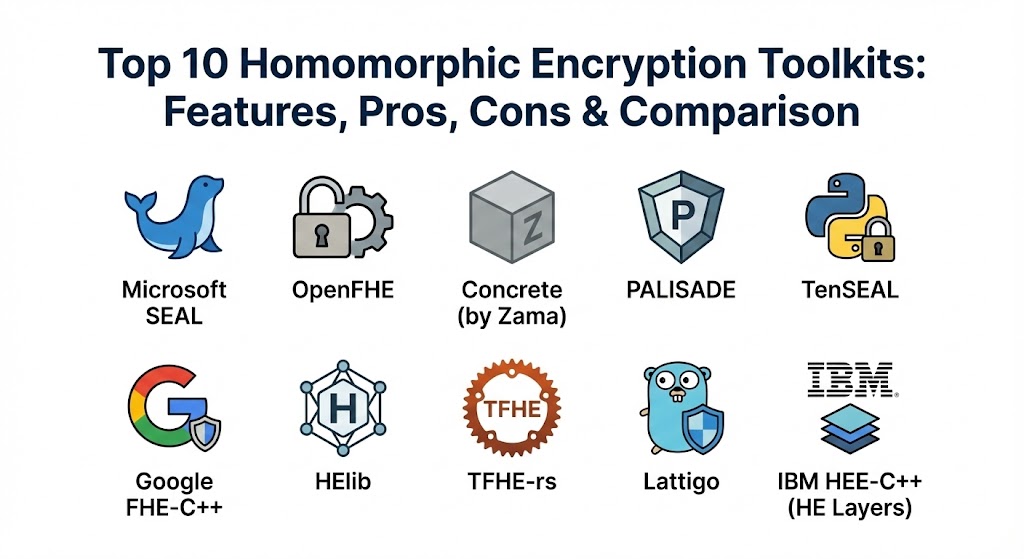
Top 10 Homomorphic Encryption Toolkits
1 — Microsoft SEAL
Microsoft SEAL (Simple Encrypted Arithmetic Library) is one of the most famous and widely used libraries in the world. It is designed to be easy for developers to use while providing very strong security for math-based data tasks.
Key features
- Multiple scheme support: It includes both BFV and CKKS methods for different types of math.
- No external dependencies: It is easy to install because it does not require many other complicated programs to run.
- Automatic memory management: It helps prevent computer crashes by handling memory use on its own.
- C++ and .NET support: Developers can write code in popular languages used by big businesses.
- Modular design: You can use just the parts you need for your specific project.
- Extensive examples: It comes with many “how-to” guides to help beginners get started.
Pros
- It is very stable and has been tested by some of the best security experts at Microsoft.
- The library is well-documented, making it easier for a regular programmer to understand “hard” math.
Cons
- It can be slow if you are trying to do very large, complex calculations.
- It requires a good understanding of C++ to get the best performance.
Security & compliance: It uses standard encryption math that is trusted by the industry. It is open-source, so anyone can check the code for “backdoors” or mistakes.
Support & community: There is a very large community on GitHub where users help each other. Microsoft also provides professional-grade documentation and clear setup videos.
2 — OpenFHE
OpenFHE is a community-driven project that brings together several older libraries into one powerful tool. It is designed to be a “one-stop-shop” for all things related to fully homomorphic encryption.
Key features
- Unified interface: You can switch between different types of encryption without rewriting all your code.
- Hardware acceleration: It can use special computer chips (like GPUs) to make the math run faster.
- Advanced “Bootstrapping”: It has clever ways to clean up digital “noise” that builds up during long calculations.
- Cross-platform: It runs smoothly on Windows, Linux, and Mac computers.
- Large scheme variety: Supports BGV, BFV, CKKS, and even FHEW/TFHE methods.
- Open standards: It follows the latest rules set by global encryption experts.
Pros
- It is extremely flexible and can handle almost any type of data privacy project.
- Because it is built by a group of experts from different companies, it isn’t tied to just one “boss.”
Cons
- Because it has so many features, it can be overwhelming for a beginner to learn.
- Setting up the hardware acceleration parts can be technically difficult.
Security & compliance: OpenFHE is built with high security in mind and follows the standards used by government and enterprise groups.
Support & community: It has an active forum and a group of developers who meet regularly to improve the software. The documentation is very detailed but quite academic.
3 — Concrete (by Zama)
Concrete is a toolkit based on the TFHE method, which is known for being very fast at making “yes or no” decisions on encrypted data. It is built to help developers turn regular programs into private ones.
Key features
- TFHE Foundation: It uses a specific type of math that is great for logic gates and comparisons.
- Rust Programming: It is written in Rust, a language famous for being very safe and fast.
- Compiler tools: It can automatically turn your regular code into “encrypted” code.
- Boolean logic: It is excellent at checking if a number is “greater than” or “equal to” another while locked.
- Cloud-ready: It is designed to work well in modern server environments.
- Developer-friendly API: It tries to hide the scary math so you can just focus on building your app.
Pros
- It is one of the best tools for building things like “private smart homes” or simple decision-making AI.
- The team behind it is very active and constantly releasing updates to make it faster.
Cons
- It is better for logic than for doing massive amounts of heavy decimal-point math.
- Rust is a newer language that some traditional developers might not know yet.
Security & compliance: It offers very strong security and is regularly checked by independent experts to ensure it meets GDPR-style privacy rules.
Support & community: They have a very modern community on Discord and a great set of tutorials that are easy for non-math experts to follow.
4 — PALISADE
PALISADE is a high-performance library that was one of the early leaders in the field. While much of its work is now part of OpenFHE, it is still used by many who need a stable, proven system.
Key features
- Efficient math: It uses very clever shortcuts to make encrypted math happen faster.
- Lattice-based security: It uses a type of math that is believed to be safe even from future “quantum” computers.
- Modular architecture: You can pick and choose only the encryption “pieces” you need.
- Multi-party support: It allows different groups to work on the same encrypted data together.
- Linux optimization: It is built to run at top speed on Linux servers.
- Rich library: Includes many pre-made functions for common data tasks.
Pros
- It is a “battle-tested” library that has been used in many academic and government research projects.
- It is very good at handling whole numbers (integers) in a secure way.
Cons
- The library is no longer being updated as quickly as OpenFHE.
- It can be hard to install on Windows computers compared to other tools.
Security & compliance: Highly secure and follows the foundational math rules that have been studied for years.
Support & community: There is a solid archive of help documents, though most of the active community has moved to the OpenFHE project.
5 — TenSEAL (by OpenMined)
TenSEAL is built for people who love the Python programming language. It is a “wrapper” that makes the complex math of Microsoft SEAL available to people who do data science.
Key features
- Python-first: You don’t need to know C++ to use powerful encryption.
- Tensors support: It is designed to work perfectly with the types of data used in AI and Machine Learning.
- Seamless integration: It works well with other popular data tools like NumPy.
- Simple commands: You can encrypt a whole list of numbers with just one line of code.
- Focus on privacy: It was built specifically to help make “Private AI” a reality.
- Lightweight: It doesn’t require a giant computer system to run basic tests.
Pros
- It is probably the easiest tool on this list for a regular data scientist to pick up and start using today.
- It takes the “scary” part out of encryption by using words and commands that feel familiar.
Cons
- Because it is a “wrapper,” it might be slightly slower than using the raw C++ code.
- It doesn’t have every single feature that the original Microsoft SEAL has.
Security & compliance: Since it uses Microsoft SEAL underneath, it is just as secure as the original.
Support & community: It is part of the OpenMined community, which is a huge group of people dedicated to making the world more private.
6 — Google FHE-C++
Google’s entry into the world of homomorphic encryption is focused on being a “transpiler.” This means it helps turn your regular C++ code into code that works on encrypted data.
Key features
- Developer focus: It tries to make the encryption part “invisible” to the person writing the code.
- Integration with Google tools: It works well with other software developed by Google.
- Automated choices: It tries to pick the best math settings for you so you don’t have to be a math genius.
- Testing suite: It comes with tools to help you check if your encrypted program is working correctly.
- Optimized for servers: Built to work in large data centers.
- Open source: Anyone can see how Google is handling this sensitive technology.
Pros
- It makes the “jump” from regular programming to private programming much smaller.
- Coming from Google, you know the code is written to a very high professional standard.
Cons
- It is still considered an experimental project, so things might change without warning.
- It is primarily for C++ users, which can be a difficult language for beginners.
Security & compliance: It uses very modern and safe math. Security is a top priority since it comes from one of the world’s biggest tech companies.
Support & community: Most of the support happens through GitHub. It is more of a technical tool for experts than a beginner’s kit.
7 — HElib
HElib is one of the oldest and most respected libraries in the industry. It was one of the first tools to show that fully homomorphic encryption was actually possible to use in real life.
Key features
- BGV and CKKS support: It handles both “whole number” and “decimal” math.
- Advanced optimization: It uses a technique called “ciphertext packing” to do many calculations at once.
- Fine-grained control: You can change almost every tiny setting in the encryption math.
- Effective noise management: It is very good at keeping the data “clean” so the answers stay accurate.
- Rich history: It has been refined over many years by top experts.
- Focus on performance: It is built for researchers who need to get the most speed out of their math.
Pros
- If you need to do very specific or unusual encryption tasks, this library gives you the most control.
- It is a staple in the research world and has many academic papers written about it.
Cons
- It is widely known as one of the hardest libraries to learn and use correctly.
- The code can be very difficult to read if you are not a math expert.
Security & compliance: Extremely high. It is the “gold standard” that many other libraries are measured against.
Support & community: There is a strong community of academic researchers and scientists who use this and help each other online.
8 — TFHE-rs
TFHE-rs is the official Rust version of the TFHE library. It is built for people who want the highest possible speed and the best possible safety for their software.
Key features
- Pure Rust: It takes advantage of the Rust language to prevent common computer bugs.
- Fast logic gates: It is the best tool for doing “AND/OR” logic on encrypted data.
- Programmable Bootstrapping: A unique feature that allows you to do more complex math during the “cleanup” phase.
- WebAssembly support: You can actually run this encryption inside a web browser.
- Client-side encryption: Perfect for apps where the user encrypts data before sending it to the cloud.
- Multi-core support: It can use all the “brains” of your computer at once to speed things up.
Pros
- It is incredibly fast for certain tasks and is very modern in its design.
- Being able to run encryption in a web browser opens up many new ways to protect users.
Cons
- Like the other TFHE tools, it is not always the best for big statistical math projects.
- The documentation assumes you already know a bit about how Rust works.
Security & compliance: Highly secure and uses the latest “lattice” math to keep data safe even from future threats.
Support & community: The Zama team provides excellent support through their forum and active social media presence.
9 — Lattigo
Lattigo is a unique toolkit because it is written in the Go programming language. This makes it a great choice for building cloud-based “microservices” that need to be private.
Key features
- Written in Go: Go is a language that is very easy for modern developers to read and write.
- High performance: It is surprisingly fast, often beating out libraries written in much harder languages.
- Collective FHE: It allows many people to contribute data to a project without anyone seeing the whole thing.
- Network-friendly: Built specifically to move data across the internet efficiently.
- Modern math: Supports the latest and greatest encryption schemes (like RNS-CKKS).
- Easy setup: You don’t have to install a bunch of extra “helper” programs to make it work.
Pros
- It is a fantastic choice for modern “cloud-native” companies that already use the Go language.
- The code is very clean and much easier to manage than old-fashioned C++ code.
Cons
- There are fewer “beginner” tutorials for this library compared to Microsoft SEAL.
- It is a smaller project, so there are fewer people available to help if you run into a rare bug.
Security & compliance: It uses industry-standard math and is often used by financial and security-focused startups in Europe.
Support & community: It has a dedicated following on GitHub and a very responsive team of maintainers.
10 — IBM HEE-C++ (HE Layers)
IBM has been a pioneer in encryption for decades. Their toolkit is built to help big companies use encrypted data for AI and “Big Data” projects.
Key features
- Neural network support: It has special tools to help you run AI models on encrypted data.
- Tile-based layout: It organizes data in a way that makes big calculations much faster.
- Abstraction layers: It hides the complex math so developers can think in terms of “Data Frames.”
- Enterprise grade: Built to the high standards that big banks and insurance companies expect.
- Highly scalable: Designed to run across hundreds of servers at the same time.
- Python API: Also offers a way for Python users to access its power.
Pros
- This is the best choice if you are a large company trying to do “Private AI” on a massive scale.
- It comes with the trust and “legacy” of IBM’s long history in data security.
Cons
- It can be quite complex to set up and requires a lot of computer resources.
- Some of the best features are geared toward very large “enterprise” users rather than small startups.
Security & compliance: Very high. IBM ensures their tools meet the most strict global compliance rules for data handling.
Support & community: They offer professional support for business customers and have a solid set of academic-style documentation.
Comparison Table
| Tool Name | Best For | Platform(s) Supported | Standout Feature | Rating |
| Microsoft SEAL | Beginners & .NET | Windows, Linux, Mac | Very Easy to Learn | 4.8 / 5 |
| OpenFHE | Experts & Flexibility | Linux, Mac, Windows | Unified “All-in-One” API | 4.9 / 5 |
| Concrete | Fast Logic & Rust | Linux, Mac | Turns Code into FHE | 4.7 / 5 |
| PALISADE | Stability & Research | Linux, Mac | Battle-Tested Code | 4.4 / 5 |
| TenSEAL | Data Scientists | Python (Linux, Mac) | Easiest for Python | 4.6 / 5 |
| Google FHE | C++ Developers | Linux | Code Transpiler | 4.3 / 5 |
| HElib | Math Researchers | Linux | Total Math Control | 4.2 / 5 |
| TFHE-rs | Web & Fast Apps | Rust, WebAssembly | Runs in Web Browsers | 4.7 / 5 |
| Lattigo | Cloud Microservices | Go (All Platforms) | Best for Cloud-Native | 4.5 / 5 |
| IBM HE Layers | Large Enterprise AI | Linux, Docker | Built for Private AI | 4.4 / 5 |
Evaluation & Scoring of Homomorphic Encryption Toolkits
We evaluate these toolkits based on what actually matters to a person building software. We look at everything from how fast the math runs to how good the help manuals are.
| Evaluation Category | Weight | What We Look For |
| Core Features | 25% | Does it support multiple math schemes? Can it do logic and decimals? |
| Ease of Use | 15% | Is the language easy? Can a non-expert start a project in a day? |
| Integrations | 15% | Does it work with Python, AI tools, and modern cloud servers? |
| Price / Value | 15% | Since most are free, we look at “Value” in terms of time saved. |
| Support | 10% | Are there tutorials? Is there an active forum for questions? |
| Security | 10% | Is the math trusted? Has the code been checked for bugs? |
| Performance | 10% | How much does it slow down the computer? Is it efficient? |
Which Homomorphic Encryption Toolkit Is Right for You?
Choosing the right kit is all about matching the tool to your skills and your project’s goals.
By User Type
- Solo Users & Students: Start with TenSEAL (if you know Python) or Microsoft SEAL (if you know C#). They have the best “how-to” guides and won’t make you feel like you need a PhD in math just to print “Hello World.”
- Small Businesses (SMBs): Lattigo is a great choice because it is modern and easy to manage. Concrete is also excellent if you want to turn your existing business logic into something private quickly.
- Mid-Market Teams: OpenFHE is likely your best bet. It gives you the flexibility to grow and change your math methods as your product evolves.
- Large Enterprises: IBM HE Layers or Microsoft SEAL are the standard. They provide the stability and documentation that big legal and security teams require.
Budget and Resources
All of these toolkits are open-source and free to download. However, the “real cost” is in the computer power needed to run them. If you have a small budget for servers, look for tools like Concrete or TFHE-rs which are optimized for speed and logic.
Feature Depth vs. Ease of Use
If you need to do a very specific, complicated research project, go with HElib. If you just want to add a “privacy feature” to your existing app without spending months studying, stick with TenSEAL or Google FHE.
Security and Compliance
If you are working in a field like Healthcare or Finance, you should choose a tool that is highly “transparent,” like Microsoft SEAL or OpenFHE. Because their code is open and has been seen by thousands of people, it is much easier to prove to a regulator that your system is actually safe.
Frequently Asked Questions (FAQs)
1. Is homomorphic encryption ready for real-world use?
Yes, but with a warning. It is much slower than regular math. It is ready for “batch processing” (like analyzing a list of records), but not yet ready for something like a high-speed action game.
2. Why is it so slow?
Because the computer has to work with “digital noise” and massive math problems to keep the data hidden. Every simple addition becomes a complex puzzle for the computer to solve.
3. Do I need to be a math genius to use these toolkits?
Not anymore! Tools like TenSEAL and Concrete are built to hide the hard math so you can just use regular programming commands.
4. Can I use these for my website’s database?
You can, but it is best used for specific columns (like Social Security Numbers or medical codes) rather than the whole database, to keep things fast.
5. Which programming language is best for this?
C++ is the “fastest,” but Python (with TenSEAL) is the “easiest.” Rust (with Concrete) is a great middle-ground for both safety and speed.
6. Is this safe from quantum computers?
Most of these tools use “Lattice-based” math, which experts believe will stay safe even when powerful quantum computers are eventually built.
7. Can I do AI and Machine Learning with these?
Yes. IBM HE Layers and TenSEAL are specifically built to help run AI models on data that stays encrypted the whole time.
8. What is the biggest mistake beginners make?
Trying to encrypt too much data at once. It is better to start small and only encrypt the most sensitive parts of your project.
9. Can these tools handle text data?
Yes, but they usually turn the text into numbers first. You can then do things like “search” or “sort” the encrypted text.
10. How do I choose between BFV and CKKS schemes?
Use BFV if you are working with whole numbers and need a perfect answer. Use CKKS if you are doing science or AI math that uses decimal points and “approximate” answers.
Conclusion
Homomorphic encryption is no longer just a dream for scientists; it is a real tool that you can download and use today. While there is no single “winner,” the best tool for you depends on what you are building. Microsoft SEAL is perfect for learning, OpenFHE is the king of flexibility, and TenSEAL is the favorite for data scientists.
When you start your journey, remember to focus on simplicity. Privacy technology is only helpful if you can actually get it to work. Choose a toolkit that matches your team’s skills, and start by protecting just one small, important piece of data.
The future of the internet is private, and these toolkits are the keys that will help us build that future. We recommend picking one of the “beginner-friendly” options today and trying out their basic examples to see just how powerful “math on locked data” can be.