Introduction
An Enterprise Data Fabric Platform is an end-to-end data management solution that uses metadata, machine learning, and automation to connect different data sources. Instead of physically moving all data into a single warehouse—which is often slow and expensive—a data fabric creates a virtual layer that allows users to access and analyze data wherever it lives. It essentially “abstracts” the complexity of the underlying infrastructure, providing a unified interface for data engineers, analysts, and business users alike.
Why It Is Important
As organizations scale, the sheer volume and variety of data become unmanageable through traditional manual integration. Data fabric platforms are critical because they automate the discovery, governance, and integration of data. This reduces the time spent on “data janitor” work and accelerates the path to insights. By providing a consistent data management layer, these platforms ensure that security policies and quality standards are applied universally, regardless of whether the data is sitting in an old SQL database or a modern cloud lakehouse.
Key Real-World Use Cases
- 360-Degree Customer View: Integrating CRM data with social media feeds, support tickets, and purchase history to understand customer behavior in real-time.
- Fraud Detection: Connecting transactional data across different banking systems to identify suspicious patterns as they happen.
- Regulatory Compliance: Automatically identifying and masking sensitive information (PII) across all company databases to meet GDPR or CCPA requirements.
- Self-Service Analytics: Allowing business users to find and use data sets through a searchable catalog without needing IT assistance.
What to Look For
When evaluating a data fabric tool, the most important criteria is active metadata management. The system should not just store data, but understand its context and relationships. Look for robust data virtualization capabilities, a strong AI-driven automation engine, and comprehensive security and governance features. Finally, ensure the platform offers extensive connectivity to both modern cloud APIs and older legacy systems.
Best for: Large-scale enterprises, data-heavy organizations in finance or healthcare, and companies operating in complex hybrid-cloud environments with significant regulatory oversight.
Not ideal for: Small businesses with simple, centralized data needs or organizations that only use a single cloud provider and have no on-premises footprint. In these cases, a basic data warehouse or simple ETL tool is usually sufficient.
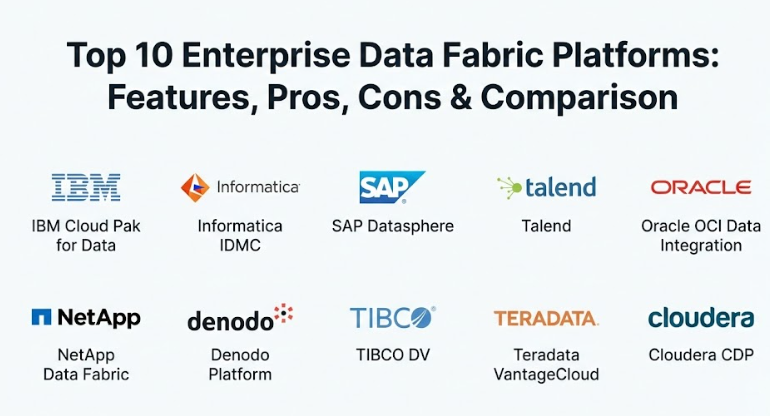
Top 10 Enterprise Data Fabric Platforms Tools
1 — IBM Cloud Pak for Data
IBM is widely considered the pioneer of the data fabric concept. Its Cloud Pak for Data is a comprehensive, modular platform that integrates data management, governance, and analysis into a single interface. It is built on a foundation of “intelligent metadata” that automates the way data is discovered and protected.
- Key features:
- Watson Knowledge Catalog for automated data discovery and lineage.
- Advanced data virtualization to query data without moving it.
- Integrated AutoAI to simplify the creation of machine learning models.
- Unified governance and privacy policies across the entire fabric.
- Industry-specific “cartridges” for pre-configured regulatory compliance.
- Deployment flexibility across any cloud or on-premises hardware.
- Pros:
- Deepest feature set for complex, global enterprise requirements.
- Excellent at handling the “heavy lifting” of data governance and security.
- Cons:
- High total cost of ownership (TCO).
- Can be overwhelming for teams without a high level of technical expertise.
- Security & compliance: FIPS 140-2, SOC 2, GDPR, HIPAA, and ISO 27001 compliant.
- Support & community: Massive global support network, IBM Documentation, and a very large enterprise user community.
2 — Informatica Intelligent Data Management Cloud (IDMC)
Informatica has evolved from a traditional ETL provider into a cloud-native data fabric leader. Its IDMC platform is powered by “CLAIRE,” an AI engine that automates thousands of manual data management tasks, making it one of the most efficient tools for large-scale integration.
- Key features:
- AI-powered CLAIRE engine for automated metadata discovery.
- Comprehensive data quality and profiling tools.
- Master Data Management (MDM) to create a single source of truth.
- Native integration with all major cloud providers (AWS, Azure, GCP).
- Low-code/No-code interface for building data pipelines.
- Integrated data marketplace for self-service access.
- Pros:
- Extremely strong for data quality and “Master Data” initiatives.
- Highly scalable and reliable for mission-critical operations.
- Cons:
- Pricing can be complex and difficult to predict as usage grows.
- Some modules can feel like separate products rather than a unified suite.
- Security & compliance: SOC 2 Type II, HIPAA, GDPR, and ISO 27001 compliant.
- Support & community: Professional 24/7 support, extensive “Informatica University,” and a global partner network.
3 — SAP Datasphere
SAP Datasphere is the successor to SAP Data Warehouse Cloud, reimagined as a comprehensive data fabric. It is specifically designed to harmonize SAP data with non-SAP data, providing a business-centric view of the organization’s information.
- Key features:
- Seamless integration with SAP S/4HANA and other SAP applications.
- Semantic modeling that preserves the business context of data.
- Integrated data cataloging for easy discovery.
- Built-in data federation to reduce data duplication.
- Collaborative spaces for different business departments.
- Open data ecosystem with partnerships like Collibra and Databricks.
- Pros:
- The essential choice for organizations running their core business on SAP.
- Excellent at maintaining the “business meaning” of data across the fabric.
- Cons:
- Less flexible for organizations that don’t have a large SAP footprint.
- Advanced features may require additional licensing.
- Security & compliance: SOC 1/2, ISO 27001, and GDPR compliant.
- Support & community: Direct SAP Enterprise Support and a massive, loyal user base.
4 — Talend (by Qlik)
Now part of Qlik, Talend offers a highly flexible data fabric that focuses on “Data Health.” It provides tools to not only move and integrate data but to constantly monitor its reliability, ensuring that the fabric isn’t just connected, but accurate.
- Key features:
- Talend Trust Score to instantly assess data quality.
- Native support for Big Data environments like Spark and Hadoop.
- Over 1,000 pre-built connectors to various apps and databases.
- Integrated API services to share data with external partners.
- Collaborative data stewardship tools for business users.
- Hybrid deployment options (Cloud, On-Prem, or Edge).
- Pros:
- Strongest focus on data trust and reliability in the market.
- Flexible, open-source roots make it adaptable to many environments.
- Cons:
- The transition following the Qlik acquisition is still ongoing.
- Initial setup of complex pipelines can be time-consuming.
- Security & compliance: ISO 27001, SOC 2, HIPAA, and GDPR compliant.
- Support & community: Robust documentation and an active “Talend Community” forum.
5 — Oracle Cloud Infrastructure (OCI) Data Integration
Oracle provides a tightly integrated data fabric within its OCI ecosystem. It is designed for high-performance data movement and virtualization, making it a natural fit for organizations that rely on Oracle’s database technology.
- Key features:
- Serverless data integration for automatic scaling.
- Real-time data streaming and change data capture (CDC).
- Integrated data catalog with automated harvesting.
- Built-in machine learning for data mapping suggestions.
- Seamless connection to Oracle Autonomous Database.
- Unified monitoring and logging across the fabric.
- Pros:
- Unrivaled performance for Oracle-to-Oracle data movement.
- Cost-effective for organizations already invested in Oracle Cloud.
- Cons:
- Can feel restrictive if your ecosystem is primarily non-Oracle.
- Management interface is professional but has a steeper learning curve.
- Security & compliance: FedRAMP, SOC 1/2/3, ISO, and HIPAA compliant.
- Support & community: Global Oracle Support and extensive Oracle University resources.
6 — NetApp Data Fabric
NetApp takes a slightly different approach, focusing on the “storage” and “infrastructure” layer of the data fabric. It is the best solution for organizations that need to manage massive volumes of data across different hardware and cloud storage tiers seamlessly.
- Key features:
- BlueXP unified control plane for all storage environments.
- Automated data tiering between on-prem and cloud.
- Integrated ransomware protection and data recovery.
- Seamless data portability across AWS, Azure, and Google Cloud.
- High-performance file services for unstructured data.
- Real-time monitoring of data storage costs and efficiency.
- Pros:
- The gold standard for hybrid-cloud storage and data mobility.
- Extremely strong at protecting data from physical or cyber failures.
- Cons:
- Focused more on the “where” of data than the “what” (less focus on analytics).
- Requires NetApp-compatible infrastructure to get the most value.
- Security & compliance: ISO 27001, SOC 2, and FIPS 140-2 compliant.
- Support & community: Excellent direct support and a strong network of storage experts.
7 — Denodo Platform
Denodo is the leader in the “Data Virtualization” niche of the data fabric market. It allows users to access and combine data from multiple sources in real-time without ever moving it, making it the fastest way to build a logical data fabric.
- Key features:
- High-performance data virtualization engine.
- Unified web-based interface for data architects and users.
- Dynamic query optimization to ensure fast results.
- Integrated data catalog with self-service capabilities.
- Automated security and governance across all virtualized sources.
- AI-powered recommendations for data discovery.
- Pros:
- Drastically reduces data duplication and storage costs.
- Allows for incredibly fast deployment of new data products.
- Cons:
- Relies on the performance of the underlying source systems.
- Not intended for “heavy” data transformation or physical movement.
- Security & compliance: SOC 2, HIPAA, and GDPR compliant.
- Support & community: Strong customer success team and “Denodo Academy” training.
8 — TIBCO Data Virtualization (by Cloud Software Group)
TIBCO provides a robust data fabric that excels in real-time environments. It is designed for organizations that need to react to data as it is created, providing a unified view of streaming and at-rest data.
- Key features:
- Real-time data virtualization and federation.
- Automated metadata discovery and mapping.
- Integrated data quality and master data management.
- Strong support for IoT and streaming data sources.
- Collaborative development environment for data teams.
- Extensive library of pre-built adapters.
- Pros:
- Excellent for high-speed, real-time business use cases.
- Highly flexible architecture that supports complex logic.
- Cons:
- Interface can feel a bit “legacy” compared to newer SaaS tools.
- Higher complexity requires specialized training to master.
- Security & compliance: ISO 27001, SOC 2, and GDPR compliant.
- Support & community: Dedicated enterprise support and a professional user group.
9 — Teradata VantageCloud
Teradata has transformed its legendary data warehousing tech into a modern data fabric called VantageCloud. It is built for the “Mega-Enterprise” that needs to run complex analytics on petabytes of data across multiple environments.
- Key features:
- ClearScape Analytics for high-performance AI and ML at scale.
- Integrated data lake and warehouse management.
- Advanced workload management to prioritize critical queries.
- Support for multi-cloud and hybrid deployments.
- Unified metadata layer for consistent governance.
- Highly efficient data compression and storage.
- Pros:
- Unmatched power for massive, complex analytical workloads.
- Extremely stable and reliable for the world’s largest companies.
- Cons:
- Very high cost of entry.
- Requires a high level of specialized knowledge to manage.
- Security & compliance: SOC 1/2, ISO 27001, HIPAA, and PCI DSS compliant.
- Support & community: High-touch enterprise support and a deep knowledge base.
10 — Cloudera Data Platform (CDP)
Cloudera offers an open-source-based data fabric that is perfect for organizations that want to avoid “vendor lock-in.” It provides a consistent data experience across the entire lifecycle—from the edge to AI.
- Key features:
- SDX (Shared Data Experience) for consistent security and governance.
- Support for open data formats (Apache Iceberg, etc.).
- Integrated tools for data engineering, warehousing, and ML.
- Multi-cloud and on-premises deployment versatility.
- Automated data discovery and cataloging.
- Real-time streaming and replication tools.
- Pros:
- Avoids proprietary lock-in by using open-source standards.
- Excellent for organizations with very large Hadoop/Spark footprints.
- Cons:
- Can be complex to manage compared to fully managed SaaS tools.
- Requires significant internal technical talent.
- Security & compliance: SOC 2, ISO 27001, and HIPAA compliant.
- Support & community: Strong community roots and professional global support.
Comparison Table
| Tool Name | Best For | Platform(s) Supported | Standout Feature | Rating (Gartner/Other) |
| IBM Cloud Pak | Global Enterprises | All (Hybrid/Cloud) | Intelligent Metadata | 4.4 / 5 |
| Informatica IDMC | Master Data focus | AWS, Azure, GCP | CLAIRE AI Engine | 4.3 / 5 |
| SAP Datasphere | SAP-centric teams | Cloud / Hybrid | Semantic Business Context | 4.1 / 5 |
| Talend | Data Trust & Quality | Cloud / On-Prem | Talend Trust Score | 4.2 / 5 |
| Oracle OCI | Oracle Database users | OCI / Hybrid | Serverless Integration | 4.0 / 5 |
| NetApp Fabric | Hybrid-cloud Storage | All Cloud / On-Prem | BlueXP Control Plane | 4.5 / 5 |
| Denodo Platform | Fast Virtualization | Cloud / On-Prem | Dynamic Query Optimizer | 4.6 / 5 |
| TIBCO DV | Real-time use cases | Cloud / Hybrid | Real-time federation | 3.9 / 5 |
| Teradata Vantage | Mega-scale analytics | All Cloud / Hybrid | ClearScape Analytics | 4.2 / 5 |
| Cloudera CDP | Open-source strategy | All Cloud / Hybrid | SDX Governance layer | 4.0 / 5 |
Evaluation & Scoring of Enterprise Data Fabric Platforms
We have evaluated the Data Fabric category using a weighted rubric that reflects the challenges of modern multi-cloud data management.
| Evaluation Category | Weight | Score (Avg) | Analysis |
| Core Features | 25% | 9 / 10 | Most tools are very mature in integration and virtualization. |
| Ease of Use | 15% | 6 / 10 | This is a complex category; tools still require high expertise. |
| Integrations | 15% | 9 / 10 | Connectivity is excellent across both cloud and legacy systems. |
| Security & Compliance | 10% | 10 / 10 | These tools are built for high-stakes, regulated industries. |
| Performance | 10% | 8 / 10 | Performance is high, but dependent on network speeds. |
| Support | 10% | 8 / 10 | Enterprise support is generally high-quality but expensive. |
| Price / Value | 15% | 6 / 10 | High entry costs make these tools major strategic investments. |
Which Enterprise Data Fabric Platform Tool Is Right for You?
Selecting a data fabric is a massive strategic move. It is not just about a tool, but about an architecture that will support your business for the next decade.
Solo Users vs SMB vs Enterprise
A data fabric is almost never necessary for solo users or SMBs. If you can see all your data in one or two apps, you don’t need a fabric. However, for an Enterprise with multiple departments, acquisitions, and cloud providers, a fabric is the only way to stay sane and secure.
Budget-Conscious vs Premium Solutions
If you are budget-conscious, look for cloud-native tools like Oracle OCI or Informatica (pay-as-you-go). If you need a Premium solution that handles global governance across thousands of servers, IBM Cloud Pak or Teradata offer the most robust, though expensive, architectures.
Feature Depth vs Ease of Use
If you need to get up and running quickly with a unified view, Denodo’s virtualization-first approach is the winner. If you need maximum Feature Depth for complex data engineering and AI model creation, IBM and Cloudera provide the most complete toolkits.
Integration and Scalability Needs
Always audit your current “gravity.” If most of your data is in SAP, start with SAP Datasphere. If you have a massive on-premises footprint that you are slowly moving to the cloud, NetApp or Informatica are the best at managing that hybrid transition.
Frequently Asked Questions (FAQs)
1. Is a Data Fabric the same as a Data Warehouse?
No. A Data Warehouse is a physical place where data is moved. A Data Fabric is a virtual layer that connects many different places (including warehouses) so they act as one.
2. What is Data Virtualization?
It is a technology that allows you to see and query data from different databases as if they were one, without actually moving the data into a new location.
3. How does AI help in a Data Fabric?
AI is used to “auto-tag” data, suggest mappings between different databases, and identify sensitive data that needs to be masked for security.
4. Can I build a data fabric on my own?
You can, using open-source tools like Spark and Kafka, but enterprise platforms provide the “connective tissue” and management interface that saves thousands of hours of manual coding.
5. How long does implementation take?
A basic data fabric for a few sources can be ready in 3 months. A global, enterprise-wide rollout usually takes 12 to 18 months of strategy and implementation.
6. Does a Data Fabric replace ETL?
Not entirely. While it reduces the need for ETL through virtualization, you will still use ETL for “heavy” data movement or preparing data for long-term storage.
7. Is my data secure when using a fabric?
Yes. In fact, it is often more secure because you can apply a single security policy across every database at once, rather than trying to manage security in each database separately.
8. What is “Metadata”?
Metadata is “data about data.” It tells the system who created the data, when it was updated, and what it represents (e.g., “this column contains customer email addresses”).
9. Can these tools handle unstructured data like PDFs?
Yes, modern platforms like IBM and NetApp are increasingly capable of cataloging and analyzing unstructured data alongside traditional database tables.
10. What is the biggest mistake when choosing a platform?
Buying a tool without a clear “Data Strategy.” A data fabric is a powerful engine, but you need to know where you want to go before you start building the roads.
Conclusion
The era of “one big database” is over. The future of business intelligence belongs to the organizations that can gracefully manage a fragmented, multi-cloud reality. An Enterprise Data Fabric Platform provides the intelligence and automation necessary to turn that fragmentation into a strategic advantage.
As we have seen, the “best” tool depends on your current technical gravity—whether you are an IBM shop, an SAP powerhouse, or an open-source advocate. Before committing, run a proof-of-concept (POC) focusing on your most difficult “silo.” Once you see your most disconnected data sources speaking the same language in a single dashboard, the value of the fabric will be undeniable.