Introduction
In the modern data stack, the way we handle data has shifted from ETL (Extract, Transform, Load) to ELT (Extract, Load, Transform). This change leverages the massive processing power of cloud data warehouses like Snowflake, BigQuery, and Redshift. However, moving data from dozens of sources into a warehouse and then running complex transformations requires a “conductor” to manage the timing, dependencies, and failures. This is exactly what ELT Orchestration Tools do. They are the glue that connects data ingestion, storage, and transformation, ensuring that every step happens in the right order and that data teams are alerted the moment something goes wrong.
Orchestration is critical because data pipelines are rarely linear. You might need to wait for a marketing API to finish its daily sync before running a dbt model that calculates your customer acquisition cost. Real-world use cases include automating daily financial reporting, syncing customer behavior data from a website to a CRM, and managing machine learning feature stores. When choosing a tool, you should evaluate it based on its ability to handle complex dependencies, its integration with your existing stack, and how easily your team can write and maintain “pipelines as code.”
Best for: Data engineers, analytics engineers, and DevOps teams in mid-market to enterprise companies. It is essential for industries like e-commerce, fintech, and SaaS where data accuracy and real-time (or near real-time) insights are competitive advantages.
Not ideal for: Small businesses with very simple data needs, such as moving a few Excel sheets into a single dashboard once a week. In those cases, the built-in scheduling features of a tool like Fivetran or even a simple Cron job may be more efficient than setting up a dedicated orchestration platform.
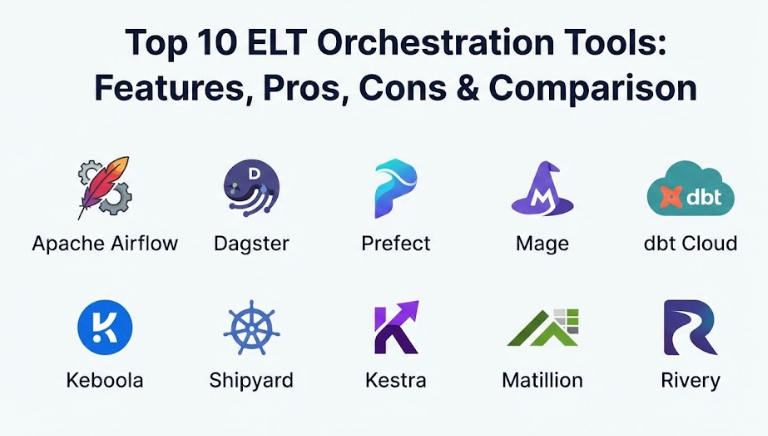
Top 10 ELT Orchestration Tools
1 — Apache Airflow
Apache Airflow is the industry standard for programmatic workflow orchestration. Originally developed at Airbnb, it allows users to define tasks and dependencies as Python code, creating Directed Acyclic Graphs (DAGs) that are highly flexible and scalable.
- Key features:
- Pipelines defined as Python code, allowing for version control and testing.
- Extensive library of “Operators” for connecting to hundreds of third-party services.
- Robust scheduling engine with support for complex cron expressions and backfilling.
- Detailed web UI for monitoring task progress and inspecting logs.
- Highly extensible architecture that supports custom plugins and providers.
- Dynamic DAG generation, allowing pipelines to adapt based on external data.
- Pros:
- Unmatched flexibility; if you can write it in Python, Airflow can orchestrate it.
- Huge global community, meaning you can find a pre-built provider for almost any tool.
- Cons:
- Significant operational overhead to manage the infrastructure (web server, scheduler, worker nodes).
- Can be “overkill” for simple tasks, with a steep learning curve for non-Python users.
- Security & compliance: SSO (via OAuth/SAML), RBAC, encryption of connections, and SOC 2 (when using managed versions like Astronomer or MWAA).
- Support & community: Massive open-source community, extensive documentation, and premium enterprise support through companies like Astronomer.
2 — Dagster
Dagster is a modern orchestrator designed for the full lifecycle of data assets. Unlike traditional task-based orchestrators, Dagster focuses on the “data assets” themselves, making it easier to track data quality and lineage throughout the ELT process.
- Key features:
- Asset-based orchestration, focusing on the data produced rather than just the task run.
- Integrated “Software-Defined Assets” that track dependencies between tables.
- Built-in support for data quality checks and metadata logging.
- Exceptional local development experience with the “Dagit” UI.
- Native integration with dbt, Airbyte, and Fivetran.
- Declarative scheduling that simplifies complex pipeline logic.
- Pros:
- Makes debugging much easier by providing visibility into the data state at every step.
- The local development environment allows engineers to test pipelines without deploying to a server.
- Cons:
- The community is smaller than Airflow’s, meaning fewer third-party “operators.”
- Requires a shift in mindset from task-oriented to asset-oriented thinking.
- Security & compliance: SSO, RBAC, secure secret management, and SOC 2 Type II compliance for Dagster Cloud.
- Support & community: Active Slack community, high-quality documentation, and direct support for Cloud customers.
3 — Prefect
Prefect is a “workflow orchestration for humans” platform that emphasizes simplicity and developer experience. It is designed to be “negative engineering” proof, handling the messy parts of pipelines like retries, logging, and caching automatically.
- Key features:
- Simple Python decorators (
@flow,@task) that turn standard code into orchestrated workflows. - “Hybrid Model” where Prefect manages the orchestration while you keep your data on your own infrastructure.
- Real-time monitoring with a fast, modern UI.
- Support for dynamic, asynchronous task execution.
- Native “Blocks” for securely managing credentials and configurations.
- Strong support for “event-driven” triggers.
- Simple Python decorators (
- Pros:
- Extremely fast to get started; you can orchestrate existing Python scripts in minutes.
- The hybrid architecture is excellent for security-conscious organizations.
- Cons:
- The transition from Prefect 1.0 to 2.0 involved breaking changes that frustrated some users.
- Managed cloud features can become expensive as the number of “task runs” increases.
- Security & compliance: SSO, RBAC, API key-based authentication, and SOC 2 compliance.
- Support & community: Growing community, excellent tutorials, and premium support for enterprise tiers.
4 — Mage
Mage is a newer player in the space that bills itself as a modern replacement for Airflow. It focuses on a “low-code/high-code” hybrid experience, allowing users to build pipelines via a GUI while maintaining the power of Python and SQL underneath.
- Key features:
- Notebook-style interface for building and testing data blocks.
- Integrated data integration (EL) and transformation (T) capabilities.
- Built-in data profiling and visualization within the pipeline editor.
- Version control and collaborative features built directly into the UI.
- Templated blocks that make it easy to reuse logic across different DAGs.
- Support for streaming and batch processing in a single platform.
- Pros:
- Dramatically speeds up the development process with its interactive editor.
- Great for teams that have a mix of data engineers and data analysts.
- Cons:
- Being a newer tool, it has fewer integrations than the legacy players.
- Enterprise features and large-scale stability are still being proven in the market.
- Security & compliance: SSO, basic RBAC, and secure environment variables.
- Support & community: Very active and helpful Slack community, fast development cycle.
5 — dbt Cloud (Semantic Layer & Job Scheduling)
While dbt (data build tool) is primarily a transformation tool, dbt Cloud provides essential orchestration features for the “T” in ELT. It manages the execution of SQL models, tests, and documentation, ensuring that your warehouse remains organized.
- Key features:
- Managed environment for running dbt jobs on a schedule or via API.
- Integrated CI/CD that runs tests on every pull request.
- The dbt Semantic Layer for defining metrics once and using them everywhere.
- Web-based IDE for developing SQL transformations.
- Automatic documentation generation and lineage tracking.
- Job triggers that can be kicked off by ingestion tools like Fivetran.
- Pros:
- The gold standard for SQL-based transformations within a warehouse.
- Makes it incredibly easy for data analysts to “own” the transformation layer.
- Cons:
- Limited as a general-purpose orchestrator; it cannot move files or call external APIs easily.
- Pricing has recently increased, making it a significant cost for larger teams.
- Security & compliance: SSO, RBAC, audit logs, SOC 2 Type II, and HIPAA compliance.
- Support & community: The largest community in the modern data stack (dbt Slack), excellent documentation.
6 — Keboola
Keboola is an end-to-end Data Stack as a Service. It doesn’t just orchestrate; it provides the ingestion, storage, transformation, and orchestration layers in a single, unified platform designed for rapid deployment.
- Key features:
- “Components” for extracting data from hundreds of sources and loading into warehouses.
- Visual orchestration builder for managing dependencies between components.
- Integrated workspaces for Snowflake, BigQuery, and Python/R.
- Automatic versioning of every configuration and transformation.
- Built-in data catalog and lineage tracking.
- Sandbox environments for testing new pipelines without affecting production.
- Pros:
- Drastically reduces the “tool sprawl” by providing everything in one package.
- Excellent for companies that want to get up and running without hiring five data engineers.
- Cons:
- Can feel like a “black box” compared to pure-play code-based orchestrators.
- Moving away from the platform can be difficult due to proprietary configurations.
- Security & compliance: SOC 2 Type II, HIPAA, GDPR, and ISO 27001 compliant.
- Support & community: High-touch customer support and a professional services wing.
7 — Shipyard
Shipyard is a low-code data orchestration platform designed for “Data Ops.” It focuses on helping teams connect their disparate data tools into a cohesive workflow using pre-built “blueprints” and a visual canvas.
- Key features:
- Visual workflow builder that requires zero coding for most common tasks.
- Extensive library of blueprints for tools like Fivetran, dbt, Snowflake, and Slack.
- Ability to write custom Python or Bash scripts when a blueprint doesn’t exist.
- Automated error handling and notifications via email or Slack.
- Fleet-wide views for monitoring hundreds of concurrent workflows.
- Support for “Webhooks” to trigger workflows from external events.
- Pros:
- One of the easiest tools for non-engineers to use to build complex workflows.
- Very transparent and predictable pricing based on usage.
- Cons:
- Power users may find the visual interface limiting compared to a code-first tool like Airflow.
- Less focus on “data assets” or “lineage” compared to Dagster.
- Security & compliance: SSO, encryption of data in transit, and secure credential storage.
- Support & community: Quick response times from the support team and clear documentation.
8 — Kestra
Kestra is an open-source, event-driven orchestrator that uses YAML to define workflows. It aims to bridge the gap between simple automation and complex data engineering, offering a high-performance engine for both.
- Key features:
- Declarative YAML-based workflow definitions (low-code but version-controllable).
- Built-in code editor with real-time validation and documentation.
- Rich set of plugins for all major cloud providers and data tools.
- High-performance execution engine capable of handling millions of tasks.
- Native support for secrets management and environment isolation.
- Event-driven triggers (file arrival, API call, message queue).
- Pros:
- The YAML approach is much easier for beginners than Python but more flexible than a GUI.
- Extremely lightweight and fast compared to Java-based legacy orchestrators.
- Cons:
- The community is still growing, so there are fewer community-contributed plugins.
- Managed cloud offering is newer and has fewer enterprise “bells and whistles” than Airflow.
- Security & compliance: SSO, RBAC, and secure communication protocols.
- Support & community: Growing GitHub community and active Discord server for support.
9 — Matillion
Matillion is a cloud-native ELT platform built specifically for high-performance data warehouses. It combines a visual “drag-and-drop” interface with powerful transformation logic, making it a favorite for enterprise teams.
- Key features:
- High-performance ingestion from hundreds of connectors.
- Visual transformation builder that generates warehouse-native SQL.
- Deep integration with Snowflake, BigQuery, Redshift, and Databricks.
- Environment management for Dev/Test/Prod cycles.
- Support for custom Python scripts and API calls within workflows.
- Enterprise-grade scheduling and monitoring.
- Pros:
- Excellent performance because it pushes all the “heavy lifting” to the data warehouse.
- Very accessible for ETL developers who are moving from legacy tools like Informatica.
- Cons:
- Can be very expensive for small teams due to its enterprise pricing model.
- Some users find the UI a bit dated compared to modern SaaS-first tools.
- Security & compliance: SOC 2 Type II, HIPAA, GDPR, and ISO 27001 compliant.
- Support & community: Extensive training (Matillion Academy) and 24/7 enterprise support.
10 — Rivery
Rivery is a SaaS ELT platform that provides a unified solution for ingestion, transformation, and orchestration. It is designed to be a “full-stack” data engine that simplifies the process of building and scaling data pipelines.
- Key features:
- Managed “Rivers” for data ingestion with automatic schema mapping.
- Logic-based orchestration for managing dependencies between ingestion and SQL.
- Support for “Python Rivers” to handle custom data processing.
- Pre-built “Kits” (templates) for common use cases like Salesforce or Google Ads.
- Integrated environment management and version control.
- Fully managed infrastructure (no servers for you to manage).
- Pros:
- The “Kits” feature allows you to deploy a full ELT pipeline for a specific source in minutes.
- Very high level of automation, reducing the need for manual maintenance.
- Cons:
- Pricing can be difficult to predict as it is based on “credits.”
- Not as flexible for highly customized “edge-case” orchestration logic.
- Security & compliance: SOC 2 Type II, HIPAA, and GDPR compliant.
- Support & community: Dedicated success managers and a professional support team.
Comparison Table
| Tool Name | Best For | Platform(s) Supported | Standout Feature | Rating |
| Apache Airflow | Complex, Code-First Pipelines | Cloud / Self-Hosted | Massive Plugin Ecosystem | 4.5 |
| Dagster | Data Asset Lineage | Cloud / Self-Hosted | Asset-Based Orchestration | 4.8 |
| Prefect | Fast Developer Workflow | Cloud / Self-Hosted | Negative Engineering Logic | 4.7 |
| Mage | Notebook-Style ELT | Cloud / Self-Hosted | Integrated Profiling | 4.6 |
| dbt Cloud | SQL Transformation Layer | Cloud (SaaS) | Semantic Layer/Lineage | 4.8 |
| Keboola | End-to-End Managed Stack | Cloud (SaaS) | Unified Data Engine | 4.6 |
| Shipyard | Low-Code DataOps | Cloud (SaaS) | Visual Blueprints | 4.5 |
| Kestra | YAML-Based Event Ops | Cloud / Self-Hosted | High-Performance Engine | 4.4 |
| Matillion | Enterprise Visual ELT | Cloud (SaaS) | Warehouse-Native SQL | 4.3 |
| Rivery | Rapid Deployment Kits | Cloud (SaaS) | Pre-Built Solution Kits | 4.5 |
Evaluation & Scoring of ELT Orchestration Tools
To help you compare these tools systematically, we have evaluated them using a weighted scoring rubric that reflects the real-world priorities of data teams.
| Category | Weight | Description |
| Core Features | 25% | Scheduling, dependency management, retries, and error handling. |
| Ease of Use | 15% | The “learning curve”—how fast a new team member can be productive. |
| Integrations | 15% | Compatibility with warehouses, APIs, and BI tools. |
| Security & Compliance | 10% | SOC 2 status, SSO, and encryption protocols. |
| Performance | 10% | Latency, scalability, and impact on target systems. |
| Support & Community | 10% | Documentation, user groups, and enterprise help. |
| Price / Value | 15% | Total cost of ownership versus efficiency gains. |
Which ELT Orchestration Tools Tool Is Right for You?
Selecting an orchestrator is a long-term commitment. Here is a practical guide to help you choose based on your specific team structure and technical requirements.
Solo Users vs SMB vs Mid-Market vs Enterprise
If you are a Solo User or a very small company, Prefect or Shipyard are the best choices because they don’t require you to manage a server. For Mid-Market teams that want to be “asset-focused,” Dagster is the modern leader. Enterprises with complex, cross-departmental pipelines and hundreds of data sources should look at Airflow (managed via Astronomer) or Matillion for the scale and support they provide.
Budget-Conscious vs Premium Solutions
If you are Budget-Conscious, the open-source versions of Airflow, Kestra, or Dagster are free to download and run (though you’ll pay for the servers). If you want a Premium solution that eliminates the “engineer” burden, Keboola and Rivery provide high-end, fully managed environments that justify their higher price point by saving you on hiring costs.
Feature Depth vs Ease of Use
If your priority is Ease of Use for a non-technical team, Shipyard and Rivery are unbeatable. If you need Feature Depth—the ability to write complex Python logic that handles petabytes of data across multiple regions—Airflow and Dagster are the only tools with the necessary depth.
Integration and Scalability Needs
If you live in Snowflake, Matillion and dbt Cloud offer the tightest possible integration. If you are building a modern, cloud-native stack with tools like Fivetran and BigQuery, Dagster and Prefect offer the best “plug-and-play” experience with those specific ecosystems.
Security and Compliance Requirements
Every tool on this list is professional, but for those in healthcare or finance, Keboola, Matillion, and dbt Cloud have the most established histories of meeting strict HIPAA and SOC 2 standards in the cloud.
Frequently Asked Questions (FAQs)
1. What is the difference between an ETL tool and an Orchestrator?
An ETL tool (like Fivetran) actually moves the data. An Orchestrator (like Airflow) tells the ETL tool when to start and then tells the transformation tool (like dbt) to begin once the move is finished.
2. Can I use Airflow for transformations?
Technically yes, but it’s not best practice. You should use Airflow to trigger transformations in a tool like dbt or a warehouse like Snowflake, rather than processing the data inside the Airflow worker.
3. What is a DAG?
DAG stands for Directed Acyclic Graph. It is a visual representation of your pipeline where “nodes” are tasks and “edges” are dependencies. “Acyclic” means the path never loops back on itself, ensuring a clear start and finish.
4. Do I need to know Python to use these tools?
For Airflow, Dagster, and Prefect, yes. For Shipyard, Rivery, and Matillion, you can do 90% of the work without writing a single line of code.
5. How much do these tools cost?
Open-source is free. Managed SaaS versions usually start at around $200–$500 per month for small teams and can scale to tens of thousands of dollars for global enterprises.
6. What is “Negative Engineering”?
This is a term used by the Prefect team to describe the 90% of engineering time spent on things that shouldn’t happen (failures, retries, slow APIs) rather than the “happy path” of moving data.
7. Can I orchestrate multiple dbt projects?
Yes, most of these tools (especially Dagster and Airflow) are excellent at managing dependencies across different dbt projects or even different departments.
8. Is data security at risk with an orchestrator?
Generally, no. Most modern orchestrators use a “hybrid” model where the metadata stays in the cloud, but your actual data never leaves your private network or warehouse.
9. What happens if a task fails in the middle of a DAG?
A good orchestrator will stop the downstream tasks, alert you via Slack or email, and allow you to “restart” the pipeline from the exact point of failure once the issue is fixed.
10. What is a “Data Asset”?
Unlike a “task” (which is just an action), an “asset” is a permanent piece of data, like a table or a file. Asset-based orchestration (like in Dagster) focuses on keeping these assets up to date.
Conclusion
The “conductor” of your data stack is just as important as the musicians. Without a solid ELT Orchestration Tool, your data warehouse quickly becomes a graveyard of stale tables and broken promises.
If you are looking for the modern standard and want to focus on data quality, Dagster is arguably the most exciting tool on the market today. If you need the security of a massive community and infinite flexibility, Airflow remains the safe, enterprise choice. For teams that want to move fast without writing code, Shipyard and Rivery are changing the way businesses handle data operations.
The “best” tool is the one that fits your team’s current skills and your company’s growth plans. Start by mapping out your dependencies, identify your most critical data assets, and then choose the orchestrator that will help you turn your raw data into a reliable, automated engine of growth.