Introduction
Smart City IoT Platforms are the centralized “brains” of a modern urban environment. They are sophisticated software layers that collect, aggregate, and analyze data from thousands of connected sensors and devices scattered across a city. By translating raw data from streetlights, water pipes, and traffic cameras into actionable insights, these platforms allow city officials to make data-driven decisions in real time.
The importance of these platforms cannot be overstated. They serve as the foundation for a sustainable and resilient urban future. Real-world use cases include intelligent traffic management to reduce congestion, smart waste collection where bins notify trucks when they are full, and environmental monitoring to track air quality in micro-neighborhoods. When choosing a platform, evaluation criteria usually include protocol support (how many types of sensors can it talk to?), scalability (can it handle millions of devices?), data visualization (is the dashboard easy to understand?), and edge computing capabilities.
Best for: Municipal governments, urban planners, public utility companies, and large-scale real estate developers. It is essential for city departments focused on transportation, public safety, and sustainability who need to centralize their digital operations.
Not ideal for: Small, single-purpose projects or private homeowners looking for basic automation. If you only need to manage ten smart lightbulbs in a single building, a full-scale Smart City IoT platform would be an expensive and unnecessary over-complication.
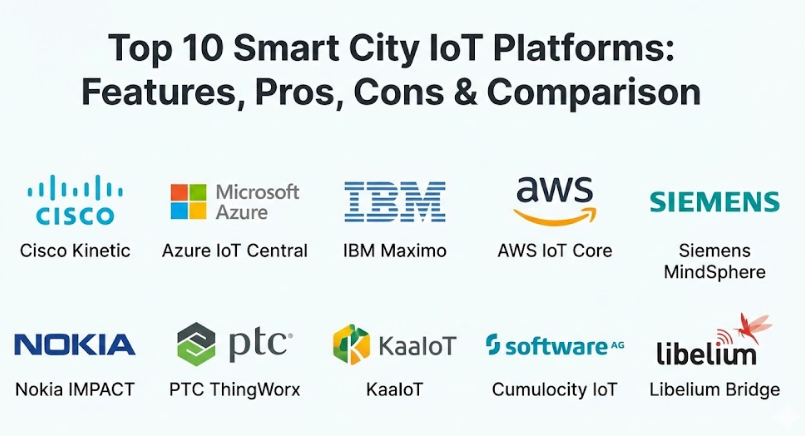
Top 10 Smart City IoT Platforms
1 — Cisco Kinetic for Cities
Cisco Kinetic for Cities is a specialized cloud-based platform designed to help municipal leaders extract, compute, and move data from connected things to the right applications. It focuses heavily on network reliability and high-speed data processing for massive urban grids.
Key features:
- Unified dashboard for managing multiple urban services (lighting, parking, safety).
- Advanced edge computing that processes data locally to reduce latency.
- “Data normalization” that translates different sensor languages into one format.
- Robust integration with Cisco’s world-class networking hardware.
- Automated policy enforcement based on real-time sensor data.
- High-performance video analytics for traffic and crowd monitoring.
Pros:
- Exceptional network security and data privacy controls built at the hardware level.
- Highly reliable for mission-critical services like emergency response coordination.
Cons:
- Higher total cost of ownership compared to open-source alternatives.
- Best performance is often tied to using other Cisco networking products.
Security & compliance: ISO 27001, SOC 2, GDPR compliant, and advanced end-to-end encryption.
Support & community: Comprehensive enterprise support, global partner network, and extensive technical documentation.
2 — Microsoft Azure IoT Central (Smart City Templates)
Microsoft Azure offers a highly flexible, low-code platform that provides specific templates for smart city applications. It is designed for city developers who want to build and deploy scalable urban solutions without managing complex underlying infrastructure.
Key features:
- Pre-built templates for water consumption, waste management, and solar power.
- Seamless integration with the broader Microsoft 365 and Power BI ecosystem.
- Plug-and-play device connectivity via the Azure Certified for IoT program.
- Massive global scale with data centers in almost every region.
- Digital Twins technology to create a virtual replica of the city’s infrastructure.
- Advanced AI and machine learning for predictive maintenance.
Pros:
- Extremely easy to scale from a single pilot neighborhood to an entire metropolis.
- Familiar interface for teams already working within the Microsoft ecosystem.
Cons:
- Costs can become unpredictable as data throughput and storage needs grow.
- Requires cloud expertise to fully optimize the advanced AI features.
Security & compliance: FedRAMP, HIPAA, GDPR, SOC 1/2/3, and ISO 27001 compliant.
Support & community: World-class enterprise support, Microsoft Learn training paths, and a huge global community.
3 — IBM Maximo for Civil Infrastructure
Building on IBM’s legacy in asset management, this platform is specifically tailored for the “hard” infrastructure of a city. It is designed for engineers and public works departments to monitor the health of bridges, tunnels, and roads using IoT sensors.
Key features:
- 360-degree view of civil infrastructure assets and their current condition.
- Integration with BIM (Building Information Modeling) for detailed structural views.
- Predictive maintenance alerts that identify structural weaknesses before they fail.
- Work order automation for repair crews based on sensor triggers.
- Environmental sensor integration to monitor weather impact on structures.
- Comprehensive compliance tracking for government safety standards.
Pros:
- The best tool for managing high-value, high-risk physical assets like bridges.
- Deeply analytical, focusing on long-term structural health and safety.
Cons:
- Not as focused on “citizen-facing” apps (like parking or street lighting).
- Complex setup that requires significant engineering data input.
Security & compliance: ISO 27001, GDPR, and enterprise-grade SSO and audit logging.
Support & community: Dedicated professional services, IBM Support portal, and specialized user groups.
4 — AWS IoT Core for Smart Cities
Amazon Web Services provides the “building blocks” for smart cities. It is a highly technical platform designed for city IT departments that want to build custom, proprietary urban applications with almost unlimited scalability and flexibility.
Key features:
- Support for billions of devices and trillions of messages with low latency.
- LoRaWAN support for long-range, low-power citywide sensor networks.
- AWS IoT Greengrass for local execution of code on edge devices.
- Integration with Amazon SageMaker for advanced urban data science.
- Rules engine that allows for automated actions across different city services.
- Secure Device Advisor for testing sensor security before deployment.
Pros:
- Pay-as-you-go pricing model is ideal for cities starting with small pilots.
- Unmatched flexibility; you can build literally any urban application imaginable.
Cons:
- Steep learning curve; requires a highly skilled technical team to manage.
- No “out-of-the-box” smart city dashboard; everything must be custom-built.
Security & compliance: FedRAMP, SOC 1/2/3, GDPR, HIPAA, and FIPS 140-2.
Support & community: Extensive developer forums, AWS Training and Certification, and premier support options.
5 — Siemens MindSphere
Siemens MindSphere is an industrial IoT (IIoT) platform that excels in the “Utility” side of smart cities. It is designed for managing power grids, water systems, and transportation networks where precision and industrial-grade reliability are required.
Key features:
- Open PaaS (Platform as a Service) with extensive industrial protocol support.
- Advanced analytics for energy optimization and grid stability.
- Digital representation of city energy flows to reduce carbon footprints.
- Strong connectivity for Siemens-based industrial hardware.
- Integrated developer tools for building city-specific industrial apps.
- High-security data “silos” to protect critical public infrastructure.
Pros:
- Unbeatable for energy management and reducing municipal carbon emissions.
- Highly rugged and reliable for industrial-scale public utilities.
Cons:
- Can be overly complex for simpler “soft” smart city tasks like public Wi-Fi.
- The user interface is more industrial and less “citizen-friendly.”
Security & compliance: ISO 27001, IEC 62443, GDPR, and SOC 2 compliant.
Support & community: Global industrial support network, Siemens MindSphere Academy, and specialized partner ecosystem.
6 — Nokia IMPACT
Nokia IMPACT (Intelligent Management Platform for All Connected Things) is built with a “connectivity-first” mindset. It is designed for cities that want to leverage 5G and massive IoT networks to manage urban services with high speed and low latency.
Key features:
- Horizontal platform that manages any device, over any protocol, across any network.
- Specialized in NB-IoT and 5G connectivity for urban-wide coverage.
- Advanced device management, including remote firmware updates for sensors.
- Pre-integrated “Smart Lighting” and “Smart Parking” modules.
- Video analytics for public safety and crowd control.
- Modular architecture that allows cities to add new services gradually.
Pros:
- Best-in-class for managing devices over cellular networks (NB-IoT, 5G).
- Very strong at remote device lifecycle management (keeping sensors updated).
Cons:
- Primarily targets telecommunications providers and very large tier-1 cities.
- Integration with legacy non-cellular networks can be more challenging.
Security & compliance: GDPR compliant, encryption, and secure bootstrap for devices.
Support & community: Professional service teams, technical documentation, and carrier-grade support.
7 — PTC ThingWorx
ThingWorx is a high-productivity platform known for its rapid application development. It is designed for cities that want to get smart services up and running quickly using an intuitive, visual drag-and-drop environment.
Key features:
- Visual development tools that reduce the need for manual coding.
- Augmented Reality (AR) integration via Vuforia for field repair crews.
- Real-time anomaly detection using built-in machine learning.
- Support for a wide range of industrial and urban protocols.
- Powerful orchestration of data from multiple siloed city departments.
- Asset monitoring with detailed historical “playbacks” of data.
Pros:
- Fastest time-to-value; you can build a city dashboard in days, not months.
- AR features allow public works teams to see sensor data overlaid on physical pipes/wires.
Cons:
- Licensing can be expensive for very large, million-sensor deployments.
- Requires a specific server infrastructure that may need significant management.
Security & compliance: SOC 2, GDPR, and ISO standards compliant.
Support & community: PTC University training, active developer community, and global support services.
8 — KaaIoT (Kaa Platform)
Kaa is a highly flexible, open-source-friendly IoT platform that offers a professional enterprise version for smart cities. It is designed for city developers who want a modular, customizable solution without being locked into a single vendor.
Key features:
- Multi-tenant architecture allowing different city departments to manage their own data.
- Customizable dashboards with a wide range of widgets and maps.
- Support for various connectivity protocols (MQTT, CoAP, HTTP).
- Metadata management for organizing thousands of city sensors.
- Automated alerts and command execution based on sensor thresholds.
- Cloud-agnostic deployment (AWS, Azure, or on-premise).
Pros:
- Very cost-effective for mid-sized cities that need high customization.
- The open-source heritage means there is a lot of community-driven innovation.
Cons:
- Requires more “hands-on” technical work than a template-based system like Azure.
- Documentation can sometimes be more developer-focused and less “user-friendly.”
Security & compliance: GDPR compliant, TLS/SSL encryption, and role-based access control.
Support & community: Active community forum, professional technical support, and onboarding consulting.
9 — Software AG (Cumulocity IoT)
Cumulocity is an “Independent” IoT platform that focuses on ease of use and rapid device connection. It is designed for cities that want to avoid vendor lock-in and need a platform that works equally well across all hardware brands.
Key features:
- Self-service device integration that doesn’t require coding.
- Cloud, on-premise, and edge deployment options.
- Real-time streaming analytics to process city data on the fly.
- Pre-built solution accelerators for smart water and smart energy.
- Extensive white-labeling options for city-branded citizen apps.
- Robust API for connecting with existing municipal ERP systems.
Pros:
- One of the easiest platforms to use for non-technical city managers.
- Very flexible deployment; you can keep your data on city servers if needed.
Cons:
- Advanced custom analytics may require external tools or plugins.
- The community ecosystem is smaller than AWS or Microsoft.
Security & compliance: ISO 27001, SOC 2, GDPR, and high-level data encryption.
Support & community: Software AG Global Support, online learning portal, and professional services.
10 — Libelium (Bridge)
Libelium is unique because they began as a hardware sensor company. Their “Bridge” platform is designed specifically to simplify the path from physical sensors to the cloud, making it the best choice for “sensor-heavy” city projects.
Key features:
- Deep integration with Libelium’s world-renowned “Waspmote” city sensors.
- Focus on environmental monitoring (air quality, noise, water levels).
- Simple data forwarding to any major cloud provider (Azure, AWS).
- Low-power management to ensure sensors last for years on battery.
- Specialized kits for “Smart Parking” and “Smart Agriculture.”
- User-friendly interface for managing sensor health and battery status.
Pros:
- The best “end-to-end” experience if you are using Libelium hardware.
- Highly specialized in environmental and sustainability data.
Cons:
- Not a full-scale application development platform like ThingWorx or AWS.
- Best suited for data collection rather than complex citywide automation.
Security & compliance: GDPR compliant, secure data transmission, and standard encryption.
Support & community: Extensive technical wikis, hardware-focused support, and global distributor network.
Comparison Table
| Tool Name | Best For | Platform(s) Supported | Standout Feature | Rating |
| Cisco Kinetic | Network-heavy cities | Cloud, On-Prem | Edge Fog Computing | 4.6 / 5 |
| Azure IoT | Low-code scalability | Cloud (Azure) | Smart City Templates | 4.8 / 5 |
| IBM Maximo | Hard Infrastructure | Cloud, On-Prem | BIM Structural Analysis | 4.3 / 5 |
| AWS IoT Core | Custom high-scale builds | Cloud (AWS) | LoRaWAN & Greengrass | 4.7 / 5 |
| MindSphere | Public Utilities | Cloud, On-Prem | Energy Grid Optimization | 4.4 / 5 |
| Nokia IMPACT | 5G/Cellular networks | Cloud, Carrier | NB-IoT Device Management | 4.2 / 5 |
| ThingWorx | Rapid AR development | Cloud, On-Prem | Vuforia AR Integration | 4.5 / 5 |
| KaaIoT | Modular customization | Multi-Cloud | Open-Source Flexibility | 4.4 / 5 |
| Cumulocity | Ease of use | Cloud, Edge | Code-free device pairing | 4.5 / 5 |
| Libelium | Environmental sensing | Cloud, Bridge | Hardware-to-Cloud Sync | 4.1 / 5 |
Evaluation & Scoring of Smart City IoT Platforms
Choosing the right platform is a multi-million dollar decision for a city. We have evaluated these tools based on a weighted scoring rubric that prioritizes the most critical needs of a modern urban environment.
| Criteria | Weight | Evaluation Focus |
| Core Features | 25% | Device management, protocol support, and data visualization. |
| Ease of Use | 15% | Dashboard intuitiveness and speed of deployment. |
| Integrations | 15% | Ability to talk to legacy city systems and various cloud providers. |
| Security & Compliance | 10% | Data privacy, encryption, and government compliance. |
| Performance | 10% | Latency, edge computing, and uptime reliability. |
| Support & Community | 10% | Quality of documentation and availability of expert help. |
| Price / Value | 15% | Licensing costs relative to the feature set and scalability. |
Which Smart City IoT Platforms Tool Is Right for You?
The “best” platform depends entirely on your city’s technical maturity and specific goals.
Solo Users vs SMB vs Mid-Market vs Enterprise
- Solo Users/Researchers: If you are a student or a single urban researcher, AWS IoT (on a free tier) or KaaIoT (open source) is the best place to start.
- SMB (Small Municipalities): For a town or small city, Azure IoT Central or Cumulocity are ideal. They offer pre-built templates and don’t require a massive IT team to manage.
- Mid-Market (Mid-sized Cities): PTC ThingWorx or Cisco Kinetic provide the balance of power and ease of use needed for expanding urban areas.
- Enterprise (Major Metropolises): Mega-cities like New York, London, or Singapore need the raw power and security of AWS, Microsoft, or Nokia IMPACT.
Budget-Conscious vs Premium Solutions
If budget is the primary concern, KaaIoT or a custom build on AWS IoT offers the lowest entry price. However, these require more expensive human talent to build. If you have the budget and want a “done-for-you” experience with high security, premium solutions like Cisco or Siemens are worth the investment.
Feature Depth vs Ease of Use
If you need deep, specialized features for bridge structural health, go with IBM Maximo. If you want a platform that a city manager can use to check streetlights without an engineering degree, choose Cumulocity.
Integration and Scalability Needs
If your city is already using Microsoft 365, the integration with Azure IoT will be seamless. If you are starting from scratch and need to scale to millions of sensors over the next decade, AWS and Nokia provide the most proven scalability.
Frequently Asked Questions (FAQs)
1. What exactly is a Smart City IoT Platform?
It is a centralized software system that connects sensors (like traffic cameras or water meters) to the internet, collects their data, and displays it on a dashboard so city officials can make decisions.
2. How do these platforms help with traffic?
They collect data from road sensors and cameras to see where congestion is happening. The platform can then automatically adjust the timing of traffic lights to improve flow and reduce idling.
3. Are these systems safe from hackers?
Top-tier platforms like Cisco and AWS use enterprise-grade encryption and secure “handshakes” for every device. However, security is a constant effort that requires regular updates and strong city policies.
4. Can these tools help reduce a city’s carbon footprint?
Yes. By optimizing street lighting (dimming them when no one is around) and managing energy grids more efficiently, cities can significantly reduce their electricity usage and carbon emissions.
5. How much do these platforms cost?
Costs vary wildly. Some are pay-as-you-go (starting at $0.10 per device/month), while others require multi-million dollar annual licenses for a whole city.
6. Do I need special sensors to use these platforms?
Most platforms are “hardware agnostic,” meaning they can talk to almost any sensor as long as it uses a standard protocol like MQTT, Zigbee, or LoRaWAN.
7. Can we track air quality with these tools?
Absolutely. Environmental monitoring is one of the most common use cases. Sensors track CO2, NO2, and particulate matter, and the platform shows the data on a public-facing map.
8. Is it possible to integrate these with citizen apps?
Yes. Most platforms have an API (Application Programming Interface) that allows developers to pull data and put it into a mobile app for citizens to report potholes or find parking.
9. What is “Edge Computing” in a smart city?
Edge computing means processing data right on the sensor or a nearby box, instead of sending everything to a far-away cloud server. This is vital for things like self-driving car data or emergency alerts where every millisecond matters.
10. How long does it take to implement a smart city project?
A small pilot project (like smart lighting on one street) can take 2-3 months. A full-scale citywide platform implementation usually takes 1-3 years.
Conclusion
The transition to a Smart City IoT Platform is no longer a futuristic dream; it is a practical necessity for the urban centers of the 21st century. Whether you prioritize the rapid development of ThingWorx, the industrial precision of Siemens, or the massive cloud power of Azure and AWS, the “best” tool is the one that aligns with your city’s specific infrastructure and budget.
The most successful smart cities don’t try to do everything at once. They choose a platform that is scalable and open, allowing them to start with one service—like smart street lighting—and gradually add others like waste management or air quality monitoring over time. By centralizing urban data, city leaders can move away from reactive “firefighting” and toward a proactive, efficient, and sustainable future for all their citizens.