Introduction
An IoT (Internet of Things) Security Platform is a comprehensive suite of technologies designed to protect connected devices and the networks they inhabit from cyber threats. Unlike traditional cybersecurity tools that focus on laptops and servers, these platforms are specialized to handle the unique constraints of IoT hardware—such as limited processing power, diverse communication protocols, and the lack of standard operating systems. They work by providing visibility into every connected device, identifying vulnerabilities, monitoring for anomalous behavior, and enforcing security policies across the entire ecosystem.
The importance of these platforms has surged as IoT devices have become the “weakest link” in corporate networks. A compromised smart camera or industrial sensor can serve as an entry point for ransomware or data exfiltration. Key real-world use cases include securing medical devices in hospitals, protecting smart grids in the energy sector, and monitoring industrial robots in manufacturing plants. When choosing a platform, users should evaluate the tool’s ability to discover “shadow” IoT (unauthorized devices), its support for legacy protocols, and how well it integrates with existing Security Operations Center (SOC) workflows.
Best for: IoT Security Platforms are most beneficial for Chief Information Security Officers (CISOs), Network Architects, and Operations Technology (OT) Managers. They are essential for large-scale enterprises in critical infrastructure, healthcare, manufacturing, and logistics where a single device failure could lead to physical safety risks or massive financial loss.
Not ideal for: Small businesses with only a handful of standard consumer-grade smart devices may find these platforms overly complex and expensive. For such users, basic network firewalls and diligent firmware updates on individual devices are often sufficient and more cost-effective.
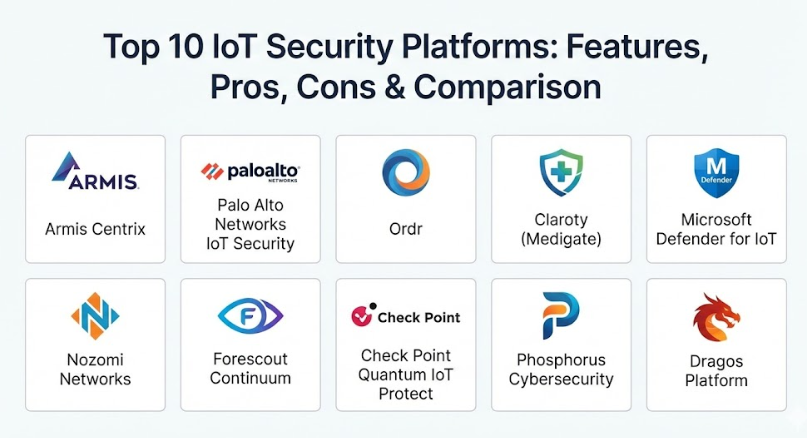
Top 10 IoT Security Platforms Tools
1 — Armis Centrix
Armis Centrix is a prominent, agentless asset management and security platform designed to provide total visibility into all connected assets. It is built for enterprises that need to see every device on their network, from smart TVs to industrial controllers, without installing software on the devices themselves.
- Key features:
- 100% agentless discovery of all managed, unmanaged, and IoT devices.
- Real-time monitoring of device behavior to detect threats.
- Automated risk scoring based on the “Armis Device Knowledgebase.”
- Integration with existing security tools like firewalls and NACs to quarantine devices.
- Passive monitoring that does not disrupt sensitive OT or medical equipment.
- Detailed asset inventory with technical specs and firmware versions.
- Vulnerability management and prioritization based on actual risk.
- Pros:
- Exceptional at finding “hidden” devices that other scanners miss.
- No need to install agents makes it very easy to deploy across thousands of diverse devices.
- Cons:
- The high level of detail can lead to “information overload” for smaller teams.
- Premium features and large-scale deployments come with a significant price tag.
- Security & compliance: SOC 2 Type II, GDPR, HIPAA, ISO 27001, and FedRAMP authorized.
- Support & community: Extensive documentation, a dedicated customer success team, 24/7 global support, and an active user community portal.
2 — Palo Alto Networks IoT Security
Palo Alto Networks provides a deeply integrated IoT security solution that leverages their Next-Generation Firewalls (NGFW). It uses machine learning to identify every device and automatically enforce security policies without requiring separate sensors.
- Key features:
- ML-powered device identification and classification.
- Automated policy recommendations based on observed device behavior.
- Built-in vulnerability assessment and risk prioritization.
- Native integration with Palo Alto’s Prisma SASE and Cortex XDR.
- Ability to block threats in real-time at the firewall level.
- Specific modules for Healthcare (medical device security).
- Comprehensive dashboard for tracking the “Security Lifecycle.”
- Pros:
- If you already use Palo Alto firewalls, activation is a simple “subscription” rather than a new hardware rollout.
- The automated policy generation saves hundreds of hours of manual firewall configuration.
- Cons:
- Only truly effective if your network is built on Palo Alto infrastructure.
- The cost can escalate quickly as you add more firewalls and subscription services.
- Security & compliance: SOC 2, ISO 27001, GDPR, and HIPAA compliant; utilizes enterprise-grade encryption.
- Support & community: World-class enterprise support, the “Live Community” forum, and extensive training through Palo Alto Networks Education.
3 — Ordr
Ordr specializes in “Whole Product Visibility,” focusing heavily on the healthcare and manufacturing sectors. It is designed to map every device communication path and create “zero trust” segmentation policies automatically.
- Key features:
- Ordr Systems Control Engine (SCE) for high-fidelity device discovery.
- Automatic generation of segmentation policies (ACLs) for networking gear.
- “Flow Genome” technology to visualize every device communication.
- Specific workflows for clinical engineering and HTM teams.
- Monitoring for device “recalls” and outdated firmware alerts.
- Integration with ServiceNow for automated asset inventory updates.
- Detection of unauthorized external communications (Shadow IoT).
- Pros:
- Outstanding for medical environments where knowing which device is connected to which patient is critical.
- Simplifies the complex task of creating network segments for legacy IoT hardware.
- Cons:
- Setup can require significant coordination with network teams for traffic mirroring.
- The interface, while powerful, has a learning curve for non-security staff.
- Security & compliance: SOC 2 Type II, GDPR, and HIPAA compliant; supports audit logs and SSO.
- Support & community: High-touch onboarding, dedicated technical account managers, and a growing library of documentation.
4 — Claroty (Medigate)
Claroty, having acquired Medigate, is a powerhouse in Cyber-Physical Systems (CPS) security. It covers the entire spectrum of IoT, OT (Operational Technology), and IoMT (Internet of Medical Things).
- Key features:
- Deep Packet Inspection (DPI) for industrial and medical protocols.
- Vulnerability management tailored to the specific risk of physical assets.
- Real-time threat detection for industrial control systems (ICS).
- Secure remote access for third-party vendors and maintenance staff.
- Network segmentation and “virtual patching” capabilities.
- Risk-based prioritization for maintenance and patching.
- Compliance reporting for standards like NIST and 62443.
- Pros:
- Perhaps the deepest expertise in industrial and medical protocols in the industry.
- The platform is highly effective at preventing downtime in manufacturing and hospitals.
- Cons:
- Can be overly complex for organizations that only have “office IoT.”
- Professional services are often required for a full implementation.
- Security & compliance: SOC 2, GDPR, HIPAA, and ISO 27001; extensive audit logging for regulatory audits.
- Support & community: Global enterprise support, Claroty Academy for training, and local partner networks.
5 — Microsoft Defender for IoT
Formerly CyberX, Microsoft Defender for IoT is a cloud-native or on-premise solution that provides agentless monitoring for industrial and corporate IoT environments. It is a natural choice for organizations deeply invested in the Microsoft Azure ecosystem.
- Key features:
- Continuous asset discovery and risk assessment.
- Native integration with Microsoft Sentinel (SIEM) and Defender for Endpoint.
- Support for proprietary industrial protocols (Modbus, Siemens S7, etc.).
- Vulnerability management with a clear “Remediation Path.”
- Threat intelligence backed by Microsoft’s massive global data signals.
- Options for air-gapped (offline) deployments in sensitive environments.
- Unified security dashboard across IT and IoT.
- Pros:
- Seamless integration with the Microsoft security stack reduces “tool sprawl.”
- The pricing is often more flexible for existing Azure customers.
- Cons:
- The cloud-centric approach may not appeal to purists in the OT space who prefer isolated systems.
- Navigating the Microsoft licensing landscape can be confusing.
- Security & compliance: SOC 1/2/3, ISO 27001, HIPAA, GDPR, and FedRAMP.
- Support & community: Massive global support network, “Microsoft Tech Community,” and extensive online documentation.
6 — Nozomi Networks
Nozomi Networks is a leader in OT and IoT visibility and security. They are particularly strong in the energy, mining, and critical infrastructure sectors where “high availability” is the top priority.
- Key features:
- Guardian sensors for deep packet inspection of industrial traffic.
- Vantage cloud-based management for global, multi-site visibility.
- AI-driven anomaly detection for process-level changes.
- Integrated threat intelligence for known vulnerabilities and exploits.
- Support for over 100+ industrial protocols.
- Central Management Console (CMC) for unified reporting.
- Smart Polling to supplement passive scanning without crashing devices.
- Pros:
- Highly reliable in extreme industrial environments; they understand “process integrity.”
- Very scalable, with the ability to monitor hundreds of sites from one screen.
- Cons:
- Requires the deployment of physical or virtual “Guardian” sensors throughout the network.
- The cost is high, reflecting its status as a premium enterprise solution.
- Security & compliance: SOC 2, GDPR, and ISO standards; supports encryption and secure access controls.
- Support & community: Professional services for large deployments, global 24/7 support, and extensive technical training.
7 — Forescout Continuum
Forescout specializes in “Active Defense” for the Enterprise of Things. Their platform is built on the principle that you cannot secure what you cannot see, providing massive scale for device discovery and control.
- Key features:
- EyeSight for 100% visibility without agents.
- EyeSegment for automating micro-segmentation across the enterprise.
- Device hygiene checking before allowing network access.
- Automated response to infected or non-compliant IoT devices.
- Support for a massive range of devices (IT, IoT, OT, IoMT).
- Integration with over 300+ third-party security and IT tools.
- Continuous monitoring for configuration “drift.”
- Pros:
- Exceptional at enforcing “NAC” (Network Access Control) for IoT—blocking bad devices instantly.
- The “Forescout Device Cloud” provides data on over 15 million devices to help identify new assets.
- Cons:
- Implementation is a major project that requires significant network engineering.
- Can be “heavy” for companies that just want simple visibility.
- Security & compliance: SOC 2, ISO 27001, GDPR, HIPAA, and FIPS 140-2.
- Support & community: Forescout University, a strong partner network, and 24/7 enterprise support.
8 — Check Point Quantum IoT Protect
Check Point’s approach to IoT security focuses on “Autonomous Protection.” It identifies IoT devices and automatically applies the most relevant security “snippets” to protect them from known and unknown threats.
- Key features:
- Autonomous IoT threat prevention at the gateway level.
- Identification of over 10,000 different IoT device models.
- Zero-day protection for IoT using Check Point’s “ThreatCloud.”
- Discovery of device vulnerabilities and risky configurations.
- Virtual patching to protect unpatched or legacy hardware.
- Integration with Check Point’s Infinity architecture.
- Micro-segmentation to isolate IoT traffic from sensitive IT data.
- Pros:
- “Virtual Patching” is a lifesaver for devices that are no longer supported by their manufacturers.
- Strong emphasis on prevention rather than just detection.
- Cons:
- Best results are achieved when used with Check Point network security gateways.
- The management console can be complex for users new to the Check Point ecosystem.
- Security & compliance: SOC 2, ISO 27001, HIPAA, and GDPR compliant.
- Support & community: Extensive global support, “Check Point UserCenter,” and a large network of certified engineers.
9 — Phosphorus Cybersecurity
Phosphorus is unique because it focuses on “xIoT” (Everything IoT) and the actual management of the device’s lifecycle—specifically focusing on password management and firmware updates.
- Key features:
- Automated credential management (finding and changing default passwords).
- Automated firmware updates across thousands of IoT devices.
- Hardening of device configurations to reduce attack surface.
- Discovery of devices across “unconventional” channels like Bluetooth.
- Assessment of device “End of Life” (EoL) status.
- Remediation of vulnerabilities directly on the device.
- Integration with major SIEM and SOAR platforms.
- Pros:
- Solves the “default password” problem, which is the #1 cause of IoT breaches.
- One of the few tools that actually “fixes” the device rather than just alerting you.
- Cons:
- Smaller company with a narrower focus than the “all-in-one” visibility giants.
- Managing firmware updates automatically carries a small risk of “bricking” older devices.
- Security & compliance: GDPR and SOC 2 compliant; focuses on secure, encrypted communications.
- Support & community: Direct customer support and detailed documentation for device hardening.
10 — Dragos Platform
Dragos is the most specialized platform on this list, focusing exclusively on Industrial Control Systems (ICS) and Operational Technology (OT). It is built by experts in industrial cyber-warfare.
- Key features:
- Asset identification for deep industrial environments (Power, Oil & Gas).
- Threat detection based on “Adversary Tactics” (TTPs) specifically for OT.
- Dragos “Neighborhood Watch” for community-sourced threat intelligence.
- Step-by-step “Playbooks” for responding to industrial cyber incidents.
- Root-cause analysis for both cyber and process-related failures.
- Visual mapping of industrial zones and communication paths.
- Compliance reporting for NERC CIP and other utility standards.
- Pros:
- The “Playbooks” are invaluable during an incident, telling your team exactly what to do.
- Unmatched threat intelligence on industrial-specific hacking groups.
- Cons:
- Extremely specialized; it is not meant for “office IoT” like smart lightbulbs.
- The cost and complexity reflect its status as a “critical infrastructure” tool.
- Security & compliance: NERC CIP, ISO 27001, SOC 2, and GDPR compliant.
- Support & community: World-class incident response services, Dragos Academy, and an elite user group.
Comparison Table
| Tool Name | Best For | Platform(s) Supported | Standout Feature | Rating |
| Armis Centrix | Total Visibility | Cloud / Web | 100% Agentless Discovery | 4.6 / 5 |
| Palo Alto IoT | Network-Integrated | Firewall-based | Automated ML Policies | 4.5 / 5 |
| Ordr | Healthcare / HTM | Cloud / On-Prem | High-Fidelity Clinical Flows | 4.7 / 5 |
| Claroty | Industrial / CPS | Cloud / Hybrid | Deep Industrial Protocol DPI | 4.8 / 5 |
| Microsoft Def. | Azure Ecosystem | Cloud / Hybrid | Sentinel / XDR Integration | 4.4 / 5 |
| Nozomi | Energy / Mining | Cloud / On-Prem | Process-level Anomaly Detect | 4.6 / 5 |
| Forescout | Active Defense | On-Prem / Cloud | Massive-scale Enforcement | 4.3 / 5 |
| Check Point | Threat Prevention | Gateway / Cloud | Autonomous Virtual Patching | 4.4 / 5 |
| Phosphorus | Device Hardening | Cloud / Web | Automated Password/Firmware | N/A |
| Dragos | ICS / Utilities | On-Prem / Hybrid | Adversary-based Playbooks | 4.7 / 5 |
Evaluation & Scoring of IoT Security Platforms
We have evaluated the IoT security market based on the primary needs of modern security teams. These scores represent the industry average for top-tier platforms.
| Evaluation Category | Weight | Score (1-10) | Explanation |
| Core Features | 25% | 9.0 | Visibility and discovery are now highly advanced across all top tools. |
| Ease of Use | 15% | 7.0 | These are powerful tools that require significant technical expertise. |
| Integrations | 15% | 8.5 | Connectivity with SIEM/SOAR/Firewalls is excellent in this category. |
| Security & Compliance | 10% | 10.0 | High security and audit standards are standard for this industry. |
| Performance | 10% | 8.0 | Passive monitoring is reliable, though sensor deployment varies. |
| Support & Community | 10% | 8.5 | Most vendors provide 24/7 support and detailed documentation. |
| Price / Value | 15% | 6.5 | These platforms are expensive and often require specialized staff. |
Which IoT Security Platforms Tool Is Right for You?
Choosing the right IoT security tool is about matching the platform to your specific “device mix” and your team’s technical capacity.
Solo Users vs SMB vs Mid-Market vs Enterprise
If you are an SMB, you likely do not need a full platform. Look for a firewall with basic IoT discovery features. Mid-market companies with a growing office-IoT presence should look at Freshservice (for asset management) or Palo Alto’s subscription. Large Enterprises with high-stakes environments—like hospitals or factories—must choose a dedicated leader like Armis, Claroty, or Ordr.
Budget-Conscious vs Premium Solutions
If budget is the primary concern, a tool that integrates into your existing firewall (like Palo Alto or Check Point) is often more cost-effective than buying a standalone platform and new sensors. However, the “Premium” standalone tools like Nozomi or Armis provide a level of visibility that integrated tools simply cannot match, potentially saving millions in avoided downtime.
Feature Depth vs Ease of Use
If your team is small, avoid “Heavy” tools like Dragos or Forescout, which require a lot of manual tuning. Instead, look for the “Autonomous” and “ML-driven” features of Palo Alto or Armis. If you have a dedicated SOC and complex industrial needs, the “Feature Depth” of Claroty or Nozomi is essential.
Integration and Scalability Needs
Before you buy, look at your existing stack. If you are a Microsoft shop, Defender for IoT is a no-brainer for the integration benefits. If you need to manage a massive global network with 100,000+ devices, Forescout or Armis are the most proven platforms for that level of scale.
Frequently Asked Questions (FAQs)
1. Why can’t I just use a regular antivirus for IoT?
Most IoT devices (like smart cameras or industrial sensors) are “closed” systems. You cannot install software like an antivirus on them. IoT security platforms work “agentlessly” by watching the network traffic instead of the device’s internal files.
2. What is “Passive Monitoring”?
Passive monitoring means the security tool “listens” to network traffic without sending any data back to the devices. This is crucial in environments like hospitals or power plants where “pinging” a device might cause it to crash or malfunction.
3. How do these platforms handle “Shadow IoT”?
Shadow IoT refers to devices employees bring in without telling IT—like a smart coffee maker or a personal voice assistant. These platforms detect the unique “fingerprint” of the device’s traffic and alert you to its presence immediately.
4. Can these tools really block an attack in progress?
Yes, but they usually do it by talking to your network gear. If the platform sees a camera talking to a malicious server in Russia, it can tell your firewall or switch to “kill” that specific connection instantly.
5. How long does implementation take?
Basic visibility can often be achieved in a few days. However, a full “Zero Trust” implementation where you are automatically blocking and segmenting devices typically takes 6 to 12 months.
6. Do I need to buy extra hardware?
Many platforms (like Armis or Microsoft) can be deployed virtually. However, industrial tools (like Nozomi or Dragos) often require physical “sensors” or “probes” to be plugged into your network switches at different locations.
7. Is my data safe if I use a cloud-based IoT platform?
Yes. Leading vendors use SOC 2 Type II certified data centers and encrypt all traffic. For extremely sensitive sites (like nuclear plants), many vendors offer “On-Premise” versions that don’t need the internet at all.
8. What is “Virtual Patching”?
IoT devices are often never patched by their owners. Virtual patching happens at the network level; the security platform recognizes a vulnerability and blocks any traffic that tries to exploit it, effectively “patching” the device without touching it.
9. Can these platforms tell me if a device is physically broken?
Often, yes. By monitoring behavior, the platform might notice a sensor has stopped sending data or is sending “garbage” data, allowing maintenance teams to fix the hardware before it causes a process failure.
10. What is the most common mistake in IoT security?
Thinking that “hiding” the devices is enough. Hackers use automated tools to find every connected device in seconds. Assuming a device is safe just because it doesn’t have a public IP address is a dangerous mistake.
Conclusion
Securing the Internet of Things is a race against time and complexity. As our world becomes more connected, the line between “Cyber Security” and “Physical Safety” is disappearing. Choosing an IoT Security Platform is not just about checking a compliance box; it is about ensuring that your hospital, factory, or office remains resilient in the face of increasingly sophisticated threats.
Whether you prioritize the seamless integration of Microsoft Defender, the specialized clinical expertise of Ordr, or the industrial-strength protection of Nozomi, the goal is clear: total visibility and rapid response. Start by auditing your most critical assets and choose the platform that gives you the clearest view into those specific devices.