Introduction
A Device Certificate Provisioning Tool is a specialized software solution designed to automate the issuance, installation, and management of digital certificates (usually X.509 certificates) onto hardware devices. Whether it is a corporate laptop, a mobile phone, or an industrial sensor, these tools ensure that the device can securely prove its identity to the network using Public Key Infrastructure (PKI). Instead of manually installing files on every gadget, these platforms handle the “handshake” between a Certificate Authority (CA) and the device, ensuring a secure and encrypted connection from day one.
The importance of these tools has skyrocketed with the rise of Zero Trust security architectures and the Internet of Things (IoT). Without automated provisioning, organizations face the impossible task of manually renewing thousands of certificates before they expire—a common cause of major network outages. Key real-world use cases include securing Wi-Fi and VPN access for remote employees, authenticating smart meters in a power grid, and protecting communication between medical devices in a hospital. When choosing a tool, users should look for support for industry-standard protocols (like SCEP, EST, or CMP), the ability to integrate with multiple Certificate Authorities, and a “low-touch” or “zero-touch” deployment model that minimizes human error.
Best for: IT security administrators, IoT architects, and network engineers in mid-to-large enterprises. It is particularly vital for sectors like finance, healthcare, manufacturing, and telecommunications where device identity and data encryption are non-negotiable.
Not ideal for: Very small businesses with only a handful of devices that can be managed manually, or organizations that do not use certificate-based authentication and rely solely on simple passwords or pre-shared keys.
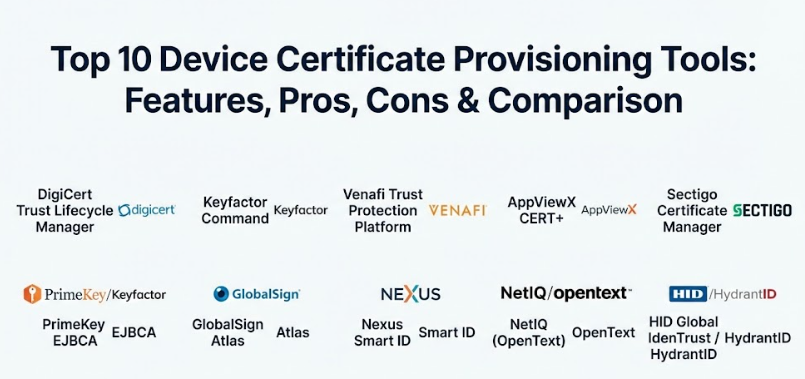
Top 10 Device Certificate Provisioning Tools
1 — DigiCert Trust Lifecycle Manager
DigiCert is a titan in the trust space, and their Trust Lifecycle Manager is a comprehensive platform that unites CA-agnostic certificate management with endpoint hardware state awareness. It is designed for large-scale enterprises needing a single pane of glass for all digital identities.
- Key features:
- Full lifecycle automation including issuance, renewal, and revocation.
- CA-agnostic management, allowing users to oversee certificates from various providers.
- Integration with popular MDM/UEM platforms like Microsoft Intune and Jamf.
- Support for multiple enrollment protocols including SCEP, EST, and ACME.
- Deep visibility into the certificate “health” of all network-connected endpoints.
- Automated discovery of existing certificates across the infrastructure.
- Pros:
- Extremely reliable infrastructure backed by one of the world’s most trusted CAs.
- High scalability, capable of managing millions of certificates across global environments.
- Cons:
- The pricing reflects its premium status and may be high for smaller firms.
- The interface is feature-dense, which can lead to a steeper learning curve for beginners.
- Security & compliance: SOC 2 Type II, HIPAA, GDPR compliant, and FIPS 140-2 Level 3 hardware security modules.
- Support & community: High-quality 24/7 enterprise support, extensive technical documentation, and a global network of certified partners.
2 — Keyfactor Command
Keyfactor Command is an industry leader in PKI as-a-Service and certificate lifecycle automation. It is built specifically for complex environments where visibility and crypto-agility are the top priorities.
- Key features:
- Real-time discovery of every certificate across cloud, on-prem, and IoT devices.
- Automated renewal and installation to prevent manual errors and outages.
- Multi-CA support to avoid vendor lock-in.
- Self-service portals for developers and IT staff to request certificates.
- Integrated “AnyGateway” technology to connect to any private or public CA.
- Robust reporting and audit logs for compliance tracking.
- Pros:
- Exceptional visibility that uncovers “rogue” certificates hidden in the network.
- Strong focus on “crypto-agility,” making it easy to swap out algorithms or CAs quickly.
- Cons:
- Setting up custom gateways for legacy CAs can require technical effort.
- May be more feature-rich (and expensive) than what a simple SMB requires.
- Security & compliance: SOC 2 Type II, ISO 27001, and supports FIPS-compliant deployments.
- Support & community: Excellent customer success teams, regular webinars, and a detailed knowledge base.
3 — Venafi Trust Protection Platform
Venafi is often credited with inventing the machine identity management category. Their platform is the “gold standard” for large Global 5000 companies that need to secure machine-to-machine communications.
- Key features:
- Enterprise-wide visibility into all machine identities.
- Automated provisioning to servers, load balancers, and IoT gateways.
- “Aperture” interface for a streamlined, user-friendly management experience.
- Robust policy enforcement to ensure all certificates meet company standards.
- Integration with DevOps tools like HashiCorp Vault and Kubernetes.
- Advanced threat detection for identifying compromised machine identities.
- Pros:
- The most mature ecosystem of integrations in the market (over 500 integrations).
- Powerful policy engine that prevents “non-compliant” certificates from being issued.
- Cons:
- Implementation can be complex due to the sheer depth of the platform.
- Generally carries a high price point suited for large enterprise budgets.
- Security & compliance: SOC 2, GDPR, HIPAA, and extensive audit logging for regulatory audits.
- Support & community: Top-tier enterprise support, “Venafi Warrior” community for experts, and a comprehensive training academy.
4 — AppViewX CERT+
AppViewX CERT+ provides a modular approach to certificate lifecycle management and focuses heavily on automation through a low-code/no-code visual workflow engine.
- Key features:
- Visual workflow constructor for designing custom automation paths.
- Support for multi-cloud and hybrid environments (AWS, Azure, GCP).
- One-click renewal and revocation for rapid incident response.
- SSH key management integrated alongside X.509 certificates.
- Role-based access control (RBAC) with granular permissions.
- Real-time alerts and notifications for expiring certificates.
- Pros:
- The low-code workflow engine makes it easy to automate complex processes without heavy scripting.
- Very strong multi-cloud support for modern hybrid infrastructures.
- Cons:
- The visual interface can sometimes be slower than command-line tools for power users.
- Onboarding a high volume of legacy devices may require specialized consulting.
- Security & compliance: SOC 2, ISO 27001, and encryption of data at rest and in transit.
- Support & community: Responsive technical support, detailed onboarding guides, and an active user portal.
5 — Sectigo Certificate Manager (SCM)
Sectigo (formerly Comodo CA) offers SCM as a cloud-native platform that manages the lifecycle of both public and private certificates from a single interface.
- Key features:
- Automated issuance and installation through SCEP and ACME protocols.
- Integration with Microsoft Active Directory and Intune.
- Support for “Zero-Touch” provisioning for IoT devices.
- Comprehensive dashboard showing certificate expiration and health.
- Ability to act as a private CA or manage external ones.
- Specific modules for S/MIME, SSL, and Code Signing.
- Pros:
- The user interface is relatively straightforward and easy to navigate for smaller teams.
- “Zero-Touch” IoT capabilities are among the best in the industry.
- Cons:
- Less flexible than Venafi or Keyfactor when dealing with extremely obscure private CAs.
- Reporting features are solid but not as deep as some “top-tier” competitors.
- Security & compliance: SOC 2 Type II, GDPR, and WebTrust certified.
- Support & community: 24/7 customer support, a wealth of white papers, and an easy-to-use support ticket system.
6 — PrimeKey EJBCA
EJBCA is one of the most famous open-source PKI solutions in the world. Now under Keyfactor, it is used by governments and massive corporations that need a high-performance, flexible CA and provisioning engine.
- Key features:
- Powerful, industrial-strength Certificate Authority software.
- Supports a massive range of enrollment protocols (EST, SCEP, CMP, ACME).
- Highly scalable, capable of issuing thousands of certificates per second.
- Flexible deployment: on-prem, in a container (Docker), or in the cloud.
- Multi-tenant architecture for service providers.
- Open-source core available for community auditing.
- Pros:
- Maximum flexibility; because it’s open-source, it can be customized for any use case.
- Extremely high performance for large-scale IoT or telecommunications projects.
- Cons:
- Requires a high level of PKI expertise to set up and manage effectively.
- The open-source version lacks the “polished” UI and support of the Enterprise edition.
- Security & compliance: Common Criteria certified, FIPS 140-2 support, and SOC 2 (Enterprise).
- Support & community: Massive open-source community, with professional enterprise support available through Keyfactor.
7 — GlobalSign Atlas
GlobalSign is another major public CA, and their Atlas platform is a cloud-based engine built to automate identities for the “modern enterprise.”
- Key features:
- High-volume certificate issuance through a cloud-native engine.
- Integration with Active Directory via the “Auto-Enrollment Gateway.”
- Support for ACME, SCEP, and EST for automated device enrollment.
- Unified management of SSL, S/MIME, and document signing.
- Multi-region support for global compliance needs.
- Scalable API for developers.
- Pros:
- Very fast issuance times, making it great for high-volume environments.
- Reduces local infrastructure footprint since it is entirely cloud-based.
- Cons:
- Primarily optimized for GlobalSign’s own CA services.
- Lacks some of the advanced discovery features of CA-agnostic tools.
- Security & compliance: WebTrust certified, GDPR compliant, and SOC 2.
- Support & community: Strong localized support in multiple languages and a detailed technical library.
8 — Nexus Smart ID
Nexus (by IN Groupe) offers a specialized focus on “trusted identities” for both people and things, with a strong presence in the European market and industrial IoT.
- Key features:
- End-to-end identity management for employees and IoT devices.
- Strong support for industrial protocols like CMP and EST.
- Mobile-first approach for workforce identities.
- Physical and digital identity convergence (e.g., smart cards and device certificates).
- Multi-tenant cloud service or on-premise installation.
- Automated renewal and lifecycle workflows.
- Pros:
- Excellent for companies that want to manage employee badges and device certificates in one place.
- Strong compliance with European standards and industrial regulations.
- Cons:
- Brand awareness is lower in the North American market.
- The interface can be complex due to the breadth of identity types it manages.
- Security & compliance: ISO 27001 certified, GDPR compliant, and Common Criteria certified components.
- Support & community: High-quality European-based support and professional services for complex integrations.
9 — Micro Focus (OpenText) NetIQ
NetIQ is a veteran in the identity and access management (IAM) space. Their certificate management capabilities are deeply integrated into their broader identity governance ecosystem.
- Key features:
- Automated certificate provisioning as part of a broader “identity lifecycle.”
- Integration with NetIQ Identity Manager.
- Policy-driven certificate issuance and renewal.
- Support for major CAs and enrollment protocols.
- Advanced auditing and reporting for regulatory compliance.
- Strong focus on governance and risk management.
- Pros:
- Perfect for existing NetIQ/OpenText customers who want a unified identity strategy.
- Excellent governance features that ensure only authorized users/devices get certificates.
- Cons:
- Can feel “heavy” if you only need certificate provisioning and not full identity governance.
- User interface is more traditional and less “modern” than SaaS-first competitors.
- Security & compliance: SOC 2, HIPAA, and ISO 27001.
- Support & community: Large global support organization and a well-established user community.
10 — HID Global IdenTrust / HydrantID
HID Global is famous for physical security, but their digital certificate services (via HydrantID) provide a robust, cloud-based solution for automated device identities.
- Key features:
- Automated provisioning through the ACME and SCEP protocols.
- Dedicated Private CA services for internal network security.
- Integration with MDM platforms like Jamf and Microsoft Intune.
- Unified management of SSL, S/MIME, and client certificates.
- Cloud-based console for easy management without hardware.
- Support for high-assurance hardware security modules (HSMs).
- Pros:
- Trusted by government and highly regulated industries for high-assurance identities.
- Very reliable cloud infrastructure with high uptime.
- Cons:
- The management console is functional but lacks some of the visual “polish” of AppViewX or Venafi.
- Custom integrations can sometimes take longer to implement.
- Security & compliance: WebTrust certified, FIPS 140-2 Level 3 HSMs, and GDPR compliant.
- Support & community: Solid enterprise support and a large library of implementation guides.
Comparison Table
| Tool Name | Best For | Platform(s) Supported | Standout Feature | Rating |
| DigiCert Trust | Large Enterprises | Cloud, On-Prem, Hybrid | CA-agnostic Discovery | 4.8/5 |
| Keyfactor Command | Crypto-Agility | Cloud, On-Prem, IoT | “AnyGateway” Connectivity | 4.7/5 |
| Venafi Platform | Global 5000 Companies | Cloud, On-Prem, Hybrid | 500+ Ecosystem Integrations | 4.6/5 |
| AppViewX CERT+ | Visual Automation | Cloud, SaaS | Low-code Workflow Engine | 4.5/5 |
| Sectigo SCM | IoT & SMB to Enterprise | Cloud, SaaS | Zero-Touch IoT Provisioning | 4.4/5 |
| PrimeKey EJBCA | High Performance / Gov | Cloud, Container, On-Prem | Industrial-strength Open Core | 4.6/5 |
| GlobalSign Atlas | Cloud-first Automation | SaaS | High-speed Cloud Issuance | 4.3/5 |
| Nexus Smart ID | EU Market / Industrial | Cloud, On-Prem | Physical/Digital Convergence | 4.2/5 |
| NetIQ (OpenText) | Identity Governance | On-Prem, Hybrid | Integrated Governance Policy | 4.1/5 |
| HID HydrantID | High-Assurance Needs | SaaS, Cloud | Trusted High-Security HSMs | 4.3/5 |
Evaluation & Scoring of Device Certificate Provisioning Tools
To provide a fair comparison, we have evaluated these platforms based on a weighted scoring rubric that reflects the priorities of a modern IT security department.
| Criterion | Weight | Evaluation Focus |
| Core Features | 25% | Protocol support (SCEP/EST/ACME), automation depth, and discovery. |
| Ease of Use | 15% | Intuitiveness of the dashboard, setup speed, and reporting clarity. |
| Integrations | 15% | Support for MDM, ERP, SIEM, and third-party Certificate Authorities. |
| Security & Compliance | 10% | Encryption standards, SOC 2/ISO certifications, and HSM support. |
| Performance | 10% | Issuance speed, system uptime, and scalability to millions of devices. |
| Support & Community | 10% | Documentation quality, onboarding, and 24/7 technical help. |
| Price / Value | 15% | Total cost of ownership versus the breadth of features provided. |
Which Device Certificate Provisioning Tools Tool Is Right for You?
Selecting a tool in this category is a balance between your current device count and your future security roadmap.
Solo Users vs. SMBs
If you are a smaller organization with fewer than 500 devices, a fully featured “Machine Identity” platform like Venafi might be overkill. Instead, look for a cloud-based service like Sectigo SCM or GlobalSign Atlas. These tools are easier to set up, require no local hardware, and allow you to pay as you grow. They provide professional-grade security without needing a full-time PKI expert on staff.
Mid-Market Organizations
For companies with 1,000 to 10,000 devices, automation becomes a necessity to prevent outages. AppViewX CERT+ is a strong choice here because its visual workflows allow your existing IT staff to build automation without deep coding. DigiCert Trust Lifecycle Manager is also excellent for this tier, offering a very “safe” and reliable choice from a brand that most leadership teams already trust.
Enterprise and Global Scale
If you are managing hundreds of thousands of devices across different continents, you need Keyfactor Command or Venafi. These tools are built to handle the complexity of “Multi-CA” environments where some certificates come from Microsoft, some from DigiCert, and some from an internal Linux server. If you are a government agency or a service provider with high technical skills, PrimeKey EJBCA offers the performance and control you need to build your own custom trust ecosystem.
Feature Depth vs. Ease of Use
If your primary pain point is “I don’t know where my certificates are,” prioritize tools with strong Discovery like Keyfactor or Venafi. If your pain point is “It takes too long to issue a certificate,” prioritize tools with Low-Touch/Zero-Touch capabilities like Sectigo or DigiCert. Always ensure the tool supports the specific hardware you have (e.g., specific brands of network switches or medical devices).
Frequently Asked Questions (FAQs)
1. What is the difference between a CA and a Provisioning Tool?
A Certificate Authority (CA) is the entity that “signs” and issues the certificate. A Provisioning Tool is the software that automates the process of getting that certificate from the CA and installing it correctly onto the device.
2. Why can’t I just use a spreadsheet to track certificates?
Spreadsheets cannot notify you of expirations in real-time, cannot automatically renew a certificate on a device, and are prone to human error. In a network of 500+ devices, a single missed renewal can take down an entire department.
3. What is SCEP and why does it matter?
Simple Certificate Enrollment Protocol (SCEP) is the “language” most mobile and networking devices use to request certificates. A good provisioning tool must support SCEP to work with iPhones, iPads, and Cisco routers.
4. Can these tools manage my internal/private certificates?
Yes. Most of the tools listed (like Keyfactor, Venafi, and EJBCA) are designed to manage both public SSL certificates and private internal certificates used for Wi-Fi or VPN access.
5. How long does it take to implement these tools?
A cloud-based tool (SaaS) can be set up in a few days. However, for a large enterprise with thousands of legacy devices, a full implementation including “Discovery” and “Policy Setup” usually takes 3 to 6 months.
6. Do these tools work with Microsoft Intune?
Yes, most of the top-tier tools (DigiCert, Sectigo, Keyfactor) have native connectors for Microsoft Intune, allowing you to push certificates to managed laptops and phones automatically.
7. What is “Zero-Touch” provisioning?
This is a feature where a device is programmed at the factory or upon first boot to automatically reach out to the provisioning tool, prove its identity, and receive its certificate without any human intervention.
8. Are these tools secure enough for a bank?
Yes. Professional tools use Hardware Security Modules (HSMs) and meet strict SOC 2 and ISO 27001 standards. They are specifically designed for high-security environments.
9. Can I use these for IoT devices like smart cameras?
Absolutely. IoT is one of the biggest use cases for these tools. They ensure that a hacker cannot “spoof” a camera and gain access to your internal network.
10. What happens if the provisioning tool fails?
Existing certificates on devices will continue to work until they expire. However, you will be unable to issue new ones or renew old ones until the tool is back online. This is why high availability (HA) is a key feature to look for.
Conclusion
Managing device identities is no longer a task that can be handled manually. As networks expand and the number of connected devices grows, the risk of a “certificate-related outage” or a security breach becomes too great to ignore. A robust Device Certificate Provisioning Tool acts as the foundation of your secure network, ensuring that every machine is known, trusted, and encrypted.
There is no single “best” tool for every company. A large enterprise might prioritize the deep discovery and policy features of Venafi or Keyfactor, while a growing business might prefer the simplicity and cloud-native speed of DigiCert or Sectigo. The right choice for you depends on your technical expertise, your current IT ecosystem, and your budget.
Before making a final decision, take the time to run a Proof of Concept (PoC) with your top two choices. Test how they handle your most “difficult” devices and see how easily they integrate with your existing MDM. By investing in the right provisioning strategy today, you are protecting your organization from the outages and breaches of tomorrow.