Introduction
A Revenue Operations (RevOps) Platform is a centralized technology solution designed to break down these barriers. It unifies data across the entire customer lifecycle, providing a “single source of truth” that helps teams align their strategies. By connecting the dots between how a lead is generated, how a deal is closed, and how a customer is retained, these platforms allow businesses to maximize their growth potential through efficiency and predictable data.
The importance of a RevOps platform lies in its ability to turn raw data into actionable insights. Real-world use cases include identifying “leakage” in the sales funnel where prospects drop off, forecasting future revenue with high accuracy, and automating repetitive tasks that eat up a team’s time. When choosing a platform, users should look for strong data integration capabilities, intuitive visualization tools, robust security protocols, and the ability to scale as the business grows. The goal is to move away from “guessing” and toward a data-driven culture where every department is pulling in the same direction to drive the bottom line.
Best for: Mid-market and enterprise-level B2B companies, particularly those in SaaS, fintech, and professional services. It is ideal for Revenue Operations Managers, VPs of Sales, and Chief Revenue Officers (CROs) who need to coordinate large teams and complex data sets.
Not ideal for: Early-stage startups or very small businesses with a handful of employees. At that stage, a standard CRM and a few spreadsheets are usually sufficient. Implementing a full RevOps platform too early can lead to unnecessary complexity and high costs before the business model is fully established.
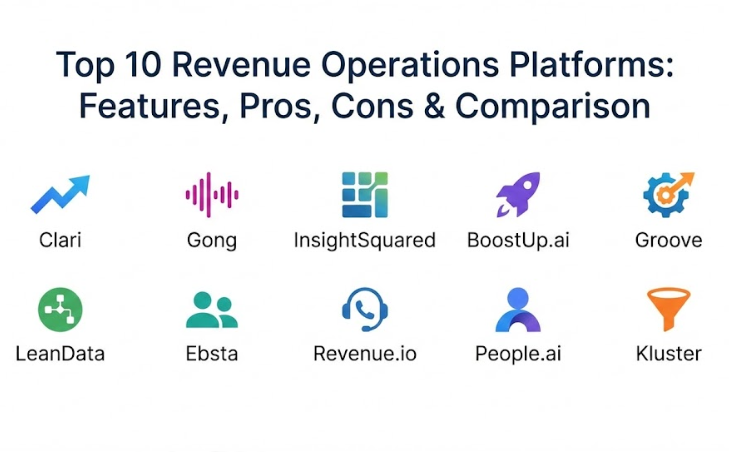
Top 10 Revenue Operations Platforms Tools
1 — Clari
Clari is a premier revenue platform that focuses heavily on revenue precision and forecasting. It is designed to help sales leaders see exactly where their deals stand and predict where the quarter will end with remarkable accuracy.
- Key features:
- Automated data capture from emails, meetings, and CRM activities.
- Predictive forecasting using historical data and AI.
- Deal inspection tools to identify “at-risk” opportunities.
- Real-time visibility into the entire sales pipeline.
- Strategy alignment boards to keep marketing and sales on one page.
- Advanced analytics for churn prediction and renewals.
- Pros:
- Significantly reduces the time managers spend on manual forecasting.
- Provides a very clear, visual interface that makes complex data easy to digest.
- Cons:
- Can be quite expensive, making it a “premium” choice for larger organizations.
- Requires a very clean CRM setup to get the most accurate AI predictions.
- Security & compliance: SOC 2 Type II, GDPR, ISO 27001, and SSO support.
- Support & community: High-touch enterprise support, dedicated success managers, and a robust online knowledge base.
2 — Gong
While many know Gong as a conversation intelligence tool, it has evolved into a full-scale revenue platform. It uses AI to analyze customer interactions across phone, email, and web conferencing to provide a complete picture of revenue health.
- Key features:
- Conversation intelligence that transcribes and analyzes sales calls.
- Reality-based deal tracking that shows what is actually happening in accounts.
- Market insights that highlight what competitors or pain points are being mentioned.
- Coaching tools for sales managers to improve team performance.
- Automated alerts for deals that haven’t had activity in a set timeframe.
- Pros:
- Removes the “guesswork” from what is happening in sales meetings.
- Extremely powerful for training and onboarding new sales reps quickly.
- Cons:
- The sheer amount of data can be overwhelming for teams without a clear strategy.
- Some reps may feel a bit uneasy with the “always-on” recording nature of the tool initially.
- Security & compliance: SOC 2 Type II, HIPAA (optional), GDPR, and end-to-end encryption.
- Support & community: Active user community (Gong Academy), 24/7 technical support, and extensive onboarding resources.
3 — InsightSquared
InsightSquared is a RevOps solution that excels in providing deep, customizable analytics for sales and marketing teams. It is built for those who love data and want to slice and dice it to find every possible growth lever.
- Key features:
- Out-of-the-box reporting for every stage of the funnel.
- Interactive dashboards that allow for deep-dive exploration.
- Sales activity tracking and productivity benchmarks.
- Advanced lead-to-revenue attribution modeling.
- Data quality management tools to find and fix CRM errors.
- Pros:
- Offers some of the most detailed reporting available in the RevOps space.
- Very strong at showing exactly which marketing efforts are driving actual dollars.
- Cons:
- The interface can feel a bit technical and less “modern” than some newer competitors.
- Setting up the most complex custom reports can require a significant time investment.
- Security & compliance: SOC 2 compliant, GDPR, and secure data hosting.
- Support & community: Solid documentation and a responsive support team that understands technical data needs.
4 — BoostUp.ai
BoostUp is an integrated revenue platform that combines forecasting, pipeline management, and conversation intelligence into one single screen. It is designed to be the “daily workspace” for revenue teams.
- Key features:
- Unified workspace for all sales and RevOps activities.
- Sentiment analysis of emails to gauge buyer intent.
- Risk-adjusted forecasting that accounts for deal sentiment.
- Collaborative deal boards for multi-stakeholder accounts.
- Automated activity logging to keep the CRM updated without rep effort.
- Pros:
- Consolidates several tools (Forecasting + Conversation Intelligence) into one, saving money.
- Very high level of customization for different sales methodologies (MEDDIC, BANT, etc.).
- Cons:
- Being a “unified” tool, it may not be as deep in one specific area as a standalone specialist.
- The platform is powerful, which means the initial setup requires careful planning.
- Security & compliance: SOC 2 Type II and GDPR compliant.
- Support & community: Personalized onboarding and a proactive customer success team.
5 — Groove
Groove is a revenue platform designed specifically for teams that use Salesforce. It is built to work natively inside the Salesforce environment, ensuring that data is always synced and reps never have to switch tabs.
- Key features:
- Native Salesforce integration (no syncing required).
- Automated sales engagement and multi-channel outreach.
- Activity capture that syncs every email and meeting automatically.
- Revenue intelligence dashboards built directly in Salesforce.
- Mobile app for reps in the field to update accounts on the go.
- Pros:
- The best choice for companies that want to maximize their Salesforce investment.
- Very high adoption rates among sales reps because it doesn’t feel like a “new” tool.
- Cons:
- Not ideal for companies that use HubSpot, Microsoft Dynamics, or other CRMs.
- Feature set is heavily focused on sales engagement, which may leave gaps in marketing alignment.
- Security & compliance: SOC 2 Type II, GDPR, and ISO 27001.
- Support & community: Strong enterprise support and a helpful library of best-practice guides.
6 — LeanData
LeanData is a specialized RevOps platform that focuses on lead-to-account matching and routing. It is the “traffic cop” of the revenue world, ensuring that every lead gets to the right person at the right time.
- Key features:
- Drag-and-drop flow builder for complex lead routing rules.
- Advanced lead-to-account matching algorithms.
- Multi-touch attribution to see which campaigns are working.
- Real-time alerts for “hot” leads that need immediate attention.
- Campaign influence tracking to justify marketing spend.
- Pros:
- Unbeatable for organizations with very high lead volumes and complex sales territories.
- Dramatically reduces “lead friction” and ensures no prospect is forgotten.
- Cons:
- Very specialized; you will still need other tools for forecasting or call analysis.
- The visual builder can become complex when routing rules are overly intricate.
- Security & compliance: SOC 2 Type II, GDPR, and secure API connections.
- Support & community: Excellent onboarding and a specialized support team that knows lead flow logic inside out.
7 — Ebsta
Ebsta is a revenue intelligence platform that focuses on “relationship intelligence.” It analyzes the strength of the relationships between your team and your prospects to determine the true health of the pipeline.
- Key features:
- Relationship score that calculates engagement based on communication patterns.
- Pipeline visibility that highlights where deals are stalling.
- Forecasting based on actual relationship strength rather than rep opinion.
- Activity tracking for emails, calls, and calendar events.
- Benchmarking tools to compare top-performing reps with the rest of the team.
- Pros:
- Provides a very unique “human” perspective on deal health.
- Excellent for long, complex enterprise sales cycles where relationships are everything.
- Cons:
- The relationship score is an algorithm, so it occasionally needs manual adjustment.
- Integration with certain niche CRMs can be less polished than the Salesforce version.
- Security & compliance: SOC 2 Type II and GDPR compliant.
- Support & community: Good documentation and a focus on personalized customer success.
8 — Revenue.io
Formerly known as RingDNA, Revenue.io is an all-in-one platform that focuses on real-time guidance. It uses AI to give reps “live” suggestions during calls and tasks to help them close more revenue.
- Key features:
- Real-time conversation guidance for sales reps.
- Integrated dialer and communication suite.
- Lead prioritization based on engagement and fit.
- Coaching dashboards for managers that highlight specific talk tracks.
- Deep Salesforce integration for automated logging.
- Pros:
- Unique “live” coaching features that help reps in the moment.
- Great for high-volume sales teams where speed and precision are critical.
- Cons:
- The focus is heavily on the “Sales” side of RevOps, with less focus on Marketing.
- Implementation can be complex due to the telephony/dialer components.
- Security & compliance: SOC 2 Type II, HIPAA (compliant versions available), and GDPR.
- Support & community: Comprehensive technical support and dedicated training for managers.
9 — People.ai
People.ai is an enterprise-grade platform that focuses on “Revenue Intelligence” by automatically capturing every single activity across the business to build a perfect picture of the go-to-market engine.
- Key features:
- 100% automated activity capture with zero manual entry.
- AI-driven opportunity and account health scores.
- Territory planning and management tools.
- Insights into “the path to success” by analyzing top-performer behavior.
- Powerful integrations with CRMs, calendars, and communication tools.
- Pros:
- Eliminates manual CRM entry, which sales reps universally love.
- Provides incredibly deep insights into how time is being spent across accounts.
- Cons:
- Might be “overkill” for mid-market companies without massive data sets.
- The pricing is definitely geared toward the high-end enterprise market.
- Security & compliance: SOC 2 Type II, GDPR, and ISO 27001.
- Support & community: Top-tier enterprise support and strategic business consulting.
10 — Kluster
Kluster is a revenue operations platform that prides itself on being fast, visual, and highly focused on the “math” of the sales funnel. It is designed to help teams build predictable revenue machines.
- Key features:
- Real-time forecasting dashboards that update as deals move.
- Deep-dive “why” analysis to explain why numbers were missed or exceeded.
- Target-setting tools based on historical conversion rates.
- Pipeline hygiene tools to find “rotting” deals.
- Simple, fast integration with major CRMs.
- Pros:
- Very easy to set up and get running compared to some legacy platforms.
- The visual design is modern and makes it easy for non-data people to understand.
- Cons:
- It doesn’t include conversation intelligence or lead routing (focused on analytics).
- Being a newer player, the third-party ecosystem is still growing.
- Security & compliance: GDPR compliant and secure data encryption.
- Support & community: Responsive support and a growing library of RevOps strategy content.
Comparison Table
| Tool Name | Best For | Platform(s) Supported | Standout Feature | Rating |
| Clari | Enterprise Forecasting | Web, Mobile | Predictive Revenue AI | 4.6 |
| Gong | Conversation Insights | Web, Mobile | AI Call Transcription | 4.7 |
| InsightSquared | Deep Data Analytics | Web | Lead-to-Rev Attribution | 4.3 |
| BoostUp.ai | Unified Sales Workspace | Web, Mobile | Sentiment-Based Forecasts | 4.5 |
| Groove | Salesforce-First Teams | Salesforce Native | Zero-Sync Salesforce Ops | 4.6 |
| LeanData | Lead Routing/Matching | Salesforce, Web | Drag-and-Drop Flow Builder | 4.8 |
| Ebsta | Relationship Health | Web, CRM Extensions | Relationship Engagement Score | 4.4 |
| Revenue.io | High-Volume Guided Sales | Web, Salesforce | Live In-Call Guidance | 4.5 |
| People.ai | Enterprise Data Capture | Web, Enterprise CRM | 100% Auto Activity Capture | 4.4 |
| Kluster | Funnel Math & Predicts | Web | “Why” Analysis Dashboards | 4.3 |
Evaluation & Scoring of Revenue Operations Platforms
When we evaluate these tools, we look at several core categories to ensure they provide real value to a revenue organization.
| Category | Weight | Description |
| Core Features | 25% | Forecasting accuracy, activity capture, and pipeline visibility. |
| Ease of Use | 15% | Adoption speed for sales reps and intuitive design. |
| Integrations | 15% | How well it connects to the existing GTM tech stack (CRM, Email, etc.). |
| Security & Compliance | 10% | SOC 2 status, GDPR compliance, and data privacy. |
| Performance | 10% | System speed, uptime, and data refresh frequency. |
| Support & Community | 10% | Availability of training, technical support, and user groups. |
| Price / Value | 15% | ROI generated versus the cost of the subscription. |
Which Revenue Operations Platforms Tool Is Right for You?
Choosing the right platform is about matching the tool’s strength to your organization’s current “pain point.”
Solo Users vs SMB vs Mid-Market vs Enterprise
If you are a Solo User or a very small company, you don’t need these tools yet; stick to a basic CRM like HubSpot Free or Pipedrive. For SMBs (under 100 people), look at Kluster or Ebsta, which offer great value without a year-long implementation. Mid-Market teams will benefit most from BoostUp.ai or Gong, which offer a great balance of features. Enterprises should prioritize Clari, People.ai, or MetricStream, as these tools are built to handle the massive data flows of global companies.
Budget-Conscious vs Premium Solutions
If you are Budget-Conscious, look for “unified” tools like BoostUp.ai or Revenue.io that combine several features (like conversation intelligence and forecasting) into one price. If you want a Premium solution and budget is not a barrier, Clari and Gong are the industry standards for a reason—their AI and support are world-class.
Feature Depth vs Ease of Use
If your primary goal is rep adoption, choose Groove (if you use Salesforce) or Gong. These tools provide immediate value to the rep, making them more likely to use them. If your goal is “Board-level” reporting and you have a dedicated RevOps team, you can afford a more complex tool like InsightSquared, which has incredible depth but a steeper learning curve.
Integration and Scalability Needs
Always check if the tool is “Native” to your CRM or if it “Syncs.” Native tools (like Groove for Salesforce) are often more reliable. If you plan to grow 200% this year, ensure you pick a tool that can handle that volume. Cloud-native platforms like People.ai are built specifically for that level of enterprise scale.
Frequently Asked Questions (FAQs)
1. What is the difference between a CRM and a RevOps Platform?
A CRM is where you store your contact and deal data (a “system of record”). A RevOps platform sits on top of that data to analyze it, forecast results, and provide insights (a “system of intelligence”).
2. Can these tools really predict my revenue?
Yes, but they are only as good as your data. Using AI, tools like Clari can look at years of history to tell you with high accuracy where your quarter will end.
3. Will my sales reps hate using this?
Not if you choose wisely. Many RevOps platforms actually save reps time by automatically logging their emails and meetings, so they don’t have to type them into the CRM manually.
4. How long does implementation take?
A simple analytics tool can be set up in a few days. A full enterprise forecasting and conversation intelligence rollout can take 2 to 4 months of careful planning and training.
5. Are these platforms secure?
Top-tier platforms like those on this list are highly secure. Look for SOC 2 Type II and GDPR compliance as the “gold standard” for data protection.
6. Do I need a RevOps Manager to run these tools?
For mid-sized and large companies, yes. While the software is powerful, you need someone who understands the “strategy” to set the rules and interpret the data correctly.
7. Can these tools help with marketing?
Yes. Tools like LeanData and InsightSquared are excellent for showing marketing exactly which campaigns are turning into actual dollars, not just “leads.”
8. What is Conversation Intelligence?
It is a technology (like Gong) that records and transcribes sales calls, then uses AI to tell you what was discussed, what the buyer’s sentiment was, and how to improve.
9. Why is “Activity Capture” important?
Because reps often forget to log calls or emails in the CRM. Automated capture ensures 100% of the work is recorded, giving the AI better data to work with.
10. How much do these platforms cost?
Pricing is almost always custom. Expect to pay per user, per month. It can range from $50/user for simple tools to $200+/user for premium enterprise suites.
Conclusion
The rise of Revenue Operations Platforms marks a shift in how businesses grow. No longer can departments work in isolation; the modern economy demands that sales, marketing, and success work as a single, unified engine. The platforms we’ve discussed today are the oil and the sensors for that engine.
When choosing your tool, don’t get distracted by “shiny” features. Focus on what is actually broken in your process. Is it your forecasting? Then look at Clari. Is it your sales coaching? Then look at Gong. Is it your lead flow? Then LeanData is your answer.
By choosing the right platform, you are doing more than just buying software; you are building a culture of transparency and predictability. You are making it easier for your team to succeed and ensuring that your company’s growth is driven by data, not by luck.