Introduction
Channel Sales Management Tools are specialized software platforms designed to help companies recruit, onboard, manage, and grow their network of third-party partners. These partners might include value-added resellers (VARs), managed service providers (MSPs), affiliates, or distributors. Instead of relying on messy email threads and disparate spreadsheets, these tools provide a centralized portal where partners can access training, register new deals, and download marketing materials.
Why It Is Important
Channel sales can often account for more than 70% of a company’s total revenue. Because these partners are not direct employees, they need an easy, low-friction way to work with your brand. A dedicated management tool ensures that partners stay engaged and motivated. It eliminates “channel conflict” (where two partners try to sell to the same customer) and provides the parent company with real-time visibility into the health of their indirect pipeline.
Key Real-World Use Cases
- Deal Registration: Partners log new sales opportunities to “lock in” their commission and prevent other partners from poaching the lead.
- Market Development Funds (MDF) Management: Tracking and approving budgets for partners to run local marketing campaigns.
- Onboarding & Training: Providing automated certification tracks so partners are fully qualified to represent complex products.
- Co-branded Collateral: Allowing partners to quickly generate marketing PDFs that feature both your logo and theirs.
What to Look For
When evaluating tools, the primary criteria should be the Partner Experience (PX). If the portal is difficult to navigate, partners will simply ignore it. You should also look for deep CRM integration (especially with Salesforce or HubSpot), robust lead distribution logic, and automated workflows that handle the “heavy lifting” of administrative tasks.
Best for: B2B software companies, hardware manufacturers, and service-based franchises that rely on a network of external sellers to scale their market reach.
Not ideal for: Small businesses that sell exclusively direct-to-consumer or very early-stage startups that do not yet have a formal partner program or the resources to manage one.
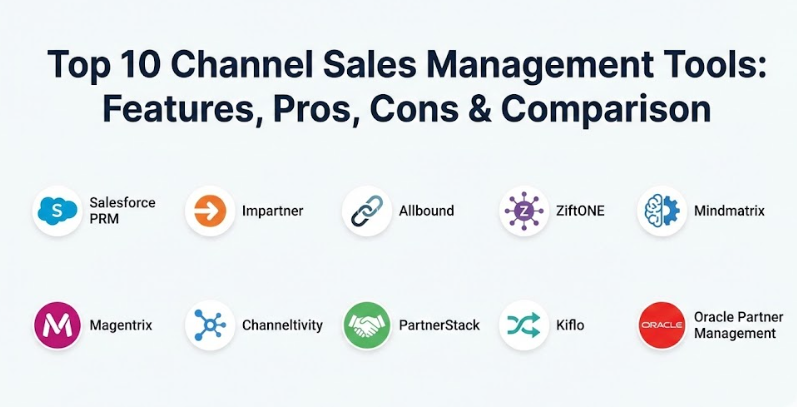
Top 10 Channel Sales Management Tools
1 — Salesforce PRM
Salesforce PRM is an extension of the world’s leading CRM. It allows companies to turn their Salesforce instance into a branded partner portal. It is built for organizations that want their indirect sales data to live in the exact same environment as their direct sales data.
- Key features:
- Guided onboarding journeys for new partners.
- Real-time deal registration and lead distribution.
- Artificial Intelligence (Einstein) for forecasting channel revenue.
- Branded CMS for sharing marketing assets.
- Integrated AppExchange for third-party add-ons.
- Automated MDF (Market Development Funds) tracking.
- Pros:
- Deepest possible integration with the Salesforce ecosystem.
- Highly customizable to fit any complex business logic.
- Cons:
- Very expensive, especially for smaller organizations.
- Requires a dedicated Salesforce administrator to manage effectively.
- Security & compliance: SOC 2, ISO 27001, GDPR, HIPAA, and high-level data encryption.
- Support & community: Massive global user community, extensive documentation (Trailhead), and 24/7 enterprise support.
2 — Impartner
Impartner is often cited as the fastest-growing pure-play PRM solution. It focuses on getting partner programs up and running quickly with a highly polished, user-friendly interface that focuses on the partner’s ease of use.
- Key features:
- “Velocity” onboarding that gets partners productive in weeks.
- Automated tier management for partner leveling.
- Through-Channel Marketing Automation (TCMA).
- Seamless integration with major CRMs like Microsoft Dynamics and HubSpot.
- Advanced analytics and “Partner Health” scorecards.
- Smart lead routing based on partner expertise or geography.
- Pros:
- Very intuitive interface that partners actually enjoy using.
- Strong focus on automation, reducing the need for manual channel managers.
- Cons:
- Some advanced features require higher-tier pricing plans.
- Customization is slightly more rigid than Salesforce.
- Security & compliance: SOC 2 Type II compliant, GDPR ready, and SSO support.
- Support & community: Strong customer success team and an “Impartner University” for training.
3 — Allbound
Allbound is a modern, cloud-based PRM that emphasizes simplicity and collaboration. It is designed to be a “wrapper” around your existing sales process, making it easy to share content and track deal progress in real-time.
- Key features:
- Content library with easy social sharing for partners.
- Simplified deal registration with automated approval workflows.
- Gamification features like leaderboards and badges.
- Learning Management System (LMS) integrations for training.
- Real-time partner activity feeds.
- Customer-facing co-branded landing pages.
- Pros:
- Quick setup time, often ready in days rather than months.
- Transparent, predictable pricing compared to legacy suites.
- Cons:
- Lacks some of the deep financial/accounting features of larger suites.
- Reporting is effective but less granular than enterprise competitors.
- Security & compliance: Encryption at rest and in transit, SSO, and GDPR compliance.
- Support & community: High-touch onboarding and responsive email/phone support.
4 — Zift Solutions (ZiftONE)
ZiftONE provides an end-to-end platform that combines channel marketing, sales, and operations. It is particularly strong for companies that want to help their partners generate their own leads through marketing automation.
- Key features:
- Full Through-Channel Marketing Automation (TCMA).
- Social media syndication for partners.
- Campaign-in-a-box for easy partner execution.
- Integrated deal registration and management.
- Comprehensive MDF and incentive tracking.
- Global partner support with multi-language capabilities.
- Pros:
- Excellent for companies with a heavy focus on “demand generation” via partners.
- Consolidates multiple tools (Marketing, Sales, Ops) into one.
- Cons:
- The platform is very broad, which can lead to a longer learning curve.
- Setup requires significant strategic planning for marketing workflows.
- Security & compliance: ISO 27001 certified, SOC 2, and GDPR compliant.
- Support & community: Dedicated account managers and a robust online knowledge base.
5 — Mindmatrix
Mindmatrix offers a “Next-Generation” PRM that blends traditional management with sales enablement. It focuses on the entire “Bridge” between the vendor, the partner, and the end customer.
- Key features:
- Automated sales playbooks for partners.
- Asset co-branding with dynamic “smart” templates.
- Integrated CRM for partners who don’t have their own.
- Multi-tier channel support for distributors and resellers.
- Incentive and loyalty management tools.
- Personalized partner dashboards.
- Pros:
- Very strong sales enablement features that help partners sell better.
- Highly flexible and capable of handling complex indirect structures.
- Cons:
- The UI can feel cluttered due to the high density of features.
- Requires a significant amount of content preparation to be effective.
- Security & compliance: SOC 2, GDPR, and data encryption protocols.
- Support & community: Comprehensive onboarding and technical support services.
6 — Magentrix
Magentrix specializes in creating secure portals that extend your CRM data to your partners. It is known for its ability to create a “social” environment where partners can collaborate and find information easily.
- Key features:
- Deep, bi-directional sync with Salesforce and Microsoft Dynamics.
- Discussion forums and social collaboration tools.
- Customizable partner onboarding checklists.
- Document management with version control.
- Training and certification modules.
- Mobile-responsive design for on-the-go access.
- Pros:
- Great balance between price and enterprise-grade features.
- Highly flexible configuration without needing heavy coding.
- Cons:
- Marketing automation features are not as deep as Zift or Impartner.
- Smaller third-party integration ecosystem than Salesforce.
- Security & compliance: SOC 2 Type II, GDPR, and SSO integration.
- Support & community: Help desk, video tutorials, and dedicated customer success.
7 — Channeltivity
Channeltivity is a “no-nonsense” PRM designed primarily for high-tech companies. It focuses on the core pillars of channel management—deal registration, lead distribution, and partner training—without unnecessary bloat.
- Key features:
- Plug-and-play Salesforce integration.
- Intuitive deal registration with conflict detection.
- Simple MDF request and approval system.
- Resource library with folder-level permissions.
- Partner training and quiz modules.
- Joint business planning tools.
- Pros:
- Very easy to use for both administrators and partners.
- Rapid deployment time and straightforward pricing.
- Cons:
- Not as “feature-heavy” as enterprise suites.
- Limited advanced marketing automation capabilities.
- Security & compliance: SOC 2 compliant, encryption, and audit logs.
- Support & community: Excellent documentation and personalized training sessions.
8 — PartnerStack
PartnerStack is unique because it focuses heavily on the “B2B SaaS” ecosystem. It combines a PRM with a marketplace where companies can discover new partners who are already selling similar software products.
- Key features:
- Automated commission payments in multiple currencies.
- Access to the PartnerStack Network of active resellers.
- Custom referral links and tracking for affiliates.
- Partner-specific email marketing tools.
- Simple deal submission forms.
- Real-time payout tracking for partners.
- Pros:
- The best tool for companies that want to scale via “referral” or “affiliate” partners.
- Handles the complex “financial” side of partner payouts automatically.
- Cons:
- Less focus on traditional “distributor” or “inventory” management.
- The marketplace can lead to lower-quality applications if not vetted.
- Security & compliance: SOC 2, GDPR, and secure payment processing.
- Support & community: Extensive library for partners and dedicated success managers.
9 — Kiflo
Kiflo is an emerging PRM designed specifically for SMBs (Small and Mid-sized Businesses). It provides a streamlined way to manage different types of partnerships (referral, sales, or affiliate) in one simple dashboard.
- Key features:
- Multi-program management in a single portal.
- Simplified asset sharing and document storage.
- Automated task reminders for partners.
- Direct integrations with HubSpot, Salesforce, and Pipedrive.
- Customizable partner sign-up pages.
- Basic deal and lead tracking.
- Pros:
- Extremely affordable for companies just starting their partner journey.
- Very clean and modern user interface.
- Cons:
- Lacks the complex “enterprise” features like multi-tier MDF.
- Reporting is basic compared to high-end competitors.
- Security & compliance: GDPR compliant and secure data hosting.
- Support & community: Email support and a helpful onboarding guide.
10 — Oracle Partner Management
Part of the broader Oracle CX suite, this tool is built for global enterprises with massive, complex channel ecosystems that span multiple countries, languages, and product lines.
- Key features:
- Global partner recruitment and profiling.
- Advanced channel financial management.
- Integrated quoting and ordering for partners.
- Sophisticated conflict resolution logic.
- Deep integration with Oracle Cloud ERP and Finance.
- Advanced business intelligence and forecasting.
- Pros:
- Unmatched scalability for global operations.
- Handles complex currency and tax requirements natively.
- Cons:
- Very complex to set up and maintain.
- The user interface can feel “legacy” compared to modern SaaS tools.
- Security & compliance: Top-tier security, ISO, SOC, HIPAA, and GDPR.
- Support & community: Global enterprise support and extensive partner network.
Comparison Table
| Tool Name | Best For | Platform(s) Supported | Standout Feature | Rating (Gartner/Other) |
| Salesforce PRM | Salesforce Power Users | Cloud / Mobile | Native CRM Integration | 4.4 / 5 |
| Impartner | Rapid Growth Teams | Cloud / Mobile | Automated Tier Mgmt | 4.6 / 5 |
| Allbound | Content & Collaboration | Cloud / Web | Simplified UX | 4.5 / 5 |
| ZiftONE | Marketing-led Channels | Cloud / Web | Full TCMA Suite | 4.2 / 5 |
| Mindmatrix | Sales Enablement focus | Cloud / Web | Smart Templates/Playbooks | 4.3 / 5 |
| Magentrix | Social Collaboration | Cloud / Mobile | Bi-directional CRM Sync | 4.5 / 5 |
| Channeltivity | High-Tech SMB/Mid-market | Cloud / Web | Easy Deployment | 4.7 / 5 |
| PartnerStack | SaaS Affiliate/Referral | Cloud / Web | Automated Payouts | 4.8 / 5 |
| Kiflo | Small Business | Cloud / Web | Multi-program support | N/A |
| Oracle PM | Global Enterprises | Cloud / On-Prem | Financial complexity mgmt | 4.0 / 5 |
Evaluation & Scoring of Channel Sales Management Tools
To help you understand how we arrived at these rankings, we used a weighted scoring rubric that prioritizes the needs of modern channel managers.
| Evaluation Category | Weight | Score (Avg) | Analysis |
| Core Features | 25% | 9 / 10 | Most tools now offer excellent deal registration and portals. |
| Ease of Use | 15% | 8 / 10 | Partner adoption is the biggest differentiator here. |
| Integrations | 15% | 8 / 10 | Bi-directional CRM sync is now an industry standard. |
| Security & Compliance | 10% | 10 / 10 | Essential for protecting sensitive customer/deal data. |
| Performance | 10% | 9 / 10 | Cloud reliability is high across the board. |
| Support | 10% | 8 / 10 | Specialized onboarding is key for these complex tools. |
| Price / Value | 15% | 7 / 10 | Enterprise tools are expensive; SMB tools offer great value. |
Which Channel Sales Management Tool Is Right for You?
Choosing a tool is not a “one-size-fits-all” scenario. Your choice depends on the maturity of your program and your budget.
Solo Users vs SMB vs Enterprise
If you are an SMB or a small team, look at Kiflo or Channeltivity. They offer the “core” features you need to get organized without overwhelming you with complexity. Enterprises with thousands of partners need the scalability and security of Salesforce PRM, Impartner, or Oracle.
Budget-Conscious vs Premium Solutions
Allbound and Kiflo are generally more accessible for teams with tighter budgets. If you have the budget for a Premium solution like Salesforce or Impartner, you are paying for deep automation that can eventually save you the cost of hiring multiple channel managers.
Feature Depth vs Ease of Use
If your partners are “low-tech” or only sell your product occasionally, Ease of Use is your #1 priority—look at Allbound. If your partners are highly sophisticated and need to manage their own marketing and sales playbooks, Mindmatrix or ZiftONE provide the necessary Feature Depth.
Integration and Scalability
Always check your CRM first. If you live in HubSpot, ensure the tool has a certified HubSpot app. If you plan to expand from 10 partners to 1,000 in the next year, ensure the tool handles “automated tiering” so you don’t have to manually promote partners as they hit their goals.
Frequently Asked Questions (FAQs)
1. What is the difference between a CRM and a PRM?
A CRM is for managing your direct relationships with customers. A PRM (Partner Relationship Management) is for managing your relationships with the partners who sell to customers.
2. How do these tools prevent channel conflict?
Through “Deal Registration.” When a partner logs a deal, the system checks if that lead already exists. If it is new, that partner is granted “protection” for that deal for a set period.
3. Do partners have to pay to use these portals?
Almost never. The vendor (you) pays for the software to make it as easy as possible for partners to sell your products.
4. Can I migrate data from my old spreadsheets into these tools?
Yes, most PRMs have robust CSV import tools to bring in your existing partner list, deal history, and resource library.
5. How long does implementation usually take?
For simpler tools like Kiflo, it can take 2 weeks. For enterprise tools like Salesforce PRM, it can take 3 to 6 months of configuration and training.
6. Do these tools handle international currencies and taxes?
Enterprise tools like PartnerStack and Oracle are designed specifically to handle complex global payouts and tax reporting.
7. Can I track who is actually downloading my marketing materials?
Yes, most PRMs provide detailed analytics on “Asset Engagement,” showing you which partners are active and which marketing pieces are most popular.
8. What is “Through-Channel Marketing Automation” (TCMA)?
It is a feature that allows you to create marketing campaigns (emails, social posts) that your partners can “launch” to their own lists with a single click.
9. Is it possible to have different “tiers” of partners?
Absolutely. You can set up “Gold,” “Silver,” and “Bronze” tiers, where Gold partners get better margins and more MDF budget automatically.
10. What is the biggest mistake when choosing a PRM?
Choosing a tool that is too complex for your partners. If it takes a partner more than 5 minutes to figure out how to register a deal, they simply won’t use the tool.
Conclusion
Building a successful channel program is about trust and efficiency. A high-quality Channel Sales Management Tool provides the structure necessary to build that trust. It ensures that your partners feel supported, their deals are protected, and they have the resources they need to win.
While Salesforce PRM and Oracle offer the ultimate in enterprise power, newer entrants like Impartner and PartnerStack are proving that user experience and automation are the future of the industry. Before committing to a platform, run a pilot with a few of your most trusted partners to ensure the workflow feels natural to them. The “best” tool is ultimately the one that turns your partners into a seamless extension of your own sales team.