Introduction
In the world of medical technology, a Medical Device Quality Management System (QMS)—often referred to as an eQMS when it is digital—is the backbone of a company’s operations. At its heart, a QMS is a collection of processes, documents, and tools that ensure a medical device is safe, effective, and compliant with government laws. Instead of just “building a product,” a medical device company must prove that every step of the design and manufacturing process was controlled and documented. This includes tracking design changes, managing supplier quality, and handling customer complaints. In the past, this was done with thousands of paper files stored in massive cabinets. Modern software tools have moved this entire world into the cloud, allowing teams to collaborate in real-time while staying “audit-ready” at a moment’s notice.
The importance of these tools cannot be overstated. A failure in quality can lead to a product recall, heavy fines from the FDA (U.S. Food and Drug Administration), or even harm to a patient. Key real-world use cases include managing CAPAs (Corrective and Preventive Actions) to fix a recurring manufacturing error, maintaining a Design History File (DHF) to prove how a device was built, and tracking employee training to ensure everyone knows how to handle hazardous materials. When choosing a tool, users should look for ease of validation (proving the software itself works correctly), a user-friendly interface that scientists and engineers will actually use, and a strong “audit trail” that records who did what and when.
Best for: Quality managers, regulatory affairs professionals, and engineering teams at medical device startups, mid-market manufacturers, and global life sciences enterprises. It is essential for anyone needing to comply with ISO 13485 or FDA 21 CFR Part 820.
Not ideal for: General consumer product manufacturers or software companies that do not operate in a regulated “life sciences” environment. If your product does not require an audit trail or strict version control to meet government safety standards, a simple project management tool or document storage app will be much cheaper and less complex.
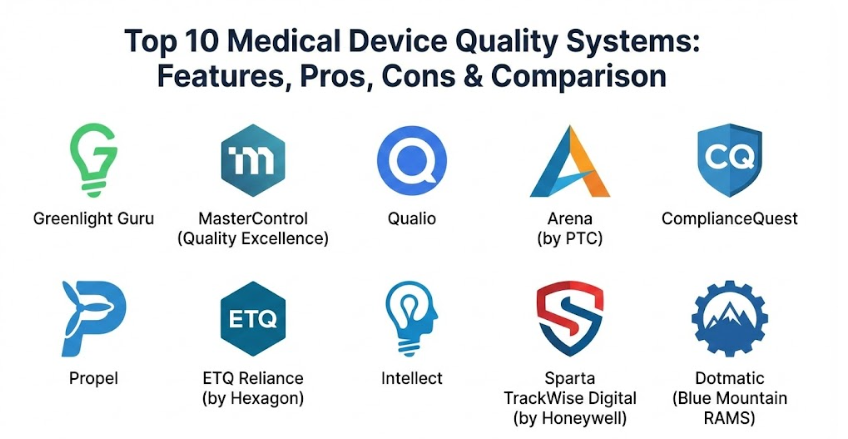
Top 10 Medical Device Quality Systems Tools
1 — Greenlight Guru
Greenlight Guru is a specialized eQMS built exclusively for the medical device industry. It is designed to help companies move from the “idea” phase to the “market” phase faster by integrating the quality system with the product development process.
- Key features:
- Integrated Design Control and Risk Management modules.
- Automated document routing and electronic signatures.
- Real-time visibility into the “State of Quality” across the entire company.
- Pre-configured workflows for CAPA, complaints, and non-conformances.
- A dedicated “Medical Device Academy” for user training and industry knowledge.
- Built-in audit management to streamline internal and external inspections.
- Part 11 compliant electronic signatures.
- Pros:
- It is built “by medical device experts for medical device experts,” so the terminology fits the industry perfectly.
- The software is already validated, which saves the company weeks of paperwork during setup.
- Cons:
- It is a premium-priced solution that might be expensive for very early-stage startups.
- Because it is so specialized for medical devices, it may lack the flexibility for labs that also do unrelated chemical work.
- Security & compliance: 21 CFR Part 11 compliant, ISO 27001 certified, SSO support, and encrypted data storage.
- Support & community: Exceptional customer success team, regular webinars, and a very active community of regulatory professionals.
2 — MasterControl (Quality Excellence)
MasterControl is one of the most established names in the life sciences world. It is a robust, enterprise-level platform that manages the entire product lifecycle, from initial research to post-market surveillance.
- Key features:
- Comprehensive document control with automated versioning.
- Training management that automatically assigns tasks based on job roles.
- Advanced CAPA and Deviation management with root cause analysis tools.
- Supplier quality management to track and grade third-party vendors.
- Integrated audit management with mobile support.
- Data analytics and reporting dashboards for high-level oversight.
- Seamless integration with major ERP and PLM systems.
- Pros:
- It is a “battle-tested” platform used by some of the largest medical device companies in the world.
- The system is incredibly deep and can handle the most complex manufacturing workflows.
- Cons:
- The user interface can feel a bit “old school” and complex compared to newer web apps.
- Implementation is a major project that often requires a dedicated consultant.
- Security & compliance: SOC 2 Type 2 compliant, HIPAA ready, and meets global standards for electronic records.
- Support & community: Extensive enterprise support, global user conferences, and a massive library of technical documentation.
3 — Qualio
Qualio is a modern, cloud-native eQMS designed for growing life sciences companies. It focuses on simplicity and speed, making it a favorite for startups that need to get their quality system up and running quickly.
- Key features:
- Simple document creation and approval workflows.
- Integrated training module that tracks employee progress.
- Easy-to-use CAPA and complaint management forms.
- Automated reporting for management reviews.
- Quality event tracking (Change Control, Deviations).
- Integration with tools like Slack and Jira for engineering teams.
- Pre-built templates for common regulatory documents.
- Pros:
- The interface is very clean and intuitive, which helps with employee adoption.
- It is much faster to implement than traditional enterprise systems.
- Cons:
- It may lack some of the deepest “customization” options that massive, multi-national companies require.
- The reporting features, while good, are not as advanced as those in high-end platforms like MasterControl.
- Security & compliance: SSO, 21 CFR Part 11 compliance, and secure cloud hosting with regular backups.
- Support & community: Dedicated onboarding managers and a very responsive chat-based support team.
4 — Arena (by PTC)
Arena is unique because it combines Product Lifecycle Management (PLM) with QMS. This means it manages the actual “parts list” and “blueprints” of the device alongside the safety and quality documents.
- Key features:
- Integrated Bill of Materials (BOM) and Quality management.
- Change control that links directly to the engineering designs.
- Compliance tracking for environmental standards like RoHS and REACH.
- Supplier collaboration portal for sharing drawings and quality specs.
- Automated training notifications based on document changes.
- Captures all product history in a single digital thread.
- CAPA management linked to the specific part or design.
- Pros:
- Perfect for companies that have complex hardware with many individual parts.
- Reduces errors because the engineering team and the quality team are looking at the same data.
- Cons:
- Can be overly complex for companies that only make software-based medical devices (SaMD).
- Requires a strong understanding of PLM principles to use effectively.
- Security & compliance: ISO 27001, SOC 2, and supports 21 CFR Part 11 for electronic signatures.
- Support & community: Professional enterprise support and a large network of implementation partners.
5 — ComplianceQuest
Built on the Salesforce platform, ComplianceQuest is a highly scalable eQMS. It leverages the power of Salesforce to provide advanced analytics, mobile access, and a modern user experience.
- Key features:
- AI-driven insights to predict potential quality issues.
- Mobile app for doing audits and reporting incidents on the go.
- Fully integrated Risk Management module (ISO 14971).
- Document control with automatic watermarking and PDF conversion.
- Supplier portal for onboarding and performance monitoring.
- Powerful dashboards built on Salesforce CRM technology.
- CAPA, Change Control, and Non-conformance modules.
- Pros:
- If your company already uses Salesforce, the integration and user training are very easy.
- The system is incredibly flexible and can be “built out” to fit unique needs.
- Cons:
- You generally need to be in the Salesforce ecosystem to get the most value out of it.
- The licensing structure can be confusing for smaller teams.
- Security & compliance: Benefits from Salesforce’s world-class security; GDPR, HIPAA, and 21 CFR Part 11 compliant.
- Support & community: Access to the massive Salesforce developer community and dedicated ComplianceQuest support.
6 — Propel
Propel is another “Product-to-Customer” platform built on Salesforce. It focuses on the “human” side of quality, aiming to make collaboration between marketing, engineering, and quality teams seamless.
- Key features:
- Collaborative design reviews with live comments.
- Integrated training and competency tracking.
- “Closed-loop” quality management (linking complaints back to design).
- Customer feedback integration directly into the quality system.
- Mobile-responsive interface for field workers.
- Configurable workflows without needing to write code.
- Automated compliance reporting for various global markets.
- Pros:
- It has a very modern, “social media” feel that makes collaboration easy.
- Excellent for companies that want to move away from “silos” and involve everyone in quality.
- Cons:
- Like ComplianceQuest, it is tied to the Salesforce platform.
- Some of the advanced features may require significant configuration.
- Security & compliance: High-level encryption, multi-factor authentication, and full audit trails.
- Support & community: Strong onboarding program and a growing community of “modern quality” advocates.
7 — ETQ Reliance (by Hexagon)
ETQ Reliance is a powerhouse eQMS used by many of the world’s most recognizable brands. It is known for its “no-code” configuration, allowing companies to build their own quality apps on top of the platform.
- Key features:
- Over 40 pre-built quality modules (CAPA, Audit, Training, etc.).
- Drag-and-drop workflow designer.
- Centralized “Dashboard of Dashboards” for global visibility.
- Powerful risk assessment tools with visual heat maps.
- Integration with a wide range of external business systems.
- Automated escalation if a quality task is not finished on time.
- Advanced search and filtering across all quality records.
- Pros:
- It is perhaps the most “customizable” system on this list.
- Ideal for massive organizations that have multiple different divisions.
- Cons:
- The level of freedom can be overwhelming; you need a clear plan before starting.
- It often requires a dedicated administrator to manage the system.
- Security & compliance: ISO 27001, SOC 2, and full support for regulated life sciences requirements.
- Support & community: Extensive training through “ETQ Academy” and a very professional support desk.
8 — Intellect
Intellect is a “no-code” QMS platform that focuses on extreme flexibility. It is designed for companies that have a very specific way of working and don’t want to change their processes to fit a software “box.”
- Key features:
- Fully customizable forms and fields.
- Integrated document control and employee training.
- CAPA and Non-conformance tracking with automated alerts.
- Audit management for internal and supplier reviews.
- Mobile app that works even when offline (for factory floor audits).
- Built-in reporting and data visualization tools.
- Electronic signature support for all regulated documents.
- Pros:
- You can literally build your own quality system without knowing how to program.
- The mobile app is very strong compared to some older competitors.
- Cons:
- Because you have to build your own workflows, the “initial” setup time can be longer.
- It may lack some of the “pre-built” industry wisdom found in Greenlight Guru.
- Security & compliance: 21 CFR Part 11 compliant, secure cloud storage, and robust audit logs.
- Support & community: Personalized customer success and a helpful online knowledge base.
9 — Sparta TrackWise Digital (by Honeywell)
TrackWise is often considered the “gold standard” for large-scale pharmaceutical and medical device manufacturing. It is a highly sophisticated platform designed for high-volume, high-risk environments.
- Key features:
- Enterprise-wide quality event management.
- AI-enabled “Quality Insights” to spot trends in data.
- Deep integration with laboratory and manufacturing equipment.
- Automated global compliance reporting.
- Advanced supplier quality and collaboration tools.
- Mobile access for “on-the-spot” quality decisions.
- Scalable architecture for companies with tens of thousands of users.
- Pros:
- It is the most robust system for managing global compliance across dozens of countries.
- Its AI features are among the most advanced in the industry.
- Cons:
- It is very expensive and is generally only suitable for large enterprises.
- The system is complex and requires specialized training to master.
- Security & compliance: Meets the highest global standards for data integrity and security.
- Support & community: Elite enterprise support and a large network of professional consultants.
10 — Dotmatic (Blue Mountain RAMS)
While Dotmatic offers many life science tools, their Blue Mountain RAMS (Regulatory Asset Management System) is a specialized QMS favorite. It focuses heavily on the “Asset” side—ensuring that the machines making the devices are calibrated and safe.
- Key features:
- Combined Calibration and Maintenance management.
- Integrated Quality workflows (CAPA, Deviations).
- Automated scheduling for machine inspections.
- Document control linked directly to specific pieces of equipment.
- Electronic signatures and audit trails for all maintenance work.
- Labeling and barcoding for lab and factory assets.
- Powerful reporting on “Equipment Readiness.”
- Pros:
- The best choice for companies where “machine calibration” is the biggest quality risk.
- It bridges the gap between the maintenance team and the quality team perfectly.
- Cons:
- It is less focused on the “Design” phase and more on the “Manufacturing” phase.
- The user interface is functional but not as modern as Qualio or Propel.
- Security & compliance: Designed specifically to meet FDA 21 CFR Part 11 and EU Annex 11.
- Support & community: Deeply knowledgeable support staff who understand both engineering and quality.
Comparison Table
| Tool Name | Best For | Platform Supported | Standout Feature | Rating |
| Greenlight Guru | Med Device Startups | Cloud / Web | Med-Device Only Focus | N/A |
| MasterControl | Large Life Science Firms | Cloud / Hybrid | Deep Process Maturity | N/A |
| Qualio | Fast-Scaling Teams | Cloud / Web | User Interface Simplicity | N/A |
| Arena (PTC) | Hardware-Heavy Teams | Cloud / Web | BOM / PLM Integration | N/A |
| ComplianceQuest | Salesforce Ecosystem | Salesforce / Web | AI-Powered Prediction | N/A |
| Propel | Collaborative Teams | Salesforce / Web | “Social” Quality Collab | N/A |
| ETQ Reliance | Multi-Divisional Firms | Cloud / Hybrid | App-Building Freedom | N/A |
| Intellect | Custom Workflows | Cloud / Mobile | No-Code Flexibility | N/A |
| Sparta TrackWise | Global Enterprise | Cloud / Web | Global Audit Readiness | N/A |
| Dotmatic (Blue Mt) | Calibration-Heavy Labs | Cloud / On-Prem | Asset-Centric Quality | N/A |
Evaluation & Scoring of Medical Device Quality Systems
We have evaluated these tools based on a weighted scoring rubric that reflects the priorities of a modern quality professional.
| Criteria | Weight | Explanation |
| Core Features | 25% | Ability to handle CAPA, Document Control, and Risk. |
| Ease of Use | 15% | How likely employees are to actually log in and use it. |
| Integrations | 15% | Connecting to Jira, ERP, or manufacturing machines. |
| Security & Comp. | 10% | 21 CFR Part 11 and data integrity standards. |
| Reliability | 10% | System uptime and validation stability. |
| Support | 10% | Help with regulatory questions and setup. |
| Price / Value | 15% | The cost relative to the risk reduced. |
Which Medical Device Quality Systems Tool Is Right for You?
Selecting an eQMS is one of the biggest decisions a company will make. It isn’t just a software purchase; it is the foundation of your regulatory strategy.
Small Startups (Pre-Market)
If you are a team of 5 to 20 people just starting your first device, you need a system that doesn’t slow you down. Qualio is a great entry point because of its simplicity. However, if you want a system that “teaches” you how to be a med-device company, Greenlight Guru is the gold standard for early-stage teams because it enforces the right habits from day one.
Hardware and Engineering-Centric Teams
If your medical device has hundreds of mechanical parts and sensors, you will likely struggle with a QMS that is “just for documents.” Arena is a strong choice here because it connects your quality records directly to your engineering blueprints (the BOM). This prevents the “I updated the design but forgot the quality document” mistake.
Large Global Enterprises
If you operate in 20 countries and have thousands of employees, you need a system with “gravity.” MasterControl or Sparta TrackWise Digital are built for this scale. They are expensive and require a team to run, but they provide the “insurance” that your global quality standards are being met everywhere.
Salesforce-First Organizations
If your sales and service teams are already living in Salesforce, it makes sense to keep your quality team there too. ComplianceQuest and Propel offer world-class quality features that feel just like the tools your other departments are already using, which makes training much faster.
Frequently Asked Questions (FAQs)
What is “Validation” in an eQMS?
Validation is the process of proving that the software does what it is supposed to do. In the medical world, you can’t just trust the software; you have to document that it works correctly for your specific needs.
Can I still use paper and spreadsheets?
Technically, yes, but it is very risky. As a company grows, paper systems become impossible to manage, leading to missed signatures, lost files, and failed audits.
Does eQMS software help with FDA audits?
Yes! During an audit, you can search for and pull up any document or record in seconds. This shows the inspector that you are in control of your quality system, which builds trust.
What is the difference between QMS and PLM?
QMS focuses on safety and compliance documents. PLM (Product Lifecycle Management) focuses on the engineering designs and parts lists. Modern systems often combine both.
Is cloud-based QMS safe for patient data?
Yes. Professional eQMS providers use high-level encryption and follow HIPAA rules to ensure that any sensitive data is protected.
How long does it take to implement an eQMS?
A simple system like Qualio can take 4 to 8 weeks. A massive system like MasterControl or TrackWise can take 6 months to a year to fully set up and validate.
What is 21 CFR Part 11?
This is an FDA rule about electronic records and signatures. It ensures that a digital signature is just as legally binding and trustworthy as a handwritten one.
Do these tools work for “Software as a Medical Device” (SaMD)?
Yes. Many of these tools (like Greenlight Guru and Qualio) have specific features for software teams, such as integrating with Jira or GitHub.
Can I use these tools for ISO 13485?
Yes, all of the tools on this list are designed to help you meet the requirements of ISO 13485, which is the international standard for medical device quality.
What is a “non-conformance”?
A non-conformance is when something goes wrong during manufacturing—like a part being the wrong size. The QMS tracks how you identified, fixed, and prevented that error.
Conclusion
Building a medical device is a noble and difficult journey. The Medical Device Quality Management System you choose will either be a “burden” that holds you back or a “map” that guides you to success. While the cost of these systems can be high, the cost of a failed audit or a product recall is much higher.
There is no single “best” tool for everyone. If you are small and fast, look at Qualio or Greenlight Guru. If you are a complex engineering firm, look at Arena. And if you are a global giant, look at MasterControl or TrackWise. The most important thing is to pick a system that your team understands and feels comfortable using every single day.