Introduction
Food Supply Chain Traceability Tools are digital systems used to track the movement of food products through every stage of production, processing, and distribution. In simple terms, these tools create a digital “passport” for your food. They record where a crop was grown, which truck hauled it, which factory processed it, and which store eventually sold it. By using technologies like barcodes, QR codes, and digital ledgers, these tools replace old paper logs with a searchable, real-time map of the entire food journey.
The importance of these tools cannot be overstated. When a foodborne illness occurs, speed is everything. Without traceability software, finding the source of a contaminated batch of spinach might take weeks of manual phone calls and paperwork. With these tools, a company can pinpoint the exact farm or processing line in seconds, potentially saving lives and preventing massive food waste. Beyond safety, these tools help verify “organic” or “fair trade” claims, ensuring that when consumers pay more for ethical food, they are getting what they paid for.
Real-world use cases are found everywhere. For example, a seafood company might use traceability to prove their tuna was caught legally in sustainable waters. A grocery chain might use it to monitor the temperature of milk during transport, ensuring it never got warm enough to spoil. When choosing a tool in this category, users should look for ease of data entry, the ability to connect with other software (interoperability), and how well the tool handles “one-step-forward, one-step-back” tracking.
Best for: Food manufacturers, large-scale farmers, grocery retailers, and logistics providers who need to comply with strict safety regulations. It is essential for Quality Assurance (QA) managers and supply chain directors in mid-to-large enterprises.
Not ideal for: Very small, local family farms that sell directly to neighbors or tiny cafes with a limited, local supply chain. If your “supply chain” is just one person driving a truck five miles once a week, these high-powered digital tools may be an unnecessary expense compared to simple digital record-keeping.
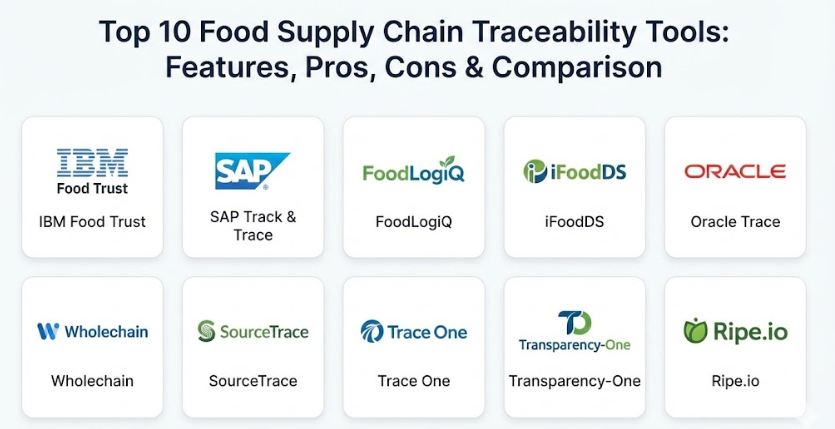
Top 10 Food Supply Chain Traceability Tools
1 — IBM Food Trust
IBM Food Trust is a leading blockchain-based platform designed to bring retailers, suppliers, and growers together into a single, highly secure network. It is built to create a permanent and unchangeable record of food data, which helps build trust between every partner in the chain.
- Key features:
- Blockchain-backed ledger for immutable data security.
- Freshness tracking module to reduce food waste.
- Digital certificate management for organic and safety audits.
- Onboarding tools for suppliers of all sizes.
- Real-time data sharing across a shared network.
- Advanced search to locate products in seconds during a recall.
- Integrated “Insights” dashboard to spot supply chain bottlenecks.
- Pros:
- Extremely high levels of data security because the records cannot be altered.
- It is a global standard used by some of the largest retailers in the world, making it easier to connect with major partners.
- Cons:
- The cost can be quite high for smaller businesses.
- Setting up the initial data flow for a large organization can be a long and technical process.
- Security & compliance: Features enterprise-grade encryption, SOC 2 compliance, and strict adherence to global data privacy laws.
- Support & community: Offers comprehensive enterprise support, a deep library of technical documentation, and a large global community of supply chain experts.
2 — SAP Logistics Business Network (Global Track and Trace)
SAP provides a massive, professional-grade solution for companies that are already using their ecosystem. Their Global Track and Trace option focuses on giving businesses a “bird’s eye view” of their shipments and production lines in real-time.
- Key features:
- Native integration with SAP ERP and S/4HANA systems.
- Real-time alerts for delivery delays or temperature changes.
- Collaborative portals for carriers and suppliers to enter data.
- Automated reporting for regulatory compliance.
- Support for “Internet of Things” (IoT) sensors on trucks and pallets.
- Detailed map-based views of the entire global supply chain.
- Standardized data formats to ensure different partners can talk to each other.
- Pros:
- If you already use SAP, this tool fits perfectly into your existing workflow.
- It is built for massive, global scale and rarely struggles with high volumes of data.
- Cons:
- It is very complex and usually requires a dedicated IT team to manage.
- The user interface can feel more “robotic” and less intuitive than newer, smaller apps.
- Security & compliance: Includes multi-factor authentication, SSO, and is fully compliant with ISO and GDPR standards.
- Support & community: Backed by SAP’s massive global support network, including 24/7 technical help and local user groups.
3 — FoodLogiQ (Trustwell)
FoodLogiQ is widely known for its focus on food safety and compliance. It is designed to help food brands manage their entire supplier network and respond to recalls with incredible speed.
- Key features:
- Centralized supplier document management (audits, insurance, etc.).
- Automated recall management that notifies all stores simultaneously.
- Standardized “Critical Tracking Events” (CTEs) and “Key Data Elements” (KDEs).
- Consumer-facing transparency tools (scan a code to see the farm).
- Real-time dashboard for food safety incidents.
- Mobile app for easier data entry in the field or warehouse.
- Incident management module to track customer complaints.
- Pros:
- Excellent at managing the legal and safety paperwork required by modern food laws.
- The recall module is very fast and can drastically reduce the time it takes to pull products off shelves.
- Cons:
- Some users find the initial setup of supplier accounts to be time-consuming.
- It focuses more on safety than on the physical logistics of shipping.
- Security & compliance: SOC 2 compliant, uses secure encryption, and is built specifically to help companies meet FSMA (Food Safety Modernization Act) requirements.
- Support & community: Known for very helpful customer success managers and a strong presence at food safety industry events.
4 — iFoodDS
iFoodDS is a specialist in the “fresh produce” category. It provides tools that cover the journey from the field to the packing house and eventually to the retailer, with a heavy emphasis on quality control and safety.
- Key features:
- Field-level data capture for harvesters and growers.
- Integrated quality inspection tools for warehouses.
- Real-time visibility into the “cold chain” (temperature tracking).
- Compliance modules for the latest safety standards.
- Flexible data entry methods, including voice and scanning.
- Detailed analytics on shelf-life and product freshness.
- Automated alerts for any safety “red flags” found during inspections.
- Pros:
- Deeply understands the unique needs of fruit and vegetable growers.
- Very good at connecting the “first mile” (the farm) to the rest of the chain.
- Cons:
- Might not be as well-suited for processed or packaged food manufacturers.
- The reporting tools can sometimes be less customizable than broader enterprise software.
- Security & compliance: Uses secure cloud hosting, standard encryption, and meets major agricultural safety standards.
- Support & community: Offers specialized onboarding for farming operations and responsive technical support.
5 — Oracle Intelligent Track and Trace
Oracle uses “Smart Contracts” and IoT technology to automate the tracking process. It is a powerful choice for large companies that want a system that can “think” and alert them to problems before they happen.
- Key features:
- Distributed ledger technology for secure record-keeping.
- Automated “Smart Contracts” that trigger payments or alerts based on data.
- Pre-built templates for food and beverage supply chains.
- Seamless integration with Oracle Cloud ERP.
- High-level visualization of multi-tier supply chains (suppliers of suppliers).
- Anomaly detection using AI to spot fake or incorrect data.
- Support for sensors that track humidity, temperature, and shock.
- Pros:
- Excellent automation—it reduces the need for manual check-ins.
- Provides great visibility into deep, multi-layered supply chains that are usually hard to see.
- Cons:
- It is an enterprise solution with a high price point.
- Requires a significant amount of data “cleaning” before it can work effectively.
- Security & compliance: Benefits from Oracle’s massive security infrastructure, including SOC 1/2/3 and global data protection.
- Support & community: Comprehensive documentation, global support centers, and a large network of implementation partners.
6 — Wholechain
Wholechain is a user-friendly traceability tool that focuses on sustainability and ethical sourcing. It is designed to be accessible to everyone in the supply chain, from a small-scale fisherman to a global restaurant chain.
- Key features:
- Mobile-first design for easy use in remote locations.
- Direct alignment with GS1 standards for global data exchange.
- “Storytelling” features for brands to share sustainability data with customers.
- Low-bandwidth mode for use in areas with poor internet.
- Integrated maps to show the geographic origin of ingredients.
- Simple “hand-off” mechanism to track products between owners.
- Support for certifications like Fair Trade or Marine Stewardship Council.
- Pros:
- One of the most intuitive and modern-looking interfaces in the industry.
- Excellent for companies that want to prove their environmental or ethical claims.
- Cons:
- May lack the deep “warehouse management” features found in bigger suites.
- Smaller user base compared to the giants like SAP or IBM.
- Security & compliance: Uses blockchain for data integrity and follows standard web security protocols.
- Support & community: Friendly, personalized support and a strong focus on building a community of ethical brands.
7 — SourceTrace
SourceTrace is a leader in “farm-to-fork” traceability with a special focus on the very beginning of the chain. It is widely used for managing smallholder farmers and agricultural cooperatives in developing regions.
- Key features:
- Farm management software that works offline in the field.
- Mobile payments for farmers to ensure they get paid fairly and quickly.
- Geofencing and satellite mapping of farm plots.
- Tracking of “input” use (seeds, fertilizers) to ensure safety.
- Quality grading at the point of collection.
- Multilingual support for diverse global workforces.
- Inventory tracking for small-scale collection centers.
- Pros:
- Unmatched for organizations working with thousands of small, individual farmers.
- Works exceptionally well in regions with poor infrastructure or no internet.
- Cons:
- Not designed for complex, high-speed factory processing lines.
- The interface is more focused on field data than on retail dashboards.
- Security & compliance: ISO 27001 certified and focuses heavily on the privacy of farmer data.
- Support & community: Specialized in helping organizations digitize rural supply chains with on-the-ground expertise.
8 — Trace One (formerly Selerant)
Trace One provides a suite of tools that focus on the “Product Lifecycle.” This means they help with everything from designing a new food recipe to ensuring the final package is labeled correctly and tracked through the chain.
- Key features:
- Integrated PLM (Product Lifecycle Management) and traceability.
- Huge database of global food regulations to ensure compliance.
- Specification management to keep recipes consistent everywhere.
- Supplier collaboration portal for sharing safety data.
- Quality control modules that connect directly to production data.
- Automated label generation that matches the ingredients in the system.
- Risk assessment tools for new ingredients or suppliers.
- Pros:
- Unique because it connects the “making” of the food with the “tracking” of the food.
- Excellent for manufacturers who have very complex recipes with many ingredients.
- Cons:
- The software is very dense and can take a long time to learn.
- It is more of a “back-office” tool and less of a “real-time logistics” tracker.
- Security & compliance: Secure cloud infrastructure with robust audit logs and compliance with international food laws.
- Support & community: Professional training services and a large community of food scientists and engineers.
9 — Transparency-One
Transparency-One helps brands discover and map their entire supply chain, right down to the source. It focuses on the “social” aspect of the chain, ensuring that every partner meets the brand’s standards for safety and ethics.
- Key features:
- “Supply Chain Discovery” to find hidden partners in your network.
- Verification of certifications (like Non-GMO or Gluten-Free).
- Real-time risk alerts based on global news (weather, strikes, outbreaks).
- Simple supplier surveys to collect data quickly.
- Dashboards that show the “readiness” of your supply chain.
- Integration with major retail platforms.
- Visual mapping of every tier in the supply chain.
- Pros:
- Great for high-level management to see where their biggest risks are.
- Very good at managing the “soft” data like certificates and audits.
- Cons:
- It relies heavily on suppliers answering questions and surveys.
- It may not provide as much “minute-by-minute” tracking of moving trucks.
- Security & compliance: Follows standard enterprise security and data privacy rules.
- Support & community: Offers dedicated “Supplier Onboarding” teams to help get your partners into the system.
10 — Ripe.io
Ripe.io calls itself the “Food Genome” project. They use a combination of blockchain and IoT to create a high-definition picture of food quality, including things like taste, ripeness, and sustainability.
- Key features:
- High-resolution data capture from sensors and scanners.
- Blockchain ledger for a single version of the truth.
- Quality “scores” for products based on sensor data.
- Consumer apps that show the “story” of the food.
- Automated workflows to trigger actions based on quality.
- Collaborative platform for farmers, distributors, and chefs.
- Predictive analytics for shelf-life and flavor development.
- Pros:
- The most “high-tech” approach to tracking quality, not just location.
- Helps farmers and brands prove that their food actually tastes better or is fresher.
- Cons:
- Still a younger company with a smaller footprint than the giants.
- Requires an investment in sensors and hardware to get the full value.
- Security & compliance: Built on secure blockchain technology with standard cloud security practices.
- Support & community: Enthusiastic team with a focus on innovation and the future of food data.
Comparison Table
| Tool Name | Best For | Platform(s) Supported | Standout Feature | Rating |
| IBM Food Trust | Global Retail Networks | Cloud / Web | Blockchain Integrity | 4.6 / 5 |
| SAP Track & Trace | Enterprise SAP Users | Cloud / Mobile | Deep ERP Integration | 4.4 / 5 |
| FoodLogiQ | Recall & Compliance | Web / Mobile | Recall Management | 4.5 / 5 |
| iFoodDS | Fresh Produce | Web / Mobile | Field-Level Capture | 4.3 / 5 |
| Oracle Trace | Automated Logistics | Cloud | Smart Contracts | 4.2 / 5 |
| Wholechain | Ethical/Sustainable Brands | Mobile-First | User Experience | 4.7 / 5 |
| SourceTrace | Smallholder Farmers | Mobile / Offline | Offline Field Mode | 4.5 / 5 |
| Trace One | Complex Manufacturers | Web | PLM + Traceability | 4.1 / 5 |
| Transparency-One | Multi-Tier Mapping | Web | Supplier Discovery | 4.0 / 5 |
| Ripe.io | Quality-Focused Brands | Web / IoT | Quality Sensing | N/A |
Evaluation & Scoring of Food Supply Chain Traceability Tools
To help you compare these options objectively, we have used the following weighted scoring rubric based on industry needs.
| Category | Weight | What We Look For |
| Core Features | 25% | Ability to track products, manage recalls, and store certificates. |
| Ease of Use | 15% | How simple the interface is for both your team and your suppliers. |
| Integrations | 15% | How well it talks to ERPs, sensors, and other external software. |
| Security & Compliance | 10% | Blockchain use, encryption, and meeting safety laws like FSMA. |
| Performance | 10% | Speed of searches and system reliability during high-stress recalls. |
| Support & Community | 10% | Training, documentation, and the responsiveness of help desks. |
| Price / Value | 15% | Whether the total cost is fair compared to the efficiency gained. |
Which Food Supply Chain Traceability Tool Is Right for You?
Selecting the right tool depends on your position in the supply chain and your specific business goals.
Solo Users vs. SMBs vs. Mid-Market vs. Enterprise
If you are an individual specialty grower or a small food business (SMB), look for tools like Wholechain or SourceTrace. They are more affordable, easier to learn, and don’t require a whole IT department. Mid-market companies that need robust safety tools should consider FoodLogiQ or iFoodDS. Global enterprises with thousands of suppliers will likely need the heavy-duty power and integration of SAP or IBM Food Trust.
Budget-Conscious vs. Premium Solutions
For those on a tight budget, look for tools that offer “modular” pricing where you only pay for what you use. Wholechain is often more accessible for smaller budgets. Premium solutions like Oracle or SAP involve significant upfront costs but provide massive automation and “big data” capabilities that can save large companies millions in the long run.
Feature Depth vs. Ease of Use
If your main goal is to have the most technically advanced system possible, IBM Food Trust or Ripe.io are top-tier. However, if you are worried that your suppliers won’t use the software if it’s too hard, Wholechain and FoodLogiQ are much more “human-friendly” and usually have higher adoption rates among partners.
Integration and Scalability Needs
Always check if the tool can grow with you. If you plan on moving into international markets, you need a tool that handles different languages and global standards (like GS1). If you already use a major accounting or warehouse system, picking a tool that has a “pre-built” connection to that system will save you months of technical headaches.
Frequently Asked Questions (FAQs)
1. Is food traceability software required by law?
In many countries, yes. Governments are passing stricter laws that require food companies to keep detailed digital records so that recalls can happen faster. These tools help you meet those legal requirements without the stress of manual paperwork.
2. What is the difference between “one-step-up” and “full” traceability?
“One-step-up” means you only know who you bought from and who you sold to. “Full” traceability means you can see the entire journey from the original farm to the final customer, even if there are ten different companies in between.
3. Does blockchain make a tool better?
Blockchain provides a very high level of security because once data is entered, it cannot be changed or deleted. This is great for preventing fraud, but it doesn’t necessarily make the software easier to use on a daily basis.
4. How long does it take to implement these tools?
A simple, cloud-based tool can be ready in a few weeks. A large enterprise system that connects to all your factories and global suppliers can take six months to a year to fully set up.
5. Can I use these tools if I have poor internet?
Some tools, like SourceTrace, are built with an “offline-first” design. This means workers can enter data in a remote field, and the app will automatically upload everything as soon as they reach an area with Wi-Fi.
6. Do my suppliers have to pay for the software too?
This depends on the tool. Some charge the main brand and let suppliers use a basic version for free, while others require every partner in the chain to have a paid subscription. Always ask about “supplier fees.”
7. How do these tools help reduce food waste?
By knowing exactly when a product was harvested and its temperature during shipping, companies can prioritize selling the “oldest” or “warmest” stock first, ensuring it doesn’t spoil in the warehouse.
8. Can I track “ingredients” in a complex product?
Yes, tools like Trace One are designed specifically for this. They can track ten different ingredients from ten different countries that all go into one single jar of sauce.
9. What is GS1?
GS1 is a global non-profit that sets the standards for barcodes and data sharing. Most high-quality traceability tools use GS1 standards to make sure their data can be read by other companies’ systems.
10. Can customers see this data?
Many tools offer “consumer-facing” features where a shopper can scan a QR code on a package and see a map of where their food came from and even see photos of the farm.
Conclusion
The future of food is transparent. As consumers demand more information and governments enforce stricter safety rules, having a high-quality traceability tool is no longer just a “nice-to-have” feature—it is a business necessity.
When choosing the right software, remember that the “best” tool is the one that your suppliers will actually use. A system with a million features is worthless if no one enters the data. Focus on a tool that matches your specific industry—whether it’s the farming focus of SourceTrace, the retail power of IBM, or the sustainability focus of Wholechain. By picking a partner that understands your unique challenges, you can build a safer, more efficient, and more trustworthy food brand.