Introduction
A cold chain monitoring platform is a digital system used to track and manage the temperature of products that are sensitive to heat or cold while they are being moved or stored. Think of it as a smart, digital eyes-and-ears system for a “refrigerator on wheels.” These platforms use small sensors placed inside shipping containers, trucks, or warehouses to record temperature, humidity, and location. This data is then sent to a central website or app where managers can watch it in real-time.
These platforms are incredibly important because many products we rely on—like life-saving vaccines, fresh seafood, and delicate chemicals—can be ruined if they get even a few degrees too warm or too cold. If a truck’s cooling system fails and nobody knows, thousands of dollars of products could be thrown away. Cold chain platforms prevent this by sending instant alerts to a phone or computer the second something goes wrong, allowing the driver or manager to fix the problem before the goods are spoiled.
Key Real-World Use Cases
- Pharmaceutical Transport: Ensuring vaccines and insulin stay within strict temperature ranges to remain safe for patients.
- Food Safety: Tracking frozen or chilled foods from the farm to the grocery store to prevent bacteria growth.
- Chemical Logistics: Monitoring volatile industrial chemicals that could become dangerous if they overheat.
- High-Value Floral Shipping: Keeping exotic flowers fresh by maintaining high humidity and cool temperatures during long flights.
When choosing a tool, users should look for battery life of the sensors, how well the software works in areas with poor cell service, and how easy it is to pull up reports for government inspectors.
Best for: Large logistics companies, pharmaceutical manufacturers, global food distributors, and warehouse managers who handle perishable goods. It is essential for anyone who needs to prove that their products stayed at the right temperature from start to finish.
Not ideal for: Small local bakeries or shops that only move goods across a single town in a few minutes, where a simple hand-held thermometer is often enough. It is also not necessary for dry goods like clothing or electronics that aren’t affected by temperature.
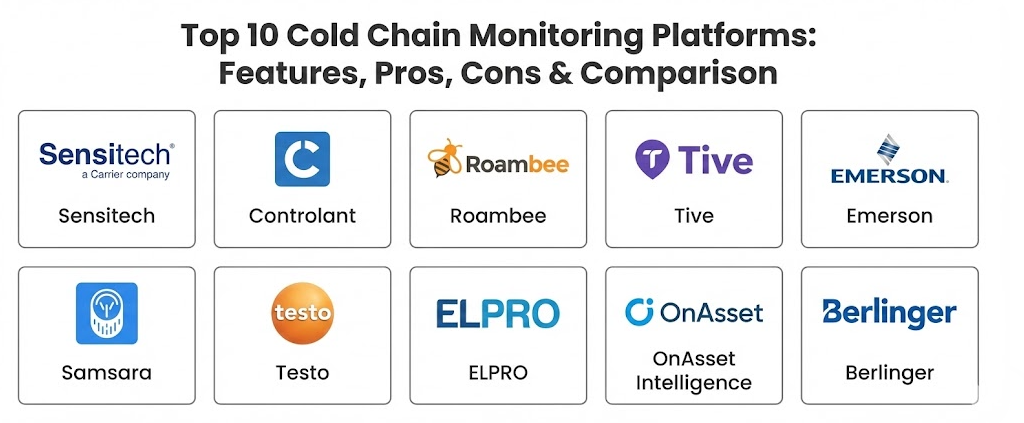
Top 10 Cold Chain Monitoring Platforms Tools
1 — Sensitech (Carrier)
Sensitech is one of the oldest and most trusted names in the industry. They provide a complete range of hardware and software designed to track everything from a single small box to a massive shipping container. Their “TempTale” devices are a world standard in the pharmaceutical industry.
Key Features
- TempTale Sensors: Highly accurate hardware loggers that are famous for their reliability.
- SensiWatch Platform: A cloud-based site that gathers all your shipping data in one place.
- Real-time GPS Tracking: Shows you exactly where your cold goods are on a map at any moment.
- Automatic Cold Chain Analysis: The software automatically flags when a shipment “broke” the temperature rules.
- Global Support Network: Access to technical help in almost every major port and city in the world.
- Post-Trip Reporting: Creates easy-to-read PDF documents that prove a shipment stayed cool.
Pros
- Their hardware is extremely durable and rarely fails, even in rough shipping conditions.
- The software is built to meet the very strict legal rules of the medicine and healthcare world.
Cons
- The interface can feel a bit older and more complex than some of the newer, “app-style” tools.
- Setting up the full system for a large company can take quite a bit of time and training.
Security & compliance: Includes SSO, 21 CFR Part 11 compliance (for pharma), data encryption, and full audit logs.
Support & community: High-quality enterprise support, extensive technical manuals, and professional onboarding services.
2 — Controlant
Controlant is a modern, fast-growing platform that became very famous for helping move millions of vaccines globally. They focus on “real-time” monitoring and automation, meaning they want to remove the need for humans to manually check temperatures.
Key Features
- Reusable IoT Blueberries: Small, powerful sensors that can be used over and over again for different shipments.
- Automated Product Release: The system automatically approves a shipment if all data is perfect, saving hours of paperwork.
- Real-time Dashboard: A very clean, modern view of all moving trucks and planes.
- 24/7 Monitoring Center: Their team can watch your shipments for you and call the driver if an alarm goes off.
- Risk Analytics: The software predicts which shipping routes are most likely to have temperature problems.
- Collaborative Portal: Allows you to share your data easily with your customers or partners.
Pros
- The software is very easy to use and looks like a modern smartphone app.
- They focus on “Zero Waste,” helping companies stop throwing away spoiled food or medicine.
Cons
- It is a premium service, so the cost might be higher than simpler “logger” tools.
- It works best with their specific sensors, so you may have to buy their hardware too.
Security & compliance: SOC 2 Type II, GDPR compliant, and uses advanced cloud security encryption.
Support & community: Excellent customer success managers and a very helpful online help center.
3 — Roambee
Roambee uses a “sensor-as-a-service” model. Instead of buying expensive hardware, you often just pay to use their sensors and software. They use artificial intelligence (AI) to help figure out why a shipment is getting too warm.
Key Features
- BeeBeacon Technology: Small sensors that can talk to each other to track a whole pallet of goods.
- AI-Powered Insights: The system “learns” from your past shipments to give better advice.
- Light & Shock Sensors: Tracks if a box was opened or dropped, not just the temperature.
- Global Visibility: Works in over 150 countries using a mix of cell signals and satellite.
- Demand-Based Payout: You only pay for the number of shipments you actually track each month.
- Predictive Alerts: Tells you if a shipment is likely to get too warm in the next two hours.
Pros
- Very flexible pricing makes it a great choice for companies that have “busy” and “quiet” seasons.
- The sensors are very easy to hide inside a box to prevent theft.
Cons
- Because it relies on AI, it can sometimes take a while for the system to “get smart” about your specific business.
- The sheer amount of data it provides can be overwhelming for small teams.
Security & compliance: ISO 27001 certified, GDPR compliant, and features robust audit logs.
Support & community: Good online documentation and a responsive technical support team.
4 — Tive
Tive is a leader in the new wave of 5G-connected tracking. They focus on making sensors that are very thin and can fit almost anywhere, providing data on location, temperature, and even how much light is hitting the package.
Key Features
- Solo 5G Trackers: The first trackers to use fast 5G networks for better signals in remote areas.
- Multi-Sensor Tracking: Monitors temperature, humidity, shock, and light all at once.
- Tive Tag: A paper-thin temperature logger that looks like a shipping label.
- Open API: Easily connects Tive data to your other business software (like your warehouse system).
- Live Map View: See your shipment move in real-time with very high accuracy.
- Green Program: They have a dedicated system for returning and recycling old trackers.
Pros
- The trackers have incredible battery life, sometimes lasting for months on a single charge.
- The “Tive Tag” is a game-changer for people who want to track small boxes without bulky hardware.
Cons
- The high-tech 5G features might be more than what a basic food distributor needs.
- In areas where 5G isn’t available, some features might slow down slightly.
Security & compliance: GDPR, encrypted data transmission, and secure SSO login.
Support & community: Very active on social media and known for having a fast, helpful customer service team.
5 — Emerson (Cargo Solutions)
Emerson is an industrial giant that knows everything about cooling and refrigeration. Their cold chain platform, often under the “Lumity” or “Cargo Solutions” brand, is built for heavy-duty industrial use and massive global fleets.
Key Features
- GO Real-Time Trackers: Rugged trackers built to survive on ships and in the back of rough trucks.
- Overseer Platform: A professional dashboard for managing thousands of trackers at once.
- Integrated Hardware: Works perfectly with Emerson’s own refrigeration units found on many trucks.
- Automated Notifications: Sends texts or emails to as many people as you need when a limit is hit.
- Historical Data Lake: Stores years of temperature data so you can look back at old shipments.
- Security Alerts: Notifies you if a truck door is opened at an unplanned location.
Pros
- Their hardware is incredibly “tough” and designed for the real world of dirty trucks and salty ships.
- Because they make the cooling machines too, their software understands “refrigeration” better than almost anyone.
Cons
- The software can look a bit more “industrial” and less “pretty” than newer startups.
- Navigating their large catalog of different trackers can be confusing for new buyers.
Security & compliance: Enterprise-grade security, ISO standards, and audit logs for regulatory proof.
Support & community: Global engineering support and a huge network of physical service centers.
6 — Samsara
Samsara is a “full-fleet” platform. They don’t just do cold chain; they do dash cams, fuel tracking, and driver safety. Their cold chain tools are an add-on that works perfectly for companies that already have their own trucks.
Key Features
- EM-Series Sensors: Wireless temperature and humidity sensors that take minutes to install.
- All-in-One Dashboard: See your driver’s speed, fuel, and trailer temperature all on one screen.
- Two-Way Reefer Control: For some trucks, you can actually change the temperature from your office.
- Instant FMCSA Compliance: Automatically generates the reports needed for food and medicine laws.
- Driver App: The truck driver can see the trailer temperature on their phone while they drive.
- Geofencing: Get an alert the moment a cold shipment enters or leaves your warehouse.
Pros
- If you have your own fleet of trucks, having everything in one app (safety, fuel, temp) is a huge time saver.
- The sensors are completely wireless and very easy to move from one trailer to another.
Cons
- It is not the best choice if you use “outside” shipping companies, as it is designed for your own trucks.
- You usually have to buy into the whole Samsara system, which can be expensive.
Security & compliance: SOC 2, HIPAA (if needed), GDPR, and highly secure cloud storage.
Support & community: Offers a massive online community, video tutorials, and 24/7 phone support.
7 — Testo (Saveris)
Testo is a German engineering company famous for making high-precision measurement tools. Their “Saveris” platform is designed for people who need the most accurate temperature data possible, such as in laboratory settings or high-end pharmacies.
Key Features
- Ultra-Precise Probes: German-engineered sensors that can measure tiny fractions of a degree.
- Saveris Cloud: A stable, high-security website for watching all your stationary and moving assets.
- Data Continuity: If the internet goes out, the sensors store the data and upload it the moment the signal returns.
- Modular System: You can add different types of sensors (CO2, pressure, light) to the same system.
- Digital Signature Reports: Reports that are legally binding and ready for government auditors.
- Alarm Management: Multiple levels of alarms (e.g., “Warning” at 5 degrees, “Danger” at 8 degrees).
Pros
- The accuracy of their sensors is world-class and often better than “all-in-one” tracking tools.
- The system is very reliable and built to last for many years in a professional environment.
Cons
- The setup is more “technical” and might require an engineer to get everything perfect.
- It is more of a “scientific” tool, so it might lack some of the “truck tracking” features of others.
Security & compliance: Full GxP compliance, 21 CFR Part 11, and high-level data encryption.
Support & community: Professional calibration services and expert technical support teams in most countries.
8 — ELPRO
ELPRO is a Swiss company that focuses almost entirely on the pharmaceutical and life sciences industries. They are the experts in “compliance,” meaning they make sure your company follows every single law about shipping medicine.
Key Features
- LIBERO Loggers: Small, highly secure loggers that don’t even need a separate software to read (they work via USB).
- ELPRO Cloud: A central platform designed specifically for the strict needs of “GXP” (Good Practice) rules.
- Stability Budgeting: The software calculates how much “total life” a vaccine has left after it gets warm.
- Automated Data Upload: Bluetooth sensors that send data to the cloud the second they are near a “gateway.”
- Global Inventory View: See every fridge and truck in your global company on one screen.
- Audit-Proof Archiving: Data is stored for years in a way that can never be deleted or changed.
Pros
- They are the #1 choice for “high-risk” pharmaceutical companies who cannot afford a single mistake.
- The USB-based “No Software Needed” loggers are incredibly helpful for shipping to remote areas.
Cons
- The software is very “strict” and professional, which can make it feel less flexible for “fun” or “easy” use.
- It is a premium, specialized tool with pricing to match its Swiss engineering.
Security & compliance: Highest level pharma compliance (GxP, 21 CFR Part 11), ISO 9001, and SOC 2.
Support & community: Expert consulting services to help you pass government audits and inspections.
9 — OnAsset Intelligence
OnAsset is the “high-tech” tracker for companies that move things by air and sea. They focus on making sure their sensors are safe to use on airplanes and don’t interfere with the pilot’s electronics.
Key Features
- SENTRY FlightSafe: The only trackers that are 100% approved to stay “on” during a flight.
- Sentinel Tags: Tiny, low-cost tags that can be stuck to hundreds of individual boxes.
- Vision Platform: A high-level dashboard that shows the “health” of your entire supply chain.
- Advanced Location Tech: Uses GPS, Wi-Fi, and cell towers to find a package even inside a warehouse.
- Environment Monitoring: Tracks air pressure and light, which is vital for high-altitude shipping.
- API Integration: Designed to “talk” to the software used by major airlines and cargo ships.
Pros
- If you ship a lot of goods by air, this is the safest and most compliant choice.
- Their location tracking is very good at finding a single box in a massive airport warehouse.
Cons
- The features are very focused on “movement” and “transport,” so it might be less ideal for a stationary warehouse fridge.
- The hardware is very advanced, which means it requires a bit more care than a simple disposable logger.
Security & compliance: FAA and EASA aviation compliant, ISO 27001, and secure data hosting.
Support & community: Excellent technical support with specialized knowledge of aviation and shipping laws.
10 — Berlinger
Berlinger is a family-owned Swiss company that has been around for over 150 years. They are famous for their simple, robust, and incredibly reliable temperature loggers used by the World Health Organization (WHO).
Key Features
- Q-tag & Fridge-tag: Simple devices with a screen that shows a “Check” or an “X” for easy reading.
- SmartView Platform: A cloud system that collects data from all your Berlinger devices worldwide.
- WHO PQS Certified: Their hardware is officially approved for use in global health programs.
- Long Battery Life: Some of their devices can stay in a fridge for 3 years without needing a charge.
- Bluetooth Connectivity: Allows you to read the temperature through a glass fridge door using your phone.
- Simple “Push-Button” Start: Designed to be used by anyone, even without any technical training.
Pros
- The hardware is incredibly easy for “non-tech” people to use—just look for the green checkmark.
- They are the “gold standard” for shipping vaccines to developing countries where internet is poor.
Cons
- The cloud platform is a bit more basic than the AI-powered dashboards of newer competitors.
- It is more of a “monitoring” tool than a “logistics management” tool.
Security & compliance: WHO certified, ISO certified, and meets all standard medical shipping rules.
Support & community: Great training for global health workers and very reliable Swiss customer service.
Comparison Table
| Tool Name | Best For | Platform(s) Supported | Standout Feature | Rating |
| Sensitech | Established Pharma | Web / Desktop / Mobile | TempTale reliability | 4.6 / 5.0 |
| Controlant | Real-time Automation | Web-based (Cloud) | Automated product release | 4.8 / 5.0 |
| Roambee | Flexible AI Tracking | Web / Mobile App | Pay-per-shipment model | 4.5 / 5.0 |
| Tive | High-tech Global Transit | Web / Mobile App | 5.0G & Solo 5G Trackers | 4.7 / 5.0 |
| Emerson | Heavy Industrial/Fleets | Web-based (Overseer) | Rugged “Reefer” hardware | 4.4 / 5.0 |
| Samsara | Companies with own trucks | Web / iOS / Android | Integrated fleet management | 4.8 / 5.0 |
| Testo | Scientific Accuracy | Web (Saveris Cloud) | German precision probes | 4.3 / 5.0 |
| ELPRO | High-risk Compliance | Web / USB / Mobile | Swiss Pharma compliance | 4.5 / 5.0 |
| OnAsset | Air Cargo & Logistics | Web-based (Vision) | FlightSafe aviation approval | 4.4 / 5.0 |
| Berlinger | Simplicity & WHO work | Web (SmartView) | 3-year battery loggers | 4.6 / 5.0 |
Evaluation & Scoring of Cold Chain Monitoring Platforms
We have scored these platforms based on what matters most to a business that needs to keep its cool.
| Criteria | Weight | Explanation |
| Core Features | 25% | Accuracy of sensors, real-time alerts, and battery life. |
| Ease of Use | 15% | How easy it is for a truck driver or warehouse worker to use. |
| Integrations | 15% | Does it connect to your other shipping or warehouse software? |
| Security & Compliance | 10% | Does it follow the strict laws for medicine and food safety? |
| Performance | 10% | Does the software stay fast even with thousands of shipments? |
| Support & Community | 10% | Can you get a human on the phone if a shipment is in danger? |
| Price / Value | 15% | Does the cost of the software save you money on spoiled goods? |
Which Cold Chain Monitoring Platforms Tool Is Right for You?
Choosing the right tool is a big decision that depends on your industry and how you move your goods.
By Industry
- Pharmaceuticals: You need a tool with high compliance. ELPRO, Sensitech, or Berlinger are the top choices because they are built specifically for “pharma laws.”
- Food & Beverage: You need speed and ease of use. Controlant and Tive are excellent for moving fresh produce or seafood quickly across borders.
- Fleet Owners: If you own your own trucks, Samsara is the winner because it combines temperature with fuel and driver safety.
By Budget
- Budget-Conscious: If you only have a few shipments a month, Roambee is great because you only pay for what you use. Berlinger is also good for simple, low-cost “check” loggers.
- Premium Solutions: If you are a global giant moving billions of dollars in goods, Controlant and Emerson provide the “all-seeing eye” that is worth the higher price.
By Technical Need
- High Accuracy: If you are working in a lab or a clean-room, Testo is the best because of its scientific German engineering.
- Remote Areas: If you ship to places with bad internet, look for Tive (with 5G) or Sensitech (with loggers that work even without a signal).
Frequently Asked Questions (FAQs)
1. What is “Real-Time” monitoring?
Real-time monitoring means you see the temperature right now. Some older tools only show you the data after the truck arrives, which is too late to save the products if they get warm.
2. Do I have to buy the sensors?
It depends on the company. Some companies like Sensitech sell you the hardware. Others like Roambee “rent” them to you as part of your monthly subscription.
3. Will the sensors work inside a thick metal container?
Yes, most modern sensors use special antennas to send their signal through the walls of a truck or container. Some also use Bluetooth to talk to a “gateway” on the outside of the truck.
4. How long do the batteries last?
Simple loggers like those from Berlinger can last up to 3 years. High-tech GPS trackers from Tive or Controlant usually last 60 to 90 days on a single charge.
5. What is “21 CFR Part 11” compliance?
This is a strict law for pharmaceutical companies. It ensures that digital records (like temperature logs) are honest, cannot be deleted, and are as good as paper records.
6. Can I see the location and the temperature?
Yes, almost all the top 10 tools show you a map of where the truck is and a graph of the temperature at the same time.
7. What happens if a sensor gets lost?
Many companies build the cost of “lost sensors” into their price. Some use “disposable” sensors for one-way trips, while others have a program to mail sensors back to them.
8. Can I use these for my home fridge?
You could, but these tools are very expensive and professional. For a home fridge, a simple $20 wireless thermometer from a hardware store is much better.
9. Do these tools track humidity too?
Yes, most cold chain sensors also track humidity, which is vital for products like medical powders, electronics, and fresh flowers.
10. How do I get an alert if the temperature is wrong?
You can set up the software to send you a text message, an email, or even a phone call the second the temperature goes above or below your “safe” range.
Conclusion
Cold chain monitoring is no longer just about a thermometer in a box; it is about a global, real-time “smart” system that protects our food and medicine. The best platform for you depends on whether you value strict compliance (like ELPRO), high-tech 5G visibility (like Tive), or full-fleet management (like Samsara).
When choosing, remember that the “best” tool is the one that gives you the peace of mind to sleep at night, knowing your shipments are safe. Look for a tool that is easy for your workers, accurate for your inspectors, and affordable for your budget. By picking the right platform today, you are protecting your products, your customers, and your company’s reputation for the future.