Introduction
Product traceability systems are digital tools that allow a company to track every step of a product’s journey, from the raw materials used to make it all the way to the final customer who buys it. Think of it as a digital diary for an object. It records where an item was made, who handled it, which batch it belonged to, and where it is currently located. This is no longer just a “nice-to-have” feature; for many businesses, it is a critical part of staying in operation and keeping customers safe.
The importance of these systems is most clear when something goes wrong. If a food product is found to be unsafe, a traceability system allows a company to find exactly which boxes are affected and remove them from shelves in minutes rather than weeks. This prevents widespread illness and protects the company’s reputation. Key real-world use cases include pharmaceutical companies proving that their medicine is genuine and not a fake, luxury brands showing that their leather is ethically sourced, and electronics manufacturers tracking specialized components to manage warranties.
When you are looking for a traceability tool, you should evaluate it based on how easily it connects to your existing machines, how much detail it can record, and how simple it is for your staff to use. You want a system that provides a single “source of truth” so that there is no confusion between different departments.
Best for: Manufacturing companies, food and beverage producers, pharmaceutical firms, and large retail brands. It is essential for quality managers, supply chain directors, and compliance officers who need to ensure safety and follow government rules.
Not ideal for: Very small local businesses that sell handmade goods directly to neighbors, or service-based businesses that do not handle physical inventory. In those cases, basic inventory tracking in a simple spreadsheet might be enough.
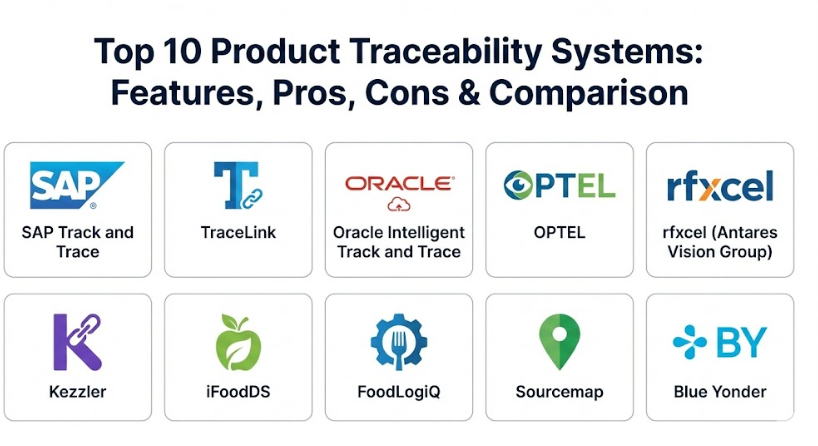
Top 10 Product Traceability Systems Tools
1 — SAP Track and Trace
SAP Track and Trace is a high-level solution built for large global companies that need to manage complex supply chains. It is designed to handle massive amounts of data and provide a clear view of where every single item is located across the globe.
Key features:
- Direct integration with SAP’s wider business software suite.
- Real-time monitoring of shipments and inventory levels.
- Serialization tools that give every single box its own unique ID.
- Automated alerts if a product moves to an unexpected location.
- Support for global standards like GS1 to ensure data works everywhere.
- Built-in tools for managing product recalls quickly and accurately.
Pros:
- It is extremely reliable and can handle millions of items without slowing down.
- Provides a very professional and audit-ready record for government inspectors.
Cons:
- The software is very expensive and is usually only for large corporations.
- It requires a lot of technical knowledge to set up and maintain correctly.
Security & compliance: Offers enterprise-grade security including SSO, data encryption, and full audit logs. It is designed to meet international standards such as ISO and GDPR.
Support & community: Extensive global support network, a massive library of documentation, and a very large community of professional users.
2 — TraceLink
TraceLink is a specialized platform focused primarily on the life sciences and pharmaceutical industries. It is designed to help companies follow the very strict laws regarding the tracking of medicine and medical devices.
Key features:
- Specialized modules for pharmaceutical serialization and compliance.
- A massive “network” approach that connects you to thousands of partners.
- Tools to verify that medicine is genuine to stop counterfeit goods.
- Automated reporting to government health agencies in different countries.
- Inventory monitoring to prevent medicine from expiring on the shelf.
- Secure data sharing between manufacturers, wholesalers, and hospitals.
Pros:
- It is the gold standard for the medicine industry and understands their specific laws.
- The “network” design makes it easy to connect with new suppliers.
Cons:
- It is very focused on healthcare, so it may not be a good fit for general manufacturing.
- The interface can feel a bit technical and crowded due to the amount of data.
Security & compliance: Highly secure with SOC 2 compliance and rigorous data privacy controls suitable for medical records and HIPAA standards.
Support & community: Provides dedicated onboarding for new partners and has a strong presence in the global pharmaceutical community.
3 — Oracle Intelligent Track and Trace
Oracle offers a cloud-based solution that focuses on providing “end-to-end” visibility. It uses modern technology like blockchain to ensure that the data recorded cannot be changed or tampered with by anyone.
Key features:
- Blockchain technology for a permanent and unchangeable record of events.
- Easy-to-use dashboards that show the entire supply chain on a map.
- Built-in templates for different industries like food or electronics.
- Integration with “Internet of Things” (IoT) sensors to track temperature or shock.
- Automated document verification to ensure all paperwork is correct.
- Tools for collaborating with partners on a shared digital platform.
Pros:
- The use of blockchain provides a very high level of trust between partners.
- It is a cloud-based tool, meaning you don’t need to manage your own servers.
Cons:
- Smaller partners in your supply chain might find it difficult to join the platform.
- The costs can grow quickly as you add more items and tracking points.
Security & compliance: Features high-level encryption and secure cloud infrastructure. It follows global standards for data residency and privacy.
Support & community: Offers 24/7 technical support and has a wide range of training materials available online.
4 — OPTEL
OPTEL provides a mix of hardware and software that is especially strong in the manufacturing and packaging industries. They are well-known for their “vision systems” that can scan products at very high speeds on a factory line.
Key features:
- High-speed cameras and scanners that integrate directly with the factory line.
- Software that records every scan and links it to a specific batch.
- Modules for tracking raw materials from the moment they arrive.
- Tools for calculating the carbon footprint and sustainability of products.
- Mobile apps for warehouse staff to scan items using their phones.
- Detailed reporting for quality control managers to spot defects.
Pros:
- It is great for companies that want to track items at the individual unit level.
- The company has a strong focus on environmental impact and sustainability.
Cons:
- Setting up the hardware (cameras and scanners) can be a big project.
- It is more focused on the “making” part of the journey than the “shipping” part.
Security & compliance: Provides secure data storage and follows ISO standards for manufacturing quality and data safety.
Support & community: Offers professional on-site installation and a dedicated customer success team.
5 — rfxcel (Antares Vision Group)
Now part of the Antares Vision Group, rfxcel is another leader in the world of serialization and tracking. They focus on data integrity, ensuring that the information in your system is 100% accurate at all times.
Key features:
- A “data validation” engine that checks for errors in real-time.
- Global compliance management for many different industries.
- Environmental monitoring to track if a product got too hot or too cold.
- Tools for protecting against theft and unauthorized “gray market” sales.
- Flexible integration with many different types of ERP software.
- Specialized portals for different types of users (suppliers vs. customers).
Pros:
- The focus on data accuracy means you can trust your reports during an audit.
- It is very flexible and can be customized for many different types of products.
Cons:
- The setup process can be slow because it is so detailed.
- The reporting tools can be complex for a first-time user to learn.
Security & compliance: Offers SOC 2 Type II certification and follows strict GDPR rules for protecting user information.
Support & community: Known for having a very responsive support team and offering deep technical expertise.
6 — Kezzler
Kezzler is a platform that specializes in “mass serialization.” They are designed for companies that make billions of items every year, such as soda bottles or snack packages, and want to track every single one of them.
Key features:
- High-speed generation of billions of unique digital IDs.
- Secure “cloud-only” architecture for easy access and scaling.
- Tools for customer engagement (e.g., a customer scans a code for a reward).
- Real-time visibility into where products are being scanned globally.
- Protection against fake or counterfeit products in the market.
- Very low “latency,” meaning the system responds almost instantly to a scan.
Pros:
- It is incredibly fast and can handle more items than almost any other tool.
- It combines marketing (customer scanning) with supply chain tracking.
Cons:
- It may be “overkill” for a company that only makes a few thousand items.
- It focuses mostly on the “ID” part of the process, not the full manufacturing steps.
Security & compliance: ISO 27001 certified and utilizes strong encryption to protect the unique IDs from being stolen.
Support & community: Provides excellent documentation and works closely with enterprise-level clients on custom projects.
7 — iFoodDS
iFoodDS is a specialized tool built specifically for the fresh produce and food industry. It is designed to help farmers, packers, and grocery stores ensure that food is fresh, safe, and tracked correctly.
Key features:
- Specialized forms for recording food safety checks in the field.
- Tools for tracking produce from the specific farm row it was picked from.
- Real-time monitoring of cooling and storage temperatures.
- Automated compliance with food safety laws (like FSMA).
- Digital records that replace messy and unreliable paper logs.
- Dashboard views for grocery buyers to see the quality of incoming food.
Pros:
- It speaks the language of the food industry and understands their unique needs.
- It is excellent for managing food safety risks and preventing large recalls.
Cons:
- It is not a good fit for companies that don’t deal with food or perishables.
- Field workers may need training on how to use the mobile apps correctly.
Security & compliance: Follows all major food safety regulations and provides secure storage for sensitive farm data.
Support & community: Offers training for workers in the field and has a deep understanding of agricultural supply chains.
8 — FoodLogiQ
FoodLogiQ is another leader in the food industry, but with a bigger focus on “quality management” and “supplier management.” It helps brands manage thousands of different suppliers to ensure they are all following the same rules.
Key features:
- A central portal where all your suppliers can upload their safety certificates.
- Automated workflows for investigating customer complaints or quality issues.
- Visualization tools that show your entire supplier network on a map.
- Standardized templates for reporting on different types of ingredients.
- Tools for managing the “social responsibility” of your suppliers.
- One-click recall management to notify everyone in the chain instantly.
Pros:
- It is one of the best tools for managing the relationship with your suppliers.
- The interface is very modern and much easier to use than older software.
Cons:
- Getting all of your suppliers to actually use the system can take a lot of work.
- Some of the more advanced features can be quite expensive.
Security & compliance: SOC 2 certified and designed to meet the highest standards of food safety and data privacy.
Support & community: Provides a wealth of webinars, white papers, and an active user community focused on food safety.
9 — Sourcemap
Sourcemap is a unique tool that focuses on the “map” part of the supply chain. It is used by companies to discover where their raw materials come from and to prove that they are being sourced ethically.
Key features:
- Deep supply chain “mapping” that can go back many levels to the original farm or mine.
- Tools for detecting risks such as child labor or deforestation in the supply chain.
- Automated surveys to gather information from small suppliers far away.
- Real-time alerts for disruptions like storms or strikes in your sourcing areas.
- Public-facing maps that show your customers where your products come from.
- Integration with satellite data to monitor environmental changes.
Pros:
- It is the best tool for companies that care deeply about “ESG” (Environmental and Social) goals.
- It provides a very clear visual picture that is easy to explain to executives.
Cons:
- It is less about “individual box tracking” and more about “supplier mapping.”
- Collecting data from very remote suppliers can still be a difficult challenge.
Security & compliance: Offers secure data collection and follows strict rules regarding the privacy of supplier information.
Support & community: Provides expert consulting to help companies map their supply chains for the first time.
10 — Blue Yonder
Blue Yonder provides a large “Supply Chain Management” suite that includes very strong traceability features. It is designed for retail and logistics companies that want to use AI to predict problems before they happen.
Key features:
- AI-driven insights that predict when a shipment might be late or lost.
- Tracking across multiple modes of transport (truck, ship, plane).
- Tools for managing “labor” and warehouse operations alongside inventory.
- Real-time “visibility” into the status of every order in the system.
- Integration with many different shipping and trucking companies.
- Automated decision-making to find the fastest way to move a product.
Pros:
- It is a very “smart” system that helps you save money by being more efficient.
- It is perfect for large retail brands with hundreds of stores.
Cons:
- It is a massive system that can be overwhelming for a small or medium business.
- The AI features require a lot of data and time to “learn” your business.
Security & compliance: Enterprise-level security with ISO and SOC certifications, and robust data protection for global operations.
Support & community: Offers 24/7 global support, a large user conference, and professional training certifications.
Comparison Table
| Tool Name | Best For | Platform(s) Supported | Standout Feature | Rating |
| SAP Track and Trace | Global Corporations | Web / Cloud / On-prem | Enterprise ERP Sync | 4.6 |
| TraceLink | Pharmaceuticals | Web / Cloud | Massive Partner Network | 4.7 |
| Oracle | Data Integrity | Web / Cloud | Blockchain-backed records | 4.5 |
| OPTEL | Fast Manufacturing | Web / Cloud / Hardware | High-speed Vision Systems | 4.4 |
| rfxcel | Data Accuracy | Web / Cloud | Data Validation Engine | 4.5 |
| Kezzler | High-Volume Items | Web / Cloud | Mass Serialization (Billions) | 4.6 |
| iFoodDS | Produce & Farmers | Web / Mobile | Field Safety Logs | 4.7 |
| FoodLogiQ | Supplier Management | Web / Cloud | Supplier Compliance Portal | 4.5 |
| Sourcemap | Ethical Sourcing | Web / Cloud | ESG & Deep Mapping | 4.4 |
| Blue Yonder | Retail & Logistics | Web / Cloud | AI-Driven Prediction | 4.3 |
Evaluation & Scoring of Product Traceability Systems
We have evaluated these tools based on a weighted scoring rubric. This helps you see which areas a tool excels in so you can choose based on what matters most to your specific business.
| Evaluation Category | Weight | Description |
| Core Features | 25% | Ability to track items at the unit, batch, or supplier level effectively. |
| Ease of Use | 15% | How simple it is for non-technical staff and partners to use the software. |
| Integrations | 15% | How well the tool talks to your existing ERP, machines, and partners. |
| Security & Compliance | 10% | Encryption, audit logs, and meeting industry laws (like FDA or FSMA). |
| Performance | 10% | Speed and reliability, especially when handling millions of data points. |
| Support & Community | 10% | Quality of documentation, customer service, and the size of the user base. |
| Price / Value | 15% | Balance between the cost of the system and the features it provides. |
Which Product Traceability Systems Tool Is Right for You?
Choosing the right tool is a big decision that depends on your company’s size, your industry, and your budget.
By Company Size
- Small to Medium Businesses (SMBs): If you are a growing business, you should look for tools that are easy to start with. FoodLogiQ or Cenozon are good choices because they don’t require a massive IT team. They are designed to be user-friendly from day one.
- Mid-Market: If you are a medium-sized manufacturer, rfxcel or OPTEL offer a great balance. They are powerful enough to handle a factory but flexible enough to change as you grow.
- Large Enterprises: Global giants should stick with SAP, Oracle, or Blue Yonder. These tools are built to handle the “weight” of a multi-billion dollar business and offer the highest levels of security and control.
By Industry
- Food & Beverage: You really need a tool that understands food safety. iFoodDS is perfect for farmers and produce, while FoodLogiQ is excellent for brands managing many suppliers.
- Pharmaceuticals & Healthcare: Don’t try to use a general tool. Stick with TraceLink or rfxcel. The laws in medicine are so strict that you need a specialist to keep you safe.
- Consumer Goods & Electronics: Kezzler is king if you make billions of items. OPTEL is great if you need to scan items on a very fast assembly line.
Budget vs. Premium
- Budget-Conscious: Cloud-based tools like Kezzler or FoodLogiQ often have more flexible pricing models. You can often start with a smaller plan and add features as you need them.
- Premium Solutions: SAP and Oracle are the “Rolls Royce” of the industry. You pay more, but you get a system that is trusted by every auditor in the world and can do almost anything.
Frequently Asked Questions (FAQs)
What is the difference between tracking and tracing?
Tracking is looking “forward” to see where a product is going (from the factory to the store). Tracing is looking “backward” to see where a product came from (from the store back to the farm). A good system does both.
Do I need a consultant to set up a traceability system?
For small systems, you can often do it yourself with help from the provider. For large enterprise systems like SAP, you will almost certainly need a professional consultant to ensure it is set up correctly.
Can these systems help me with sustainability?
Yes. Many modern tools like Sourcemap allow you to track the carbon footprint of your materials and prove that your suppliers are not damaging the environment or using unfair labor practices.
Is my data safe in a cloud-based traceability tool?
Leading providers use very strong security, including encryption and private servers. In many cases, your data is safer in their cloud than it would be on a single computer in your own office.
How long does it take to implement a new system?
A simple mobile-based system can be set up in a few weeks. A full factory integration with cameras and ERP connections can take six months to a year, depending on the complexity.
Can I track products at the “individual item” level?
Yes, this is called “serialization.” It involves giving every single unit its own unique code. This is common in medicine and luxury goods but is becoming more popular in food and electronics too.
What is blockchain, and do I need it for traceability?
Blockchain is a way of storing data so it can never be changed. While it is very secure and builds trust between partners, it is not “required” for every business. Standard secure databases are still fine for many companies.
Will my suppliers agree to use the same software?
This is the biggest challenge in traceability. Most successful companies require their suppliers to use the tool as part of their contract. Many tools offer “lite” versions to make it easier for small suppliers to join.
How do these systems help during a product recall?
Instead of calling every store, you can just search for the “batch number” in your software. It will tell you exactly which stores received that batch so you can contact only those locations instantly.
Can I use barcodes or do I need RFID?
Most systems work with both. Barcodes are cheap and easy, but RFID is faster because you can scan many items at once without “seeing” them. The software usually doesn’t care which one you use.
Conclusion
Choosing a product traceability system is an investment in the safety, honesty, and future of your business. In a world where customers and governments are demanding more information than ever before, being able to prove exactly where your products come from is a massive advantage. These tools help you move away from messy paperwork and “guessing” and move toward a clear, digital view of your entire operation.
The “best” tool for your company is the one that fits your specific industry and can grow along with you. There is no one-size-fits-all answer. A farmer needs different features than a medicine maker or a laptop manufacturer. Take your time to request demos, talk to your suppliers, and think about where you want your business to be in five years. By picking the right partner today, you are protecting your brand and ensuring that your customers can always trust the items you sell.