Introduction
Global Trade Management (GTM) systems are specialized software platforms that help businesses manage the complicated process of moving goods across international borders. Think of these systems as a digital command center for everything related to importing and exporting. They handle the “paperwork” of international trade, ensuring that a company follows the laws of every country it touches, calculates the correct taxes and duties, and tracks shipments as they move around the world.
These systems are important because international trade is full of risks. Without them, a company might accidentally ship goods to a restricted person, pay too much in customs fees, or have their cargo stuck at a port for weeks due to incorrect documentation. GTM systems automate these checks, saving time and preventing expensive legal trouble. Real-world use cases include screening customers against “denied party” lists, automatically classifying products with the right tariff codes, and managing free trade agreements to lower costs. When choosing a tool, you should look for accurate trade data, ease of integration with your current software, and how well it handles the specific regions where you do business.
Best for: Large manufacturers, global retailers, and logistics companies that ship high volumes of goods internationally. It is especially useful for compliance officers, supply chain managers, and finance teams in industries like electronics, automotive, and pharmaceuticals.
Not ideal for: Small businesses that only sell products locally or ship very rarely to just one or two countries. For these users, a simple shipping plugin or a third-party customs broker is usually a better and cheaper alternative.
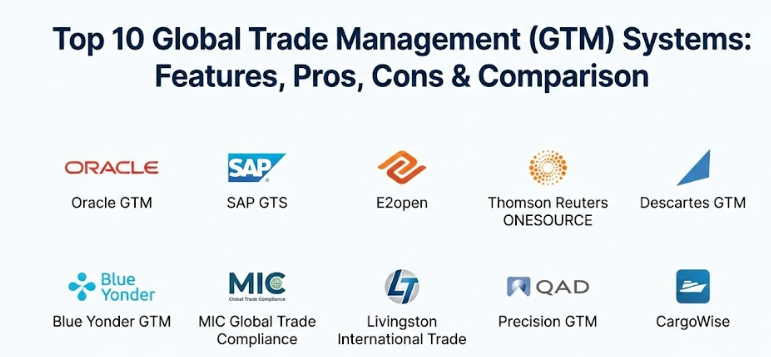
Top 10 Global Trade Management (GTM) Systems Tools
1 — Oracle Global Trade Management
Oracle provides a heavy-duty, cloud-based platform that is part of its larger supply chain suite. It is built for very large companies that need to manage high-volume global operations with extreme precision and visibility.
- Key features:
- Automated restricted party screening to check for blocked customers or partners.
- Centralized trade data repository for all legal and regulatory documents.
- Advanced product classification tools for multiple jurisdictions.
- Landed cost simulator to predict the total cost of an import.
- Real-time visibility into the compliance status of orders and shipments.
- Automated generation of export and import documents.
- Pros:
- Provides incredible visibility across the entire global supply chain.
- Highly scalable for the largest and most complex global enterprises.
- Cons:
- Can be very expensive and complex to set up initially.
- Requires a significant amount of training for the staff to use it effectively.
- Security & compliance: SOC 2 Type II, GDPR compliant, SSO support, and high-level data encryption.
- Support & community: Extensive enterprise support, detailed digital documentation, and a massive global network of partners.
2 — SAP Global Trade Services (GTS)
SAP GTS is the go-to choice for companies already using SAP as their main business software. it focuses on making international trade as automated and safe as possible by linking it directly to sales and shipping data.
- Key features:
- Seamless integration with other SAP business modules for data consistency.
- Automated customs processing for many different countries.
- Risk management tools to handle financial risks in international trade.
- Electronic compliance reporting for statistical reporting to authorities.
- Sanctioned party list screening integrated into the sales workflow.
- Management of free trade agreements to reduce duty costs.
- Pros:
- Eliminates manual data entry by pulling info directly from your ERP.
- Excellent at handling the specific regulatory needs of European and North American markets.
- Cons:
- Mostly beneficial only if you are already an SAP user.
- The user interface can feel stiff and “corporate” compared to newer apps.
- Security & compliance: ISO certifications, GDPR, SOC 1 and 2, and robust role-based access controls.
- Support & community: 24/7 global support, a huge professional user community, and certified implementation partners.
3 — E2open Global Trade Management
Formerly known as Amber Road, E2open offers a massive database of trade information called Global Knowledge. It is designed for companies that need the most up-to-date information on world trade laws.
- Key features:
- Access to an extensive database covering trade rules for over 200 countries.
- Proactive notifications when trade regulations change in your regions.
- Tools to manage preferential trade programs and duties.
- Automated import and export compliance checks.
- Supply chain visibility at the individual order and shipment level.
- Expert-led compliance services for companies that need extra help.
- Pros:
- The underlying trade data is updated daily by a team of experts.
- Very strong at helping companies find and use free trade agreements.
- Cons:
- Integrating it with non-standard business systems can be a challenge.
- The pricing model can be difficult to understand for smaller teams.
- Security & compliance: ISO 9001:2015 certified processes, SOC 2 compliance, and secure multi-tenant architecture.
- Support & community: Comprehensive onboarding, dedicated customer success teams, and professional consulting services.
4 — Thomson Reuters ONESOURCE Global Trade
ONESOURCE is a cloud-based tool that simplifies trade compliance while giving senior managers a “big picture” view of their global operations. It is particularly strong for tax and duty management.
- Key features:
- Automated screening against hundreds of global restricted party lists.
- Localized solutions for specific regions like Latin America and Asia-Pacific.
- Tools for duty optimization to find potential savings and high ROI.
- Integration with major software like SAP S/4HANA using standard APIs.
- Auditable logging and tracing for every transaction.
- Multi-tenant architecture with isolated and encrypted customer data.
- Pros:
- Excellent localized support for difficult regions like Brazil or China.
- Very strong focus on the financial and tax side of global trade.
- Cons:
- Might feel a bit too focused on tax for a logistics-heavy team.
- User interface can be complex for those not familiar with tax software.
- Security & compliance: Multi-layer encryption, SOC 2, and high-availability disaster recovery.
- Support & community: High-level enterprise support and translated documentation for global users.
5 — Descartes Global Trade Management
Descartes is known for its “CustomsInfo” content, which many other systems actually use. Their platform is built for speed and adaptability, making it a favorite for e-commerce and fast-moving shippers.
- Key features:
- Massive library of Harmonized Tariff Schedule (HTS) codes and export rules.
- AI-powered tools to reduce “false positives” during security screening.
- Real-time shipment tracking with proactive risk monitoring.
- Foreign Trade Zone (FTZ) management for duty deferral.
- Easy integration with e-commerce platforms and existing ERP systems.
- Automated manifest filings for customs authorities worldwide.
- Pros:
- The AI-assisted screening saves a lot of time by ignoring “fake” alerts.
- Very flexible; you can use just the data or the full software suite.
- Cons:
- The sheer amount of data can be overwhelming without a dedicated expert.
- Mobile experience is not as advanced as some competitors.
- Security & compliance: SOC 2 Type II, GDPR, and standard industrial encryption.
- Support & community: Excellent customer success stories, training videos, and a global help desk.
6 — Blue Yonder Global Trade Management
Blue Yonder focuses on using artificial intelligence to make the whole supply chain—from planning to delivery—run flawlessly. Their GTM tool is a part of this larger, smart network.
- Key features:
- AI-driven forecasting to help plan for potential trade disruptions.
- Multi-tier network visibility that shows every step of a product’s journey.
- Automated restricted party screening and export license management.
- Integrated logistics and warehouse management features.
- Flexible deployment options, including cloud or on-premises.
- Role-based access controls and detailed audit trails.
- Pros:
- Excellent for companies that want to use AI to predict future problems.
- The staff is known for being very professional and responsive.
- Cons:
- Reporting features can be somewhat limited compared to specialized tools.
- Setting up the advanced AI features requires a lot of data and effort.
- Security & compliance: SSO, MFA, SOC 2 compliance, and comprehensive audit logging.
- Support & community: Excellent customer service, boot camps for training, and an active user forum.
7 — MIC Global Trade Complianc
MIC is a specialized provider that caters to over 700 customers worldwide. It is a very “pure” trade compliance tool that focuses on automation and standardization across different countries.
- Key features:
- Global customs management for many different regions (North America, Europe, Asia).
- Automated origin calculation to see which free trade agreements apply.
- Intrastat reporting for trade within the European Union.
- Excise Movement and Control System (EMCS) for specific types of goods.
- Standardized processes that help a company grow into new markets.
- Direct electronic connections to many government customs systems.
- Pros:
- One of the best at handling the technical details of European customs laws.
- Very focused on “standardizing” trade so every office follows the same rules.
- Cons:
- The brand is smaller, so there are fewer third-party consultants for hire.
- Can feel a bit “niche” compared to the giant software suites.
- Security & compliance: ISO standards, GDPR, and secure data hosting in Europe.
- Support & community: Professional project management, dedicated support, and maintenance services.
8 — Livingston International Trade Management
Livingston is a bit different because they are a massive customs broker that also provides software. Their focus is on high-touch service and “outsourcing” your trade worries to their experts.
- Key features:
- Managed services where Livingston experts handle the trade work for you.
- Advanced analytics platform for global trade reporting and insights.
- Comprehensive trade consultancy for complex legal questions.
- Supplier audit programs to ensure your partners are following the rules.
- Training and education for your internal teams.
- Specialized support for North American trade (USMCA).
- Pros:
- Great for companies that want “experts on demand” rather than just a tool.
- Huge amount of experience in navigating government agencies.
- Cons:
- More of a “service” than a pure software product, which can be more expensive.
- May not be the best fit for companies that want to keep everything “in-house.”
- Security & compliance: Top-tier security audits and a clear, clean audit trail for every transaction.
- Support & community: Advisors on demand, localized knowledge in 40 major trading countries.
9 — QAD Precision Global Trade Management
QAD Precision is designed to bridge the gap between “shipping” and “compliance.” It is built for businesses that want their warehouses and their compliance teams to talk to each other.
- Key features:
- Seamless integration with Enterprise Resource Planning (ERP) systems.
- Real-time dashboards showing trade statistics and costs.
- Automated documentation that is specific to your customer’s needs.
- Cost calculations and third-party management options.
- Early detection of potential customs or documentation issues.
- Searchable trade history for easy reporting.
- Pros:
- Excellent for improving operational efficiency and cash flow.
- The visibility tools are very helpful for making quick business decisions.
- Cons:
- Success depends heavily on having very clean data to start with.
- Lacks some of the “AI” flair of the newer market leaders.
- Security & compliance: Standard enterprise encryption, audit logs, and SOC 2 compatibility.
- Support & community: Implementation services, professional blog for updates, and a dedicated help desk.
10 — CargoWise
CargoWise is a massive, cloud-based platform licensed for use in almost every country on earth. It is built specifically for logistics companies and freight forwarders who move goods for others.
- Key features:
- Licensed for use in 195 different countries, making it truly global.
- Built-in customs management for many different jurisdictions.
- Electronic connections to ports, port authorities, and carriers worldwide.
- Financial management tools including multi-currency billing and e-invoicing.
- Real-time shipment visibility for all partners in the supply chain.
- Highly automated workflows to reduce the need for manual data entry.
- Pros:
- The most “global” tool on the list with support for 30 different languages.
- Continuous updates (thousands of features added every few years).
- Cons:
- The customer service can be slow due to the massive size of the company.
- The learning curve is very steep because the system is so large.
- Security & compliance: Geo-compliance to protect sensitive data across borders and audit-ready traceability.
- Support & community: Large network of certified partners, comprehensive training portals, and global user groups.
Comparison Table
| Tool Name | Best For | Platform(s) Supported | Standout Feature | Rating |
| Oracle GTM | Global Enterprise | Cloud / Web | Landed Cost Simulator | N/A |
| SAP GTS | SAP User Bases | Cloud / On-Prem | Direct ERP Integration | N/A |
| E2open | Regulatory Data | Cloud / Web | 200+ Country Database | N/A |
| Thomson Reuters | Tax & ROI | Cloud / Web | Localized Latin America Support | N/A |
| Descartes | E-commerce/Speed | Cloud / Web | AI-Powered Screening | N/A |
| Blue Yonder | AI Forecasting | Cloud / On-Prem | Multi-Tier AI Network | N/A |
| MIC Compliance | Standardization | Cloud / Web | Europe-Specific Customs | N/A |
| Livingston | Expert Outsourcing | Web / Service | Human Expert Advisory | N/A |
| QAD Precision | Warehouse Sync | Web / On-Prem | Order-to-Settlement View | N/A |
| CargoWise | Freight Forwarding | Cloud / Web | 195 Country Coverage | N/A |
Evaluation & Scoring of Global Trade Management (GTM) Systems
To help you decide, we have scored these tools based on a weighted rubric. This shows where each tool really shines.
| Category | Weight | Oracle | SAP GTS | E2open | Descartes | CargoWise |
| Core Features | 25% | 10/10 | 9/10 | 9/10 | 9/10 | 10/10 |
| Ease of Use | 15% | 6/10 | 6/10 | 7/10 | 8/10 | 5/10 |
| Integrations | 15% | 9/10 | 10/10 | 8/10 | 9/10 | 9/10 |
| Security | 10% | 10/10 | 10/10 | 9/10 | 9/10 | 10/10 |
| Performance | 10% | 10/10 | 9/10 | 9/10 | 10/10 | 9/10 |
| Support | 10% | 9/10 | 9/10 | 8/10 | 8/10 | 6/10 |
| Price / Value | 15% | 7/10 | 7/10 | 8/10 | 9/10 | 8/10 |
Which Global Trade Management (GTM) Systems Tool Is Right for You?
Choosing the right system is a big commitment. Here is a quick guide to help you narrow down your list.
By Company Size
If you are a small to mid-sized business (SMB), look for tools that are easier to set up, like Descartes or QAD Precision. These are more flexible and won’t require a whole team of experts just to install. Mid-market companies often find a great balance in E2open or MIC, as they offer professional-level data without being as “heavy” as the giant ERP modules. For a global enterprise, there is really no substitute for Oracle GTM, SAP GTS, or CargoWise, as they are built to handle thousands of shipments a day.
Budget vs. Premium Solutions
If you are budget-conscious, look for systems with “pay-as-you-go” models or those that focus on specific tasks like restricted party screening. Descartes and Greenly are often more affordable for growing teams. If you want a premium solution and have the budget to match, SAP GTS and Oracle provide the highest level of automation and security that money can buy.
Feature Depth vs. Ease of Use
If you need feature depth—like managing complex free trade agreements in 50 different countries—you should expect a steeper learning curve. CargoWise and SAP are very deep but hard to learn. If you want ease of use, Descartes and Thomson Reuters have invested more in modern, friendly web interfaces that are easier for a new hire to understand.
Integration and Scalability Needs
Always start with what you already have. If you are an “SAP shop,” it almost always makes sense to use SAP GTS. If you use many different systems across your warehouses, a “system-agnostic” tool like E2open or Descartes is better. If you plan to grow very fast into many new countries, CargoWise is the most scalable because it is already set up for almost every country in the world.
Frequently Asked Questions (FAQs)
1. What is a “denied party” list?
This is a list of individuals, companies, or groups that governments have banned from doing business. GTM systems automatically check your customers against these lists to make sure you don’t accidentally ship to them, which could result in huge fines.
2. Can these tools help me pay less in taxes?
Yes. Many systems help you manage Free Trade Agreements (FTAs). By correctly proving where your goods were made, the software can help you qualify for lower or zero duty rates, which saves your company a lot of money.
3. How long does it take to set up a GTM system?
A simple, cloud-based tool can be running in a few weeks. However, a major enterprise system that connects to all your warehouses and factories can take six months to a year to be fully set up.
4. Will this software replace my customs broker?
Not necessarily. A GTM system gives you the tools to do much of the work yourself, but many companies still use a broker for the most complex local laws. However, using the software usually makes your broker much faster and cheaper.
5. Do these systems work for all countries?
The top-tier tools like CargoWise and E2open cover over 200 countries. Some smaller tools might focus only on North America or Europe, so always check the “country coverage” before you buy.
6. Can a GTM system track my ocean freight?
Many GTM systems, like Oracle and Descartes, include tracking features. They can tell you where your container is on the ocean and alert you if there is a delay at the port.
7. Is my trade data safe in the cloud?
Yes. Professional GTM tools use enterprise-grade encryption and security protocols like SOC 2. Your trade secrets and customer lists are kept behind multiple layers of digital protection.
8. What is “Landed Cost”?
Landed cost is the total price of a product once it reaches your warehouse, including the original price, shipping, insurance, taxes, and customs duties. GTM systems help you calculate this before you even buy the product.
9. Do I need to be an expert to use this software?
You don’t need to be a lawyer, but you do need to understand the basics of shipping and trade. Most companies designate a “super-user” who receives extra training to manage the system for everyone else.
10. Can these tools help with “environmental” reporting?
Many modern GTM tools are starting to include features to track the carbon footprint of shipments, helping companies meet new “green” laws and sustainability goals.
Conclusion
Choosing a Global Trade Management (GTM) system is one of the most important decisions a global company can make. It is the difference between a smooth, profitable supply chain and a messy, high-risk operation. The “best” tool isn’t always the one with the most buttons or the highest price; it is the one that fits your current volume, your existing software, and your team’s skill level.
Remember that the goal of these tools is to give you peace of mind. By automating the difficult and boring parts of trade compliance, you free up your team to focus on growing your business. Whether you choose the massive power of Oracle, the expert advisory of Livingston, or the global reach of CargoWise, moving to a professional GTM system is a major step toward a more successful future.