Introduction
Materials informatics platforms are specialized software tools that help scientists and engineers find new materials—like better plastics, stronger metals, or longer-lasting batteries—using data and computer models. In the past, creating a new material required years of “trial and error” in a laboratory. A scientist would mix chemicals, wait for a result, and try again if it failed. These platforms change that by using artificial intelligence and big data to predict how a material will behave before it is even made.
A Materials Informatics Platform is essentially a digital brain for chemistry and manufacturing. These tools take all the data from past experiments, scientific papers, and computer simulations and organize them. Then, they use smart programs to spot patterns that a human might miss. This helps researchers narrow down thousands of possibilities to just the few that are most likely to work.
These tools are important because the world needs better materials faster than ever. Whether we are trying to build electric vehicle batteries that charge in minutes or aircraft parts that are lighter and stronger, we cannot afford to wait decades for a lucky discovery. By using data, companies can save millions of dollars in laboratory costs and bring products to market much sooner.
Key Real-World Use Cases
- Battery Design: Finding new chemical mixes that hold more energy without catching fire.
- Sustainable Packaging: Creating biodegradable plastics that are just as strong as traditional oil-based ones.
- Alloy Development: Mixing different metals to create parts for jet engines that can handle extreme heat.
- Chemical Discovery: Finding new catalysts that make industrial processes faster and cleaner.
Choosing the Right Platform
When looking for a platform, you should check if it can handle “dirty data”—which means information that might be missing pieces or looks messy. You should also look for how easy it is to use for people who are not computer programmers. A good tool should allow a chemist to use artificial intelligence without needing to write code.
Best for: Research and development (R&D) teams, materials scientists, and product engineers in the automotive, aerospace, chemical, and electronics industries. It is ideal for mid-sized to large companies that have a lot of historical experiment data they want to use.
Not ideal for: Small businesses that do not do their own research or companies that only use standard, off-the-shelf materials without ever trying to improve them.
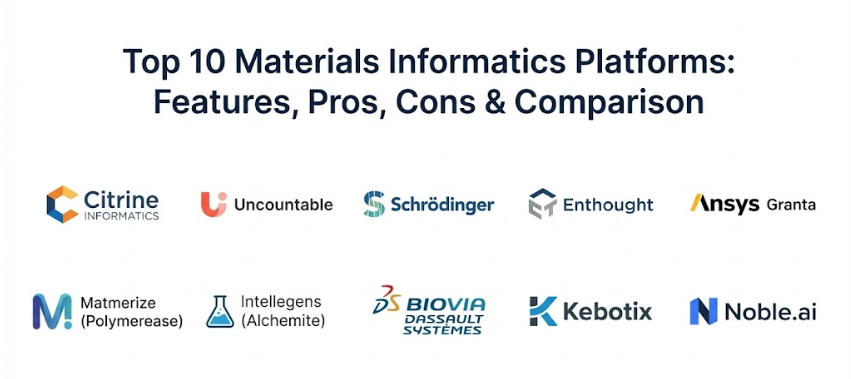
Top 10 Materials Informatics Platforms Tools
1. Citrine Informatics
Citrine Informatics is a leading platform that focuses on “data-driven” material discovery. It is designed to help companies use their own experimental data to build models that predict the properties of new chemical formulas. It is used by some of the biggest chemical and metal companies in the world to speed up their research.
- Key Features:
- AI models that work even when you only have a small amount of data.
- A central place to store all company research so it isn’t lost in old notebooks.
- Graphical tools that let scientists visualize how different ingredients affect the final product.
- Automated workflows that suggest which experiment to run next.
- The ability to combine physical laws with machine learning for more accurate results.
- Tools for “uncertainty quantification,” which tells you how much the AI trusts its own guess.
- Pros:
- Excellent at making sense of small, messy datasets common in chemistry.
- Very strong collaborative features that let teams across the world work together.
- Cons:
- The platform can be expensive for smaller research groups.
- It requires a good amount of initial setup to organize old data properly.
- Security & compliance: Offers SSO, data encryption at rest and in transit, and is SOC 2 compliant.
- Support & community: High-quality onboarding, dedicated customer success managers, and extensive technical documentation.
2. Uncountable
Uncountable provides a platform that looks and feels like a very smart spreadsheet combined with a powerful database. It is designed specifically for teams that work in laboratories. It replaces old-fashioned lab notebooks and helps scientists track every version of a formula they create.
- Key Features:
- A structured database that records every ingredient and measurement in an experiment.
- Real-time charts that update as soon as a scientist enters new data.
- Search tools that let you find any experiment run by anyone in the company.
- Predictive tools that suggest how to tweak a formula to reach a target goal.
- Inventory management to keep track of the chemicals currently in the lab.
- Automatic report generation for sharing results with managers.
- Pros:
- Very easy to learn for people who are used to working in Excel.
- Helps eliminate “silos” where different teams don’t know what others are doing.
- Cons:
- Not as focused on deep physics simulations as some other platforms.
- Customizing the data entry fields can take some time during the first week.
- Security & compliance: Encryption, granular user permissions, and audit logs for every change made.
- Support & community: Direct access to support engineers and a helpful online training portal.
3. Schrödinger
Schrödinger is a giant in the world of “computational chemistry.” While other tools focus mostly on data from the lab, Schrödinger focuses on physics. It simulates how atoms and molecules move and stick together. It is widely used in both drug discovery and materials science.
- Key Features:
- Atomic-scale simulations that show how molecules interact.
- Predictive modeling for mechanical, optical, and electrical properties.
- A massive library of chemical structures to use as a starting point.
- High-performance computing that can run thousands of simulations at once.
- Tools for studying polymers, thin films, and surfaces.
- Visual 3D modeling of molecular structures.
- Pros:
- The ability to test a material before even stepping into a lab.
- Decades of scientific research baked into the software algorithms.
- Cons:
- It has a very steep learning curve and usually requires a PhD to use effectively.
- Requires a lot of computer power (hardware) to run the complex simulations.
- Security & compliance: Enterprise-level security, SSO integration, and ISO certifications.
- Support & community: Global team of scientific experts, annual user meetings, and deep academic ties.
4. Enthought
Enthought is unique because they don’t just give you a piece of software; they help you build a custom platform for your specific needs. They focus on “digital transformation,” helping traditional science companies move their entire workflow into a data-driven environment.
- Key Features:
- Custom-built AI tools designed for specific materials like polymers or oils.
- Training for scientists to learn how to use Python and data science.
- Data cleaning services to help move old paper records into a digital system.
- Visualization dashboards that help managers see the progress of R&D.
- Open-source integration, allowing teams to use the latest free scientific tools.
- Cloud-based or on-site installation options.
- Pros:
- You get a tool that is perfectly fit for your specific business.
- They help teach your staff new skills, which is a long-term benefit.
- Cons:
- Because it is often custom, it can take longer to get started.
- The cost can be high due to the amount of expert consulting involved.
- Security & compliance: Varies based on the custom setup; typically includes encryption and secure access.
- Support & community: Very high-touch support, custom training sessions, and a professional services team.
5. Ansys Granta
Ansys Granta is often considered the gold standard for “material intelligence.” It is essentially a massive, professional library of information on every material known to man. It helps engineers choose the right material for a product based on cost, weight, and environmental impact.
- Key Features:
- A massive database of over 4,000 different types of materials.
- Tools for choosing materials that are eco-friendly and follow regulations.
- Integration with design software (CAD) so engineers can test parts digitally.
- Management tools for a company’s own “secret” material data.
- Comparison charts that show how materials perform against each other.
- Cost-estimation tools based on current market prices.
- Pros:
- The data is incredibly accurate and trusted by engineers worldwide.
- Excellent for making sure materials follow laws like GDPR or chemical safety rules.
- Cons:
- It is more of a library than an “AI discovery” tool.
- The interface can feel a bit old-fashioned and technical.
- Security & compliance: SOC 2, ISO 27001, and very strict internal data controls.
- Support & community: Large user community, global support offices, and university programs.
6. Matmerize (Polymerease)
Matmerize is a newer company that focuses specifically on polymers (plastics) and chemicals. Their platform, called Polymerease, is designed to be very fast and easy for chemists who want to use AI to find new plastic formulas without being computer experts.
- Key Features:
- Instant property prediction for new polymer structures.
- A “virtual laboratory” where you can mix ingredients on screen.
- Automatic suggestion of the best ingredients to reach a goal.
- Easy data uploading from spreadsheets.
- Specialized models for heat resistance, flexibility, and strength.
- A clean, modern web interface that works in a browser.
- Pros:
- Very fast and focused specifically on the needs of the plastics industry.
- The interface is very simple and does not require a lot of training.
- Cons:
- Not suitable for things like metals or ceramics (it’s for polymers).
- The company is smaller, so it may have fewer features than the giants.
- Security & compliance: Uses secure cloud hosting and data encryption.
- Support & community: Direct support from the founding scientists and online guides.
7. Intellegens (Alchemite)
Intellegens has a special technology called Alchemite. This tool is famous for its ability to find patterns in data that is “sparse”—which means there are a lot of missing entries. This is very common in science, where a researcher might have measured the weight of a material but forgot to measure its color.
- Key Features:
- Unique AI that “fills in the blanks” for missing data points.
- Rapid modeling that takes minutes instead of days.
- Integration with existing laboratory software.
- Tools for optimizing the manufacturing process, not just the material.
- A simple dashboard for running “what if” scenarios.
- API access for advanced users to build their own tools.
- Pros:
- The best tool if you have old data that is messy or incomplete.
- It is very fast and doesn’t require a lot of computer power.
- Cons:
- The interface is a bit more basic than some of the larger platforms.
- It requires some understanding of data science to get the best results.
- Security & compliance: GDPR compliant and uses standard data encryption.
- Support & community: Responsive technical team and a growing user base in the UK and Europe.
8. Dassault Systèmes (BIOVIA)
BIOVIA is a massive enterprise platform that handles everything from the first idea in the lab to the final product on the factory floor. It is part of the Dassault Systèmes family, which is famous for its engineering software used by car and plane makers.
- Key Features:
- An end-to-end “digital thread” that connects research to manufacturing.
- Collaborative lab notebooks that work on tablets and computers.
- Advanced simulation tools for biology, chemistry, and materials.
- Tools for managing regulatory compliance and safety data sheets.
- A massive ecosystem of other software that it can talk to.
- Predictive analytics for quality control on the assembly line.
- Pros:
- The most complete system for a very large company.
- It makes it easy to move a material from the lab to a real product.
- Cons:
- It is very expensive and very complex to install.
- Smaller teams will likely find it has far more features than they need.
- Security & compliance: Industry-leading security, ISO certified, and HIPAA/GDPR ready.
- Support & community: Massive global support network, certified training partners, and user groups.
9. Kebotix
Kebotix focuses on the “Self-Driving Lab.” Their platform uses AI to not only predict new materials but also to control the robots in the lab. It is designed to create a loop where the computer predicts a material, a robot makes it, the computer learns from the result, and tries again.
- Key Features:
- AI-driven “Brain” that manages the research process.
- Automation tools that can connect to lab hardware and robots.
- Special focus on green chemistry and sustainable materials.
- Cloud-based platform for managing remote labs.
- Predictive models for electronic materials and chemicals.
- Tools for optimizing chemical reactions to use less energy.
- Pros:
- The closest thing to a fully automated discovery system.
- Very forward-thinking approach that saves a massive amount of human time.
- Cons:
- Requires a lot of expensive lab robotics to get the full benefit.
- Still a relatively new company compared to some of the others.
- Security & compliance: Encryption and secure cloud access controls.
- Support & community: Expert team available for consulting and technical setup.
10. Noble.ai
Noble.ai focuses on what they call “Science-Based AI.” Many AI programs just look for patterns in numbers, but Noble.ai builds the laws of science (like gravity or heat) directly into the AI. This means the computer won’t suggest something that is physically impossible.
- Key Features:
- “Science-infused” machine learning for more realistic predictions.
- Rapid data ingestion that works with many different file types.
- A clean dashboard that shows “Digital Twins” of products.
- Tools for reducing the number of physical experiments needed.
- Ability to predict how a product will age or wear out over time.
- Easy integration with existing data storage systems.
- Pros:
- The results are much more likely to be physically possible than standard AI.
- Very fast at processing large amounts of complex information.
- Cons:
- Focuses more on the “product” level than the “atomic” level.
- Can be difficult to understand how the AI reached its conclusion.
- Security & compliance: Enterprise-grade security and SOC 2 compliance.
- Support & community: Professional onboarding and a team of science-focused account managers.
Comparison Table
| Tool Name | Best For | Platform(s) Supported | Standout Feature | Rating |
| Citrine Informatics | R&D Data Management | Cloud (SaaS) | AI for small/messy data | 4.8/5 |
| Uncountable | Laboratory Workflow | Cloud (SaaS) | Spreadsheet-like lab database | 4.7/5 |
| Schrödinger | Physics-based tests | Windows, Linux, Cloud | Atomic-scale simulations | 4.9/5 |
| Enthought | Custom AI builds | Cloud, On-Premise | Custom scientific consulting | 4.5/5 |
| Ansys Granta | Material Selection | Windows, Cloud | Massive material library | 4.8/5 |
| Matmerize | Plastics & Polymers | Cloud (SaaS) | Polymer-specific AI models | 4.4/5 |
| Intellegens | Missing/Sparse Data | Cloud (SaaS) | “Alchemite” fill-in-the-blanks | 4.6/5 |
| BIOVIA (Dassault) | Global Enterprises | Cloud, On-Premise | End-to-end digital thread | 4.7/5 |
| Kebotix | Automated Labs | Cloud (SaaS) | AI for robotic labs | 4.3/5 |
| Noble.ai | Realistic Products | Cloud (SaaS) | Science-infused machine learning | 4.6/5 |
Evaluation & Scoring of Materials Informatics Platforms
We have evaluated these tools based on a specific weighted scoring rubric to help you decide which one fits your needs.
| Criteria | Weight | What it measures |
| Core features | 25% | Ability to store data, run models, and predict properties. |
| Ease of use | 15% | Can a regular scientist use it without writing code? |
| Integrations | 15% | Does it work with lab hardware, Excel, and CAD software? |
| Security & compliance | 10% | Is the data safe? Does it follow laws like SOC 2 or GDPR? |
| Performance | 10% | How fast are the simulations and the user interface? |
| Support & community | 10% | Is there a human to call? Is the documentation clear? |
| Price / value | 15% | Does the cost justify the time and money saved in the lab? |
Which Materials Informatics Platforms Tool Is Right for You?
Selecting the right platform is a big decision that depends on your company size, your budget, and what you are trying to build.
Solo Users vs SMB vs Mid-Market vs Enterprise
If you are a solo researcher or a very small team, you might not need a massive platform. Tools like Intellegens or Matmerize are great because they are focused and fast. For a mid-market company that wants to organize its lab, Uncountable is a perfect choice because it helps you move away from paper notebooks without a massive price tag. Global enterprises will likely want BIOVIA or Citrine Informatics because these tools are designed to hold millions of data points and work across many different countries.
Budget-Conscious vs Premium Solutions
If you are on a tight budget, look for tools that offer “SaaS” (Software as a Service) pricing, where you pay a monthly fee. Uncountable and Matmerize are often more accessible. If you have a large budget and need the highest level of scientific accuracy, Schrödinger or Ansys Granta are premium solutions that provide data and simulations you cannot get anywhere else.
Feature Depth vs Ease of Use
There is usually a trade-off: the more powerful a tool is, the harder it is to learn. Schrödinger can do almost anything at the atomic level, but it is very difficult to master. Uncountable is much easier to use but doesn’t do the deep physics simulations. Think about who will be using the tool every day. If they are chemists who just want to find a better formula, go for ease of use. If they are computational physicists, go for feature depth.
Frequently Asked Questions (FAQs)
1. What is materials informatics?
It is the use of data science and artificial intelligence to find, test, and improve new materials much faster than traditional laboratory methods.
2. Can these tools replace a real scientist?
No. These tools are like a “super-calculator” for scientists. They suggest what might work, but a human scientist is still needed to design the experiments and make the final decisions.
3. Do I need to be a programmer to use these?
Most modern platforms like Uncountable or Citrine are designed for scientists, not programmers. They use simple dashboards and buttons rather than complex code.
4. What kind of data do I need to start?
You can start with your old laboratory notebooks, spreadsheets, or even data from scientific papers. Some tools like Ansys Granta provide their own data for you to use.
5. How much time can these platforms save?
Some companies report that they can find a new material in months instead of years, often reducing the time spent on R&D by 50% or more.
6. Is my data safe if it’s in the cloud?
Yes, professional platforms use high-level encryption and security standards like SOC 2 to ensure that your “secret formulas” stay private and safe from competitors.
7. Can these tools help with sustainability?
Absolutely. Many companies use these platforms specifically to find materials that are non-toxic, recyclable, or use less energy to produce.
8. What is “sparse data”?
In science, data is often sparse when some measurements were taken but others were missed. Tools like Intellegens are designed to handle this specific problem.
9. Can these tools predict how a material will fail?
Yes, many platforms can simulate “stress tests” to see when a material will crack, melt, or wear out before you ever build a real part.
10. How much do these platforms cost?
The price varies based on the number of users and the amount of data. Most companies do not list prices on their websites and require a conversation with their sales team for a custom quote.
Conclusion
Materials informatics platforms are changing the way we build the world. By taking the power of data and artificial intelligence and putting it into the hands of scientists, these tools are making the impossible possible. Whether it’s a lighter car door, a more efficient solar cell, or a plastic that doesn’t pollute the ocean, the next great discovery will likely come from a data-driven platform.
When choosing a platform, remember that there is no single winner. The best tool is the one that fits your specific science and your specific team. If you are working with plastics, a polymer tool is best. If you are a global manufacturer, an enterprise system is likely the right move. By starting with your data and a clear goal, you can pick a partner that will help you innovate faster and stay ahead of the competition.