Introduction
In the world of semiconductor manufacturing, precision is everything. Every wafer that passes through a fabrication plant (fab) undergoes hundreds of complex steps, and even a tiny error can lead to a massive loss in yield. This is where a Manufacturing Execution System (MES) for factory automation comes in. Think of it as the central nervous system of a semiconductor plant. It bridges the gap between the high-level business planning systems and the actual machinery on the floor.
A semiconductor-specific MES doesn’t just track data; it orchestrates the entire production flow. It ensures that the right recipe is applied to the right wafer at the right time. In an industry where “time to market” and “yield” are the two most important words, having a robust MES is no longer optional—it is a requirement for survival. From managing “paperless” cleanrooms to automating the transport of material through Overhead Hoist Transport (OHT) systems, these tools are what allow modern chips to be built at scale.
Introduction to Factory Automation MES for Semiconductors
Factory Automation MES in the semiconductor industry is a specialized software layer designed to manage and monitor the highly complex production lifecycle of chips. Unlike a general-purpose MES, a semiconductor version must handle specific challenges like wafer-level traceability, recipe management, and integration with SECS/GEM communication protocols.
Why is it Important?
Semiconductor fabrication is one of the most capital-intensive industries on earth. A single modern fab can cost billions of dollars to build. The MES is vital because it maximizes the return on that investment by reducing cycle times, preventing human errors, and ensuring high-quality output. It provides real-time visibility so managers can see bottlenecks as they happen, rather than finding out about them days later when a batch is ruined.
Key Real-World Use Cases
- WIP Tracking: Real-time tracking of “Work in Progress” (WIP) as lots move through different tools.
- Recipe Enforcement: Ensuring that a machine only starts a process if the correct recipe is loaded for that specific batch.
- Quality & Compliance: Automatically collecting metrology data to ensure everything stays within “Statistical Process Control” (SPC) limits.
- Maintenance Synchronization: Automatically halting production on a tool that is due for maintenance to prevent equipment damage.
What to Look For (Evaluation Criteria)
When choosing a tool, you should look for several key factors:
- Scalability: Can it handle hundreds of thousands of wafer starts per month?
- Integration: How easily does it connect to your existing Equipment Automation (EA) and ERP systems?
- Configurability: Can you change workflows without writing thousands of lines of code?
- Real-time Performance: In a high-speed fab, a delay of even a few seconds in data processing can slow down the entire line.
Best for: Large-scale semiconductor foundries, IDMs (Integrated Device Manufacturers), and assembly and test facilities. It is ideal for operations managers, automation engineers, and quality assurance teams who need perfect traceability and high throughput.
Not ideal for: Very small research labs or prototype shops that only process a few wafers a week. In those cases, the overhead of setting up a full MES might outweigh the benefits. Simple tracking spreadsheets or basic lab management software might be better alternatives for low-volume, non-automated environments.
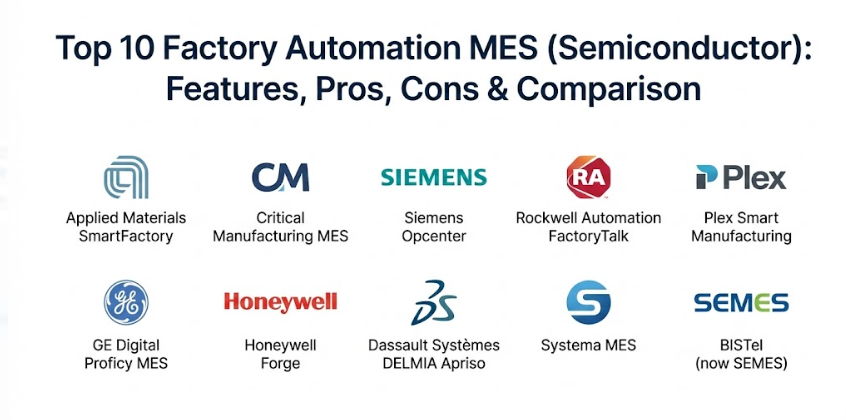
Top 10 Factory Automation MES (Semiconductor) Tools
1 — Applied Materials SmartFactory FAB300
Applied Materials is a giant in the semiconductor world, and their FAB300 system is designed specifically for high-volume 300mm wafer fabrication. It is built to serve as the backbone for fully automated “lights-out” manufacturing.
Key Features:
- Configurable Workflow Engine: Allows users to change business processes in days rather than months.
- High-Volume Support: Proven to handle over 300,000 wafer starts per month.
- Native Equipment Integration: Deep integration with fab tools using industry-standard protocols.
- Near-Zero Downtime: Supports rolling upgrades to keep the factory running 24/7.
- Advanced Dispatching: Smartly prioritizes lots to reduce wait times at critical machines.
- Full Genealogy: Tracks the history of every wafer from start to finish for perfect quality audits.
Pros:
- Incredibly stable and trusted by the world’s largest chipmakers.
- Designed by people who also build the actual fabrication machines, leading to better harmony.
Cons:
- Extremely expensive and usually requires a large team for implementation.
- Can be very complex to customize for unique, non-standard processes.
Security & compliance:
Offers enterprise-level security with detailed audit logs and role-based access. It complies with major global semiconductor safety and data standards.
Support & community:
Provides 24/7 global enterprise support and has a massive community of expert consultants and engineers.
2 — Critical Manufacturing MES for Semiconductors
Critical Manufacturing offers a modern, Industry 4.0-ready MES that has gained a lot of popularity for its flexibility and ease of use compared to older legacy systems.
Key Features:
- Modular Architecture: You can start with basic modules and add advanced features as you grow.
- Digital Twin Integration: Provides a 3D visual representation of the shop floor in real-time.
- SEMI E142 Support: Native support for substrate mapping standards used in the industry.
- Adaptive Scheduling: Automatically adjusts the schedule when a machine breaks down or a priority changes.
- Advanced IoT Data Platform: Collects massive amounts of sensor data for deep analysis.
- Cloud or On-Premise: Can be deployed in the cloud, on-site, or as a hybrid of both.
Pros:
- Much more user-friendly and visually intuitive than older “green-screen” systems.
- Fast implementation times for a system of its complexity.
Cons:
- As a newer platform, it may lack some of the niche legacy features of older competitors.
- Requires a strong internal IT team to manage the advanced data platform.
Security & compliance:
Includes SSO integration, high-level encryption, and is built to be GDPR and ISO compliant.
Support & community:
Offers extensive online documentation, a dedicated training university, and responsive global support teams.
3 — Siemens Opcenter Execution Semiconductor
Formerly known as Camstar, this tool is one of the most widely used MES solutions in the world for both wafer fab and assembly/test operations. It is known for its robustness and ability to handle high complexity.
Key Features:
- End-to-End Traceability: Tracks components from raw silicon through to the final packaged chip.
- Paperless Manufacturing: Replaces all manual logs with electronic travelers and records.
- Mass Customization: Handles high-mix production where every batch might be slightly different.
- Yield Monitoring: Provides real-time feedback on how many chips are passing or failing.
- Built-in Quality Gates: Prevents a lot from moving to the next step if it hasn’t passed previous tests.
- Modular Extensions: Easily adds modules for material management or advanced scheduling.
Pros:
- Very powerful for “High-Mix, Low-Volume” environments as well as high-volume fabs.
- Integrates perfectly with the wider Siemens industrial software ecosystem.
Cons:
- The interface can feel a bit dated and sometimes requires many clicks for simple tasks.
- Upgrading to newer versions can be a long and costly project.
Security & compliance:
Highly secure with SOC 2 readiness, detailed audit trails, and compliance with FDA (for medical chips) and ISO standards.
Support & community:
Extremely mature support network with thousands of certified engineers worldwide and deep technical forums.
4 — Rockwell Automation FactoryTalk ProductionCentre
Rockwell Automation is a leader in industrial control, and their FactoryTalk MES provides a strong bridge between the factory machines and the business office.
Key Features:
- PLC Integration: Unmatched connectivity with Rockwell’s own machine controllers.
- Performance Analytics: Provides clear dashboards for Overall Equipment Effectiveness (OEE).
- Asset Monitoring: Tracks the health of every motor and sensor to predict when they might fail.
- Scalable Architecture: Works for a single production line or a global network of factories.
- Recipe Management: Securely stores and deploys machine settings to prevent errors.
- Quality Management: Built-in tools for tracking defects and managing scrap.
Pros:
- If your factory uses Rockwell hardware, this software integrates more smoothly than anything else.
- Excellent at providing high-level business intelligence for executives.
Cons:
- Can be very expensive to license all the different modules you might need.
- Less “out-of-the-box” semiconductor specific features than FAB300 or Critical Manufacturing.
Security & compliance:
Strong security features including encryption, SSO support, and compliance with NERC CIP and other standards.
Support & community:
Huge global presence with 24/7 phone support and a massive network of local service providers.
5 — Plex Smart Manufacturing Platform
Plex (now part of Rockwell) is a cloud-native platform that combines MES, ERP, and quality management into a single system. It is popular for smaller to medium semiconductor companies.
Key Features:
- Cloud-First Design: No need to manage your own servers or hardware on-site.
- Unified System: Combines production data with financial and inventory data.
- Real-Time Visibility: See exactly what is happening in the factory from any web browser.
- Supply Chain Tracking: Tracks materials from suppliers all the way to the customer.
- Quality SPC: Built-in statistical process control to keep production within limits.
- Subscription Model: Pay as you go, which reduces the huge upfront cost of software.
Pros:
- Very fast to get up and running compared to traditional on-premise systems.
- Simplifies the IT landscape by combining many different tools into one.
Cons:
- Being cloud-only can be a risk for factories with unstable internet connections.
- May not be powerful enough for the most complex 300mm “Mega-Fabs.”
Security & compliance:
Fully SOC 2 compliant, uses modern cloud encryption, and meets GDPR requirements.
Support & community:
Provides solid online support and has an active “Plex Community” where users share ideas.
6 — GE Digital Proficy MES
GE Digital provides a very powerful and data-heavy MES that is used by manufacturers who need to crunch massive amounts of information to optimize their yield.
Key Features:
- Microservices Architecture: Makes the system very stable and easier to update in small pieces.
- No-Code Configuration: Allows engineers to build dashboards and workflows without being programmers.
- Enterprise Scale: Designed to manage many different factories from a single central office.
- Advanced Analytics: Includes AI tools to find the root cause of production problems.
- Zero-Downtime Upgrades: Designed so the factory never has to stop for a software update.
- Quality Enforcement: Automatically locks machines if quality standards are not met.
Pros:
- Excellent for organizations that want to move away from custom-coded legacy systems.
- Very strong analytical tools for improving yield and efficiency.
Cons:
- The licensing model can be confusing and lead to unexpected costs.
- Requires a good amount of training for operators to use the full range of features.
Security & compliance:
Enterprise-grade security, ISO 27001 certified, and includes full auditability for regulatory compliance.
Support & community:
Comprehensive support through GE Vernova, including professional services and on-site training.
7 — Honeywell Forge Production Intelligence
Honeywell Forge is an enterprise performance management platform that uses AI and big data to help semiconductor plants operate at peak efficiency.
Key Features:
- AI-Driven Insights: Automatically spots anomalies in data that humans might miss.
- Sustainability Tracking: Monitors energy and water use to help meet environmental goals.
- Centralized Command Center: Provides a “single pane of glass” view for all factory operations.
- Predictive Maintenance: Tells you when a machine is likely to fail before it actually happens.
- Anomaly Detection: Watches for deviations in the manufacturing process in real-time.
- Remote Access: Securely monitor the fab from anywhere in the world.
Pros:
- Excellent for mature fabs that want to add a layer of “intelligence” on top of their operations.
- Strong focus on sustainability and energy saving.
Cons:
- It is more of an “optimization layer” than a traditional “lot-tracking” MES.
- Integration with older, non-Honeywell equipment can be difficult.
Security & compliance:
Very high focus on cybersecurity, with dedicated protection for industrial control systems.
Support & community:
Premium enterprise support with dedicated engineers and global response centers.
8 — Dassault Systèmes DELMIA Apriso
Dassault Systèmes is famous for 3D design, and their DELMIA Apriso MES is designed to connect the digital design of a product with its physical manufacturing.
Key Features:
- Global Process Standardization: Allows a company to use the exact same workflows in every fab worldwide.
- 3D Work Instructions: Provides operators with visual, 3D guides for complex tasks.
- Integrated Logistics: Manages the movement of materials inside the factory and the warehouse.
- Tight PLM Integration: Connects directly to the design software used to create the chips.
- Real-Time Quality: Tracks quality at every single step, not just at the end.
- Scalable Framework: Built to handle the massive transaction volumes of modern factories.
Pros:
- Best in class for companies that want a perfect link between design and manufacturing.
- Powerful “global” features for companies with fabs in different countries.
Cons:
- The learning curve is very steep for new users.
- Implementation projects are typically very long and expensive.
Security & compliance:
Supports high-level encryption, SSO, and is ISO and GDPR compliant.
Support & community:
Strong global support and a large community of users in the aerospace, automotive, and electronics industries.
9 — Systema MES (Semiconductor Suite)
Systema is a specialized European company that focuses specifically on high-end automation for the semiconductor and electronics industries.
Key Features:
- Semiconductor-Specific: Built from the ground up for wafer fabs and assembly/test.
- Automation-First: Designed to manage complex material handling systems and robots.
- Lightweight and Fast: Known for being highly responsive and not “bloated.”
- Advanced Material Tracking: Handles everything from individual wafers to complex sub-assemblies.
- Configurable Logic: Allows for very complex business rules to be applied to production.
- Tool Connectivity: Excellent built-in drivers for connecting to fab equipment.
Pros:
- Much more focused on the specific needs of chipmakers than general industrial software.
- Highly responsive customer service from experts who know the semiconductor industry.
Cons:
- Smaller company compared to giants like Siemens or Applied Materials.
- May have a smaller network of local consultants in some parts of the world.
Security & compliance:
Follows all major European and global data security standards.
Support & community:
High-touch support from specialized engineers who act more like partners than just vendors.
10 — BISTel Manufacturing Intelligence
BISTel (now part of SEMES) provides a suite of tools that focus on “Manufacturing Intelligence” and automation, particularly for the high-precision world of semiconductors.
Key Features:
- EES Integration: Strong Equipment Engineering Systems (EES) that monitor tool health.
- Fault Detection & Classification (FDC): Spots machine errors in milliseconds.
- Run-to-Run Control: Automatically adjusts machine settings for the next batch based on previous results.
- Predictive Analytics: Uses machine learning to improve yield.
- Advanced Metrology Management: Collects and analyzes measurements taken during production.
- Automation Orchestration: Manages the flow of lots between different automated tools.
Pros:
- Unbeatable for improving “Yield” through advanced data and machine control.
- Deeply rooted in the South Korean and global semiconductor industry.
Cons:
- More of a “precision control” system than a full “administrative” MES.
- The interface can be very technical and requires expert knowledge to use.
Security & compliance:
Complies with industrial standards and offers secure data handling for proprietary chip designs.
Support & community:
Strong support in Asia and major semiconductor hubs around the world.
Comparison Table
| Tool Name | Best For | Platform(s) Supported | Standout Feature | Rating |
| FAB300 | High-Volume 300mm Fabs | On-Premise, Windows | Proven reliability at massive scale | N/A |
| Critical Manufacturing | Industry 4.0 & Hybrid Cloud | Cloud, On-Premise, Hybrid | Modern 3D Digital Twin Interface | N/A |
| Opcenter (Camstar) | High-Mix, High-Volume | On-Premise, Windows | End-to-end chip traceability | N/A |
| FactoryTalk | Rockwell Hardware Users | On-Premise, Windows | Seamless PLC & Machine integration | N/A |
| Plex | Mid-market & Fast Growth | Cloud (SaaS) | Combined MES and ERP in the cloud | N/A |
| Proficy MES | Enterprise Scale & AI | Cloud, On-Premise | Microservices & No-code configuration | N/A |
| Honeywell Forge | Sustainability & Optimization | Cloud (SaaS) | AI-driven production intelligence | N/A |
| DELMIA Apriso | Design-to-Manufacturing | On-Premise, Windows | Tight connection to chip design (PLM) | N/A |
| Systema MES | Niche & Specialized Fabs | On-Premise, Linux/Windows | Highly responsive & automation-first | N/A |
| BISTel | Yield Improvement & FDC | On-Premise, Windows | Advanced Run-to-Run machine control | N/A |
Evaluation & Scoring of Factory Automation MES (Semiconductor)
To help you decide, we have created a weighted scoring rubric based on what matters most in a modern chip factory.
| Category | Weight | Evaluation Criteria |
| Core Features | 25% | Lot tracking, recipe management, and wafer genealogy. |
| Ease of Use | 15% | Training time for operators and intuitiveness of the UI. |
| Integrations | 15% | Connectivity to SECS/GEM, ERP, and PLM systems. |
| Security & Compliance | 10% | Data encryption, audit logs, and ISO/GDPR standards. |
| Performance | 10% | Latency, uptime, and ability to handle high data volumes. |
| Support & Community | 10% | Speed of support and availability of documentation. |
| Price / Value | 15% | Total cost of ownership versus yield improvement. |
Which Factory Automation MES (Semiconductor) Tool Is Right for You?
Small Labs vs. Enterprise Fabs
If you are a university lab or a small startup, you might not need a full MES. However, if you are growing quickly, a cloud system like Plex is a great starting point because it doesn’t require a massive IT infrastructure. For the world’s largest foundries, Applied Materials FAB300 or Siemens Opcenter are the standard choices because they can handle millions of transactions without breaking.
Budget-Conscious vs. Premium
While no semiconductor MES is “cheap,” some are more affordable than others. Cloud-based subscriptions (SaaS) like Honeywell Forge or Plex allow you to pay as you grow. Premium systems like DELMIA or FAB300 require massive upfront investment but offer deeper features that can save millions in yield in the long run.
Ease of Use vs. Power
Critical Manufacturing is widely praised for having the most modern and easy-to-use interface. On the other hand, tools like BISTel or FAB300 are incredibly powerful and technical, but they require highly trained engineers to manage the complex rules and logic.
Frequently Asked Questions (FAQs)
1. What is the difference between a general MES and a semiconductor MES?
A semiconductor MES must handle “wafer-level” tracking, manage complex “recipes” for chemicals and lasers, and communicate with machines using specific protocols like SECS/GEM. General MES tools for food or furniture usually don’t have these niche features.
2. Can I use these tools in a “lights-out” factory?
Yes. Tools like FAB300 and Opcenter are specifically designed to coordinate with robots and automated transport systems so that the factory can run with very few humans inside the cleanroom.
3. Is cloud or on-premise better for a chip fab?
On-premise is traditional because of the extreme need for speed and data security. However, cloud systems are becoming more popular for “back-end” operations like assembly and testing where millisecond latency is less critical.
4. How long does it take to implement a new MES?
For a large fab, it can take anywhere from 12 to 24 months. Smaller facilities might get up and running in 6 months, but it always requires a lot of data mapping and machine testing.
5. Does an MES replace an ERP?
No. An ERP (like SAP) manages the “money and orders,” while the MES manages the “wafer and machines.” They work together to ensure the business is profitable.
6. Can these tools help improve my yield?
Absolutely. By using advanced analytics and run-to-run control, an MES can spot tiny variations in production and adjust machine settings automatically to keep the yield as high as possible.
7. Is it possible to upgrade an MES without stopping production?
Modern systems like GE Proficy and Applied Materials FAB300 are designed for “near-zero downtime” upgrades, allowing you to update parts of the system while the rest of the factory keeps running.
8. What is SECS/GEM?
It is the standard communication language used by semiconductor machines to talk to the MES. If your MES doesn’t support SECS/GEM, it cannot automate a modern fab.
9. Why is traceability so important?
If a chip fails inside a smartphone or a car, the manufacturer needs to know exactly which wafer it came from, which machine processed it, and even which chemicals were used. This is what an MES provides.
10. How much does a semiconductor MES cost?
The cost varies wildly. For a large fab, the software, licenses, and implementation can easily cost several million dollars. For smaller sites, subscription models might start in the low thousands per month.
Conclusion
Choosing the right MES for semiconductor factory automation is one of the most important decisions a chipmaker will ever make. There is no “perfect” tool—only the tool that fits your specific needs. If you are building the world’s most advanced processors at a massive scale, you need a heavy-duty system like Applied Materials FAB300 or Siemens Opcenter. If you are looking for a more modern, flexible, and visually intuitive experience, Critical Manufacturing is a top choice.
The key to success is to focus on what matters most for your operation: is it throughput, yield, ease of use, or hardware integration? By carefully evaluating your needs against the tools on this list, you can ensure that your factory stays at the cutting edge of the most precise industry in the world.