Introduction
A Yard Management System (YMS) is a software solution designed to oversee and optimize the movement of trucks, trailers, and containers within this space. Think of it as an air traffic control system, but for semi-trucks and shipping containers. Instead of relying on clipboards and walkie-talkies, a YMS provides a digital map of the yard, allowing managers to see exactly where every trailer is parked, which ones are empty, and which ones are loaded with urgent inventory.
A Yard Management System is critical because it bridges the visibility gap between transportation (TMS) and warehousing (WMS). While a warehouse system knows what is on the shelves and a transportation system knows where a truck is on the highway, they often lose track of assets once they enter the facility’s gate. This “black hole” leads to wasted time for drivers, excessive idling, and costly detention fees. By digitizing the yard, companies can automate gate check-ins, optimize dock door scheduling, and prioritize “yard moves” for the jockey drivers who shuffle trailers around.
Key Real-World Use Cases
- Automated Gate Operations: Reducing paperwork and manual data entry by using self-service kiosks or mobile apps for incoming drivers.
- Trailer Tracking: Eliminating the need for manual “yard walks” by using GPS or RFID to maintain a real-time inventory of all trailers.
- Dock Door Optimization: Automatically assigning trailers to specific doors based on the priority of the goods inside.
- Detention Fee Reduction: Alerting staff when a carrier’s trailer has been sitting too long, preventing expensive late fees.
What to Look for When Choosing a YMS
When evaluating a YMS, you should prioritize real-time visibility, ease of integration with your existing WMS or TMS, and mobile functionality for yard jockeys. A good system should offer a user-friendly “drag-and-drop” interface and powerful analytics that can help you identify where delays are happening. Security and scalability are also vital, especially if you manage multiple sites or expect to grow your operations.
Best for: Large distribution centers, manufacturing plants, 3PL providers, and retail hubs that handle high volumes of trailer traffic daily. It is essential for operations looking to reduce labor costs and improve the speed of their “meter-to-cash” cycle.
Not ideal for: Small businesses with only one or two dock doors and low trailer turnover. If your yard only sees five trucks a day, a simple spreadsheet or a shared calendar is usually more cost-effective than a dedicated software suite.
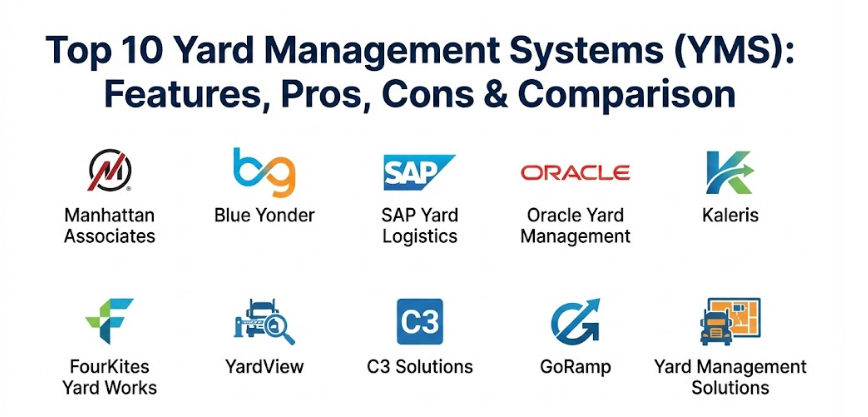
Top 10 Yard Management Systems (YMS) Tools
1 — Manhattan Associates Yard Management
Manhattan Associates offers an enterprise-grade YMS that is part of their broader “Active” supply chain suite. It is built for complex, high-velocity environments that require seamless coordination between the warehouse and the gate.
- Key Features:
- Real-time graphical view of the yard and dock doors.
- Automated task interleaving for yard jockeys.
- Gate management with driver self-service capabilities.
- Advanced appointment scheduling for carriers.
- Deep integration with Manhattan Active WMS and TMS.
- Real-time alerts for dwell time and temperature-controlled trailers.
- Pros:
- Unmatched scalability for global enterprises with massive yards.
- Highly intelligent task prioritization that reduces fuel and labor costs.
- Cons:
- High cost of ownership makes it less accessible for smaller firms.
- The system is feature-heavy, which can lead to a longer training period.
- Security & Compliance: SOC 2, GDPR compliant, SSO support, and enterprise-grade encryption.
- Support & Community: Comprehensive online documentation, 24/7 global support, and a large annual user conference (Manhattan Momentum).
2 — Blue Yonder Yard Management
Blue Yonder (formerly JDA) provides a YMS that focuses on AI-driven optimization. It is designed to predict bottlenecks before they happen and suggest the best possible moves for yard personnel.
- Key Features:
- AI-powered dock door and yard slot optimization.
- End-to-end visibility of inbound and outbound flow.
- Mobile workflows for yard drivers and gate clerks.
- Automated exception management and real-time notifications.
- Integration with major ERPs and supply chain platforms.
- Sustainability tracking to monitor and reduce idling time.
- Pros:
- Strong predictive analytics that help with proactive planning.
- Excellent mobile interface that works well on ruggedized field devices.
- Cons:
- Can be complex to configure initially for unique yard layouts.
- Frequent updates may require dedicated IT attention.
- Security & Compliance: ISO 27001, GDPR, and robust role-based access controls.
- Support & Community: Extensive knowledge base, dedicated account managers for enterprise clients, and a global partner network.
3 — SAP Yard Logistics
For companies already running on the SAP ecosystem, SAP Yard Logistics is a natural choice. It offers deep integration with SAP S/4HANA, EWM (Extended Warehouse Management), and TM (Transportation Management).
- Key Features:
- Yard bin and storage location management.
- Direct integration with gate hardware like ANPR (number plate recognition).
- Comprehensive dock appointment scheduling and resource planning.
- Real-time process monitoring via interactive 2D and 3D maps.
- Multi-commodity support (truck, rail, and container).
- Integrated safety and compliance check workflows.
- Pros:
- Seamless data flow within the SAP environment, reducing integration headaches.
- High level of process governance and auditability for regulated industries.
- Cons:
- Expensive licensing fees if you aren’t already an SAP customer.
- Requires specialized SAP consultants for implementation and customization.
- Security & Compliance: GDPR, SOC 2, and high-level SAP security protocols.
- Support & Community: Massive global community, extensive SAP Help Portal, and premium enterprise support.
4 — Oracle Yard Management
Oracle’s YMS is part of their SCM Cloud suite. It is designed for businesses that want a unified, cloud-native experience for managing their entire supply chain, from the factory floor to the final mile.
- Key Features:
- Cloud-based yard visibility with real-time asset tracking.
- Automated trailer check-in and check-out at the gate.
- Performance dashboards and customizable reporting.
- Seamless integration with Oracle WMS and Transportation Management.
- Mobile app support for real-time task management.
- Geofencing capabilities to track assets as they enter/exit.
- Pros:
- Reliable cloud performance with high uptime and scalability.
- Unified data model that simplifies reporting across the supply chain.
- Cons:
- Less “stand-alone” flexibility compared to niche YMS providers.
- Some advanced automation features may require additional Oracle modules.
- Security & Compliance: HIPAA, SOC 1/2, GDPR, and FedRAMP compliance.
- Support & Community: Oracle Cloud Customer Connect community and global 24/7 support.
5 — Kaleris Yard Management (formerly PINC)
Kaleris is a specialized leader in yard management. Known for its “digital yard” concept, it was one of the first to use drone technology and advanced IoT sensors to manage trailer inventory.
- Key Features:
- Real-time yard execution and automated asset tracking.
- Gate automation with self-service driver kiosks.
- RFID and IoT sensor integration for 100% inventory accuracy.
- Predictive arrival and dwell time analytics.
- Multi-yard visibility for regional managers.
- Mobile workflows specifically designed for yard jockeys.
- Pros:
- Highly specialized and focused purely on solving yard problems.
- Fast ROI due to significant reductions in manual yard checks.
- Cons:
- Hardware-heavy setups (RFID/Sensors) can increase initial setup costs.
- Smaller ecosystem compared to giants like SAP or Oracle.
- Security & Compliance: SOC 2 Type II, GDPR, and secure cloud hosting.
- Support & Community: Strong customer success program and detailed online training modules.
6 — FourKites Yard Works
FourKites is famous for its real-time visibility platform, and Yard Works is their dedicated extension for the yard. It excels at combining “over-the-road” tracking data with on-site yard management.
- Key Features:
- Seamless visibility from transit into the yard.
- Predictive arrival times based on real-world traffic data.
- Automated dock scheduling and carrier collaboration.
- Real-time dwell time monitoring and automated alerts.
- Digital gate check-in and paperless documentation.
- Analytics to identify carrier performance and bottlenecks.
- Pros:
- Exceptional visibility that connects the yard to the rest of the world.
- Very easy-to-use interface that requires minimal training.
- Cons:
- Best suited for companies already using the FourKites visibility platform.
- Lacks some of the deep “task interleaving” found in Manhattan or Blue Yonder.
- Security & Compliance: SOC 2, GDPR, and advanced data encryption.
- Support & Community: Dedicated implementation teams and a robust online user portal.
7 — YardView
YardView is a versatile, cloud-based YMS that prides itself on being “built for the people in the yard.” It offers a straightforward, easy-to-implement solution that focuses on the core needs of yard managers.
- Key Features:
- Interactive yard maps with drag-and-drop moves.
- Comprehensive gate activity logs and driver tracking.
- Dock door visibility and status monitoring.
- Inventory management for trailers and containers.
- Automated notifications for carriers and warehouse staff.
- Mobile-optimized workflows for field personnel.
- Pros:
- Extremely simple to learn and use, leading to high employee adoption.
- Very flexible and can be customized to fit unique yard layouts.
- Cons:
- Lacks some of the advanced AI and predictive features of larger competitors.
- Not as deeply integrated into major ERP suites as SAP or Oracle.
- Security & Compliance: Secure cloud hosting, SSL encryption, and standard audit logs.
- Support & Community: Known for very responsive and personal customer support.
8 — C3 Solutions (C3 Yard)
C3 Solutions specializes in dock scheduling and yard management. Their YMS is often praised for its ability to manage the delicate balance between the warehouse schedule and yard capacity.
- Key Features:
- Advanced appointment scheduling and dock management.
- Real-time trailer tracking and yard driver dispatching.
- Carrier portal for self-service scheduling and visibility.
- Detailed performance metrics and carrier report cards.
- Automated task generation based on operational priorities.
- Multi-site management from a single dashboard.
- Pros:
- Industry-leading dock scheduling capabilities.
- Great balance of enterprise power and ease of use.
- Cons:
- Some users find the interface less “modern” than newer SaaS startups.
- Can be expensive for smaller facilities.
- Security & Compliance: SOC 2 Type II, GDPR, and ISO standards.
- Support & Community: Excellent onboarding programs and a helpful resource library.
9 — GoRamp
GoRamp is a modern, agile SaaS provider that focuses on removing bottlenecks at the warehouse gate. It is particularly popular for its fast implementation and user-friendly design.
- Key Features:
- Cloud-based yard and dock management.
- Automated appointment booking for carriers.
- Digital driver check-in and paperless workflows.
- Real-time eagle-eye view of the entire yard.
- Dwell time and utilization reporting.
- ROI calculator to track financial benefits.
- Pros:
- Very fast setup (can often be live in weeks rather than months).
- Highly affordable for mid-market and even smaller operations.
- Cons:
- Not as feature-rich as the top-tier enterprise suites.
- Lacks some of the hardware integrations (like drones/RFID) offered by Kaleris.
- Security & Compliance: SOC 2 Type II certified and GDPR compliant.
- Support & Community: 24/7 customer support via chat and email, plus a growing user community.
10 — Yard Management Solutions
Yard Management Solutions provides a robust, standalone YMS designed to automate tasks for both small trucking yards and large distribution centers. It focuses on boosting productivity and reducing operating costs.
- Key Features:
- Graphical real-time yard visibility and mapping.
- Gate management with automated check-in/out.
- Dock door scheduling and trailer tracking.
- Yard driver task management and dispatching.
- Load and unload optimization tools.
- Customizable reporting and real-time alerts.
- Pros:
- Excellent visibility that makes the yard feel organized and professional.
- Very competitive pricing for the features provided.
- Cons:
- The mobile app interface can be slightly less intuitive than some competitors.
- Support response times can vary depending on the plan level.
- Security & Compliance: Varies / Standard encryption and audit trails.
- Support & Community: Email-based support and a detailed knowledge base.
Comparison Table
| Tool Name | Best For | Platform(s) Supported | Standout Feature | Rating (Gartner/Peer) |
| Manhattan Associates | Large Global Enterprise | Cloud / On-Prem | Task Interleaving | 4.6 / 5 |
| Blue Yonder | AI-Driven Optimization | Cloud / SaaS | Predictive Analytics | 4.5 / 5 |
| SAP Yard Logistics | SAP Ecosystem Users | Cloud / On-Prem | S/4HANA Integration | 4.3 / 5 |
| Oracle Yard Management | Unified SCM Needs | Cloud-Native | SCM Cloud Ecosystem | 4.4 / 5 |
| Kaleris | Automation-Heavy Yards | Cloud / SaaS | RFID/IoT Tracking | 4.7 / 5 |
| FourKites Yard Works | Transit-to-Yard Visibility | Cloud / SaaS | Predictive ETAs | 4.5 / 5 |
| YardView | Mid-Size Operations | Cloud / SaaS | Ease of Use | 4.8 / 5 |
| C3 Solutions | Dock-to-Yard Coordination | Cloud / SaaS | Dock Scheduling | 4.6 / 5 |
| GoRamp | Fast Implementation | Cloud / SaaS | Paperless Check-in | 5.0 / 5 |
| Yard Mgmt Solutions | Standalone Performance | Cloud / SaaS | Graphical Map View | 4.0 / 5 |
Evaluation & Scoring of Yard Management Systems (YMS)
To help you decide, we have evaluated these tools using a weighted rubric based on the most critical needs of modern logistics professionals.
| Category | Weight | Description |
| Core Features | 25% | Yard visibility, gate management, and trailer tracking capabilities. |
| Ease of Use | 15% | Intuitiveness for gate clerks, yard jockeys, and managers. |
| Integrations | 15% | How well it connects with WMS, TMS, and ERP systems. |
| Security & Compliance | 10% | Data encryption, GDPR, SOC 2, and audit capabilities. |
| Performance | 10% | System reliability, uptime, and speed of real-time updates. |
| Support | 10% | Quality of documentation, onboarding, and customer help. |
| Price / Value | 15% | ROI potential and transparency of pricing. |
Which Yard Management System Tool Is Right for You?
Choosing a YMS is not about finding the “best” software, but finding the “best fit” for your specific operation.
Solo Users vs. SMB vs. Mid-Market vs. Enterprise
- Small/SMB: If you are managing a single yard with moderate traffic, GoRamp or Yard Management Solutions offer the best balance of price and essential features.
- Mid-Market: For growing operations that need a bit more power without the enterprise price tag, YardView and C3 Solutions provide excellent scalability.
- Enterprise: Large-scale organizations with complex requirements should look at Manhattan, Blue Yonder, SAP, or Oracle.
Budget-Conscious vs. Premium Solutions
If budget is your primary constraint, look for a SaaS solution with a lower upfront cost, like GoRamp. However, if you are losing hundreds of thousands of dollars a year in detention fees or lost inventory, a premium solution like Kaleris with RFID tracking will pay for itself much faster.
Feature Depth vs. Ease of Use
Do you need AI to predict your arrival times, or do you just need a digital map so you don’t have to walk the yard? For deep features, choose Blue Yonder. For simplicity and high team adoption, YardView is hard to beat.
Integration and Scalability Needs
If your company is “all-in” on SAP or Oracle, the native YMS modules from those providers will save you a massive amount of integration work. If you need a specialized system that works with any WMS, a best-of-breed solution like Manhattan or Kaleris is the way to go.
Frequently Asked Questions (FAQs)
1. What is the primary benefit of a YMS?
The biggest benefit is real-time visibility. It allows you to know where every trailer is, reducing the time spent searching for equipment and significantly cutting down on detention fees paid to carriers.
2. How does a YMS integrate with my WMS?
Most modern YMS tools use APIs to communicate with your Warehouse Management System. When a trailer is checked in at the gate (YMS), it notifies the warehouse (WMS) that the inventory is available to be unloaded.
3. Is a YMS hard to implement?
Cloud-based solutions like GoRamp can be live in a few weeks. However, enterprise-scale implementations involving hardware (like RFID or gate sensors) can take several months.
4. Can a YMS help with driver shortages?
Yes. By automating the gate and optimizing dock moves, you reduce the time drivers spend waiting in their cabs. This improves driver satisfaction and helps carriers turn their equipment around faster.
5. Do I need special hardware for trailer tracking?
Not necessarily. You can use “passive” tracking where yard jockeys manually update locations on a tablet. However, “active” tracking using GPS, RFID, or IoT sensors provides much higher accuracy without manual effort.
6. What are detention and demurrage fees?
These are fees charged by carriers when their trailers or containers are held at your facility longer than the agreed-upon time. A YMS helps you prioritize these assets to avoid these costs.
7. Can a YMS manage rail yards?
Yes, several systems (like SAP Yard Logistics and transloads.co) are specifically designed to handle both trucks and railcars in the same environment.
8. Is my data secure in a cloud YMS?
Generally, yes. Most top providers are SOC 2 compliant and use high-level encryption. Always check for these certifications when choosing a provider.
9. How does geofencing work in a yard?
Geofencing creates a “virtual fence” around your property. When a trailer equipped with a GPS tracker crosses that line, the YMS automatically checks it in or out without human intervention.
10. What is a “yard jockey”?
A yard jockey (or shunter) is a specialized driver who moves trailers from parking spots to dock doors within the yard. A YMS directs their work to ensure they are always making the most efficient moves.
Conclusion
The yard is no longer the “forgotten” part of the supply chain. As transportation costs rise and warehouse efficiency becomes more critical, a Yard Management System (YMS) is becoming a mandatory tool for any serious logistics operation. Whether you need the global power of Manhattan Associates, the AI-driven insights of Blue Yonder, or the agile simplicity of GoRamp, there is a solution available for every size and budget.
Remember that the “best” tool is the one that your team will actually use and that solves your most painful bottlenecks—whether that’s gate congestion, lost trailers, or skyrocketing detention fees. By bringing visibility and automation to your yard, you can turn a chaotic parking lot into a competitive advantage.