Introduction
Managing an electrical grid is a complex job that requires constant attention. To keep the lights on, utility companies and grid operators use specialized tools known as Energy Management Systems (EMS) and Distribution Management Systems (DMS). At its simplest, an EMS helps manage the big “highways” of electricity—the transmission lines that carry power over long distances. A DMS focuses on the “local streets”—the distribution lines that bring power directly to homes and businesses. Together, these tools allow operators to see what is happening across the entire network in real-time, predict potential problems, and fix outages quickly. Without this software, balancing the supply of electricity with the ever-changing demand of a city would be nearly impossible.
When choosing a grid operations tool, it is important to look for reliability, ease of integration, and the ability to handle new types of energy, like solar and wind. Modern systems must be able to process huge amounts of data from smart meters and sensors while remaining secure against outside threats. Reliability is the most critical factor; if the software fails, the grid could face serious instability.
Best for: Large-scale utility companies, regional transmission organizations, and municipal power providers who need to maintain high reliability and manage complex electrical networks. It is also ideal for industrial sites that run their own microgrids.
Not ideal for: Small businesses or individual building owners who only need to track their monthly electricity bill. These tools are designed for infrastructure-level control, not basic energy accounting or home automation.
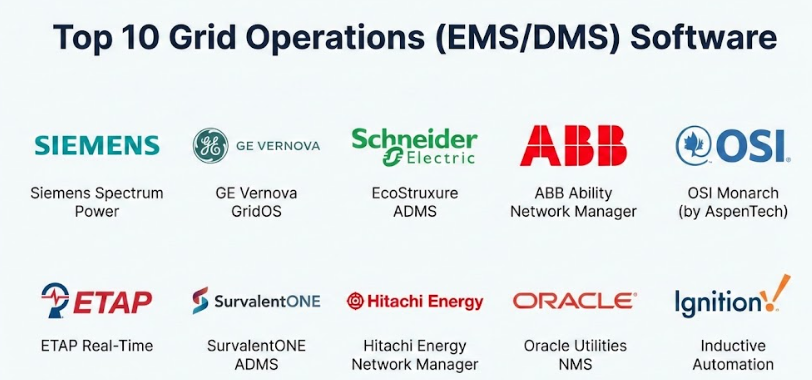
Top 10 Grid Operations (EMS/DMS) Software Tools
1 — Siemens Spectrum Power
Siemens Spectrum Power is a highly flexible platform designed to manage both transmission and distribution networks. It is built for large utilities that require a “cockpit” view of their entire energy ecosystem, from power plants to the end consumer.
- Key features:
- Advanced state estimation to ensure data accuracy across the grid.
- Real-time monitoring of transmission line stability.
- Integrated tools for managing renewable energy sources.
- Automated “what-if” simulations for contingency planning.
- Scalable architecture that grows with the utility’s infrastructure.
- Mobile access for field technicians to see grid status.
- Pros:
- Extremely stable and proven in some of the world’s largest power grids.
- Highly customizable to fit the specific regulatory needs of different regions.
- Cons:
- The initial setup and configuration can be very time-consuming.
- Requires specialized training for staff to master all advanced functions.
- Security & compliance: High-level encryption, multi-factor authentication, and full compliance with international grid security standards like NERC CIP and ISO.
- Support & community: Offers comprehensive global enterprise support, detailed technical documentation, and a large community of professional users.
2 — GE Vernova GridOS
GE Vernova GridOS (formerly part of GE Digital) is an advanced suite of tools focused on “orchestrating” the modern grid. It is specifically designed to handle the challenges of moving away from fossil fuels toward more intermittent energy sources like wind and solar.
- Key features:
- AI-driven forecasting for renewable energy production.
- Real-time visibility into local distribution “bottlenecks.”
- Dynamic line rating to maximize the capacity of existing wires.
- Integrated outage management to speed up restoration times.
- Modular design allowing utilities to add features as needed.
- Advanced cybersecurity layers built into every module.
- Pros:
- Strong focus on future-proofing the grid for green energy.
- Excellent data visualization that makes complex situations easy to understand.
- Cons:
- The transition from older GE systems to the new GridOS platform can be complex.
- Premium pricing that may be high for smaller cooperatives.
- Security & compliance: Includes built-in audit logs, SOC 2 compliance, and robust data protection protocols.
- Support & community: Strong dedicated support teams and a massive network of utility partners worldwide.
3 — Schneider Electric EcoStruxure ADMS
The EcoStruxure Advanced Distribution Management System (ADMS) is a leader in the distribution space. It combines SCADA, outage management, and distribution management into one single, unified platform.
- Key features:
- Unified data model that prevents information silos.
- Peak load management to prevent system overloads.
- Automated fault isolation to limit the number of people affected by blackouts.
- Volt/VAR optimization to reduce energy waste during delivery.
- Detailed weather integration for better storm response.
- Support for electric vehicle (EV) charging infrastructure.
- Pros:
- The “all-in-one” approach simplifies daily operations for dispatchers.
- Excellent integration with other Schneider Electric hardware and sensors.
- Cons:
- The interface can feel “busy” and overwhelming for new users.
- Updates sometimes require significant testing to ensure compatibility with custom plugins.
- Security & compliance: Adheres to GDPR for data privacy and meets rigorous international cybersecurity frameworks for industrial control systems.
- Support & community: Extensive online knowledge base and 24/7 global support availability.
4 — ABB Ability Network Manager
ABB’s Network Manager is a robust solution for both EMS and DMS needs. It focuses on providing a high level of situational awareness, helping operators make better decisions faster during emergencies.
- Key features:
- Real-time wide-area monitoring for large-scale transmission.
- Advanced generation control to balance supply and demand.
- User-friendly dashboards that highlight critical alarms.
- Seamless integration with Geographic Information Systems (GIS).
- Tools for managing inter-utility power exchanges.
- Predictive maintenance alerts for grid hardware.
- Pros:
- Known for very high uptime and system reliability.
- The platform is efficient at handling massive amounts of real-time sensor data.
- Cons:
- Customization often requires help from the vendor’s professional services team.
- The software can be hardware-intensive, requiring modern server environments.
- Security & compliance: ISO certified with strong focus on protecting mission-critical control paths.
- Support & community: Well-established onboarding programs and specialized training centers for operators.
5 — OSI Monarch (by AspenTech)
OSI Monarch is famous for its “open” architecture. It is a highly scalable platform that allows utilities to build a custom system using standard building blocks, making it a favorite for many mid-sized and large utilities.
- Key features:
- True real-time database architecture for lightning-fast updates.
- Flexible “smart” alarms that group related issues together.
- Easy integration with third-party software and legacy equipment.
- High-resolution graphical displays for grid visualization.
- Built-in training simulator for new grid operators.
- Automated reporting for regulatory compliance.
- Pros:
- Very fast performance, even under heavy system stress.
- Lower cost of ownership over time due to its modular nature.
- Cons:
- Requires a more “hands-on” IT team to manage the open architecture.
- The user community is highly technical, which may be a hurdle for non-experts.
- Security & compliance: Robust role-based access control and full support for NERC CIP requirements.
- Support & community: Excellent reputation for customer service and a very active user group.
6 — ETAP Real-Time
ETAP is widely used for its “Digital Twin” technology. It creates a perfect digital copy of the physical grid, allowing operators to simulate changes and test protective devices before they are actually deployed in the field.
- Key features:
- Continuous real-time simulation of grid behavior.
- Automatic generation of switching orders.
- Integrated protection and coordination analysis.
- Energy accounting to track losses across the system.
- Microgrid master controller capabilities.
- Cloud-ready deployment options.
- Pros:
- The “Digital Twin” feature is world-class for planning and safety.
- The software is very good at identifying the root cause of a failure.
- Cons:
- Can be more focused on engineering analysis than daily “dispatch” operations.
- May require high-end workstations to run complex simulations smoothly.
- Security & compliance: Multi-layer password protection and audit trails.
- Support & community: Strong academic and professional community with vast documentation.
7 — SurvalentONE ADMS
Survalent focuses on making grid management easy for small-to-medium-sized utilities and cooperatives. Their “SurvalentONE” platform is designed to be simple to install and maintain without a massive IT department.
- Key features:
- Single-database architecture for SCADA, OMS, and DMS.
- Intuitive “SmartVU” interface that is easy to learn.
- Built-in tools for demand response and load shedding.
- Easy-to-use report builder for management and regulators.
- Automated restoration following a storm.
- Native mobile applications for field crews.
- Pros:
- Much easier to deploy than the massive enterprise systems.
- Excellent customer support that treats smaller clients as a priority.
- Cons:
- May lack some of the deepest “big data” analytics found in larger competitors.
- Not primarily designed for massive, multi-national transmission networks.
- Security & compliance: Standard industrial security features including secure VPN support and audit logs.
- Support & community: Known for high-quality onboarding and “walk-you-through-it” support.
8 — Hitachi Energy Network Manager
Hitachi’s Network Manager provides a unified view of the entire energy value chain. It is particularly strong in managing the transition between traditional power generation and modern, decentralized energy.
- Key features:
- Cybersecure SCADA platform as a foundation.
- Advanced generation management for hydro, thermal, and renewables.
- Economic dispatch to find the cheapest way to meet demand.
- Interoperability with a wide range of industrial communication protocols.
- High-performance historian for analyzing past events.
- State-of-the-art situational awareness tools.
- Pros:
- Exceptional at balancing very large, diverse energy portfolios.
- The user interface is modern and reduces operator fatigue.
- Cons:
- The licensing structure can be complex and expensive.
- Requires a significant commitment to professional services during the initial build.
- Security & compliance: Meets global mission-critical standards for high-availability systems.
- Support & community: Reliable enterprise support with deep expertise in power engineering.
9 — Oracle Utilities Network Management System
Oracle brings the power of its massive database and enterprise software experience to the utility sector. Their NMS is built for utilities that want to integrate grid operations deeply with customer billing and workforce management.
- Key features:
- Deep integration with customer information systems (CIS).
- Advanced outage analytics based on customer call patterns.
- Automated switching plans to keep workers safe.
- Real-time distribution power flow analysis.
- Workforce management to track trucks and crews in the field.
- Advanced analytics for long-term grid planning.
- Pros:
- Unrivaled at connecting “the grid” to “the business.”
- Powerful data processing capabilities for utilities with millions of customers.
- Cons:
- Can feel like “too much software” for a small utility.
- The system is complex and requires specialized Oracle database knowledge.
- Security & compliance: Benefits from Oracle’s world-class security infrastructure and compliance certifications.
- Support & community: Global reach with extensive training programs and dedicated account managers.
10 — Inductive Automation Ignition
While not a “traditional” EMS/DMS in the same way as the others, Ignition is a powerful industrial platform that many modern utilities are using to build custom, modular grid monitoring solutions.
- Key features:
- Unlimited tags and clients for a flat licensing fee.
- Web-based deployment that works in any browser.
- Easy connection to PLC, RTU, and smart sensors.
- Powerful scripting engine for custom logic.
- Mobile-responsive dashboards built with modern web tech.
- Built-in historian for data logging.
- Pros:
- Extremely cost-effective and flexible compared to traditional vendors.
- Easier to learn for modern IT and web developers.
- Cons:
- You have to “build” the grid logic yourself rather than having it “out of the box.”
- Less specialized power engineering features compared to Siemens or GE.
- Security & compliance: Uses modern web security (TLS), SSO, and is highly auditable.
- Support & community: One of the most active and helpful user communities in the industrial world.
Comparison Table
| Tool Name | Best For | Platform Supported | Standout Feature | Rating |
| Siemens Spectrum Power | Large Global Utilities | On-Premise / Hybrid | State Estimation Depth | N/A |
| GE Vernova GridOS | Renewables Integration | Cloud-Native / Hybrid | AI-Driven Forecasting | N/A |
| Schneider EcoStruxure | Distribution Networks | On-Premise / Hybrid | Unified ADMS Model | N/A |
| ABB Network Manager | Mission-Critical Ops | On-Premise | High-Availability SCADA | N/A |
| OSI Monarch | Open-Architecture Needs | On-Premise / Cloud | Real-Time DB Performance | N/A |
| ETAP Real-Time | Digital Twin Modeling | On-Premise / Cloud | Real-Time Grid Simulation | N/A |
| SurvalentONE ADMS | Small-Mid Utilities | On-Premise / Hybrid | Ease of Use / Setup | N/A |
| Hitachi Net. Manager | Diverse Energy Portfolios | On-Premise | Economic Dispatch Logic | N/A |
| Oracle Utilities NMS | Enterprise Integration | Cloud / On-Premise | Customer Data Synergy | N/A |
| Ignition | Custom / Modular Projects | Web / On-Premise | Unlimited Licensing Model | N/A |
Evaluation & Scoring of Grid Operations Software
The following table evaluates these tools based on a weighted system that reflects what matters most in a real-world control room.
| Criteria | Weight | Explanation |
| Core Features | 25% | Ability to perform EMS/DMS tasks accurately. |
| Ease of Use | 15% | How quickly an operator can learn and use the tool. |
| Integrations | 15% | Ability to connect with GIS, SCADA, and IoT sensors. |
| Security | 10% | Protection against cyberattacks and unauthorized access. |
| Performance | 10% | Speed and reliability under heavy grid stress. |
| Support | 10% | Quality of documentation and customer help. |
| Price / Value | 15% | Total cost compared to the benefits provided. |
Which Grid Operations Tool Is Right for You?
Choosing the right software is not about finding the “best” one on the list; it is about finding the one that fits your specific needs.
Solo Users vs. Large Enterprises
If you are a consultant or a small research team, a tool like ETAP or Ignition might be best because they are easier to set up for smaller projects. For a massive utility company that powers millions of people, Siemens, GE, or ABB are the standard choices because they can handle the sheer scale and risk of an entire region.
Budget-Conscious vs. Premium Solutions
If budget is a major concern, SurvalentONE offers a great balance of features for the price, especially for cooperatives. Ignition is also very popular for those who want to avoid high per-device fees. On the other hand, Schneider Electric and Oracle are premium choices that offer deeper “business-side” features for those who can afford the higher cost.
Feature Depth vs. Ease of Use
If you need the most advanced engineering simulations, ETAP is the clear winner. However, if your main goal is simply to help your dispatchers handle daily outages and storm response more effectively, SurvalentONE or Schneider Electric may provide a more user-friendly experience.
Security and Compliance
For utilities in highly regulated environments (like the United States or Europe), choosing a vendor with a strong history of NERC CIP or GDPR compliance is non-negotiable. Siemens, Hitachi, and ABB have built their reputations on meeting these strict security requirements for decades.
Frequently Asked Questions (FAQs)
What is the main difference between EMS and DMS?
EMS is for high-voltage transmission networks (the “bulk” movement of power), while DMS is for the lower-voltage distribution networks (getting power to the customer).
What does ADMS stand for?
It stands for Advanced Distribution Management System. It is basically a DMS that has extra features like outage management and smart grid optimization all in one package.
Can these systems be run in the cloud?
Yes, many modern systems like GE GridOS and OSI Monarch now offer cloud-based or hybrid options, though many utilities still prefer on-premise servers for maximum security.
How long does it take to implement this software?
A full enterprise rollout can take anywhere from 12 months to several years, depending on the complexity of the grid and how much data needs to be migrated.
Do these tools help with renewable energy?
Yes. Modern grid software is designed specifically to help balance the unpredictable nature of wind and solar power with traditional power sources.
Is cybersecurity a major concern for these tools?
Absolutely. Because these systems control critical infrastructure, they are built with multiple layers of security to prevent unauthorized access.
Do I need a big IT team to run this?
Large systems like Siemens or Oracle usually require a dedicated team. Smaller systems like Survalent are designed to be managed by a much smaller staff.
Will this software help reduce power outages?
Yes. By using automated fault detection and isolation, these systems can often restore power to most customers in minutes rather than hours.
How do these tools integrate with smart meters?
They use specialized communication protocols to pull data from AMI (Advanced Metering Infrastructure) systems to see exactly where outages are occurring.
Are there free or open-source versions?
There are some open-source grid modeling tools used by researchers, but for real-time control of a public utility, professional commercial software is required for safety and liability reasons.
Conclusion
Choosing the right grid operations software is one of the most important decisions a utility company can make. The right tool acts as the “brain” of the electrical system, ensuring that power is delivered safely, efficiently, and reliably. While Siemens and GE lead the market for massive transmission networks, companies like Schneider Electric and Survalent offer exceptional solutions for the local distribution side.
Ultimately, the “best” tool depends on the size of your network, your budget, and how quickly you need to integrate new technologies like electric vehicles and solar panels. By focusing on reliability and ease of use, you can find a solution that not only keeps the lights on today but also prepares your grid for the energy challenges of the future.