Introduction
Energy Trading and Risk Management, commonly known as ETRM, is a specialized category of software designed to handle the complex lifecycle of buying, selling, and moving energy commodities. In simple terms, it is the digital backbone for companies that deal with electricity, natural gas, crude oil, and refined products. These systems allow businesses to track trades, manage physical logistics like pipelines or power grids, and calculate the financial risks associated with price swings in the market. Without these tools, energy companies would have to rely on manual spreadsheets, which are prone to errors and cannot keep up with the fast pace of modern energy markets.
The importance of ETRM lies in its ability to provide a single “source of truth.” It connects the front office (traders who execute deals), the middle office (risk managers who monitor exposure), and the back office (accountants who handle settlements and billing). In a world where energy prices can change in seconds due to weather events or global news, having a real-time view of your position is vital. Real-world use cases include a utility company hedging its fuel costs to keep consumer prices stable, or a renewable energy producer managing the intermittent flow of wind and solar power into the national grid.
When choosing an ETRM tool, users should evaluate several criteria: the software’s ability to handle specific commodities (like power versus gas), its ease of integration with existing accounting systems, and the depth of its risk analytics. A good system should offer clear visibility into “Mark-to-Market” valuations and provide robust tools for regulatory compliance.
Best for: Large utility companies, independent power producers, energy retailers, global oil and gas firms, and financial institutions that trade energy derivatives. It is ideal for any organization that needs to manage high-volume transactions and complex physical delivery schedules.
Not ideal for: Small businesses with very low trade volumes or companies that only consume energy without actively trading or hedging. If your energy needs are simple and predictable, a standard enterprise resource planning (ERP) system or even basic accounting software might be more cost-effective.
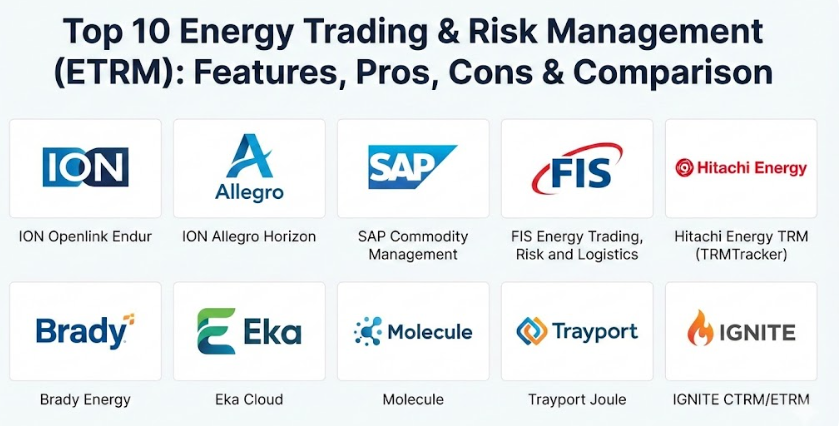
Top 10 Energy Trading & Risk Management (ETRM) Tools
1 — ION Openlink Endur
Openlink Endur is widely considered the gold standard for large-scale energy trading operations. It is a comprehensive platform that covers the entire trade lifecycle, from the initial deal capture to the final financial settlement, supporting multiple commodities on a single screen.
- Key features:
- Front-to-back office automation for seamless trade processing.
- Advanced risk analytics including Value-at-Risk (VaR) and stress testing.
- Sophisticated physical logistics management for power and gas.
- Integrated credit risk monitoring to track counterparty exposure.
- Real-time Profit and Loss (P&L) reporting across global portfolios.
- Extensive library of pre-built regulatory reports.
- Highly customizable workflow engine to match specific business rules.
- Pros:
- Unmatched depth of functionality for complex, multi-commodity portfolios.
- Strong reputation and long-standing presence in the global energy market.
- Highly flexible architecture that can be tailored to very specific needs.
- Cons:
- Significant implementation time and high cost of ownership.
- The interface can feel complex and requires extensive user training.
- Security & compliance: Includes enterprise-grade security features such as single sign-on (SSO), detailed audit logs, and role-based access controls to meet strict global regulations.
- Support & community: Offers dedicated enterprise support, extensive documentation, and a large global community of experienced consultants and users.
2 — ION Allegro Horizon
Allegro Horizon is a modular and flexible ETRM solution known for its modern architecture. It is designed to help energy companies manage their physical and financial positions while providing clear insights into market risks.
- Key features:
- Modular design allowing companies to buy only the features they need.
- Real-time position visibility across power, gas, and oil.
- Integrated tools for managing renewable energy certificates and carbon credits.
- Automated deal validation and confirmation workflows.
- Robust “Greeks” and sensitivity analysis for risk managers.
- Scalable cloud-ready deployment options.
- User-friendly dashboards for executive-level reporting.
- Pros:
- Easier to customize and upgrade compared to older legacy systems.
- Strong focus on the user experience with an intuitive interface.
- Excellent at handling the specific needs of power and gas utilities.
- Cons:
- Can become expensive as more modules are added over time.
- Customizations can sometimes complicate the standard upgrade path.
- Security & compliance: Features robust encryption, audit trails, and compliance tools that align with ISO standards and regional energy regulations.
- Support & community: Provides comprehensive training programs, active user forums, and responsive customer service for technical issues.
3 — SAP Commodity Management
SAP Commodity Management is an extension of the world-famous SAP ERP ecosystem. It integrates energy trading directly into a company’s financial and supply chain processes, making it a top choice for firms already using SAP.
- Key features:
- Direct integration with SAP S/4HANA for real-time financial updates.
- Unified data model for both trading and physical operations.
- Automated settlement and invoicing tied directly to the general ledger.
- Risk management tools that cover price, currency, and quantity risks.
- Advanced contract management for long-term energy agreements.
- Compliance tools for global tax and environmental regulations.
- Pros:
- Eliminates data silos between the trading desk and the accounting department.
- Provides a highly stable and scalable platform for global enterprises.
- Leverages the existing SAP infrastructure, reducing the need for new IT stacks.
- Cons:
- Requires a deep understanding of the SAP ecosystem to manage effectively.
- Can be less “nimble” for high-frequency traders compared to pure-play ETRMs.
- Security & compliance: Benefits from SAP’s world-class security framework, including SOC 2 compliance, advanced encryption, and global data privacy protections.
- Support & community: Backed by a massive global network of SAP partners, consultants, and a very active professional community.
4 — FIS Energy Trading, Risk and Logistics
FIS offers a financial-grade ETRM platform that combines the rigor of banking risk management with the practical needs of energy logistics. It is particularly strong for organizations that trade a mix of financial derivatives and physical energy.
- Key features:
- Real-time market data integration from global exchanges.
- Sophisticated credit risk and collateral management tools.
- End-to-end logistics tracking for pipelines and storage facilities.
- Comprehensive VaR and stress testing models.
- Automated regulatory reporting for EMIR, REMIT, and Dodd-Frank.
- Cloud-native architecture for faster deployment and updates.
- Pros:
- Exceptional risk management capabilities rooted in financial industry expertise.
- Strong performance in handling high volumes of financial trades.
- Very clear and customizable reporting for risk and compliance officers.
- Cons:
- The setup process can be technically demanding for smaller teams.
- Physical logistics features may feel secondary to the financial trading tools.
- Security & compliance: Highly secure platform with regular audits, SSO support, and compliance features that meet the highest financial industry standards.
- Support & community: Offers 24/7 global support, an extensive knowledge base, and professional onboarding services for new clients.
5 — Hitachi Energy TRM (TRMTracker)
Hitachi Energy provides a TRM platform that is deeply focused on the power industry. It uses advanced analytics to help companies navigate the shift toward renewable energy and decentralized power grids.
- Key features:
- AI-powered forecasting for wind, solar, and market prices.
- Integrated asset optimization for power plants and battery storage.
- Comprehensive support for Power Purchase Agreements (PPAs).
- Detailed carbon accounting and renewables tracking.
- Streamlined “bid-to-bill” processes for electricity markets.
- Real-time grid visibility for physical traders.
- Pros:
- Best-in-class tools for renewable energy and grid-specific trading.
- Incorporates cutting-edge AI to improve forecasting accuracy.
- Strong focus on sustainability and the global energy transition.
- Cons:
- Might be too specialized for companies focused solely on oil or gas.
- Advanced AI features may require additional configuration and data.
- Security & compliance: Follows rigorous security protocols, including ISO certifications and advanced data encryption for cloud deployments.
- Support & community: Dedicated industry experts provide specialized support for power and utility-specific challenges.
6 — Brady Energy
Brady Energy is a leading ETRM provider in Europe, with a very strong focus on physical power and gas markets. It is known for its ability to handle the complex scheduling and nomination tasks required in European energy hubs.
- Key features:
- Automated physical scheduling and nominations for European grids.
- Short-term power trading tools for intraday and day-ahead markets.
- Integrated risk management and P&L reporting.
- Support for multiple currencies and complex cross-border trades.
- Built-in compliance for REMIT and other regional regulations.
- Modular architecture for easy scaling.
- Pros:
- Excellent reputation for handling physical energy logistics in Europe.
- Very responsive to changes in European market rules and regulations.
- Strong tools for short-term and intraday trading desks.
- Cons:
- Less presence in North American or Asian markets compared to global giants.
- User interface can feel a bit traditional compared to newer SaaS tools.
- Security & compliance: Fully compliant with European data standards and regional energy market security requirements.
- Support & community: Offers localized support in several European languages and a deep understanding of regional market dynamics.
7 — Eka Cloud
Eka is a modern, cloud-native platform that provides a unified view of trading, risk, and supply chain. It is designed for agility and speed, making it a great choice for companies that want to move away from legacy on-premise systems.
- Key features:
- Cloud-native “apps” that can be deployed quickly for specific tasks.
- Real-time data visualization with interactive dashboards.
- Mobile-friendly interface for traders and managers on the go.
- Advanced analytics powered by a built-in data engine.
- Integrated sustainability and ESG (Environmental, Social, and Governance) tracking.
- Seamless API connections to external data sources.
- Pros:
- Very fast implementation times compared to traditional ETRMs.
- Highly scalable and requires minimal IT maintenance.
- Modern, sleek interface that is easy for new users to learn.
- Cons:
- The “app-based” model might feel fragmented for users wanting a single monolithic system.
- Depth in some very specific physical logistics areas may be slightly less than legacy tools.
- Security & compliance: Cloud security is a priority, with SOC 2 compliance, encryption at rest and in transit, and robust identity management.
- Support & community: Offers strong digital support, online training resources, and a growing community of cloud-focused energy firms.
8 — Molecule
Molecule is a newer player in the ETRM space, focusing on providing a simple, automated, and modern experience. It is designed for small to mid-sized trading shops that need robust tools without the complexity of enterprise software.
- Key features:
- Automated deal capture from major exchanges like ICE and CME.
- Near-real-time position and P&L reporting.
- Zero-install SaaS platform that works in any web browser.
- Simplified risk metrics like Value-at-Risk and stress testing.
- Automatic updates—users are always on the latest version.
- Transparent pricing with no hidden implementation fees.
- Pros:
- The most user-friendly and modern interface in the ETRM market.
- Can be up and running in weeks, not months or years.
- Automates away most of the manual data entry work.
- Cons:
- May lack the very deep “corner-case” features required by massive global utilities.
- Less customization available compared to platforms like Openlink.
- Security & compliance: Uses modern cloud security standards, regular penetration testing, and clear audit trails for every transaction.
- Support & community: Highly praised for its responsive customer success team and clear, modern documentation.
9 — Trayport Joule
Trayport Joule is a dominant platform in the European energy trading community. While it started as a trading screen, its integrated ETRM capabilities make it a vital tool for traders who need to see the market and manage their risk in one place.
- Key features:
- Direct connectivity to almost all European energy exchanges and brokers.
- One-click trading with integrated risk checks.
- Real-time position management for power, gas, and coal.
- Integrated market data and price discovery tools.
- Simplified settlement and trade reconciliation.
- Strong community-driven features for OTC (Over-the-Counter) trading.
- Pros:
- Essential for anyone trading heavily in European OTC and exchange markets.
- Extremely fast execution and real-time market visibility.
- Very high adoption rate among European energy traders.
- Cons:
- The ETRM features are very focused on trading and may lack back-office depth.
- Mainly focused on the European market, with less utility elsewhere.
- Security & compliance: Follows strict exchange-level security protocols and provides full audit logs for regulatory oversight.
- Support & community: Features a very active user community and specialized support for high-frequency trading environments.
10 — IGNITE CTRM/ETRM
IGNITE provides a cost-effective, cloud-based solution that is popular among mid-tier energy companies. It strikes a good balance between feature depth and ease of use, making it an accessible option for growing firms.
- Key features:
- Support for a wide range of commodities including crude, refined, and power.
- Real-time P&L and risk dashboards.
- Integrated logistics and inventory management.
- Automated regulatory reporting tools.
- Configurable deal templates for faster trade entry.
- Subscription-based pricing model.
- Pros:
- Much more affordable than the high-end enterprise solutions.
- Quick to deploy and easy to navigate for smaller teams.
- Provides a solid “all-in-one” experience for front, middle, and back offices.
- Cons:
- Advanced risk modeling might not be as deep as specialized financial ETRMs.
- Fewer third-party consulting resources available compared to ION or SAP.
- Security & compliance: Standard cloud security controls, encryption, and audit logging are included to ensure data integrity and compliance.
- Support & community: Responsive customer support team and helpful onboarding guides for new users.
Comparison Table
| Tool Name | Best For | Platform Supported | Standout Feature | Rating (Gartner) |
| ION Openlink Endur | Large Global Enterprises | Cloud, On-Premise | Multi-commodity depth | 4.1 / 5 |
| ION Allegro Horizon | Mid-to-Large Utilities | Cloud, On-Premise | Modular flexibility | 4.5 / 5 |
| SAP Commodity Mgmt | SAP-centric companies | Cloud (S/4HANA) | Native ERP integration | 4.0 / 5 |
| FIS Energy Platform | Financial & Risk focus | Cloud, SaaS | Bank-grade risk tools | 4.0 / 5 |
| Hitachi Energy TRM | Renewables & Power | Cloud-Native | AI-powered forecasting | 4.4 / 5 |
| Brady Energy | European Power/Gas | Cloud, Hybrid | Physical scheduling | 4.5 / 5 |
| Eka Cloud | Agility & Analytics | Cloud-Native | App-based architecture | 4.3 / 5 |
| Molecule | Small/Mid Traders | SaaS (Web-based) | Automation & Usability | 4.2 / 5 |
| Trayport Joule | European Traders | Desktop/Web | Market connectivity | N/A |
| IGNITE CTRM | Mid-market firms | SaaS (Cloud) | Value for money | 4.2 / 5 |
Evaluation & Scoring of ETRM Tools
To help you understand how these tools compare, we have used a weighted scoring rubric based on key industry requirements.
| Evaluation Criteria | Weight | What We Look For |
| Core Features | 25% | Trade capture, risk analytics, and physical logistics depth. |
| Ease of Use | 15% | User interface, learning curve, and daily workflow efficiency. |
| Integrations & Ecosystem | 15% | APIs, exchange connectivity, and ERP integration capabilities. |
| Security & Compliance | 10% | Encryption, audit logs, and regulatory reporting features. |
| Performance & Reliability | 10% | System uptime, calculation speed, and handling large data sets. |
| Support & Community | 10% | Documentation quality and responsiveness of customer service. |
| Price / Value | 15% | Total cost of ownership versus the features provided. |
Which ETRM Tool Is Right for You?
Choosing an ETRM system is a major decision that depends on your company’s size, budget, and the specific commodities you trade.
Solo Users vs. SMBs
For small trading houses or solo professional traders, simplicity and automation are key. Molecule or IGNITE are excellent choices because they offer fast setup and require very little IT infrastructure. These tools automate the “boring” parts of trading, like data entry, so you can focus on the market.
Mid-Market Players
Companies that are growing and need more depth—especially in risk management—should look at Allegro Horizon or Eka Cloud. These platforms offer the modularity to grow with you. If you are primarily focused on the European power market, Brady Energy is a strong contender due to its specialized logistics tools.
Large Enterprises
Global utilities and oil majors with massive, complex portfolios usually require the “big guns.” Openlink Endur offers the most comprehensive feature set available, while SAP Commodity Management is the logical choice for organizations that want their trading data to flow perfectly into their accounting and ERP systems.
Feature Depth vs. Ease of Use
If your primary goal is to have the most advanced risk models (like CVA or DVA), FIS or Openlink are the leaders. However, if you want your team to actually enjoy using the software every day without constant help from IT, Molecule and Eka lead the way in modern design.
Frequently Asked Questions (FAQs)
1. What is the difference between CTRM and ETRM?
CTRM stands for Commodity Trading and Risk Management, covering all commodities like metals or grain. ETRM is a sub-set specifically built for energy products like power, gas, and oil, featuring specialized logistics for things like pipelines and grids.
2. How long does it typically take to implement an ETRM?
Modern SaaS solutions like Molecule can be ready in a few weeks. However, large enterprise systems like Openlink or SAP can take anywhere from six months to two years, depending on the complexity and customization required.
3. Do these tools support renewable energy?
Yes, modern ETRMs like Hitachi Energy TRM and Allegro have specific modules for renewable certificates, carbon credits, and managing the unique risks of wind and solar power generation.
4. Can ETRM software help with regulatory compliance?
Most top-tier ETRM tools have built-in reporting for major regulations like REMIT (Europe), EMIR, and Dodd-Frank (USA). They automatically format your trade data to meet the requirements of regulators.
5. How much does ETRM software cost?
Costs vary wildly. A simple SaaS subscription might start around $100,000 per year, while a massive enterprise deployment can cost several million dollars when you include implementation, licensing, and support fees.
6. Can I use Excel instead of an ETRM?
While many small firms start with Excel, it is very risky. Spreadsheets lack audit trails, real-time data, and the ability to handle complex risk calculations accurately, leading to potential financial losses or regulatory fines.
7. Does ETRM software integrate with accounting systems?
Yes, most ETRM systems are designed to connect with ERPs like SAP, Oracle, or Microsoft Dynamics to ensure that trade settlements and invoices flow directly into the company’s financial records.
8. What is “Mark-to-Market” (MtM) in energy trading?
MtM is a method of valuing a trade based on current market prices rather than the price when the trade was made. ETRM tools calculate this in real-time to show your current profit or loss.
9. Are these platforms secure for cloud use?
Yes, modern cloud-native ETRMs use high-level encryption and are often hosted on secure infrastructure like AWS or Azure, meeting strict standards like SOC 2 and ISO 27001.
10. What is a “Front-to-Back” system?
This refers to a system that covers every step of a trade: the front office (entering the trade), the middle office (checking risks), and the back office (billing and accounting).
Conclusion
Selecting the right ETRM software is one of the most important technology decisions an energy company can make. The right tool acts as more than just a database; it is a strategic partner that helps you minimize risk, stay compliant, and find new opportunities in a volatile market.
What matters most is finding a system that fits your specific operational style. A massive utility needs the deep customization of a platform like Openlink or SAP, while a fast-moving, agile trading desk might be much better served by a modern, automated SaaS solution like Molecule or Eka.
Ultimately, there is no single “best” tool for everyone. The winner is the one that provides your team with the clearest data, the most reliable risk metrics, and the smoothest daily workflow. By carefully evaluating your commodity focus and your technical needs against the options listed above, you can build a solid foundation for your trading business.